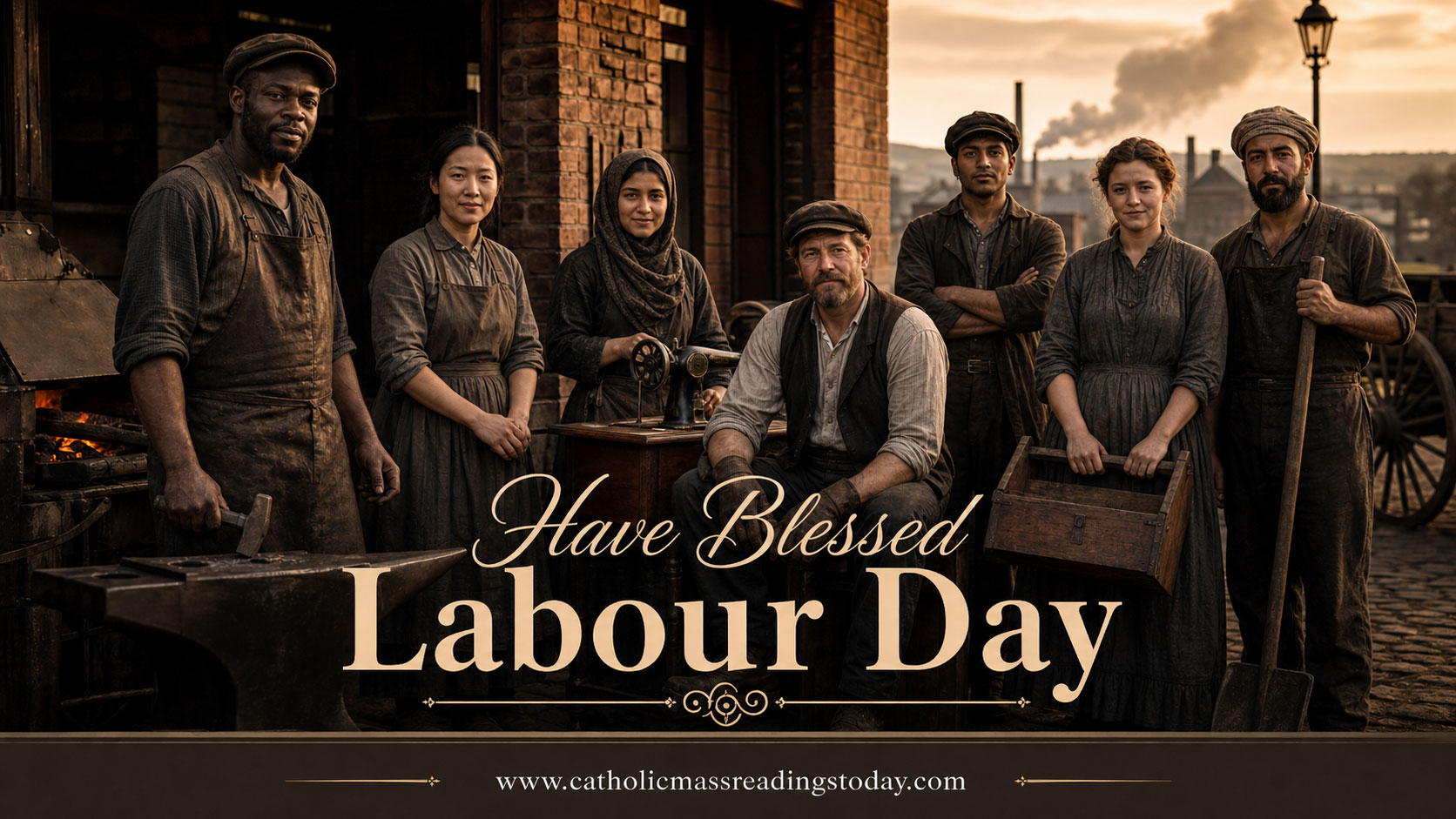
Every year, Labour Day offers the world a moment to pause and recognize something so ordinary that it is often taken for granted: WORK. Behind every home built, every child taught, every road repaired, every meal prepared, every patient cared for, and every community sustained, there are human hands, human effort, and human sacrifice.
For many people, Labour Day is simply a public holiday. It is a day off work, a chance to rest, gather with family, or enjoy a slower pace of life. But its meaning runs much deeper than that. Labour Day was not born out of convenience. It came out of struggle, sacrifice, and a long demand for justice and dignity for working people.
For a Catholic audience, Labour Day also carries a spiritual meaning. Work is not only economic. It is human. It is moral. It is part of our participation in God’s ongoing care for the world. The Church has always taught that labour must never be separated from the dignity of the person who performs it.
So as we say, Have Blessed Labour Day, we are saying more than “enjoy the holiday.” We are offering gratitude for work, honour for workers, and prayer for justice, rest, and dignity in every workplace.
What Is Labour Day?
Labour Day is a day set aside to honour workers and the contributions they make to society. It recognizes the value of labour in all its forms, whether manual, professional, domestic, agricultural, industrial, or intellectual.
It is a day to remember that societies do not function by accident. They are carried, day after day, by people who wake early, sacrifice comfort, and use their gifts to provide for families and to serve the common good.
In many countries, Labour Day is observed on May 1, often called International Workers’ Day or May Day. In other countries, such as the United States and Canada, Labour Day is observed on a different date, usually in September. Even so, the central meaning remains the same: to recognize the dignity, struggles, and rights of workers.
The History of Labour Day
To understand Labour Day well, it helps to go back to the 19th century, especially during the Industrial Revolution. This was a time of enormous economic and technological change. Factories expanded, cities grew rapidly, and industries became more powerful. But for workers, life was often extremely hard.
Many people worked:
- very long hours, sometimes 12 to 16 hours a day
- in dangerous or unhealthy conditions
- for very low wages
- without legal protection
- with no guaranteed time off
- and often without any security if they were injured or dismissed
Children also worked in factories and mines. Women were often underpaid. Families lived under enormous strain. In many places, workers had little voice and almost no bargaining power.
Out of this hardship came labour movements, groups of workers, organizers, and reformers who demanded fairer conditions. One of the central demands was the eight hour workday: eight hours for work, eight hours for rest, and eight hours for personal and family life.
That demand became one of the great rallying cries of labour history.
The Haymarket Connection
One of the major historical events connected to Labour Day took place in Chicago in 1886. Workers had organized massive demonstrations demanding the eight hour workday. On May 4 of that year, during a labour rally in Haymarket Square, violence broke out after a bomb was thrown. Police and civilians were killed, and the event became one of the most remembered and controversial moments in labour history.
Though the circumstances were complex and tragic, the Haymarket affair became a symbol of the workers’ struggle for justice, fair treatment, and humane working conditions. Over time, May 1 came to be associated internationally with workers’ rights and labour solidarity.
Why May 1 Became Labour Day in Many Countries
In 1889, the International Socialist Congress in Paris declared that May 1 would be observed as a day of worker demonstrations and remembrance, especially connected to the movement for the eight-hour day. From there, the date spread across many parts of the world.
Today, many countries observe Labour Day on May 1, though the style of celebration differs. Some mark it with parades, public speeches, labour events, and trade union activities. Others treat it more quietly as a public holiday and day of recognition.
Why Labour Day Matters
Labour Day matters because work matters, and workers matter.
It reminds us that labour is not just about productivity or profit. It is about people. Behind every job is a human being with a family, a body that grows tired, a mind that needs peace, and a soul that deserves respect.
Labour Day matters because it pushes back against forgetfulness. It stops society from acting as though roads build themselves, hospitals heal on their own, food appears without farmers, and economies grow without sacrifice.
It also matters because not every worker experiences dignity at work. Even today, many people still face:
- unfair wages
- unsafe working conditions
- exploitation
- harassment
- discrimination
- overwork without rest
- job insecurity
- and economic systems that value output more than human life
Labour Day remains important because the struggle for justice in work is not over.
The Catholic Meaning of Labour Day
For a Catholic, Labour Day should never be treated as only a civic holiday. It touches something central in Catholic social teaching: the dignity of the human person and the dignity of work.
The Church teaches that work is not a punishment. Work is part of our vocation as human beings. In the Book of Genesis, man is placed in the garden “to till it and keep it.” Human labour, when rightly understood, is a form of cooperation with God’s creative action.
Work allows people to:
- provide for themselves and their families
- serve others
- develop their gifts
- contribute to society
- and participate in the common good
But the Church is equally clear on another point: the human person is always greater than work. Work exists for the person, not the person for work.
This is one of the most important truths of Catholic social teaching.
A job should never strip a person of dignity. Economic systems should never treat workers as tools. Profit can never be the only measure of success. If labour is honoured but the labourer is crushed, something is deeply wrong.
Saint Joseph the Worker and Labour Day
In the Catholic tradition, Labour Day naturally brings to mind Saint Joseph the Worker.
Saint Joseph was a carpenter, a man of honest labour, silence, obedience, and responsibility. He did not preach sermons or lead crowds, yet he served God in a hidden and faithful way through his work and family life.
In 1955, Pope Pius XII established the feast of Saint Joseph the Worker on May 1. This was deeply meaningful. The Church wanted to place the dignity of labour under the protection and example of Saint Joseph. It was a way of saying that human work is not outside the life of holiness. A workshop can be a place of sanctity. Labour, offered to God, can become prayer.
Saint Joseph reminds us that greatness is often quiet. Much of the world is upheld not by famous people, but by faithful people.
Labour Day Is Also About Rest
One part of the conversation around work that is often neglected is rest.
A society that praises endless work but has no respect for rest eventually becomes harsh and inhuman. The Christian understanding of life includes both labour and rest. God Himself gives the pattern of work and Sabbath. Human beings are not machines. They need time for prayer, family, healing, silence, and renewal.
That is why Labour Day is not only a day to honour labour. It is also a day to remember that rest is holy. A worker is not valuable only when producing. A person remains valuable even in stillness.
For many families, a blessed Labour Day can be a chance to recover something easily lost in modern life: time together.
The Rights of Workers
Throughout history, Labour Day has been closely connected to workers’ rights. These include the right to:
- fair wages
- safe working conditions
- reasonable working hours
- rest and leave
- organize and be represented
- be treated with respect
- and work without exploitation or discrimination
Catholic social teaching strongly supports the protection of workers. Popes and Church leaders have repeatedly spoken about unjust labour structures, abuse of workers, and the moral duty of societies to create economic systems rooted in justice.
One of the most influential Church documents on this was Rerum Novarum, issued by Pope Leo XIII in 1891. It addressed the rights and duties of capital and labour and became foundational for modern Catholic social teaching. It defended the dignity of workers and rejected systems that reduced human beings to economic units.
That teaching still speaks powerfully today.
Labour Day in the Modern World
Labour has changed in many ways since the 19th century. The world now includes office work, digital work, remote work, platform economies, and global supply chains. Yet the core questions remain the same:
- Is the worker respected?
- Is the family protected?
- Is there fair pay?
- Is there time for rest?
- Is the work environment safe?
- Does the economy serve the human person, or the other way around?
These questions remain urgent.
Some workers today face visible hardship. Others face quieter forms of exhaustion, burnout, stress, instability, and pressure to always be available. Many parents work long hours and still struggle to provide. Others cannot find decent work at all.
That is why Labour Day must remain more than a ritual. It should keep society awake to the real conditions of working people.
How to Mark Labour Day in a Meaningful Way
Labour Day can be celebrated in simple but meaningful ways.
It can be a day to:
- thank God for the gift of work
- pray for the unemployed and underpaid
- honour the sacrifices of parents and workers
- support fairness in the workplace
- reflect on whether we ourselves treat workers with dignity
- and spend time resting with gratitude
For Catholics, it can also be a day to ask important spiritual questions:
- Is my work bringing me closer to God?
- Do I work honestly and with integrity?
- Do I allow work to crowd out family, prayer, and rest?
- Do I appreciate the hidden labour of others?
- Am I attentive to the poor and exploited?
A blessed Labour Day is not only one spent away from work. It is one spent remembering the true meaning of work.
Have Blessed Labour Day
To say Have Blessed Labour Day is to speak both blessing and truth.
It is to bless the farmer in the field, the teacher in the classroom, the mechanic in the workshop, the nurse in the ward, the cleaner, the builder, the shopkeeper, the driver, the mother at home, the labourer in the heat, the clerk at the desk, the artisan, the security guard, the caregiver, the technician, the office worker, and every person whose effort helps sustain life around us.
It is also to say that labour should never be cheapened, and workers should never be forgotten.
Labour Day reminds us that behind every functioning society is human effort, and behind that effort is human dignity. It reminds us that justice matters. It reminds us that rest matters. It reminds us that work, when rooted in dignity and offered with love, can be something holy.
So on this day, may we give thanks for every honest worker.
May we remember those who suffer in unjust conditions.
May we honour the dignity of labour.
And may we ask God to bless the work of human hands.
Have Blessed Labour Day.