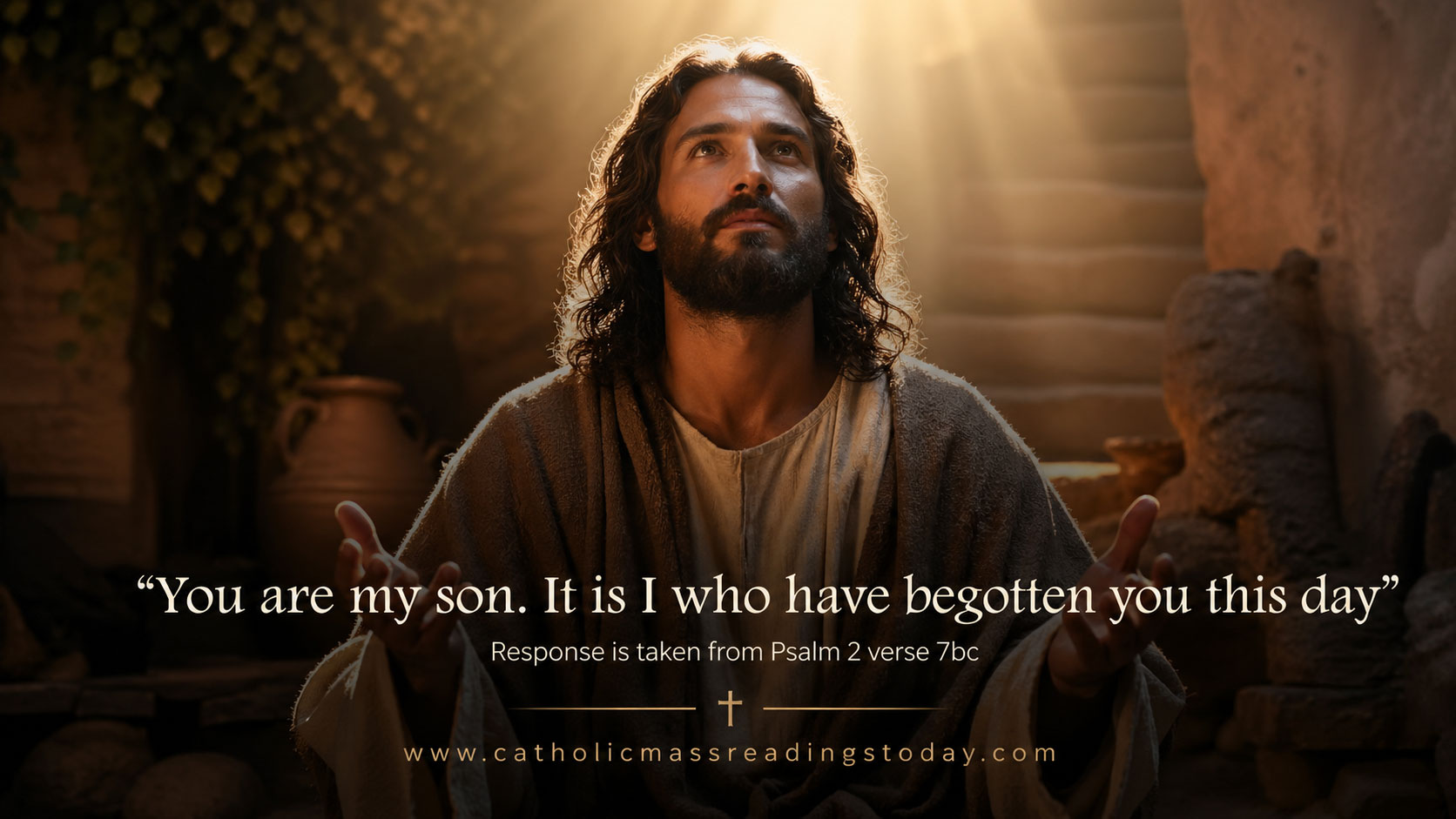
There is something deeply majestic in these words, and at the same time something deeply tender: “You are my son. It is I who have begotten you this day.”
This is not just a line of poetry. It is a window into the heart of God.
In the psalm, these words carry the voice of divine authority, but when the Church prays them, they also point us toward Christ. They remind us that Jesus is not simply a teacher among many, nor a prophet standing at a distance from God. He is the Son, beloved, one with the Father, eternally from Him.
And that changes everything.
Because if Christ is truly the Son, then His words are not suggestions, and His promises are not empty comfort. They carry the weight of heaven itself. When He speaks, the Father is not absent. When He acts, the heart of God is being revealed.
There is also something beautiful in the phrase “this day.” It gives a sense of immediacy, as though God’s truth is not trapped in the past but alive before us now. The Father’s love for the Son is not an old event. It is living, eternal, always present. And through Christ, that same love is opened to us.
That is perhaps the most moving part of all: this psalm does not only tell us who Jesus is; it also helps us understand who we are invited to become in Him.
We are not the Son by nature as He is. But through grace, through baptism, through life in Christ, we are drawn into that relationship. We are allowed to stand before God არა as strangers, but as children. What belongs to Christ by nature becomes, by mercy, something we are invited to share.
So this verse is full of both reverence and hope.
It calls us to adore Christ for who He is: the eternal Son of the Father.
And it calls us to live with the dignity of those who, in Him, have been brought near.
In a world where so many people struggle with identity, worth, and belonging, this psalm quietly reminds us that everything becomes clear when we begin with God. Christ knows who He is because He knows the Father. And we begin to understand who we are when we remain in Christ.
So these words are not distant theology. They are light.
They remind us that Jesus is the true Son, sent for our salvation.
And they remind us that in Him, no life is meaningless, no heart is forgotten, and no child of God is without a place in the Father’s love.