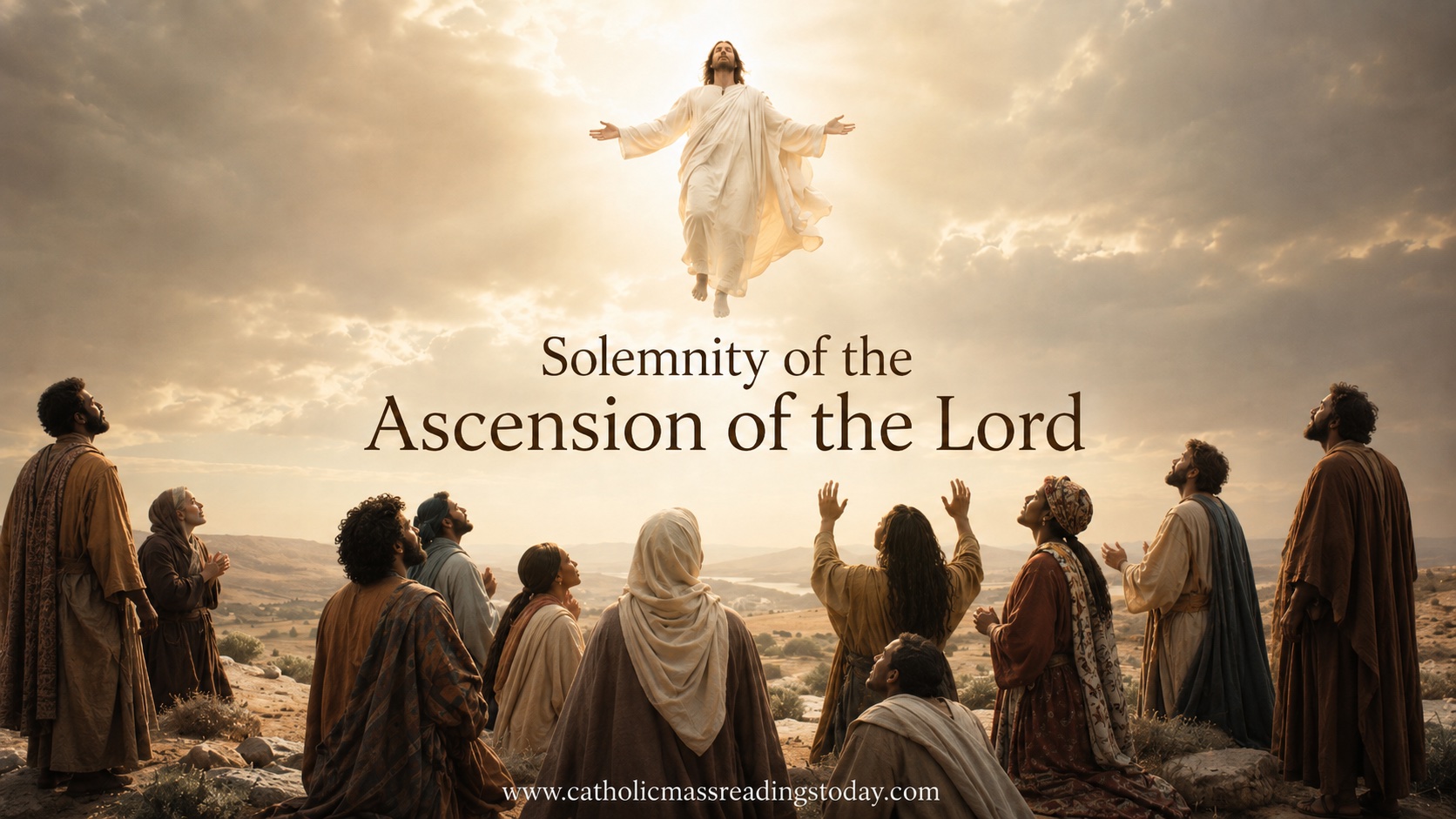
The Solemnity of the Ascension of the Lord is one of the great feasts of the Church, full of light, hope, and holy instruction. At first glance, the Ascension can seem like a moment of departure, as though Christ is leaving His disciples behind. But the Church has always understood it differently. The Ascension is not the absence of Christ. It is His exaltation. It is the glorification of the risen Lord, who returns to the Father not to abandon His people, but to reign for them, intercede for them, and draw them toward the destiny He has opened.
For Catholics, the Solemnity of the Ascension of the Lord is not only something to remember. It is something to live.
What is the Solemnity of the Ascension of the Lord?
The Solemnity of the Ascension of the Lord celebrates the moment when Jesus, after His Passion, Death, and Resurrection, ascended into heaven in the sight of His disciples. Sacred Scripture presents this mystery clearly, especially in the Acts of the Apostles and at the end of Saint Luke’s Gospel. The Lord, having completed His earthly mission, returned to the Father in glory.
But He did not ascend as one escaping the world. He ascended as the victorious Son. The One who took on our humanity, suffered in our flesh, died, and rose again, now carries that glorified humanity into heaven itself. This is one of the deepest reasons the feast is so important: in Christ, human nature has entered the glory of God.
The Ascension therefore is not merely about where Jesus is. It is about what He has made possible for us.
The history and place of this solemnity in the Church
From the earliest centuries, Christians honored the mystery of the Ascension with deep reverence. The feast developed very early in the life of the Church and has long been counted among the principal solemnities of the liturgical year. Traditionally, it is celebrated forty days after Easter, reflecting the biblical witness that the risen Lord appeared to His disciples over forty days before ascending. In some places, for pastoral reasons, its observance is transferred to the following Sunday, but its meaning remains the same: the Church rejoices in the enthronement of Christ and prepares her heart for Pentecost.
The Solemnity of the Ascension of the Lord stands as a bridge between Easter and Pentecost. It proclaims that Christ is glorified and that the Church, now awaiting the Holy Spirit in a special way, must not remain passive. The Lord ascends, and the Church is sent.
Why the Ascension matters so much
The Ascension matters because it reveals who Jesus truly is and what His saving work has accomplished.
Christ does not simply vanish from sight. He takes His place at the right hand of the Father. This is the language of kingship, authority, and divine glory. The crucified one is now exalted. The rejected one is now enthroned. The one who humbled Himself in obedience is now openly revealed as Lord.
For the Catholic faithful, this means we do not follow a dead teacher or merely remember a noble example from the past. We belong to the living Christ, reigning in glory. He is not absent in weakness. He is present in power.
The Ascension also reminds us that heaven is not a distant idea. It is our true homeland opened by Christ. He has gone before us, not to separate Himself from us, but to prepare a place for us. The Church sees in this mystery the pledge of her own future. Where the Head has gone, the Body is called to follow.
What the Solemnity of the Ascension of the Lord teaches Catholics
The Solemnity of the Ascension of the Lord teaches several truths that are central to Catholic life.
First, it teaches us that Christ is Lord of history. The world may look unstable, noisy, and often hostile to the Gospel, but the Ascension reminds us that final authority belongs to Jesus Christ. No earthly power is above Him. No darkness can overthrow His reign.
Second, it teaches us that Christian hope is real. Heaven is not wishful thinking. In Christ, it has already been entered by one who shares our humanity. The Ascension keeps the Christian from living only for what is passing. It lifts the eyes and steadies the heart.
Third, it teaches us that the Church has a mission. Just before His Ascension, the Lord gave His disciples their task: to preach, to baptize, to teach, and to bear witness to Him to the ends of the earth. The Church does not exist to preserve comfort. She exists to announce Christ.
Fourth, it teaches us that the Lord remains with us. This is one of the great paradoxes of the feast: Jesus goes, and yet He does not leave us orphaned. He remains present through His grace, through His word, through the sacraments, through the Holy Spirit, and through His living presence in the Church. The Ascension is not distance. It is a new mode of nearness.
What it means for the Catholic faithful today
For Catholics today, the Solemnity of the Ascension of the Lord is both comfort and challenge.
It comforts us because it tells us that Christ reigns, Christ intercedes, and Christ has opened heaven.
It challenges us because it asks whether our lives reflect that truth.
- Do we live as people who know that our citizenship is in heaven?
- Do we pray with confidence to the Lord who reigns?
- Do we remain faithful to the mission He gave His Church?
- Do we carry the Gospel into our homes, our work, our friendships, and our daily duties?
The Ascension does not encourage daydreaming about heaven while neglecting the world. It calls for the opposite. Because Christ reigns in glory, we must live on earth with greater faithfulness, greater courage, and greater purpose. We are not called to stand still staring upward. We are called to return to daily life transformed, knowing that every part of life can now be lived in union with the risen and ascended Lord.
What is expected of us?
The Church, in celebrating the Solemnity of the Ascension of the Lord, invites the faithful to several practical responses.
We are called to deepen our desire for heaven. This does not mean despising earthly life, but seeing it rightly. We use this world without making it our ultimate home.
We are called to greater trust. Christ reigns. Therefore despair is never fitting for the Christian heart.
We are called to witness. The Ascension is closely tied to mission. A Catholic who truly believes that Christ is Lord cannot keep that truth hidden away as a private opinion.
We are called to holiness. If Christ has raised human nature to glory, then our lives should not be lived carelessly. We are meant for more than sin, distraction, and spiritual mediocrity.
We are called to prayer. The ascended Lord intercedes for us. The Church therefore lives with confidence, lifting her needs to the Father through Christ.
The Ascension and the life of the Church
The Solemnity of the Ascension of the Lord is also a feast of the Church herself. It reminds the Church who her Lord is, where her strength comes from, and what her mission must remain.
In every generation, the Church is tempted either to fear the world too much or to imitate it too closely. The Ascension corrects both errors. The Church need not fear as though Christ were absent, and she must not conform as though His kingdom were no different from earthly kingdoms. Her Lord reigns already, and her mission remains His.
That is why this solemnity has such dignity in the liturgy. It is not merely the memory of a departure. It is the celebration of Christ’s glory and the renewal of the Church’s confidence.
A final word for the faithful
The Solemnity of the Ascension of the Lord should leave the Catholic heart both peaceful and strengthened.
- Peaceful, because Christ has gone before us into glory.
- Strengthened, because the same Lord sends us into the world with purpose.
- Peaceful, because heaven has been opened.
- Strengthened, because the mission is not finished.
- Peaceful, because Christ reigns.
- Strengthened, because we must live as His witnesses.
This feast tells us that our faith is not trapped in the past. Christ is alive. Christ is glorified. Christ is with His Church. And Christ is drawing all things toward their fulfillment in Him.
Let the heart be lifted
To celebrate the Solemnity of the Ascension of the Lord well is to let the heart be lifted. It is to remember that Christ has not withdrawn His care from the world. It is to believe more firmly that heaven is real, that the Church’s mission matters, and that our lives are meant to be directed toward eternal glory.
The Lord has ascended, but He has not abandoned us.
He reigns, and He remains.
He has gone before us, and He calls us to follow.
That is why this solemnity is filled not with sadness, but with hope.