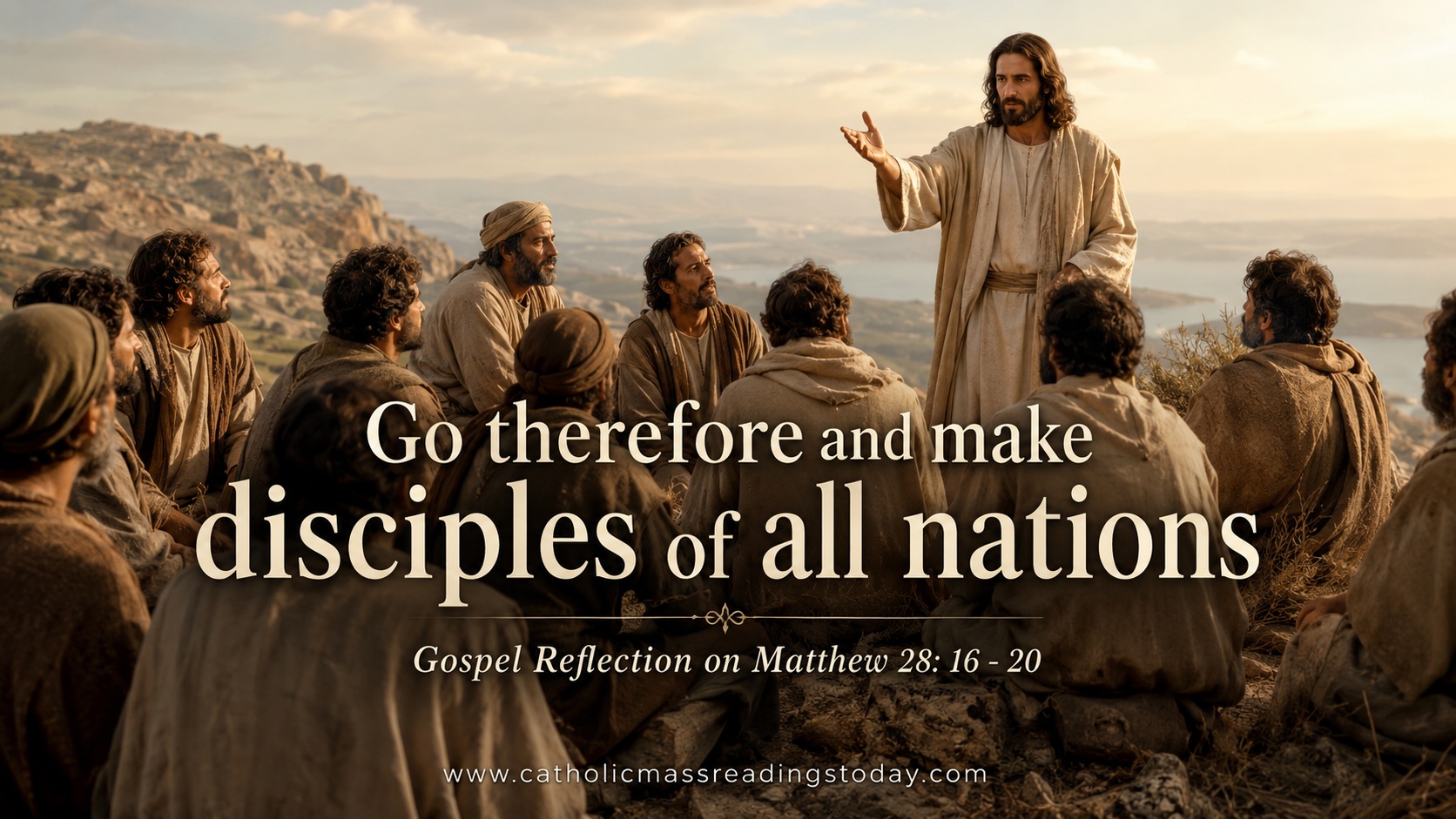
This Gospel brings us to one of the great summits of the New Testament. The risen Lord stands before His disciples and speaks words that are full of majesty, mission, and consolation. He does not speak as a teacher offering one last piece of advice. He speaks as the victorious Son, the One who has passed through the Cross, conquered death, and now reveals the full scope of His authority and His saving plan.
He begins with these words: “All authority in heaven and on earth has been given to me.”
That is not a small statement. It means that the risen Christ is Lord over all. His authority is not limited by place, culture, time, or human opposition. It reaches heaven and earth. The world may often appear confused, divided, and ruled by many competing powers, but the Gospel reminds us that above all earthly authority stands Jesus Christ. He is not one voice among many. He is the Lord.
That truth matters deeply for the life of faith. We do not build our lives on shifting opinion, passing ideologies, or temporary human power. We build on Christ. If He truly has all authority, then His word is not optional. His commandments are not suggestions. His Gospel is not one path among many equal paths. He is the risen Lord, and His truth carries the weight of heaven.
And yet it is striking that this great declaration is followed immediately by a mission: “Go therefore and make disciples of all nations.” In other words, the authority of Christ is not given merely to inspire awe. It is given for salvation. Because He is Lord of all, the Gospel is meant for all. No people, no nation, no language, no culture lies outside His saving desire.
The Church has always understood this as part of her very identity. She does not exist only to preserve memories of Jesus, nor only to care for those already inside. She is sent. She is missionary by nature. The Church goes out because Christ has commanded it.
And notice carefully what He says: not simply “go and gather admirers,” but “make disciples.” A disciple is one who follows, learns, is formed, and gives his life to the Master. This means the mission of the Church is not only about numbers or outward expansion. It is about conversion, formation, and holiness. It is about helping men and women truly come to know Christ, believe in Him, and live according to His teaching.
Then the Lord names the sacramental heart of this mission: “baptising them in the name of the Father and of the Son and of the Holy Spirit.” This is one of the clearest and most precious revelations of the Holy Trinity in the Gospel. The Christian is baptized not into a vague religious identity, but into the very life of the triune God. The faith of the Church is deeply Trinitarian because the life of salvation itself is Trinitarian.
Baptism is not a mere symbol of belonging. It is the true beginning of new life in Christ. Through it, the person is cleansed, claimed for God, and brought into the life of grace. This is why the Church treasures baptism so deeply. It is not an optional ritual. It is the doorway into Christian life.
But Jesus does not stop there. He also says: “teaching them to observe all that I have commanded you.” This is equally important. The Christian life is not completed by baptism alone without formation. Faith must be taught. Conscience must be formed. The commandments of Christ must be lived. The Church therefore baptizes, but she also teaches. She proclaims mercy, but she also proclaims truth. She welcomes, but she also forms.
This matters very much today. We live in a time when many people are willing to accept a comforting image of Jesus, but resist the idea that His teaching should shape their lives. Yet the Lord’s own words are clear: disciples are to be taught to observe all that He commanded. Love for Christ cannot be separated from obedience to Christ. A Church that truly loves the world must not withhold the truth that saves it.
There is also a very human and touching detail at the beginning of this Gospel: “When they saw him they worshipped him; but some doubted.” That line is full of realism. Even here, before the risen Lord, there is still weakness in some hearts. And yet Jesus still entrusts the mission to them.
That should give all of us courage.
The Lord does not wait for perfect disciples before sending them. He works through those who still need grace, those who still tremble, those who still have questions, those who still must grow. The Church has never been a community of the flawless. She is a community gathered by mercy and sent by grace.
That does not excuse mediocrity, but it does remind us that the mission depends first on Christ’s power, not on our perfection. The same Lord who sent the apostles also formed them, strengthened them, and remained patient with them. He still does the same with us.
And then comes the final promise, one of the most consoling in all Scripture: “Behold, I am with you always, to the close of the age.”
This is the heart’s resting place.
The Lord does not send His Church out alone. He does not give a mission and then withdraw. He remains. He is with His Church in her preaching, in her sacraments, in her suffering, in her fidelity, in her moments of hidden holiness, and in her labor for souls. He is with the missionary, with the priest, with the parent teaching the faith, with the religious sister, with the catechist, with every ordinary believer trying to live the Gospel in daily life.
He is with us always.
That promise is the source of Christian courage. The mission is great, the world is often difficult, and our own weakness is real. But Christ remains. The Church goes forward not because the times are easy, but because the Lord is faithful.
So this Gospel gives us a complete vision of the Christian life and mission:
- Christ is Lord.
- The world must hear the Gospel.
- The nations are called to discipleship.
- Baptism brings us into the life of the Trinity.
- The commandments of Christ must be taught and lived.
- And through it all, the Lord remains with His people.
That is why this passage never grows old. It is not only the conclusion of Matthew’s Gospel. It is the living commission of the Church in every age.
Today, then, the Lord asks us not only to admire His words, but to receive them personally. Am I living as a true disciple? Am I allowing Christ’s authority to shape my life? Am I helping others come closer to Him by my witness, my charity, my fidelity, and my truthfulness? Do I really believe that He is with His Church now, not only in the past?
These are not small questions. But they are full of hope, because the One who asks them is the same Lord who promises His abiding presence.
Let us Pray
Lord Jesus Christ,
You are risen in glory
and all authority in heaven and on earth belongs to You.
Teach us to live as true disciples,
faithful to Your word
and obedient to Your commandments.
Strengthen Your Church in her mission.
Help us to carry the Gospel with courage, humility, and love.
Make us faithful witnesses in our homes,
in our communities,
and wherever You send us.
Deepen in us the grace of our baptism,
that we may live always
in the name of the Father and of the Son and of the Holy Spirit.
And when we feel weak, uncertain, or afraid,
remind us of Your promise:
that You are with us always,
to the close of the age.
Amen.