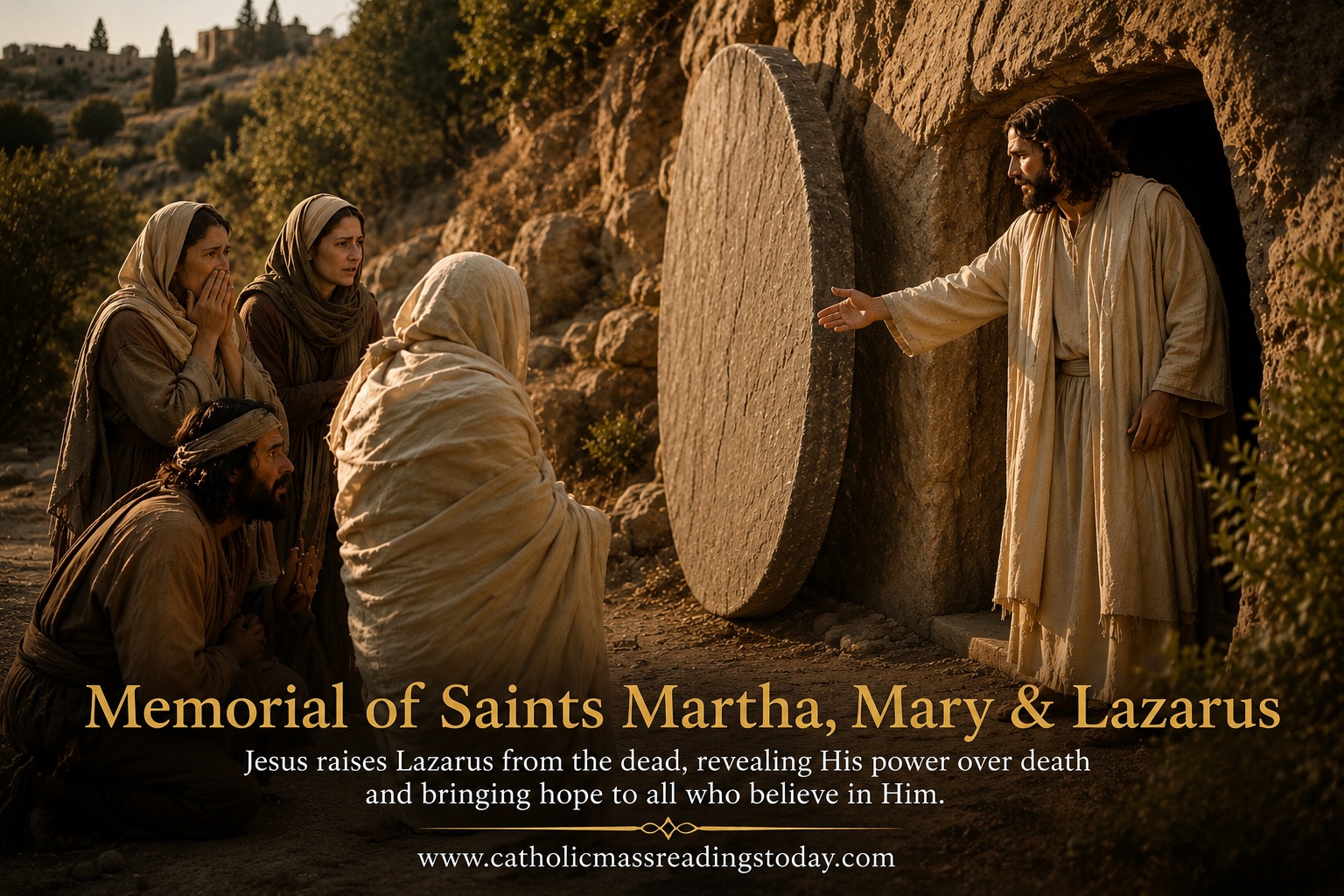
The Family Jesus Loved
From the Quiet Village of Bethany to a Friendship That Changed the World
“Now Jesus loved Martha and her sister and Lazarus.” — John 11:5
There are places in the Holy Land where the Gospel seems to come alive the moment you arrive. Bethlehem tells the story of Christ’s birth. Nazareth whispers of His hidden years. Jerusalem bears witness to His Passion, Death, and Resurrection.
Then there is Bethany.
It was not a grand city. It had no magnificent palaces, no towering temple, and no political influence. Travelers heading toward Jerusalem could easily have overlooked it. Yet, tucked away on the eastern slope of the Mount of Olives, just over three kilometres from Jerusalem, stood a small village that became one of the most cherished places in the earthly life of Jesus.
For within that quiet village lived three ordinary siblings whose names would become known throughout the Christian world:
Martha. Mary. Lazarus.
The Church honours them together because together they offered something increasingly rare in every generation: a home where Christ was always welcome.
Their story is not one of kings conquering nations or prophets performing spectacular signs. Instead, it is the story of friendship, a friendship so genuine that the Son of God regularly left the noise of Jerusalem simply to spend time in their company.
In a world captivated by power and fame, the Gospel reminds us that one family in a humble village became unforgettable because they loved Jesus, and Jesus loved them in return.
A Village Called Bethany
During the first century, Bethany was a modest Jewish village surrounded by olive groves, vineyards, fig trees, and dusty roads that wound through the Judean hills.
Pilgrims travelling to Jerusalem for the great feasts often passed nearby. Shepherds watched their flocks across the rocky slopes, while farmers cultivated small plots of land inherited from previous generations.
The village itself was peaceful compared to nearby Jerusalem. Jerusalem was crowded, argued, judged, plotted and Bethany rested.
For Jesus, whose public ministry constantly attracted crowds, Bethany became something else entirely. It became home.
Whenever opposition in Jerusalem grew fierce, He often crossed the Mount of Olives and descended into the quiet streets of Bethany. There He found something He could rarely enjoy elsewhere:
A family who welcomed Him not because of His miracles, not because of His growing fame, but simply because they loved Him.
Three Siblings, Three Beautiful Hearts
The Gospel introduces the household almost naturally, as though the early Christians already knew them well. It is remarkable that Scripture never identifies them by their father’s name or family lineage.
Instead, they are remembered simply as siblings. Martha, Mary and Lazarus.
Each possessed a remarkably different personality. Each loved Christ differently. Each reflected a different aspect of Christian discipleship.
Martha
Martha appears first in the Gospels and was almost certainly the eldest of the family.
Her name comes from the Aramaic word Martha, meaning “lady” or “mistress of the house.”
Everything about her suggests responsibility. She managed the household, organized meals and welcomed guests.
She noticed every practical detail that others overlooked. Without people like Martha, families struggle. Churches struggle, communities struggle.
She was the sort of woman who quietly ensured that everyone else had enough.
She likely rose before dawn to grind grain into flour, bake bread in stone ovens, fetch water from the village well, prepare vegetables, tend oil lamps, oversee servants if the family had any, and make certain visitors were received with honour.
Hospitality in Jewish culture was considered sacred. To welcome a guest well was to honour God Himself. Martha lived this calling wholeheartedly.
Mary
Mary, by contrast, possessed a quieter spirit. While Martha busied herself serving others, Mary listened. She observed, reflected and treasured moments that others might miss.
Where Martha expressed love through action, Mary expressed love through presence. She delighted in simply being near Jesus.
The Gospels repeatedly portray her sitting at His feet, not as a passive observer but as a true disciple.
In first century Judaism, to “sit at someone’s feet” was the position of a student learning from a respected teacher. This detail is extraordinary.
Jesus welcomed Mary into a place where women were rarely invited by rabbis of His day.
He treated her as someone fully capable of hearing, understanding, and embracing the Word of God.
Lazarus
Of the three, Lazarus remains the most mysterious. He never speaks a single recorded word in Scripture. Yet silence should never be mistaken for insignificance.
The Gospel simply tells us something astonishing. Jesus loved him, those few words reveal everything.
Lazarus did not become famous because of eloquent preaching or dramatic speeches. He became known because he belonged to Christ.
Sometimes the holiest people leave behind the fewest recorded words.
Before They Ever Met Jesus
The Bible tells us nothing about their childhood, no record of their parents and says nothing about their early education. Yet by understanding first century Jewish family life, we can glimpse the world in which they grew up.
The siblings would likely have learned the Scriptures from an early age. Every Sabbath they gathered in the local synagogue to hear the Law and the Prophets.
They celebrated Passover each year, remembering Israel’s deliverance from Egypt. Fasting, praying and learning to trust in the God of Abraham, Isaac, and Jacob.
Like countless Jewish families, they waited for the promised Messiah. Little could they have imagined that one day He would regularly sit at their own table.
The First Meeting
Scripture never tells us exactly how Jesus first met Martha, Mary, and Lazarus. Perhaps they encountered Him during one of His early journeys through Judea or possibly they first heard Him preach near Jerusalem.
Perhaps mutual friends introduced them. Whatever the circumstances, something extraordinary happened. The friendship endured.
Unlike many who followed Jesus only because of His miracles, this family welcomed Him as a friend.
The relationship became deeply personal. Jesus did not merely visit their house once. He returned again and again, numerous times.
The house in Bethany gradually became one of the few places where He could escape the relentless demands of ministry.
Imagine those evenings when the roads finally quiet, the crowds left behind. The disciples resting after another exhausting day. Inside the house, lamps flickered against stone walls, fresh bread filled the room with its warm aroma.
Olive oil glistened beside bowls of figs, lentils, roasted fish, herbs, and wine.
Laughter replaced arguments, conversation replaced confrontation. For perhaps the only time during many difficult weeks, Jesus simply enjoyed being among friends.
The Gospels never describe these evenings in detail, yet their repeated visits suggest something profoundly human. The Son of God treasured friendship.
A Home Unlike Any Other
Many welcomed Jesus for what He could do. Crowds followed Him hoping to witness another miracle. Some wanted healing while others wanted food. Many expected political liberation with religious leaders questioning Him hoping to trap Him.
Even some disciples struggled to understand Him, but in Bethany, Jesus found something different.
He found people who loved Him before asking anything from Him. Their home became a refuge not because it was luxurious or because it was large. But because love lived there. Hospitality has always held a special place within Christianity.
Long before magnificent cathedrals were built, the Church often gathered in ordinary homes. Meals became places of prayer. Conversations became opportunities for faith. Tables became altars of friendship.
The house of Martha, Mary, and Lazarus beautifully foreshadowed that tradition.
A Meal That Changed Christian History
One afternoon, Jesus entered their home once again. Martha immediately did what Martha always did. She began preparing the meal as the guests had arrived. Everything needed attention, bread, water, serving bowls, cooking, cleaning and all this to ensure the best hospitality.
Yet Mary did something that probably surprised everyone present. Instead of helping in the kitchen, she quietly sat at Jesus’ feet and listened to every word He spoke.
To Martha, this seemed terribly unfair, the work was overwhelming. Eventually, unable to contain her frustration, she approached Jesus.
“Lord, do you not care that my sister has left me to serve alone? Tell her then to help me.”
It is one of the most relatable moments in the entire Gospel.
Anyone who has prepared a large family gathering understands Martha’s feelings.
She was not angry because she disliked serving. She was overwhelmed.
Jesus answered with remarkable tenderness.
“Martha, Martha, you are anxious and troubled about many things; one thing is necessary. Mary has chosen the better part, which shall not be taken away from her.”
These words have sometimes been misunderstood. Jesus was not criticizing Martha’s generosity. He never suggested that serving others lacked importance. After all, Christ Himself came “not to be served but to serve.”
Instead, He gently reminded Martha that work should never crowd out the presence of God.
There are seasons for serving and seasons for sitting quietly before the Lord. Christian life requires both.
The Church has treasured this lesson for two thousand years. Martha reminds us to love through service, Mary reminds us to love through contemplation. Neither completes the Gospel without the other.
A Friendship Unlike Any Other
As the months passed, the bond between Jesus and the family deepened. The disciples came to know the road to Bethany almost by heart. Whenever they crossed the Mount of Olives, they knew where they were going. Not to another crowd, not to another confrontation but to friends.
John’s Gospel preserves one sentence unlike any other:
“Now Jesus loved Martha and her sister and Lazarus.” (John 11:5)
No other household receives such a direct declaration. It is a remarkable glimpse into the humanity of Christ. The eternal Son of God, who loved the whole world enough to die for it, also loved particular people personally.
He laughed with them, shared meals with them, rested under their roof and accepted their friendship. This truth should comfort every Christian.
Our relationship with Christ is never merely distant or abstract. He desires friendship.
Just as He knocked on the door of Bethany, He continues to knock on the doors of our own homes and hearts.
The Miracle That Changed Everything
“I am the Resurrection and the Life. Whoever believes in me, though he die, yet shall he live.” — John 11:25
For a long time, life in Bethany must have seemed wonderfully ordinary.
The familiar rhythm of the seasons continued as it always had. Olive trees bore their fruit. Pilgrims travelled the winding road to Jerusalem. The small house belonging to Martha, Mary, and Lazarus remained a place of welcome, laughter, prayer, and friendship.
Jesus continued His ministry throughout Galilee and Judea, preaching the Kingdom of God, healing the sick, forgiving sinners, and revealing the Father’s love wherever He went.
Whenever His journeys brought Him near Jerusalem, He often chose to stay in Bethany.
To the disciples, the little village became more than another stop on their travels. It was a place where they could rest their weary feet after long days on dusty roads. It was where Martha’s table was always prepared, where Mary listened intently to every word Jesus spoke, and where Lazarus’ quiet companionship offered a welcome break from the constant demands of ministry.
No one could have imagined that this peaceful household would soon become the setting for one of the greatest miracles ever recorded.
Shadows Begin to Fall
Illness in the ancient world often arrived without warning. There were no hospitals, no antibiotics, no modern physicians. A simple fever could quickly become fatal.
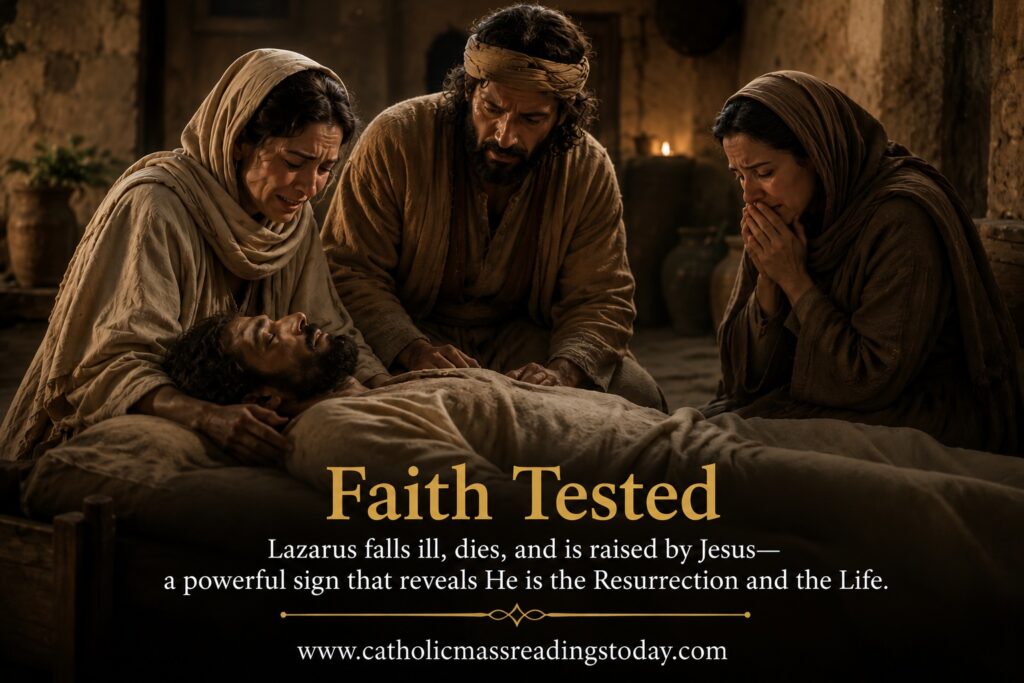
One day, Lazarus became seriously ill. At first, the family probably hoped it was nothing more than a passing sickness. Martha would have done everything possible to care for her brother. Mary, undoubtedly, prayed with deep trust that God would restore him.
But the illness worsened. Each day brought greater concern. The strength slowly disappeared from Lazarus’ body. The conversations inside the house grew quieter, meals remained untouched and hope began to fade. There was only one person they believed could help.
Jesus.
A Message Sent in Faith
The sisters did not send a long explanation. They did not attempt to persuade Jesus. Their message consisted of only a few words.
“Lord, he whom you love is ill.” (John 11:3)
It is one of the most touching requests found anywhere in Scripture. Notice what they did not say. They did not write,
“Come quickly.”
They did not demand a miracle. They simply placed the situation into the hands of the One they trusted completely.
Their message rested on one truth alone. Jesus loved Lazarus. Surely that would be enough.
An Unexpected Delay
When the messenger finally reached Jesus, His response surprised everyone. Instead of leaving immediately for Bethany, Jesus remained where He was for two more days. To the human eyes, the delay seemed impossible to understand.
Surely the sisters expected Him to come at once, they watched the road each morning, hoping to see Him approaching over the hills.
Perhaps every distant traveller caused their hearts to race for a moment. But Jesus did not appear.
Meanwhile, Lazarus grew weaker, then came the moment every family dreads.
Lazarus died.
The house that had once echoed with conversation fell silent except for weeping.
Jewish Mourning
To understand the depth of this moment, it helps to understand Jewish customs.
Following death, burial usually took place on the same day. The body was washed carefully and wrapped in linen cloths. Perfumed spices were used both as an act of honour and to lessen the odour of decomposition.
Family and neighbours gathered immediately. Professional mourners were sometimes present.
Prayers filled the house, tears flowed freely and the dead were laid in rock cut tombs, sealed with heavy circular stones.
Lazarus was buried.
The stone rolled into place and four long days passed. From every human perspective, hope had ended.
Jesus Begins the Journey
Only after those four days did Jesus announce to His disciples,
“Let us go to Judea again.”
The disciples were alarmed. Jerusalem had become dangerous. The religious leaders had already attempted to stone Him. Returning meant risking His own life. Then Jesus spoke words the disciples scarcely understood.
“Our friend Lazarus has fallen asleep, but I go to awaken him.”
Thinking literally, they replied,
“Lord, if he has fallen asleep, he will recover.”
Only then did Jesus tell them plainly,
“Lazarus has died.”
Thomas, often remembered only for his later doubts, displayed remarkable courage.
Turning to the others, he said,
“Let us also go, that we may die with him.”
The journey toward Bethany had become a journey toward the Cross.
Martha Runs to Meet Jesus
News spread quickly through Bethany. Jesus was approaching. Before He even entered the village, Martha hurried out to meet Him.
One can almost picture the scene. Dust rising beneath hurried footsteps, tears still fresh upon her face. A heart torn between grief and hope. When she reached Jesus, her first words carried both sorrow and faith.
“Lord, if you had been here, my brother would not have died.”
There is no accusation in her voice. Only heartbreak. She believed completely that Jesus could have healed Lazarus. Yet even now her faith remained astonishing.
She continued,
“But even now I know that whatever you ask from God, God will give you.”
It is a remarkable statement from a grieving sister. Even in disappointment, she trusted Christ.
The Greatest Conversation in Bethany
Jesus replied,
“Your brother will rise again.”
Martha answered according to the common Jewish belief in the future resurrection.
“I know that he will rise again in the resurrection on the last day.”
Then Jesus revealed one of the greatest truths ever spoken. He did not merely promise resurrection. He declared Himself to be its source.
“I am the Resurrection and the Life. Whoever believes in me, though he die, yet shall he live, and everyone who lives and believes in me shall never die.”
Then came the question that echoes through every generation.
“Do you believe this?”
Martha’s answer stands beside Saint Peter’s confession at Caesarea Philippi as one of the clearest professions of faith in the New Testament.
“Yes, Lord; I believe that you are the Christ, the Son of God, who is coming into the world.”
The woman once worried about serving dinner now proclaimed one of Christianity’s deepest truths. Her faith had matured through suffering.
Mary’s Tears
Martha quietly returned home and whispered to her sister,
“The Teacher is here and is calling for you.”
Mary rose immediately. The mourners assumed she was going to the tomb and followed her.
When she reached Jesus, she fell at His feet. It was exactly where the Gospel had placed her before. She had listened at His feet and now she wept at His feet. Her words were identical to Martha’s.
“Lord, if you had been here, my brother would not have died.”
Sometimes grief speaks with the same words from different hearts.
Jesus Wept
The Gospel records one of its most profound moments. Seeing Mary weeping, the mourners grieving and the heartbreak that death had caused made Jesus Himself begin to weep.
Two simple words.
“Jesus wept.”
They are the shortest verse in the Bible. Perhaps they are also among the most beautiful.
The Son of God stood before the tomb fully aware that Lazarus would soon walk out alive.
Yet He still cried. His tears reveal that divine power never diminishes genuine compassion.
He entered fully into human sorrow, sharing their pain. He mourned with those who mourned.
For Christians throughout history, these tears have become a source of immense comfort. The God who raises the dead is also the God who understands our grief.
Before the Tomb
Jesus asked,
“Where have you laid him?”
They led Him to the tomb. It was a cave sealed by a heavy stone. Standing before it, Jesus gave a surprising command.
“Take away the stone.”
Martha hesitated. Always practical, she quietly reminded Him,
“Lord, by this time there will be an odour, for he has been dead four days.”
Jesus gently answered,
“Did I not tell you that if you believed you would see the glory of God?”
The stone was rolled away, silence settled over the crowd and no one knew what would happen next.
“Lazarus, Come Out!”
Jesus lifted His eyes toward heaven. He thanked the Father. Then, with authority that belonged to God alone, He cried out,
“Lazarus, come out!”
For a brief moment… Nothing happened. Then movement a figure appeared within the darkness. Still wrapped in burial cloths… Lazarus walked out alive.
The silence exploded into astonishment. Grief gave way to joy and tears became laughter.
Death had surrendered before the voice of Christ. Jesus calmly instructed,
“Unbind him, and let him go.”
A Miracle That Changed History
The raising of Lazarus was far more than a miracle performed for one family. It became the final great sign before Christ’s own Passion.
Many who witnessed it believed in Jesus. Others hurried to report what had happened to the religious authorities. Instead of rejoicing, the chief priests and Pharisees became deeply alarmed.
If Jesus could raise the dead… How could anyone stop Him?
The Gospel tells us that from that day forward they actively planned His death.
Ironically, the miracle that restored Lazarus’ life hastened the events that would lead Jesus to Calvary.
One Last Supper in Bethany
Only a short time later, Jesus returned once more to Bethany.
It would be one of His final evenings before entering Jerusalem. A supper was prepared in His honour. Martha served once again. Nothing had changed about her generous heart.
Lazarus sat at the table with Jesus. The man who had once lain four days in a tomb now shared a meal with the One who had restored his life.
Mary quietly entered carrying an alabaster jar filled with pure nard. It was worth nearly a year’s wages.
Without hesitation, she broke the jar. She poured the perfume upon Jesus’ feet.
Then, in one of the most tender acts recorded in Scripture, she wiped His feet with her hair.
The fragrance filled the entire house. Some protested. Judas complained that the perfume should have been sold and the money given to the poor. Jesus defended Mary.
“Leave her alone. She has kept this for the day of my burial.”
Mary understood something many others still did not. The Cross was approaching.
A Family Forever Changed
The home in Bethany would never be ordinary again. Martha had witnessed the power of faith, Mary had witnessed the compassion of Christ and Lazarus had experienced resurrection before the Resurrection.
Each would carry those memories for the rest of their lives. The days ahead would bring betrayal, crucifixion, silence, and finally Easter morning.
But whatever lay ahead, the family of Bethany had already learned one unforgettable truth: When Jesus speaks, even death must obey.
From the Empty Tomb to an Everlasting Legacy
“Go to my brothers and say to them, ‘I am ascending to my Father and your Father, to my God and your God.'” — John 20:17
When dawn broke on the third day after Jesus’ crucifixion, the world changed forever.
The stone had been rolled away. The tomb was empty. Death had been defeated.
The Resurrection was not simply the conclusion of Jesus’ earthly ministry, it was the beginning of the Church’s mission. For the disciples, everything they believed was suddenly transformed by one undeniable truth:
Christ was alive.
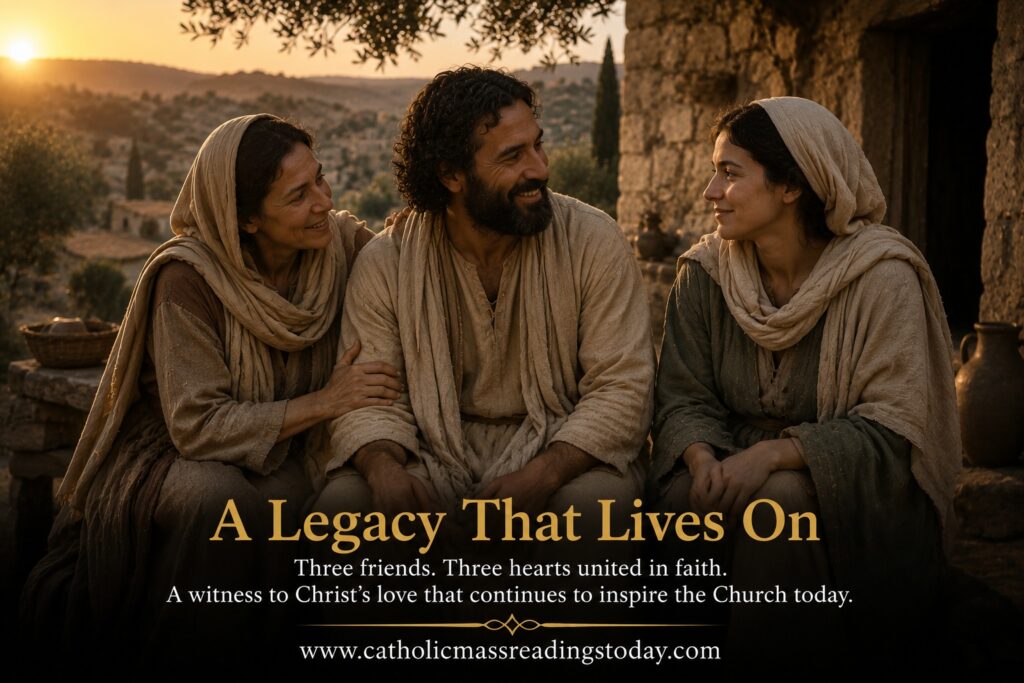
Among those who experienced this transformation most deeply were the three siblings from Bethany.
Martha, Mary and Lazarus.
The family who had once welcomed Jesus into their home would now spend the rest of their lives carrying His Gospel into the world.
Bethany After Easter
The Gospels become surprisingly quiet after the Resurrection. This silence has often frustrated historians.
After following Martha, Mary, and Lazarus through some of the most dramatic moments in Christ’s ministry, Scripture suddenly says almost nothing about the remainder of their lives. But silence should never be mistaken for insignificance.
The mission of the Church had only just begun. The Apostles were preparing to proclaim Christ throughout the world. The Holy Spirit would soon descend at Pentecost. Persecution would arise.
Jerusalem would become increasingly dangerous for those who openly professed Jesus as the Messiah. The beloved family of Bethany now belonged to a growing community whose lives would never again be ordinary.
Lazarus: A Living Witness
Imagine, for a moment, what life must have been like for Lazarus after the Resurrection.
He had already experienced something almost unimaginable. He had been dead, buried, mourned. Then called back to life by the voice of Jesus.
Everywhere he went, people must have recognised him.
“Isn’t that Lazarus?”
“The man who was in the tomb?”
“The one Jesus raised?”
He never needed elaborate sermons, his very existence proclaimed Christ. Simply seeing him was testimony that Jesus possessed authority over death itself.
John’s Gospel tells us that many people came to Bethany not only to see Jesus, but also to see Lazarus. His life had become living evidence of the power of God.
That popularity, however, came with danger. The chief priests even discussed putting Lazarus to death because his continued presence caused many to believe in Jesus (John 12:10–11). It is one of history’s great ironies. The man who had already died once was now marked for death again simply because he bore witness to Christ.
Martha: The Servant Who Never Stopped Serving
The Resurrection did not change Martha’s personality. It perfected it. Throughout the Gospels she had demonstrated practical love.
After Easter, that same generosity would have become one of the quiet foundations of the early Christian community.
The Acts of the Apostles describes believers gathering in homes, breaking bread together, praying together, and caring for one another.
One cannot help but imagine Martha thriving in such a community. Her home had already become a place where Christ was welcomed. Now it would become a place where Christians gathered in His name. Hospitality became one of the earliest forms of evangelisation.
Before churches existed, Christian homes became churches. Martha had already shown the world what such a home looked like.
Mary: A Disciple to the End
Mary’s love for Jesus had always been deeply personal. She had listened at His feet, wept before Him, nointed Him for burial and now she lived with the certainty that death had not defeated her Lord.
Although Scripture does not continue her story after Easter, her example remained unforgettable.
Generations of Christians would remember the woman who chose “the better part.”
She reminds believers in every age that discipleship begins by listening. Prayer comes before mission and love grows in silence before it blossoms into action.
What Happened Next?
Here we arrive at one of the most fascinating parts of their story.
The Bible ends without telling us what became of Martha, Mary, and Lazarus. Because of this, early Christian communities preserved traditions that were handed down through the centuries. These traditions are valuable and ancient.
However, Catholics should remember an important distinction: They belong to Christian tradition, not to Sacred Scripture. The Church treasures them without requiring Catholics to accept every historical detail as certain fact.
The Western Tradition
One of the oldest Western traditions tells us that persecution in Judea eventually forced several disciples of Jesus to leave the Holy Land. According to this tradition, Martha, Mary, Lazarus, and several other early Christians were placed aboard a small boat without sails or oars.
Humanly speaking, they should never have survived. Yet, guided by God’s providence, they crossed the Mediterranean Sea and reached the southern coast of what is now France.
There they continued preaching Christ. The tradition identifies several locations connected with their later ministry.
Lazarus became associated with Marseille, where he is believed to have served as the city’s first bishop.
Martha became connected with Tarascon, where her devotion and charity inspired generations of Christians.
Mary is traditionally associated with a life of prayer near Sainte Baume, where she is said to have spent many years in solitude, contemplating the mysteries of Christ.
These traditions have shaped Christian devotion across France for centuries.
Magnificent churches still bear their names. Pilgrims continue to visit these places today.
Whether every historical detail can be verified is another matter, but the traditions themselves testify to the deep love Christians have always held for this remarkable family.
The Eastern Tradition
Eastern Christianity preserves a different tradition concerning Lazarus. According to this account, after persecution intensified in Judea, Lazarus travelled to Cyprus.
There he became the first Bishop of Kition, modern day Larnaca. Tradition states that he served the Church faithfully for many years before dying peacefully. His tomb in Cyprus became an important pilgrimage site.
Even today, the Church of Saint Lazarus in Larnaca stands as one of the most treasured Christian shrines on the island.
Interestingly, Eastern tradition says that after being raised by Jesus, Lazarus rarely smiled. Having experienced death itself, he viewed earthly life differently.
Only one story tells of him smiling after seeing someone stealing a clay pot. He reportedly remarked,
“Clay steals clay.”
Whether historical or symbolic, the story beautifully reflects the Christian understanding that earthly possessions fade, while eternal life alone endures.
How Did They Die?
The Bible never records the deaths of Martha, Mary, or Lazarus. Ancient traditions offer different accounts.
Some traditions suggest Lazarus died peacefully after many years of ministry. Others describe him as eventually suffering martyrdom.
Martha is generally remembered as dying after a life devoted to charity and service.
Mary’s death is likewise surrounded by differing traditions.
Because Scripture remains silent, the Church wisely refrains from making definitive historical claims. What matters most is not the exact manner of their deaths but the faithfulness with which they lived.
Why the Church Loves This Family
Very few families occupy such an important place in the Gospels. The family of Bethany teaches that holiness is not reserved for priests, bishops, missionaries, or martyrs alone.
Holiness begins at home. Their house became holy because Christ was welcomed there.
Martha teaches us that serving others is holy.
Mary teaches us that prayer is indispensable.
Lazarus teaches us that Christ truly is the Lord of life.
Together they present a complete picture of Christian discipleship.
- Service.
- Prayer.
- Witness.
None is complete without the others.
Pope Francis and the Memorial
For centuries, the Roman Calendar celebrated only the Memorial of Saint Martha on 29 July.
Mary and Lazarus were honoured separately through Scripture and tradition but did not share her universal liturgical memorial.
That changed in 2021.
Recognising the profound unity of this family in the Gospel, Pope Francis approved a decree issued by the Dicastery for Divine Worship that officially renamed the celebration:
Memorial of Saints Martha, Mary & Lazarus.
The decision reflected more than historical accuracy. It expressed a beautiful theological truth.
The three siblings cannot really be separated. Whenever Scripture speaks of one, the others are never far away. Their faith was shared, their suffering was shared, their friendship with Christ was shared and their witness belongs together.
Today, Catholics throughout the world celebrate them as one family whose different gifts together reveal the richness of Christian life.
Lessons for Every Christian Home
The story of Bethany feels surprisingly modern. Every family contains different personalities.
Some resemble Martha, always working, always organising, always serving while others resemble Mary. Quiet, reflective, prayerful and still others resemble Lazarus, often unnoticed.
Yet their faithful presence quietly strengthens everyone around them.
The Gospel never suggests that one personality is superior. Instead, Christ draws each person toward holiness according to the gifts God has given them.
A healthy Christian family needs servants. It needs listeners and faithful witnesses.
Bethany reminds us that holiness flourishes where love is lived daily.
The House That Never Closed Its Door
Perhaps the greatest lesson this family leaves us is wonderfully simple.
They opened their door. Again and again they welcomed Jesus not because they expected miracles, not because they sought recognition and not because history would remember them.
They simply loved Him.
In doing so, their ordinary house became one of the holiest homes in Scripture. There are no accounts of spectacular speeches by Martha, no sermons from Lazarus only a handful of words from Mary.
Yet their lives have inspired Christians for two thousand years because they understood something many people still struggle to learn.
Christ desires not merely admiration. He desires friendship.
The Legacy of Bethany
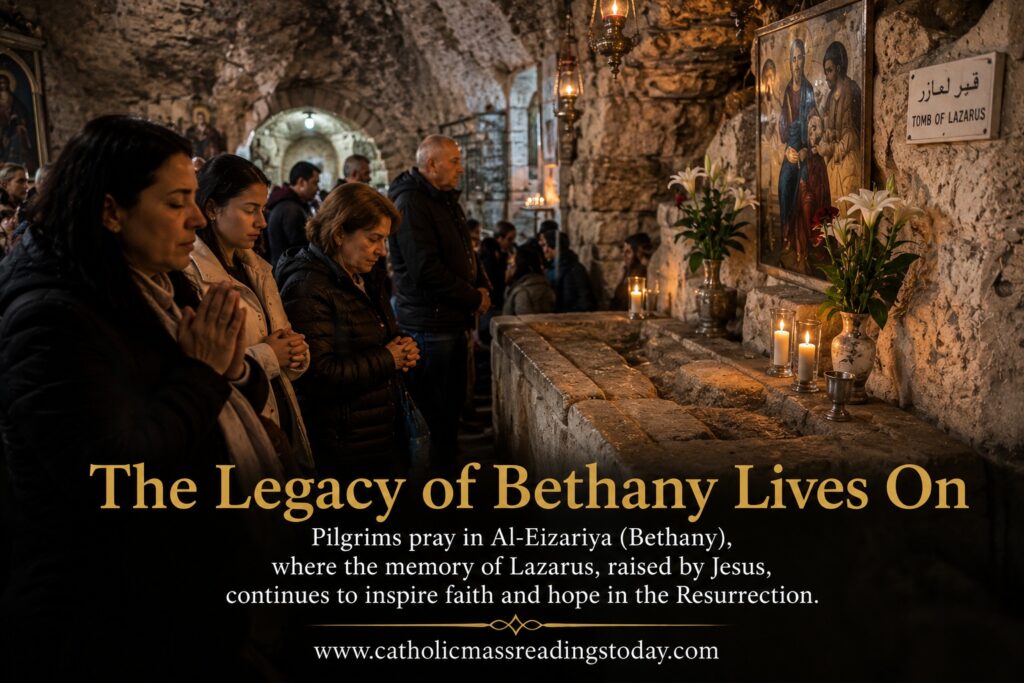
Today, pilgrims still walk the narrow streets of modern Bethany, now known as Al-Eizariya, a name that itself preserves the memory of Lazarus.
Visitors descend into the ancient tomb traditionally associated with his burial.
They pray where Jesus once stood, they remember the tears of Martha, the devotion of Mary and the miracle of Lazarus.
But perhaps the greatest memorial to this family is not found in stone churches or ancient tombs. It is found wherever Christians welcome Christ into their homes.
- Whenever a family gathers for prayer around the dinner table…
- Whenever someone quietly serves without seeking recognition…
- Whenever a believer chooses time with God over endless distractions…
- Whenever hope triumphs over grief because of faith in the Resurrection…
The spirit of Bethany lives on.
A Prayer for the Memorial of Saints Martha, Mary & Lazarus
Heavenly Father,
We thank You for the beautiful witness of Saints Martha, Mary, and Lazarus, whose home became a place of welcome for Your Son.
Through Martha, teach us to serve generously without losing sight of Your presence.
Through Mary, teach us to sit at the feet of Jesus, listening attentively to His Word and allowing it to shape our lives.
Through Lazarus, strengthen our hope in the promise of the Resurrection and remind us that Christ is Lord even over death itself.
May our homes become places of faith, hospitality, prayer, and love.
May we always open our hearts to Jesus as they did in Bethany.
And when our earthly journey is complete, may we rejoice with all the saints in the eternal home You have prepared for those who love You.
Through Christ our Lord.
Amen.