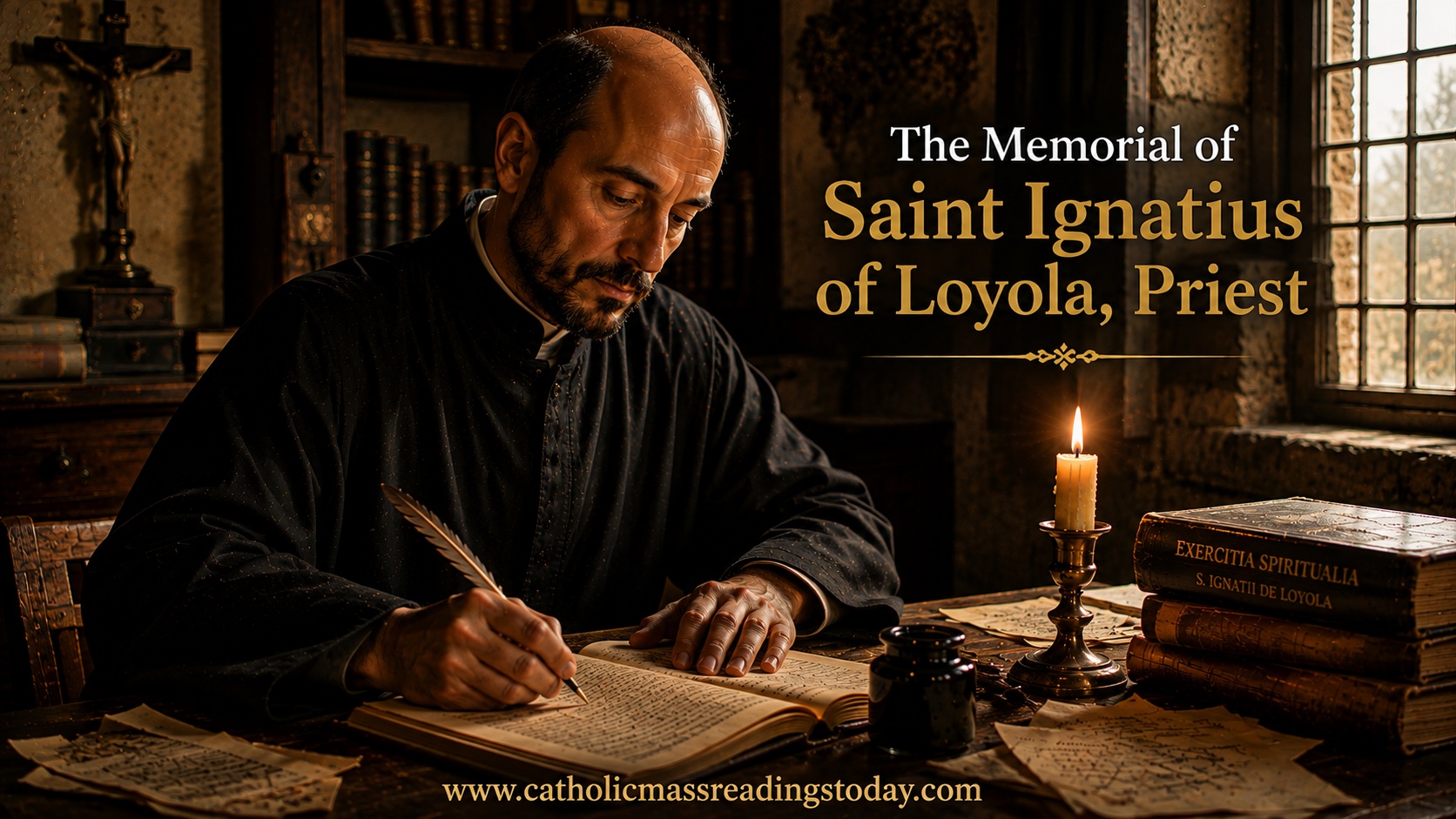
Feast Day: July 31
Saint Ignatius of Loyola is remembered as one of the greatest spiritual leaders in the history of the Catholic Church. His remarkable journey from an ambitious soldier seeking earthly glory to a humble servant devoted entirely to Christ continues to inspire millions of Christians around the world. Through his unwavering faith, profound spiritual wisdom, and the founding of the Society of Jesus (Jesuits), Saint Ignatius transformed not only his own life but also the course of the Church during one of its most challenging periods.
His story reminds us that God often uses our deepest wounds as the beginning of our greatest mission.
A Noble Birth in the Kingdom of Spain
Ignatius was born in 1491 at the family castle of Loyola, in the Basque region of northern Spain. He was baptized Íñigo López de Oñaz y Loyola, the youngest of thirteen children born into a noble family with strong ties to the Spanish royal court.
Growing up in an aristocratic household, Ignatius was educated in the customs of knighthood. From an early age he admired brave soldiers, military heroes and noble gentlemen. Like many young noblemen of his generation, he dreamed of honour, prestige and recognition.
After the death of his mother while he was still young, Ignatius spent much of his youth in the household of Juan Velázquez de Cuéllar, a high ranking official serving King Ferdinand of Spain. There he learned courtly manners, diplomacy, swordsmanship and military strategy.
Although intelligent and charismatic, the young Ignatius was far from the saint the world would later know. He loved elegant clothing, social gatherings, gambling, romance and the excitement of military life. His ambitions were centred more on personal glory than on God.
The Battle That Changed Everything
The defining moment of Ignatius’ life came in 1521 during the Battle of Pamplona.
French forces attacked the Spanish fortress where Ignatius was stationed. Despite being greatly outnumbered, Ignatius urged the defenders to continue fighting.
During the fierce battle, a cannonball shattered one of his legs and badly injured the other. The fortress quickly surrendered, but the French soldiers, impressed by his courage, treated him with honour and arranged for him to be transported back to his family home at Loyola.
The physical injuries were devastating.
His leg had been badly broken, and after the initial surgery, one bone healed improperly. Concerned about his appearance more than the pain, Ignatius insisted that doctors break the bone again so it would heal correctly.
The procedures were agonizing, performed without modern anaesthesia.
Months of recovery followed.
It was during this long confinement that God quietly began transforming his heart.
Discovering Christ Through Books
Unable to ride horses or engage in military activities, Ignatius searched for books to pass the time.
He requested popular stories of knights and heroic adventures.
None were available.
Instead, he was given two books:
- The Life of Christ by Ludolph of Saxony.
- A collection of stories about the saints known as The Golden Legend.
At first he read them simply because there was nothing else to do.
Gradually something remarkable happened.
He noticed that when he imagined returning to military glory, the excitement quickly faded.
But when he imagined following Christ with the courage of the saints, the joy remained long after his thoughts ended.
This observation became one of the foundations of what Ignatius would later call the discernment of spirits, learning to distinguish the movements that draw us closer to God from those that leave the soul empty.
His conversion had begun.
Leaving Everything Behind
Once he had recovered enough to walk, Ignatius made a decision that astonished everyone who knew him.
He would become a soldier but now in the service of Christ.
Before beginning his new life, he travelled to the Benedictine shrine of Our Lady of Montserrat.
There he spent an entire night in prayer before the Blessed Sacrament.
He confessed his sins, laid down his sword and dagger before the altar of the Blessed Virgin Mary, and exchanged his noble garments for the simple clothing of a poor pilgrim.
This symbolic act marked the beginning of a completely new life.
The Cave at Manresa
Ignatius then settled near the town of Manresa, where he spent nearly a year in prayer, fasting and penance.
Much of this time was spent in a small cave overlooking the Cardoner River.
There he experienced intense spiritual struggles, periods of discouragement and moments of extraordinary mystical insight.
These experiences eventually became the foundation of one of Christianity’s greatest spiritual masterpieces:
The Spiritual Exercises
Rather than being merely a book to read, the Spiritual Exercises became a practical guide helping believers deepen their relationship with God through prayer, Scripture meditation, examination of conscience and discernment.
For more than five centuries these exercises have transformed countless priests, religious and lay faithful across the world.
Even today they remain among the Church’s most influential spiritual resources.
A Pilgrim to the Holy Land
Ignatius longed to preach the Gospel where Jesus Himself had walked.
In 1523, he travelled to the Holy Land. He hoped to remain permanently. However, the Franciscan custodians responsible for Christian pilgrims believed the political situation was too dangerous.
Though disappointed, Ignatius accepted their decision with humility and returned to Europe.
This willingness to surrender even holy desires when guided by legitimate Church authority became a defining characteristic of his spirituality.
Returning to School
Ignatius soon realised that if he wished to serve Christ effectively, he needed a proper education. Already in his thirties, he humbly returned to study alongside much younger students.
He attended schools in Barcelona before studying at Alcalá and Salamanca. Eventually he entered the University of Paris, then one of Europe’s leading centres of learning.
His classmates initially found him unusual. He was older than most students, deeply devoted to prayer and constantly encouraging others to seek God. Yet his sincerity gradually attracted companions.
Gathering Companions for Christ
Among those deeply influenced by Ignatius was a brilliant young student named Francis Xavier.
At first Xavier sought academic success and worldly achievement.
Ignatius patiently challenged him with Christ’s words:
“What profit is there for one to gain the whole world and forfeit his soul?”
These words slowly transformed Xavier’s heart. Soon others joined them and together they made vows of poverty, chastity and missionary service. The small group dreamed of serving Christ wherever the Church needed them most.
The Birth of the Society of Jesus
In 1540, Pope Paul III officially approved the new religious order. It became known as the Society of Jesus, or simply the Jesuits. Ignatius reluctantly accepted election as the first Superior General.
From their headquarters in Rome, the Jesuits quickly expanded across Europe, Asia, Africa and the Americas.
Their mission focused on:
- Preaching the Gospel.
- Defending the Catholic faith.
- Educating young people.
- Caring for the poor.
- Serving wherever the Church had the greatest need.
- Undertaking missionary work throughout the world.
Within only a few decades, Jesuit missionaries reached India, Japan, China, Brazil, Ethiopia and many other regions previously untouched by Christianity.
A Lasting Influence on the Church
Saint Ignatius lived during the turbulent years of the Protestant Reformation. The Catholic Church faced enormous internal and external challenges.
His response was not anger or division. Instead, he sought renewal through holiness, education and complete fidelity to Christ.
Jesuits became leading theologians, educators, missionaries and confessors. They founded schools, colleges and universities that continue educating millions today.
Ignatius also insisted that every Jesuit cultivate a profound interior life rooted in prayer, discernment and obedience to God’s will.
His famous prayer remains one of the Church’s most beloved:
Take, Lord, and receive all my liberty, my memory, my understanding and my entire will. All I have and possess You have given me. To You, O Lord, I return it. Everything is Yours; do with it what You will. Give me only Your love and Your grace; that is enough for me.
His Final Years
Although responsible for a rapidly growing worldwide order, Ignatius remained remarkably humble.
He spent countless hours writing letters, directing souls, guiding missionaries and strengthening Jesuit communities.
It is estimated that he wrote more than 6,000 letters, many of which continue to provide wisdom for Christian leadership and spiritual growth.
Despite declining health, he continued serving until the very end.
His Death
Saint Ignatius died peacefully in Rome on July 31, 1556, at the age of approximately 65.
His death came quietly after years of tireless service to the Church.
He was buried in Rome, where his remains now rest beneath the magnificent Church of the Gesù, the mother church of the Society of Jesus. His influence, however, had only begun.
Canonisation
Pope Paul V beatified Ignatius in 1609.
Just thirteen years later, on March 12, 1622, Pope Gregory XV canonised him alongside several other great saints, including:
- Saint Francis Xavier
- Saint Teresa of Ávila
- Saint Philip Neri
- Saint Isidore the Farmer
The Church recognised not only his personal holiness but also the immense spiritual fruits flowing from his life and mission.
Why Saint Ignatius Matters Today
The life of Saint Ignatius speaks powerfully to Christians in every generation.
In a world filled with distractions, ambitions and constant noise, he teaches us the importance of listening for God’s voice.
His spirituality reminds us that every decision, whether large or small can become an opportunity to seek God’s greater glory.
His famous motto,
Ad Majorem Dei Gloriam
“For the Greater Glory of God,”
continues to inspire Catholics around the world to offer every aspect of their lives in loving service to Christ.
His witness assures us that no past is too broken for God’s mercy, no dream is too worldly to be transformed by grace, and no heart is beyond the reach of the Holy Spirit.
The ambitious young soldier became one of the Church’s greatest saints because he allowed God to reshape his life completely. That same invitation remains open to each one of us today.
Prayer of Saint Ignatius of Loyola
Heavenly Father,
You called Saint Ignatius of Loyola from the pursuit of earthly honour to the service of Your Son and the building of Your Church.
Through his prayers and example, grant us hearts that seek Your will above all else. Teach us to discern Your voice amid the distractions of the world, to trust Your providence in every circumstance, and to live each day for Your greater glory.
May we never grow weary in following Christ, but remain faithful in prayer, generous in service, and steadfast in hope.
Through the intercession of Saint Ignatius of Loyola, strengthen us to become joyful witnesses of the Gospel wherever You send us.
We ask this through Christ our Lord.
Amen.
“Ad Majorem Dei Gloriam” — “For the Greater Glory of God.”