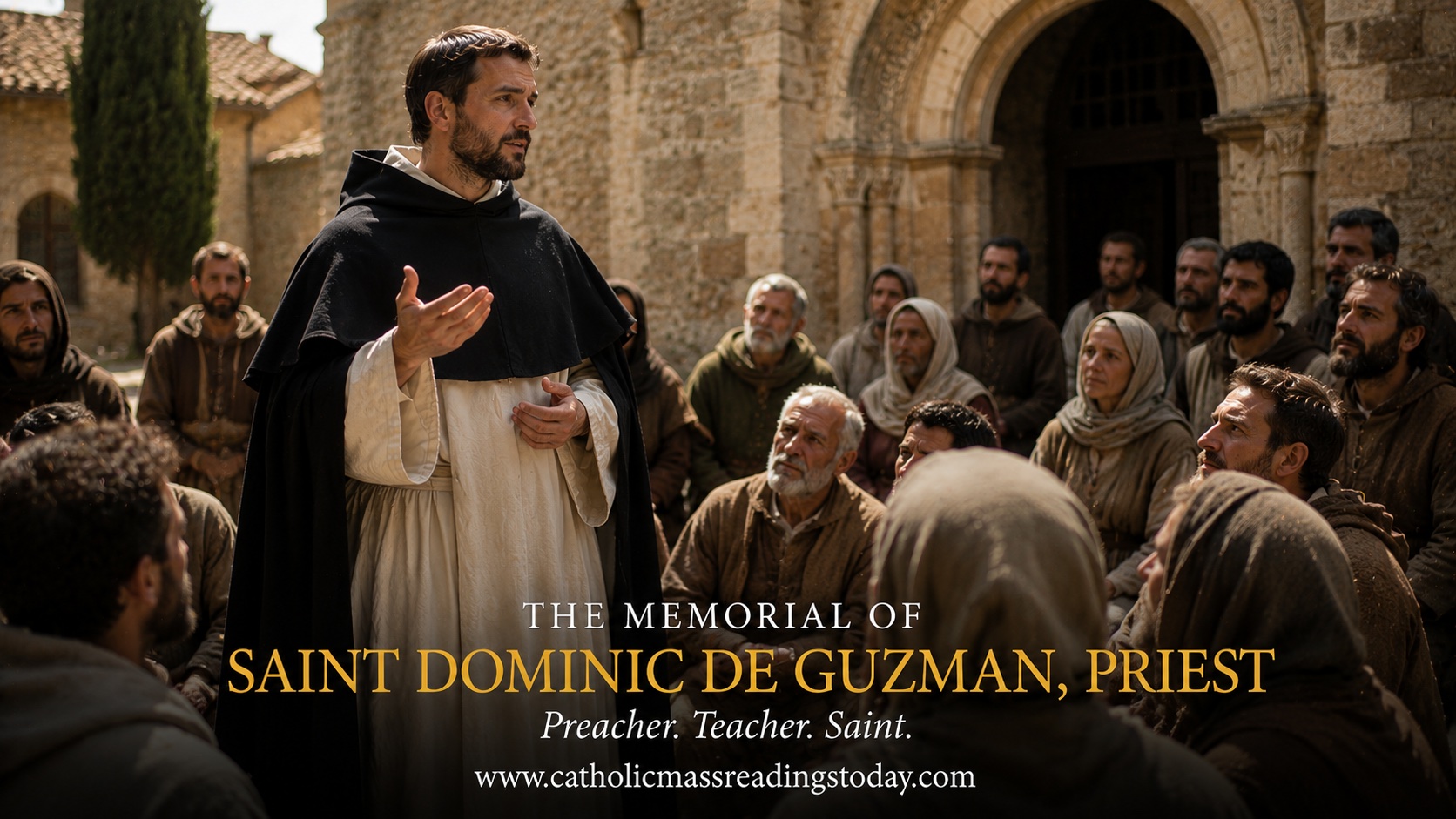
Every year on 8 August, the Catholic Church celebrates The Memorial of Saint Dominic de Guzmán, Priest, a man whose life transformed the Church through his unwavering love for truth, his deep devotion to prayer, and his tireless preaching of the Gospel. More than eight centuries after his death, the influence of Saint Dominic continues to be felt wherever the Word of God is proclaimed with clarity, charity, and fidelity.
Saint Dominic lived during a time when many Christians had become confused by false teachings and religious division. Rather than responding with anger or force, he chose a different path. He believed that the most convincing answer to error was a life of holiness, sound teaching, and genuine compassion. His example reminds us that the Gospel is spread most effectively not through argument alone, but through lives that reflect the love of Christ.
Today, his spiritual sons and daughters of the Dominican Order continue his mission across the world in schools, universities, parishes, missions, and places of study, carrying forward the work that began with one humble priest who trusted completely in God.
A Child Born Into Faith
Saint Dominic was born around 1170 in the village of Caleruega, in the Kingdom of Castile, in what is now Spain. His parents, Felix de Guzmán and Blessed Joan of Aza, were respected Christians who raised their children in an atmosphere of prayer, generosity, and love for God.
From an early age, Dominic displayed a remarkable seriousness about his faith. While other children were occupied with ordinary pursuits, he developed a love for Scripture and spent long hours reflecting on the mysteries of God. Those who knew him recognized not only his intelligence but also his humility and kindness.
Tradition preserves a number of stories surrounding his birth and childhood that reflected the belief that God had prepared him for a special mission. Whether understood symbolically or historically, these accounts reveal how deeply people came to associate Dominic with the light of Christ shining into the world.
Education and a Compassionate Heart
As a young man, Dominic was sent to study at the University of Palencia, one of Spain’s foremost centres of learning. There he devoted himself to theology, Sacred Scripture, and the liberal arts.
Yet Dominic never allowed learning to become an end in itself. During a devastating famine, he witnessed families suffering from hunger while students continued their studies in relative comfort. Deeply moved by their suffering, he made an extraordinary decision.
He sold his treasured books, handwritten manuscripts that were enormously valuable in the twelfth century, and gave the proceeds to feed the poor.
When questioned about why he had sacrificed such precious possessions, Dominic is remembered as saying that he could not study from “dead skins” while people were dying of hunger.
This simple act revealed something that would define his entire life: knowledge must always lead to charity.
Becoming a Priest
After completing his studies, Dominic became a canon regular at the Cathedral of Osma. There he embraced a disciplined life centred on prayer, community, study, and pastoral service.
His reputation for wisdom, humility, and holiness quickly spread.
Around 1203, Dominic accompanied Bishop Diego of Osma on a diplomatic journey through southern France. During these travels, he encountered the Albigensian (Cathar) heresy, a movement that rejected many essential Christian beliefs, including the goodness of creation and the reality of Christ’s Incarnation.
Dominic soon realized that many ordinary people had embraced these errors because they had rarely encountered priests who combined faithful teaching with genuine simplicity of life.
Winning Hearts Through Truth and Charity
Rather than condemning people from a distance, Dominic chose to meet them where they were.
He travelled on foot.
He lived simply.
He accepted poverty.
He entered into respectful conversations with those who disagreed with him.
He spent countless hours explaining the faith patiently through Scripture and reason.
His method was revolutionary for its time. Dominic believed that truth should never be separated from charity. Even when confronting serious error, he treated every person with dignity and compassion.
His nights were often spent in prayer.
His days were devoted to preaching.
Many witnesses later recalled hearing him pray through the night with tears for those who had lost their faith.
The Birth of the Order of Preachers
Dominic gradually recognised that the Church needed more than one dedicated preacher. It needed an entire community devoted to proclaiming the Gospel.
In 1216, Pope Honorius III officially approved the Order of Preachers, today known simply as the Dominican Order.
Unlike many existing religious communities, Dominic’s order combined several essential elements:
- profound study of Sacred Scripture and theology,
- common life in community,
- disciplined prayer,
- evangelical poverty,
- and active preaching wherever the Church needed them.
Dominic wanted his friars to become both scholars and missionaries.
He insisted that careful study strengthened effective preaching because people deserved to hear the truth explained clearly and faithfully.
This emphasis on learning would later shape Catholic education for centuries.
A Friend of the Blessed Virgin Mary
Saint Dominic’s name has long been associated with devotion to the Holy Rosary.
According to longstanding Dominican tradition, the Blessed Virgin Mary encouraged Dominic to promote this form of prayer during his preaching against heresy. While historians distinguish between documented history and later devotional tradition, there is no doubt that the Dominican Order became the principal promoter of the Rosary throughout the world.
For generations, Dominicans taught Christians to meditate on the mysteries of Christ’s life through Mary’s eyes.
Today, millions of Catholics continue this spiritual practice, making the Rosary one of the Church’s most beloved devotions.
A Life Marked by Humility
Despite becoming founder of a rapidly growing religious order, Dominic never sought prestige.
He preferred walking rather than riding whenever possible.
He owned very little.
He dressed simply.
He spent long hours in prayer before the Blessed Sacrament.
He often wept while praying for sinners and for the needs of the Church.
Those who lived with him consistently described him as joyful, approachable, and deeply compassionate.
He loved conversation, welcomed questions, and believed that every encounter was an opportunity to bring someone closer to Christ.
His Final Journey
By 1221, years of constant travel, preaching, fasting, and sacrifice had weakened Dominic’s health.
While travelling in northern Italy, he became seriously ill.
He was taken to the Dominican convent at Bologna, where his brothers cared for him during his final days.
Even as death approached, Dominic remained peaceful.
He encouraged his fellow friars to remain faithful to their vocation.
He urged them to preserve humility, charity, and obedience.
Above all, he reminded them never to abandon the mission of preaching the Gospel.
Saint Dominic died on 6 August 1221, surrounded by his brothers in prayer.
He was about fifty-one years old.
His death was not the result of martyrdom or violence, but of a life completely spent in the service of Christ and His Church. Years of tireless preaching, continual travel, rigorous fasting, and generous self-sacrifice had gradually worn out his body, but his spirit remained steadfast until the end.
Canonisation and Lasting Legacy
Only thirteen years after his death, Pope Gregory IX, who had known Dominic personally, canonised him in 1234.
His influence on the Church has only grown stronger with time.
The Dominican Order produced some of Catholicism’s greatest theologians, including Saint Thomas Aquinas, whose writings continue to shape Catholic doctrine. It also gave the Church countless missionaries, bishops, educators, scientists, scholars, and saints who carried Dominic’s vision across every continent.
Dominican preaching helped renew the spiritual life of medieval Europe, established centres of learning that became renowned universities, and strengthened the Church’s commitment to faithful teaching rooted in Sacred Scripture and Sacred Tradition.
Why Saint Dominic Still Matters Today
Saint Dominic’s witness is perhaps even more relevant today than it was eight hundred years ago.
We live in an age filled with competing voices, confusion, and endless information. Dominic reminds us that truth is not discovered through noise or argument alone but through humble study, sincere prayer, and lives transformed by Christ.
He teaches us that authentic evangelisation begins with personal holiness. Before we can speak convincingly about God, we must first know Him through prayer. Before correcting others, we must allow the Gospel to transform our own hearts.
His life also challenges Catholics to love both faith and reason. Dominic never separated intellectual pursuit from spiritual growth. He believed that every believer should continue learning about the faith so that they could explain it with confidence and charity.
Celebrating the Memorial of Saint Dominic
The Memorial of Saint Dominic is an invitation to renew our commitment to prayer, study, and evangelisation. It is a day to thank God for those who faithfully preach His Word and to pray for priests, religious, catechists, teachers, missionaries, and all who dedicate their lives to sharing the Gospel.
Many Catholics honour Saint Dominic by attending Holy Mass, praying the Rosary, reading Sacred Scripture, studying the Catechism, or performing works of charity. Others take time to learn more about the Dominican saints whose lives continue to enrich the Church.
Above all, this memorial reminds us that every Christian is called to become a witness to the truth—not through harsh words or pride, but through humility, integrity, compassion, and an unwavering love for Jesus Christ.
More than eight centuries after his earthly pilgrimage ended, Saint Dominic still points the Church toward the same mission that shaped his entire life: to know Christ deeply, to proclaim Him faithfully, and to lead others into the joy of His Gospel.
Let us Pray
Heavenly Father,
You raised up Saint Dominic to proclaim the truth of the Gospel with wisdom, humility, and unwavering faith. Through his example, teach us to seek You with sincere hearts, to love Your Word more deeply each day, and to bear witness to Christ with both courage and charity.
Grant us the grace to grow in prayer, to remain faithful to the teachings of Your Church, and to share the hope of the Gospel with gentleness and compassion. May we never grow weary in pursuing truth or serving those in need, but always strive to reflect the love of Your Son in our words and our actions.
Through the intercession of Saint Dominic, strengthen all priests, religious, catechists, missionaries, and those who dedicate their lives to proclaiming Your Word. Bless them with wisdom, perseverance, and joy in their vocation, so that many hearts may be led to know and love Jesus Christ.
May the Blessed Virgin Mary, whom Saint Dominic loved so dearly, keep us close to her Son and help us to remain faithful until the day we are welcomed into Your eternal Kingdom.
We ask this through Christ our Lord.
Amen.