“You are sons of those who murdered the prophets.”
There are words of Jesus that comfort us immediately, and there are words that first wound the conscience before they heal it. Christ speaks with extraordinary severity to the scribes and Pharisees:
“You are like whitewashed tombs, which outwardly appear beautiful, but within they are full of dead men’s bones and all uncleanness.”
These are difficult words. Yet they come from the same Jesus who welcomed sinners, touched lepers, forgave the woman caught in adultery and wept at the tomb of Lazarus. His severity, therefore, cannot be separated from His love.
Christ speaks strongly because the human soul matters to Him. He is not interested merely in how holy we appear. He desires that we actually become holy. This distinction lies at the heart of today’s Gospel.
The Danger of a Beautiful Exterior
In the time of Jesus, tombs could be whitewashed so that they appeared clean and could easily be identified. Christ takes this familiar image and turns it into a powerful examination of conscience. Something can appear beautiful while concealing corruption within.
The Lord applies this image to religious hypocrisy. The scribes and Pharisees whom He rebukes had cultivated an outward appearance of righteousness, but Christ could see what human eyes could not. He could see the heart.
This Gospel should make every Christian uncomfortable in a healthy way because the temptation Christ identifies did not disappear with the Pharisees. It remains with us.
We may attend Mass and still carry bitterness against another person, we may wear a crucifix while treating an employee, colleague or family member without dignity.
We may know Catholic teaching well enough to correct everybody else while refusing to confront our own sins. We may speak beautifully about mercy and yet refuse forgiveness.
We may appear generous because others can see our generosity while remaining indifferent to suffering that brings us no recognition, we may even defend the truth loudly while forgetting that truth must always be lived in charity.
There is nothing wrong with outward expressions of faith. Catholics should never be ashamed of them. The crucifix, the Rosary, sacred images, genuflection, fasting, processions and other devotional practices can be beautiful expressions of genuine faith.
The problem begins when the outward sign no longer corresponds to the inward life. Jesus wants both. He wants the lips that profess faith and the heart that belongs to Him.
God Sees What Others Cannot See
Much of our modern life is concerned with appearance. We carefully choose what other people see. Social media has intensified this behaviour. A person can present happiness while suffering deeply, display generosity while seeking admiration, or project moral certainty while living an entirely different private life.
But no image we construct can deceive God. This should not primarily frighten us. For the sincere Christian, it should also be a source of tremendous consolation. God sees the good that nobody applauds.
- He sees the mother quietly sacrificing for her children.
- He sees the father working long hours to provide honestly for his family.
- He sees the young person resisting temptation when nobody would have discovered the sin.
- He sees the person who forgives silently.
- He sees the hidden act of charity.
- He sees the tears shed in prayer when everyone else thinks everything is fine.
And God also sees those places within us that still require conversion. We cannot hide them from Him. Nor do we need to. Christ does not ask us to approach Him pretending that we are already saints. He asks us to approach Him truthfully so that His grace can make us saints. That is a huge difference.
Honouring the Prophets While Rejecting Their Message
The second part of Christ’s rebuke goes even deeper. The scribes and Pharisees built monuments to the prophets and claimed that, had they lived in earlier generations, they would never have participated in killing them. Yet when the One toward whom the prophets pointed stood before them, many refused to listen.
There is a warning here for us. It is much easier to honour a prophet after he is dead than to obey the truth while it is confronting us. The prophets of Israel were rarely comfortable men. They called people away from idolatry, injustice, exploitation and false worship. They disturbed complacency because they reminded Israel that belonging to God required conversion.
The same danger exists today.
- We can admire the saints while ignoring what made them saints.
- We can admire Saint Francis of Assisi while remaining attached to possessions.
- We can praise Saint Teresa of Calcutta while ignoring the suffering person near us.
- We can honour Saint John Paul II while being afraid to defend the dignity of human life.
- We can admire Saint Thérèse of Lisieux while refusing the small daily sacrifices through which love becomes holy.
- We can honour martyrs while remaining silent whenever faith becomes inconvenient.
It is possible to love the memory of holiness without accepting the demands of holiness. Christ calls us beyond admiration. He calls us to imitation.
The Gospel Must First Judge Me
There is another danger hidden within today’s reading. When we hear Jesus condemning hypocrisy, our minds may immediately identify someone else. We think of a politician, a religious leader, a neighbour, a relative, perhaps another Christian whom we consider hypocritical and suddenly we have escaped the Gospel.
The Word of God was proclaimed to convert my heart first. Before asking who else resembles the whitewashed tomb, I must ask whether there is something in me that Christ desires to cleanse.
- Do I behave differently when nobody is watching?
- Is there resentment beneath my kindness?
- Do I secretly enjoy the failures of people I dislike?
- Do I demand mercy for myself but justice without mercy for others?
- Do I practise my faith because I love God, or partly because I want others to think well of me?
- Have I become skilled at recognizing the sins of the world while becoming blind to my own?
These questions are not intended to lead us into despair. They are invitations to freedom.
The person who continually hides from the truth becomes imprisoned by appearances. The person who allows Christ to reveal the truth can begin to change. This is why examination of conscience is so important in Catholic spiritual life, and it is why the Sacrament of Reconciliation is such an extraordinary gift.
Christ Does Not Merely Expose the Tomb, He Opens It
Christianity does not end with discovering what is wrong with us.vIf it did, the Gospel would be unbearable. Jesus reveals sin because He has come to conquer it.
The same Lord who says, “Woe to you,” will soon stretch out His arms upon the Cross. He does not expose humanity’s sin from a safe distance. He enters into the consequences of that sin and offers His life for our redemption.
At Calvary, the hypocrisy, violence, pride and rebellion of humanity meet the mercy of God, and mercy triumphs. This is why no sincere examination of conscience should ever end merely with, “Look how terrible I am.”
It should end with:
“Jesus, have mercy on me and change me.”
The Church gives us Confession precisely for this reason. We enter carrying what we would rather hide and speak the truth before God. Through the ministry entrusted by Christ to His Church, we hear the words of absolution.
The hidden wound is brought into the light and grace begins its healing work. There is something profoundly beautiful about this. The world often tells us to conceal our weakness. Christ tells us to bring it to Him.
Christianity Without Conversion Becomes Appearance
One of the great dangers for any practising Christian is becoming accustomed to holy things.
- We can hear Scripture so often that it stops disturbing us.
- We can receive the Eucharist regularly while forgetting the astonishing mystery before us.
- We can recite familiar prayers while the heart remains somewhere else.
- We can become knowledgeable about Catholicism without becoming more like Christ.
Religious familiarity is not the same thing as holiness. Holiness requires conversion and conversion is not something that happened once when we first believed. It is the work of an entire lifetime.
- Every morning presents another opportunity to say yes to God.
- Every relationship becomes a place where charity can grow.
- Every temptation becomes an opportunity to choose Christ.
- Every wound becomes an invitation to forgiveness.
- Every success becomes an opportunity for gratitude rather than pride.
- Every failure can teach humility.
- Every ordinary day can become holy when it is offered to God.
Let the Inside Become Beautiful
Christ’s image of the whitewashed tomb ultimately raises a simple question:
What would our lives look like if the inside became as beautiful as the outside?
- What if our private thoughts reflected the faith we profess publicly?
- What if the patience we show strangers were also given to our families?
- What if our prayers changed the way we conducted our businesses?
- What if receiving the Body of Christ made us more attentive to the suffering members of His Body?
- What if our devotion to Mary taught us her humility and obedience?
- What if every Rosary slowly made our hearts more like the Heart of her Son?
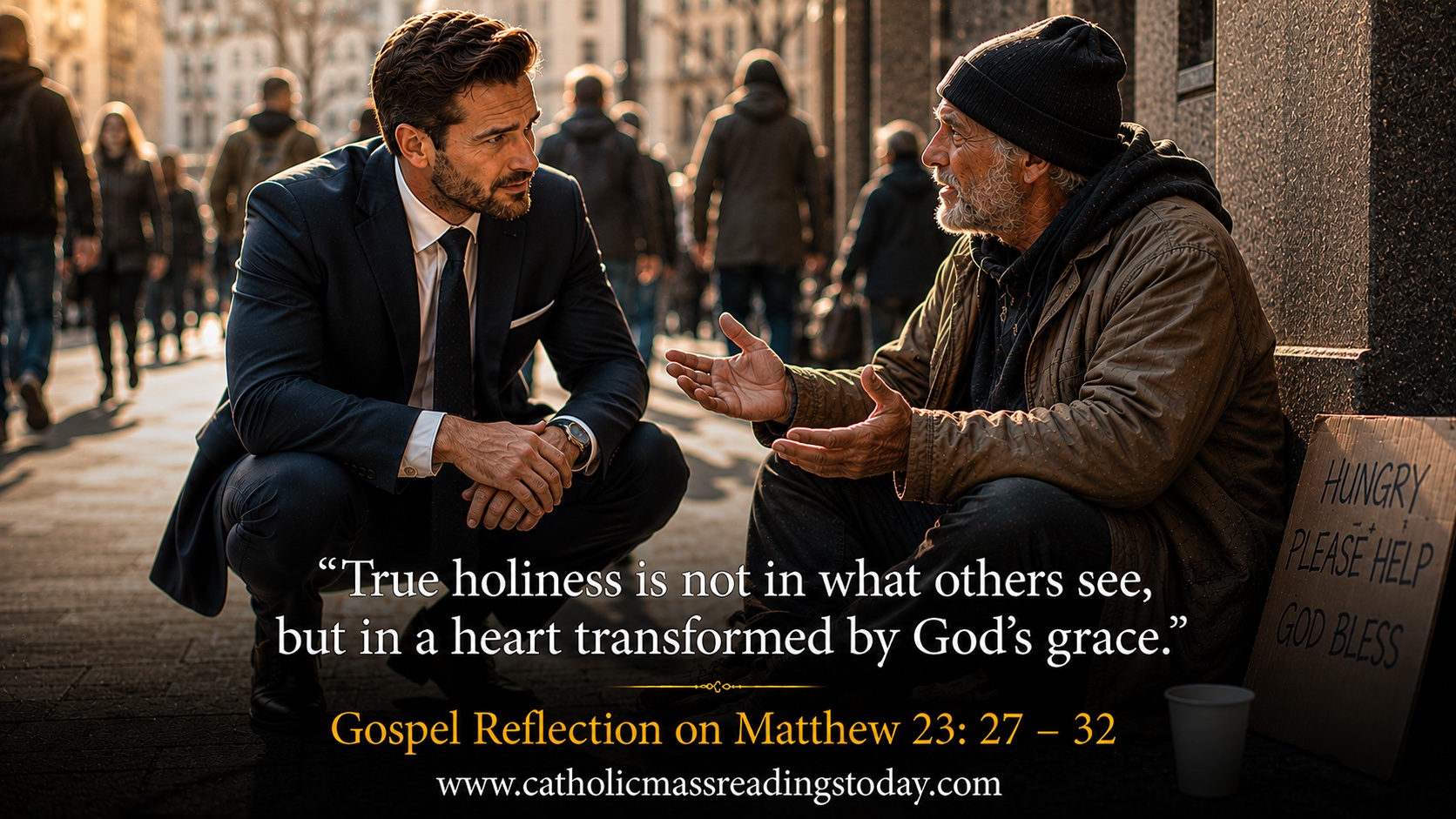
This is the Christianity Christ desires. Not performance, not appearances, not holiness for an audience but a heart transformed by grace. The world has enough appearances. What it desperately needs are witnesses both men and women whose lives quietly demonstrate that Jesus Christ is truly Lord.
Today’s Gospel therefore ends not simply as a condemnation of hypocrisy but as a call to integrity. Let us ask Christ for the courage to allow Him beneath the surface, let Him enter the places we carefully hide from others, let Him cleanse resentment, pride, envy, dishonesty, selfishness and whatever else has found a home there.
We should not fear opening those doors to Christ. The One standing outside them is not an enemy coming to destroy us. He is the Saviour who gave His life to make us new and when Christ is permitted to transform what lies within, something remarkable happens: gradually, the outer life no longer needs to pretend.
The goodness others see begins to flow from the goodness God is creating within. That is Christian integrity. That is conversion and that is the holiness to which every one of us is called.
Let us Pray
Lord Jesus Christ,
You search the heart and know us completely.
Nothing is hidden from Your loving gaze.
Deliver us from hypocrisy
and from the desire merely to appear righteous before others.
Purify our thoughts, our intentions and our desires.
Where there is pride, give us humility.
Where there is resentment, give us forgiveness.
Where there is selfishness, teach us generosity.
Where there is falsehood, establish us firmly in Your truth.
Give us the courage to examine our lives sincerely
and the humility to seek Your mercy
in the Sacrament of Reconciliation.
May the faith we profess with our lips
become visible in our choices,
our relationships, our work
and our treatment of every person we meet.
Make our hearts worthy dwelling places for Your presence,
so that we may not merely appear to belong to You,
but may truly be Yours.
You live and reign with God the Father
in the unity of the Holy Spirit,
God, for ever and ever.
Amen.