The Mother Whose Tears, Prayer and Perseverance Helped Lead Saint Augustine Home
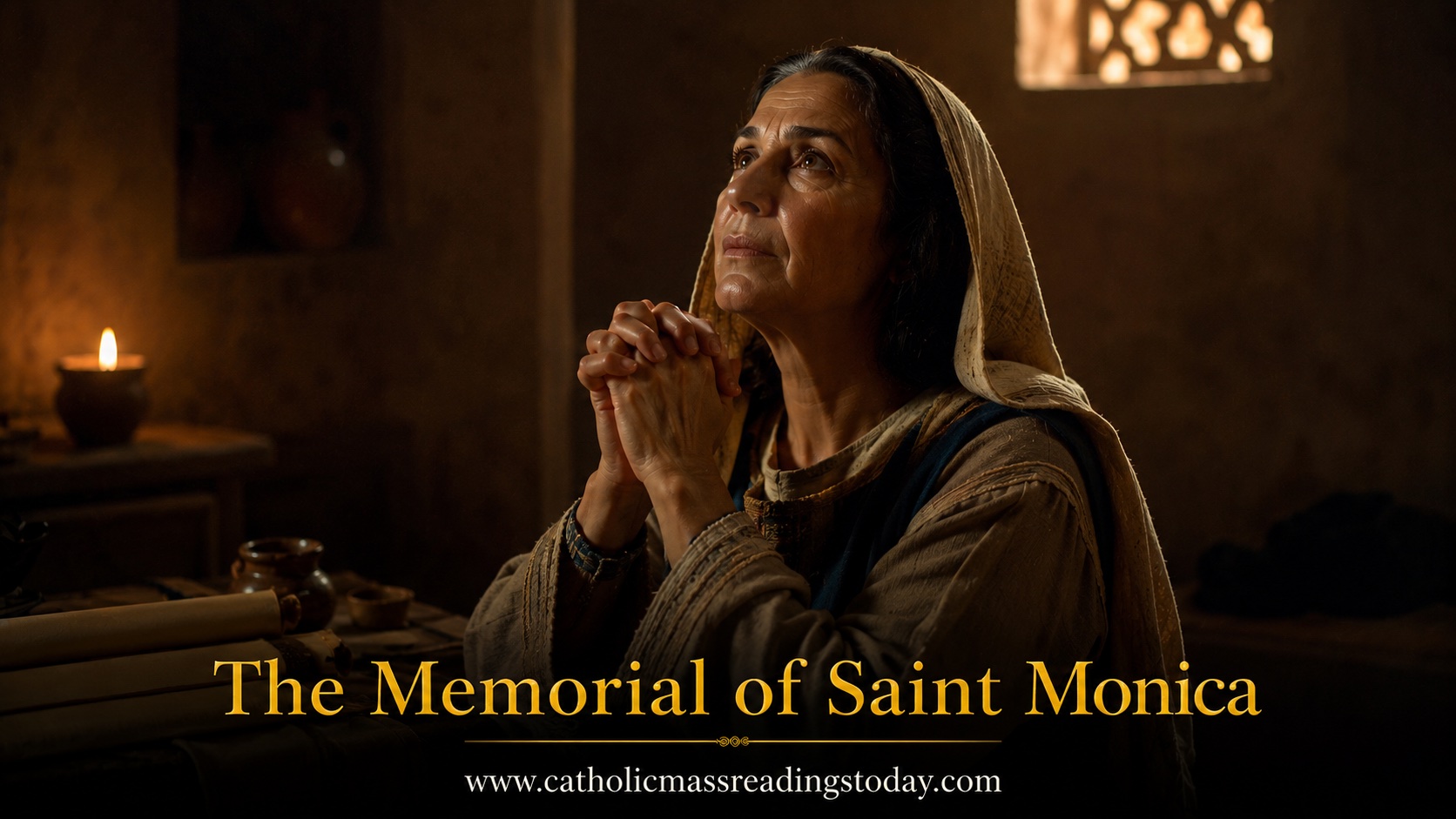
Every year on August 27, the Catholic Church celebrates the Memorial of Saint Monica, one of Christianity’s most beloved mothers and one of its most enduring witnesses to persevering prayer. Her feast fittingly falls immediately before the August 28 memorial of her son, Saint Augustine of Hippo, the great bishop and Doctor of the Church.
Saint Monica never founded a religious order. She never governed a diocese, wrote a theological masterpiece or preached before great crowds. Much of her holiness unfolded in places that rarely attract the attention of history: within a difficult marriage, around the family home, in churches where she prayed, along roads she travelled while pursuing a wandering son, and through years in which seemingly unanswered prayers tested her hope.
Yet her life helped shape one of the greatest Christian thinkers the Church has ever known.
Behind Augustine’s extraordinary conversion stands the figure of a mother who refused to stop praying for him.
That is why the Memorial of Saint Monica speaks so powerfully to parents today, especially those carrying the quiet sorrow of watching a child abandon the faith, make destructive choices or become indifferent to God. Monica’s story does not offer an easy formula promising immediate results. It offers something deeper: a witness to the extraordinary things God can accomplish through faith that refuses to surrender hope.
Saint Monica’s Birth and Christian Childhood in North Africa
Monica was born around A.D. 331 in Thagaste, an ancient North African town in what is now Algeria. Some older sources give approximately 333, but Vatican sources place her birth in 331. She was of Berber background and grew up in a prosperous Christian family at a time when North Africa was one of the great centres of Christianity in the Roman world.
This was the world in which Monica’s faith first took root.
From childhood she was formed in the Sacred Scriptures and in Christian practice. Prayer, participation in the sacramental life and service within the Christian community gradually shaped the woman she would become.
This early formation would prove invaluable.
Monica’s adult life would not unfold peacefully. She would experience disappointment in marriage, widowhood, anxiety over her children, long periods of uncertainty and the painful spiritual wandering of the son she loved so intensely.
The faith planted in childhood became the foundation upon which she stood when almost everything around her became difficult.
Monica’s Marriage to Patricius
As a young woman, Monica married Patricius, a pagan from Thagaste.
Their marriage was not easy.
Ancient accounts portray Patricius as quick-tempered and difficult, and Catholic tradition remembers Monica’s patience within a household that frequently tested her. Vatican News also describes him as ambitious, irascible and unfaithful.
It is important when telling Monica’s story today not to misunderstand her patience as an endorsement of cruelty, infidelity or mistreatment within marriage. Christian forgiveness never makes another person’s wrongdoing good, nor does Catholic teaching require someone facing serious abuse to remain in danger.
What Monica demonstrates is something different: she refused to allow another person’s failings to determine the condition of her own soul.
She prayed, practised charity, learnt when to speak and when silence would accomplish more and she remained faithful to Christ. Over time, something remarkable happened.
Patricius became a Christian.
Monica had not forced conversion upon him. Her witness, patience and prayer had helped prepare the ground upon which grace could work. Vatican accounts particularly remember her ability to choose the right moment for dialogue and her characteristic combination of waiting, patience and prayer.
But the conversion for which Monica would become known throughout the Christian world was still to come.
Monica Becomes the Mother of Augustine
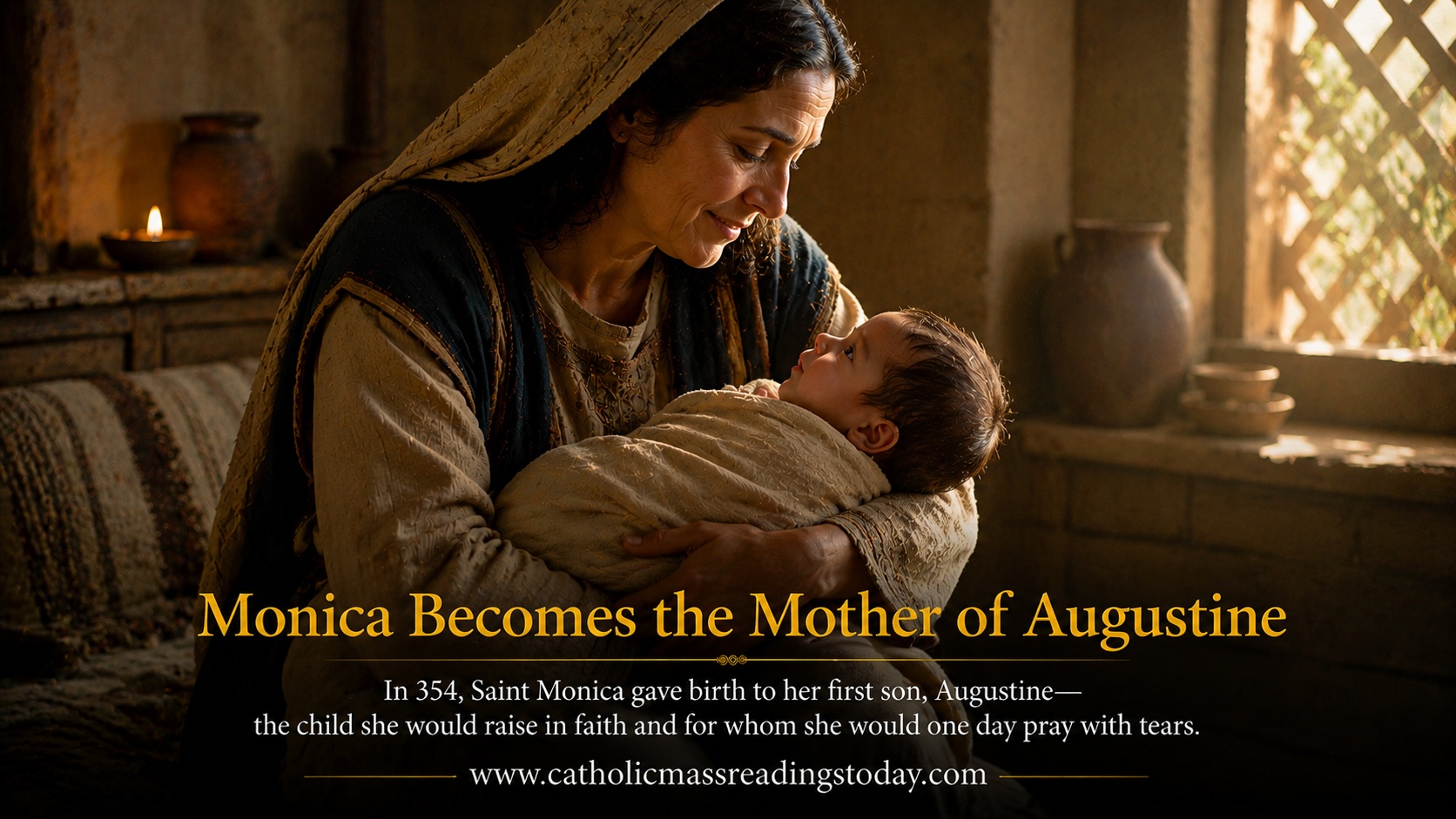
At about the age of twenty-two, Monica gave birth to her first son, Augustine, in 354. She and Patricius would also have another son, Navigius, and a daughter whose name has not been preserved with certainty.
Augustine was extraordinarily gifted.
He possessed a brilliant mind, an exceptional command of language and an intense personality. Those gifts would eventually be placed entirely at the service of Christ.
But first they carried him far from the faith of his mother.
As Augustine grew older, Monica watched the child she had raised within Christianity become increasingly fascinated by ambitions, philosophies and ways of living far removed from the Catholic faith.
He pursued rhetoric and intellectual success. While studying at Carthage, Augustine entered a relationship with a woman with whom he would live for many years and fathered a son, Adeodatus. He also became attracted to Manichaeism, a religious movement whose teachings departed radically from Christianity.
For Monica, this was more than an intellectual disagreement between mother and son.
She believed Augustine had wandered from the truth that could save him.
And so began the long chapter of her life that would make her one of history’s great examples of persistent intercessory prayer.
The Mother of Tears
Monica prayed for Augustine year after year. She prayed when he resisted her, she prayed when his intellectual pride carried him elsewhere, she prayed when there appeared to be little evidence that anything was changing and she even prayed when the answer she desperately wanted seemed indefinitely delayed.
Her tears became so closely associated with Augustine’s conversion that Christian tradition has remembered him as the “son of so many tears.” But Monica did more than weep. Her prayer was active hope.
She sought spiritual guidance. She remained close to the Church. She followed Augustine’s journey with the concern of a mother who could see gifts within her son that he himself had not yet surrendered to God.
This is one reason Saint Monica remains extraordinarily relevant.
Many Catholic parents know this particular sorrow. They baptized their children, bring them to Mass, teach them how to pray, they prepared them for First Holy Communion and Confirmation and then adulthood comes and some walk away.
A son may now say he no longer believes, daughter may have stopped attending Mass. A child may be living in a way that leaves a parent deeply worried.
Monica’s life does not tell such parents that they can control another person’s conversion.
They cannot. God respects human freedom. Instead, Monica teaches them something perhaps more difficult:
Keep loving. Keep praying. Keep witnessing. Keep entrusting that person to God.
Grace may be working in places a parent’s eyes cannot yet see.
Augustine Leaves for Rome
Augustine’s ambitions eventually carried him beyond North Africa. In 382 he decided to travel to Rome to advance his career. Monica wanted to accompany him though Augustine had other plans.
According to the story preserved in his life, he departed without her, leaving his grieving mother behind while she believed he would remain nearby. It must have seemed like another defeat but providence was already moving through circumstances neither mother nor son fully understood.
Augustine later travelled from Rome to Milan, where in 384 he obtained a prestigious position teaching rhetoric. Monica eventually followed him to Italy. There she encountered the man who would become one of the decisive human instruments in Augustine’s conversion:
Saint Ambrose, Bishop of Milan.
Monica, Augustine and Saint Ambrose
Augustine initially went to hear Ambrose partly because of the bishop’s reputation as an accomplished speaker. But something unexpected happened. He began listening not merely to how Ambrose spoke but to what he was saying. Questions Augustine had dismissed began to appear differently. His objections to Christianity weakened and the Scriptures he had once regarded with contempt began opening before him with new depth.
Meanwhile, Monica continued praying. She had spent years watching Augustine search everywhere for truth and now she was watching truth slowly find Augustine. The change was not immediate as conversion rarely is.
Augustine wrestled with his ambitions, desires, relationships and intellectual objections. He had reached the point where Christianity increasingly appeared true, yet accepting its truth would require changing his life. That struggle eventually reached a crisis.
“Take and Read”: The Conversion Monica Had Awaited
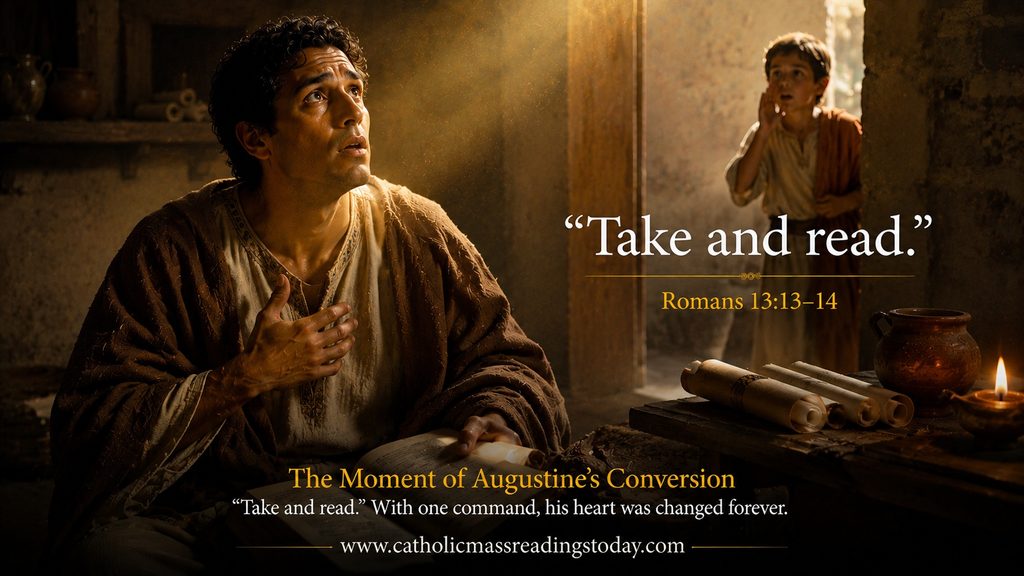
In Milan in 386, Augustine reached one of the decisive moments of his life. Tormented by the conflict within himself, he withdrew into a garden and wept. There, according to the account he later recorded, he heard what sounded like a child’s voice repeating:
“Take and read.”
He interpreted the words as an instruction to open Scripture. He took up Saint Paul’s writings and encountered Romans 13:13 – 14, a passage calling the reader away from drunkenness, lust and rivalry and toward putting on the Lord Jesus Christ.
Something finally broke open within Augustine. The resistance collapsed. The man for whom Monica had prayed through years of disappointment was surrendering himself to Christ.
During the Easter Vigil of 387, Augustine was baptized in Milan by Saint Ambrose. Imagine Monica witnessing that moment, the child she had carried, the young man whose choices had caused her anguish, the brilliant son who had searched through philosophy and religious error, the man she had followed across sea and country, now stood within the Catholic Church as a baptized Christian.
Years of prayer had reached a moment she once could only imagine yet Monica’s greatest joy was not that she had won an argument. Her son had found Christ.
Monica’s Prayer Was Answered Beyond What She Asked
There is an especially beautiful dimension to Monica’s story. She had prayed that Augustine would become Catholic and God gave considerably more.
Augustine would eventually become a priest and then Bishop of Hippo. He would preach for decades, defend the faith, shepherd Christians through turbulent times and write works that would profoundly influence Catholic theology and Western thought. His writings include the Confessions, The City of God and On the Trinity.
He would become Saint Augustine of Hippo, Bishop and Doctor of the Church.
Monica did not live long enough to witness all of this. She never saw Augustine wearing episcopal vestments, she never saw generations studying his theology, she never saw churches named after him, she never knew that more than sixteen centuries later Christians throughout the world would still read the spiritual autobiography in which her own faith appears so movingly, she saw something simpler.
She saw Augustine return to God and for her, that was enough.
Mother and Son Prepare to Return to Africa
After Augustine’s baptism, the group prepared to return to North Africa, where Augustine intended to live a life dedicated to God.
Monica travelled with them.
Their journey eventually brought them to Ostia, the port of ancient Rome, where they waited for a ship that would carry them home.
There, near the end of Monica’s life, occurred one of the most beautiful episodes recorded in Augustine’s Confessions.
Mother and son stood together beside a window overlooking a garden.
They began speaking about God and eternal life.
Their conversation moved beyond the things of this world toward contemplation of the life of heaven. Augustine describes an extraordinary shared spiritual experience in which their hearts seemed momentarily lifted toward the eternal Wisdom of God.
It has become known as the Vision of Ostia.
For years Monica and Augustine had seemed spiritually separated by an enormous distance.
Now they stood together contemplating eternity. The mother had prayed for her wandering son and now the son had returned. Shortly afterward, Monica understood that her earthly work was nearly finished.
“Why Am I Still Here?”
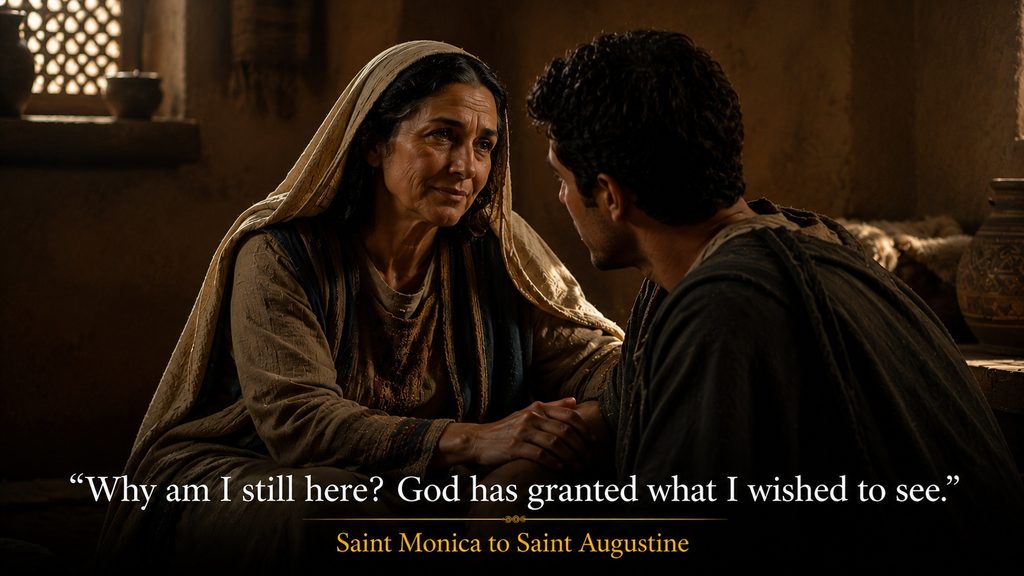
After the experience at Ostia, Monica spoke to Augustine with extraordinary peace.
The great earthly desire that had accompanied so many years of her life had been fulfilled. She had wanted to see Augustine become a Catholic Christian before she died.
Now she had seen even more: Augustine was prepared to abandon worldly ambition and dedicate himself to the service of God. She told him, in substance, that earthly life no longer held the same attraction for her. God had granted what she had hoped to see.
These were not the words of someone despairing of life. They were the words of someone whose deepest hope had been fulfilled. Within days, Monica became ill with a fever and she would never board the ship for Africa.
The Death of Saint Monica at Ostia
As Monica’s illness worsened, Augustine and his brother remained beside her. Navigius expressed sorrow that their mother might die so far from her homeland.
Monica was remarkably unconcerned, she no longer needed Thagaste. She did not require an impressive tomb. She knew that the God who had accompanied her across North Africa and Italy was not limited by geography.
Her final request was beautifully Catholic. She asked her sons to remember her at the altar of the Lord wherever they might be. Those words reveal something profound about Monica’s faith.
At the end of her life, she pointed her children toward the Eucharistic sacrifice. Not toward monuments, not toward earthly achievements but toward the altar.
After approximately nine days of illness, Saint Monica died at Ostia in 387, aged about fifty-six.
Augustine was thirty-three. He closed his mother’s eyes.
The man whose mother had shed so many tears for him now struggled with tears of his own.
In the Confessions, Augustine would later write movingly about his grief. Yet his sorrow was transformed by Christian hope. Monica had not simply vanished into nothingness. She had died believing in Christ and awaiting the resurrection of the dead.
From an Ordinary Grave to the Heart of Rome
Monica was initially buried at Ostia.
Her earthly remains would not remain there permanently. Her relics were eventually transferred to Rome in the fifteenth century under Pope Martin V and today are venerated in the Basilica of Saint Augustine in Rome.
Her veneration spread increasingly through the Church, particularly among mothers and wives.
The placement of her modern liturgical memorial on August 27, immediately before Saint Augustine’s memorial on August 28, gives the Church’s calendar a beautiful symbolism.
First comes the mother who prayed then comes the son for whom she prayed.
What Saint Monica Actually Gave the Church
It would be too narrow to remember Monica only because she happened to be Augustine’s mother. Her holiness has its own voice. She shows that tremendous spiritual influence can emerge from a life largely hidden from public view.
The Church needs theologians, missionaries, priests, religious, teachers and courageous public witnesses. But it also needs mothers and fathers praying quietly for their children when nobody else knows the anguish they carry.
It needs husbands and wives who bring Christ into their homes, widows who continue trusting God through loneliness, grandparents praying for grandchildren and ordinary Catholics whose perseverance becomes the hidden soil from which another person’s vocation may eventually grow.
Monica’s greatness is found precisely here. She did not convert Augustine herself.
God did.
Monica’s task was to love him, pray for him, speak when appropriate, remain close when possible and trust God when she could do nothing else. There is profound humility in that kind of love.
Saint Monica and Parents Whose Children Have Left the Church
This may be the part of Monica’s story that speaks most urgently to Catholic families today. Many parents carry a grief they seldom discuss. Their adult children no longer attend Mass.
Some no longer believe in God while others identify as Catholic but have little connection with the sacramental life of the Church.
Parents sometimes look back and torment themselves:
Where did we go wrong?
Monica’s story reminds us that even children raised within believing families possess freedom.
Augustine’s wandering was real. So was his mother’s sorrow. But his story was not finished during the years when Monica feared it was going terribly wrong. That distinction matters.
The person you are praying for today is still living a story whose ending you do not know.
God can reach someone through a conversation you never witness.
Through suffering, friendship, Scripture, beauty, an unexpected encounter, a priest, a future spouse, the birth of a child and a moment of silence after years of running.
Grace has more doors than we can see. Saint Monica therefore teaches parents neither despair nor control.
She teaches hopeful intercession.
- Pray.
- Love.
- Witness.
- Entrust.
And allow God to remain God.
Persevering Prayer Is Not Failed Prayer
One of the most important lessons of the Memorial of Saint Monica concerns unanswered prayer.
We sometimes imagine that if God has not answered quickly, He has not answered at all. Monica’s life challenges that assumption. She prayed through years when Augustine appeared to be moving farther rather than closer to the faith.
Had she judged God’s activity only by immediate appearances, she could easily have concluded that her prayers were accomplishing nothing. But grace was working through a much larger story.
This does not mean every prayer will be answered exactly as Monica’s was. Christianity never gives us permission to manipulate God by believing that enough prayers force Him to produce the outcome we demand.
Prayer is deeper than that.
Persistent prayer changes circumstances according to God’s wisdom, but it also changes the person who prays.
It teaches surrender, purifies love, strengthens hope and it forces us to place people we love into hands greater than our own.
Monica eventually discovered that God’s answer was greater than what she could initially see. The wandering son became a saint. The restless intellectual became a Doctor of the Church.
And the tears of an anxious North African mother became part of the spiritual inheritance of Christians throughout the world.
Saint Monica’s Importance to the Catholic Church
Saint Monica is especially honoured as a patron of mothers, wives, widows, difficult marriages and those praying for family members who have wandered from the faith. Her example has inspired organized prayer among Christian mothers as well; by the nineteenth century, associations under her patronage were spreading internationally to pray particularly for husbands and children who had strayed.
But her importance extends beyond those particular circumstances. Monica embodies several essential Catholic convictions. She demonstrates that holiness is possible in ordinary family life.
She demonstrates that prayer and the sacraments can sustain a person through years of uncertainty and that evangelization sometimes happens through patient witness rather than argument.
She demonstrates that no human being should be reduced permanently to the worst chapter of his or her life and she demonstrates the extraordinary influence a faithful parent can have upon generations never personally encountered.
When Monica died at Ostia, she could not have known what Augustine would become. She certainly could not have known what her own life would mean to Christians centuries later.
Today, countless mothers whisper prayers through tears and invoke Saint Monica’s intercession. Countless people who have wandered from God encounter her story and recognize something of themselves in Augustine.
Countless families discover through Monica that hope can survive even a very long night.
The Memorial of Saint Monica: A Saint for Our Own Time
The world surrounding Monica was different from ours, yet the human heart has changed remarkably little.
- Parents still worry about their children.
- Marriages still experience hardship.
- Young people still search for identity and meaning.
- Intelligent people still wrestle with faith.
- Families still endure the pain of watching someone they love make destructive decisions.
- People still wonder whether God hears prayers that have been repeated for years.
That is why Monica does not belong only to the fourth century. She belongs beside the mother praying the Rosary late at night for her son, the father asking God to bring his daughter back to Mass, the grandmother who has prayed for the same grandchild for twenty years, the spouse who quietly places a loved one’s conversion before God and beside every Christian who has ever wondered whether continuing to pray makes any difference.
Saint Monica’s answer comes through her life:
Do not measure God’s work only by what you can see today.
Augustine’s story was still being written.
So is ours and the stories of the people for whom we pray.
The tears offered to God are never meaningless. The prayers whispered when hope feels exhausted are still prayers. And the person who appears farthest from God may be closer to a moment of grace than anyone realizes.
The Memorial of Saint Monica therefore celebrates much more than the mother of Saint Augustine.
It celebrates the holiness of perseverance. The strength of a faithful mother.
The hidden power of intercession.
The patience of Christian hope.
And above all, the grace of a God who can reach the restless human heart in ways we could never have planned.
Saint Monica lived long enough to see the prayer that had defined so much of her life answered. Then with extraordinary peace, she was ready to go home. Her son continued the journey and through him and through the mother whose prayers accompanied him, the Church and the world would never be quite the same.
Prayer to Saint Monica
O God,
who consoled Saint Monica
by granting in Your mercy
the conversion of her son, Saint Augustine,
look with compassion upon all families
who turn to You in hope.
Through the intercession of Saint Monica,
strengthen mothers and fathers
who pray for their children.
Console those whose loved ones
have wandered from the faith,
and preserve them from discouragement and despair.
Teach us to pray with perseverance,
to love without ceasing,
to speak with charity,
and to entrust to Your providence
what we cannot change by our own strength.
Bring back those who have wandered from You.
Heal wounded families.
Strengthen troubled marriages.
Comfort widows and all who suffer in silence.
May the tears we offer in prayer
become seeds of hope,
and may we never forget
that Your grace can reach every human heart.
Through the intercession of Saint Monica,
draw our families ever closer to Christ,
and grant that, after faithfully serving You on earth,
we may one day be reunited in the joy of Your heavenly Kingdom.
Through Christ our Lord.
Saint Monica, pray for all mothers and fathers.
Saint Monica, pray for all mothers and fathers.
Saint Monica, pray for those who have wandered from the faith.
Amen.