“Behold, the Bridegroom! Come Out to Meet Him”
There is something deeply beautiful about the image Jesus places before us in today’s Gospel. It is nighttime. Ten young women are waiting with their lamps. Somewhere in the darkness, a wedding celebration is approaching, and at the centre of everything is the bridegroom whose arrival they have been expecting. Some have prepared carefully for the wait. Others have not. Then, when the night is at its darkest, the silence is suddenly broken by a cry: “Behold, the bridegroom! Come out to meet him.”
Behind this simple story lies one of the most serious and hopeful teachings of the Christian life. Christ is the Bridegroom. We are the people waiting for Him, and the journey of our earthly life is our time of preparation.
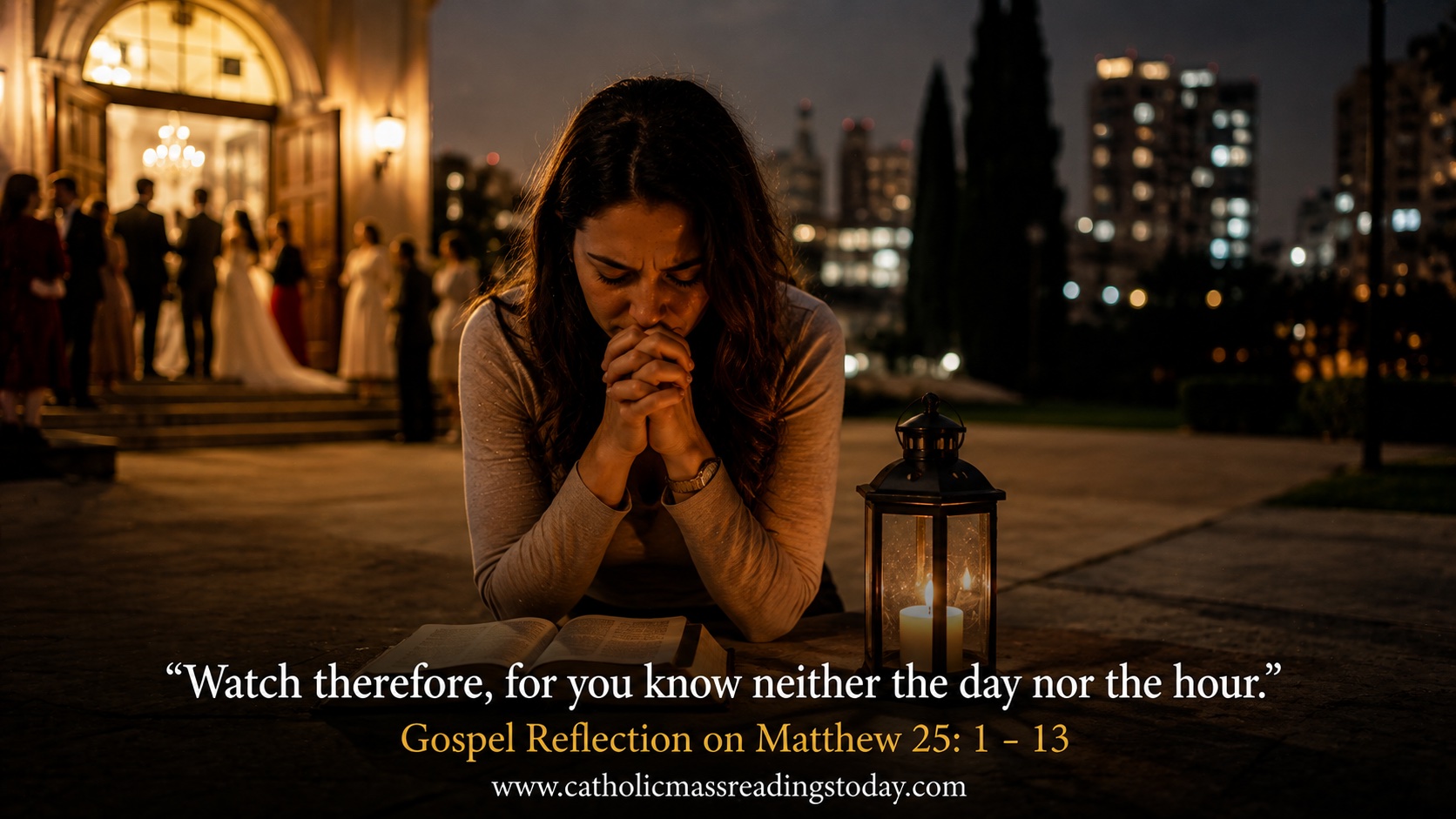
Jesus ends the parable with words that should remain in our hearts: “Watch therefore, for you know neither the day nor the hour.”
This is not an invitation to live in fear. Christ does not want His disciples spending their lives anxiously calculating when He will return or wondering constantly when death will come. Rather, He asks us to live so faithfully today that whenever He comes, He will find us ready.
The ten maidens in the parable initially appear remarkably similar. All ten have been invited to the wedding. All ten are waiting for the same bridegroom. All ten carry lamps. All ten eventually become tired and fall asleep. From outward appearances, there seems to be little difference between them.
Yet there is one crucial distinction. Five have brought enough oil for their lamps. Five have not.
That difference is hidden until midnight.
There is an important spiritual lesson here. Much of our Christian life takes place where other people cannot see it. Someone may appear religious outwardly and yet be slowly becoming empty within. We may call ourselves Catholic, have been baptized, know our prayers, own a Bible, wear a crucifix and attend Mass from time to time. These things are good, but Jesus continually leads us deeper. He asks what is happening within the heart.
Is there still oil in the lamp?
Is there a living relationship with God beneath the outward signs of our faith? Is there prayer when nobody is watching? Is there repentance when we fall into sin? Is there mercy toward those who have wounded us? Is there generosity toward the poor? Is there faithfulness when doing what is right becomes difficult?
The lamp can be understood as the faith we profess, while the oil points us toward the interior life that keeps faith alive: God’s grace received and responded to through prayer, charity, fidelity, repentance and good works. A lamp without oil may still look like a lamp, but when darkness comes, it cannot give light.
Our Catholic faith must therefore become more than something we carry. It must become something we live.
We cannot speak beautifully about mercy while refusing to forgive. We cannot profess love for Christ while deliberately ignoring the suffering person beside us. We cannot proclaim the Eucharist to be the Body and Blood of the Lord while treating the Mass as though it were of little importance. We cannot continually speak about prayer while giving God only the few moments left after everything else has taken our attention.
Faith must penetrate life.
The wise maidens understood something the foolish maidens did not: preparation cannot always be postponed until the final moment.
This becomes especially significant because the bridegroom was delayed. The women expected him, but he did not arrive immediately. They had to wait.
Many Christians know what that kind of waiting feels like. We pray for healing, but illness continues. We pray for a son or daughter who has wandered from the faith, yet years pass and nothing seems to change. We ask God to repair a marriage, provide employment, bring reconciliation to a family or relieve a burden, but the answer does not come when we expected it.
Sometimes the hardest part of faith is not believing that God exists. It is trusting Him when He appears to be late.
The delay of the bridegroom reveals the difference between temporary enthusiasm and persevering faith. It is relatively easy to trust God when prayers are answered quickly and life unfolds according to our hopes. The deeper test comes when we have prayed for months or years and still must say, “Jesus, I trust in You.”
The wise maidens prepared for the possibility of a long night. We must do the same.
Interestingly, Jesus tells us that all ten maidens eventually fell asleep. The wise slept as well as the foolish. Their wisdom did not consist in remaining physically awake throughout the night. Their wisdom consisted in being prepared before they slept.
This is an important distinction. Christian watchfulness does not mean living in constant nervousness about the end of the world. Nor does holiness require us to withdraw from ordinary human life.
We work. We rest. We raise children. We study. We build homes. We celebrate birthdays. We share meals. We laugh with friends. We care for elderly parents. We make plans for tomorrow.
These ordinary things can themselves become places of holiness when they are lived in friendship with God.
A mother faithfully caring for her children can be keeping her lamp burning. A father working honestly for his family can be keeping his lamp burning. A nurse caring compassionately for a patient can be keeping her lamp burning. A young person resisting temptation when nobody would know can be keeping his lamp burning. A widow quietly praying her Rosary can be keeping her lamp burning.
The question is not whether we are doing extraordinary things every moment. The question is whether Christ remains at the centre of the ordinary things we are doing.
Then comes midnight and suddenly the cry is heard:
“Behold, the bridegroom! Come out to meet him.”
Midnight is significant because it is an unexpected hour. Life has its own midnights moments that arrive without warning and remind us how little control we actually possess.
A telephone call can change a family forever. A medical examination can bring news nobody expected. Someone can leave home in the morning without knowing that the day will unfold differently from every other day.
And eventually every earthly life reaches its final hour. We know that we will die, but we do not know when.
Christianity does not ask us to deny this reality. It teaches us to face it with hope because death has already been confronted and defeated by Jesus Christ. Through His Cross and Resurrection, death is no longer the final word for those who belong to Him.
Nevertheless, the uncertainty of our final hour makes the present moment extraordinarily precious.
How often do we postpone the things that matter most?
- One day I will return to Confession.
- One day I will begin praying again.
- One day I will forgive that person.
- One day I will return to Sunday Mass.
- One day I will repair that relationship.
- One day I will take my faith seriously.
But who among us has been promised that particular “one day”?
God has given us today.
Today we can pray. Today we can forgive. Today we can confess our sins. Today we can tell someone we love them. Today we can feed someone who is hungry. Today we can reconcile with someone from whom pride has separated us. Today we can return to Christ.
Grace always meets us in the present.
When the foolish maidens realize their lamps are failing, they turn desperately to the others and ask for some of their oil. The wise maidens cannot give it to them.
At first their refusal can sound harsh. Yet Jesus is revealing another profound truth: there are certain spiritual decisions nobody else can make for us.
Other people can help us enormously. A mother can pray for her son for decades. A priest can teach us the Gospel. A friend can encourage us to return to the Church. Our parents can introduce us to prayer. Saints can inspire us. The Church can offer us the sacraments.
But nobody can love God in our place, nobody can repent in our place, nobody can forgive in our place and no one can make our final response to Christ for us.
The holiness of our parents cannot simply be transferred to us. The faith of our spouse cannot replace our own relationship with God. We cannot stand before Christ one day and offer Him somebody else’s lamp.
There comes a point when every human heart must personally answer the Lord’s invitation.
This makes the Gospel particularly relevant to the world in which we live. Modern life gives us countless ways to remain occupied while becoming spiritually asleep. We can wake in the morning and reach for our phones before giving a single thought to God. We can spend hours scrolling through social media and then convince ourselves that ten minutes of prayer is impossible. We can know immediately what is happening on the other side of the world while remaining almost completely unaware of what is happening inside our own souls.
Our schedules may be full while our lamps are becoming empty.
The answer is not necessarily to abandon technology, careers, recreation or the legitimate responsibilities of life. Rather, Christ asks us to put everything back into its proper order.
God must not become an afterthought.
Keeping the lamp burning often begins with very ordinary decisions: making time for prayer before the day becomes busy, reading the Scriptures, returning faithfully to Sunday Mass, praying the Rosary, examining our conscience, going regularly to Confession, receiving the Eucharist with reverence, forgiving someone who has hurt us, caring for the poor and choosing what is right even when nobody is watching.
These actions may appear small, but holiness is often built through small acts of fidelity repeated over a lifetime.
For Catholics, however, preparation for Christ is never simply a matter of trying harder to become good people. We cannot fill the lamp through human effort alone. We need grace.
This is why Christ has given us the sacramental life of His Church.
In Baptism, we receive new life in Christ. In the Sacrament of Reconciliation, the Lord restores us when sin has wounded our communion with Him. In the Holy Eucharist, Christ gives Himself as food for our journey.
There is something especially beautiful about reading the parable of the bridegroom in the light of the Eucharist.
The Church waits for the return of Christ in glory, yet while we wait, He does not leave us alone. At every Mass, the Bridegroom whom we await comes sacramentally among His people.
The Christ we hope one day to see face to face already comes to us beneath the appearances of bread and wine.
Every worthy reception of Holy Communion therefore becomes preparation for eternity.
We receive the One we are waiting to meet.
The most sobering moment of today’s parable comes when the foolish maidens finally return and discover that the door has been shut. They cry, “Lord, lord, open to us.” But the bridegroom replies, “Truly, I say to you, I do not know you.”
These words should not be weakened. Jesus takes human freedom seriously. Our earthly choices matter. There is judgment. There is eternity. There comes a moment when the time of preparation is complete.
Yet this warning should never be separated from the immense mercy of God. If you are hearing this Gospel today, the door of mercy is open now. Perhaps you have been away from the Church for many years. Come home. Perhaps there is a sin you have been too ashamed to confess. Bring it to Christ in the Sacrament of Reconciliation and perhaps your prayer life has almost disappeared. Begin again.
Perhaps your faith has become lukewarm and the flame seems very small. Ask the Holy Spirit to breathe upon it.
God is not waiting eagerly to condemn the sinner who wants to return. Christ is the Good Shepherd who searches for the lost sheep. He is the Father who welcomes the prodigal home. He is the Saviour who told the repentant thief, “Today you will be with me in Paradise.”
As long as we have this present moment, we can turn toward Him.
And we should not overlook the beautiful image Jesus chose for the end toward which we are travelling.
It is a wedding feast.
Christ could have spoken only of judgment, yet He presents the Kingdom as a celebration and Himself as the Bridegroom.
This tells us something essential about Christian readiness. We are not preparing merely because we are afraid to die. We are preparing because Someone we love is coming.
The One who comes is Jesus Christ—the One who sought sinners, healed the wounded, forgave Peter, welcomed the outcast and stretched out His arms upon the Cross for us. The hands of the Bridegroom are the hands that bear the wounds of love.
For the Christian who loves Christ, the cry “Behold, the bridegroom!” is therefore not ultimately a message of terror. It is a message of hope. The One for whom the human heart was created is coming.
Today’s Gospel leaves us with a simple question that each of us must answer privately before God:
How is the lamp of my soul?
Perhaps it is burning brightly. Then give thanks to God and remain humble.
Perhaps the flame has weakened. Ask Christ to strengthen it.
Perhaps you fear that it has almost gone out. Do not despair. The smallest sincere movement of the heart toward God can become the beginning of conversion.
We cannot rewrite yesterday, and tomorrow has not been promised to us. But today has been placed into our hands. So let us live today faithfully.
Let us pray while we have time to pray. Let us forgive while we have time to forgive. Let us love while there are still people beside us to love. Let us receive Christ while He gives Himself to us in the Eucharist. Let us confess our sins while His mercy is offered to us. Let us serve those in need while we still possess hands capable of serving.
Then, whenever the midnight cry finally reaches us “Behold, the Bridegroom! Come out to meet Him!” may Christ find that we have not spent our lives preparing for everything except eternity.
May our lamps be burning and our hearts recognize Him and may the Bridegroom lead us into that eternal wedding feast where there will be no more darkness, no more waiting and no more separation from the God for whom our hearts were made.
Let us Prayer
Lord Jesus Christ,
Divine Bridegroom of Your Church,
You call us to remain watchful
as we await Your coming.
Keep alive within us the light of faith
and fill our hearts with the grace
that enables us to love You faithfully.
When we become distracted
by the passing things of this world,
turn our hearts again toward You.
When our faith grows weak, strengthen us.
When we fall into sin, call us to repentance.
When we become weary in prayer, sustain us.
When we are tempted to postpone conversion,
remind us of the precious gift of today.
Grant that we may seek You faithfully
in prayer and in the Holy Scriptures,
receive You worthily in the Holy Eucharist,
recognize You in the poor and suffering,
and serve You with love
in every person You place before us.
May the lamps of our souls remain burning
until the hour when You call us from this life.
And when at last we hear the cry,
“Behold, the Bridegroom! Come out to meet Him,”
may we rise with joy to meet You
and enter with You into the eternal wedding feast
of the Kingdom of Heaven.
You who live and reign
with God the Father
in the unity of the Holy Spirit,
God, for ever and ever.
Amen.