From a Restless Young Man Searching for Happiness to One of the Greatest Teachers in the History of Christianity
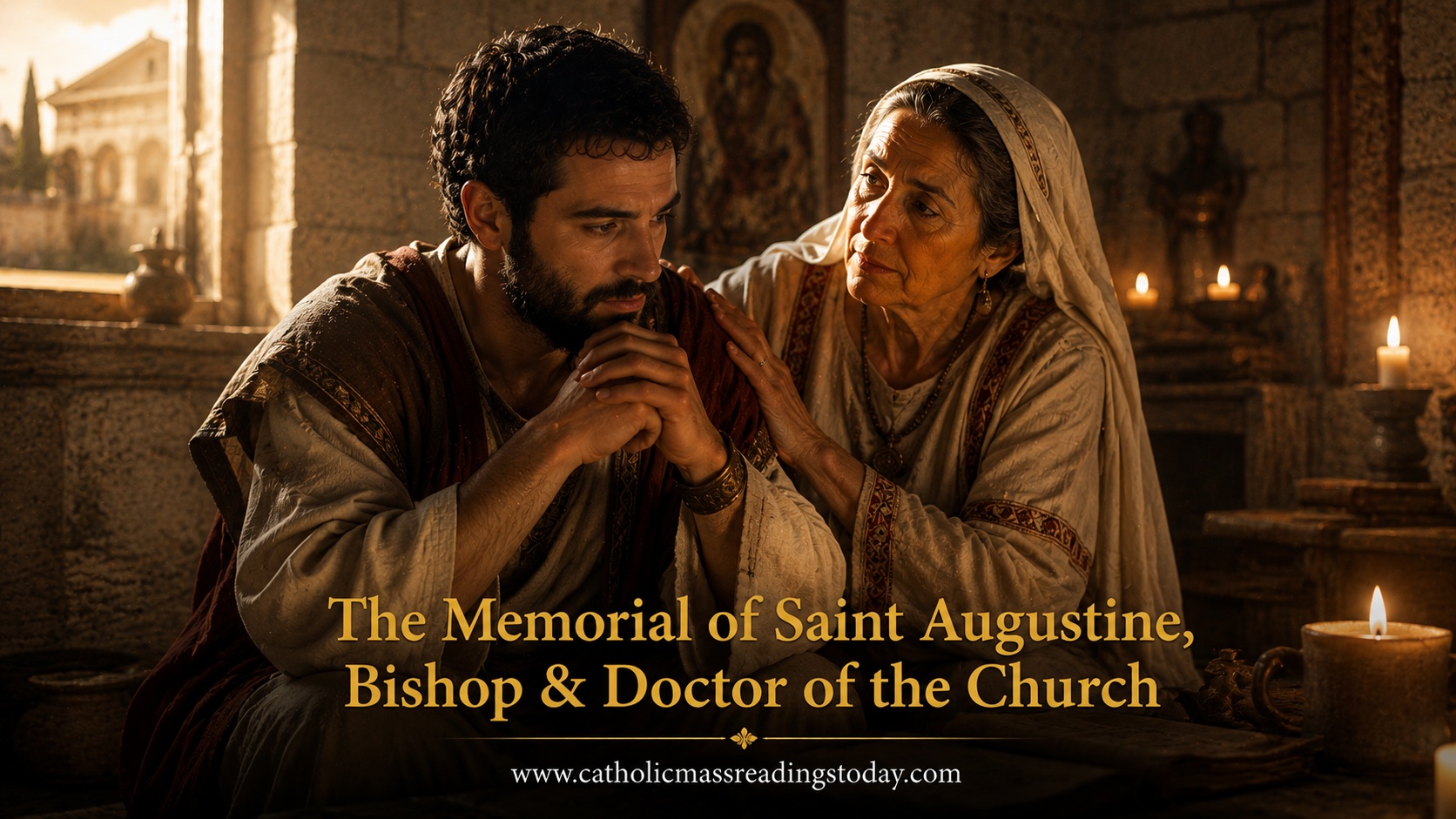
Every year on August 28, the Catholic Church celebrates the Memorial of Saint Augustine, Bishop & Doctor of the Church, one day after the Memorial of his mother, Saint Monica. The placement of their memorials beside one another is especially fitting. On August 27, the Church remembers the mother who prayed through years of tears for her wandering son. On August 28, she remembers what that son eventually became.
Few saints have left an intellectual and spiritual legacy comparable to Saint Augustine of Hippo. He was a philosopher, theologian, priest, bishop, preacher and prolific writer whose thought helped shape Western Christianity. Yet perhaps the most compelling thing about Augustine is that he did not begin life looking like someone destined to become a saint.
He knew ambition. He knew sexual temptation. He knew intellectual pride and religious confusion. He fathered a child outside marriage, spent years following Manichaeism, struggled to accept the Christian faith of his mother and repeatedly searched for happiness in places that could not satisfy the deepest hunger within him.
Then grace found him.
The story celebrated in The Memorial of Saint Augustine, Bishop & Doctor of the Church is therefore not merely the biography of a brilliant theologian. It is the story of a human heart that searched almost everywhere before finally surrendering to the God who had been pursuing it all along.
Saint Augustine was born in Thagaste in Roman North Africa on November 13, 354, and died at Hippo on August 28, 430. Between those two dates unfolded one of the most remarkable journeys in Christian history.
Augustine’s Birth in Roman North Africa
Augustine was born in Thagaste, in what is now Souk Ahras, Algeria, into a world very different from the Europe with which later Western Christianity would often be associated.
North Africa was then an important part of the Roman Empire and possessed a vigorous Christian culture. The African Church had already produced major figures such as Tertullian and Saint Cyprian of Carthage.
Augustine’s parents were Patricius and Monica.
His father, Patricius, was initially a pagan, while his mother, Monica, was a devoted Christian. Monica’s influence upon Augustine would become one of the defining relationships of his life. She raised him within the Christian faith, but the young Augustine did not simply follow the path she hoped he would take.
From an early age, Augustine displayed unusual intellectual ability. He had a remarkable gift for words, argument and persuasion. His family recognized his potential and made sacrifices so that he could receive the education necessary for advancement within Roman society.
He studied first locally and later pursued rhetoric, the discipline that could open the doors to public prestige and influence.
The young Augustine wanted success but beneath that ambition was something much deeper that he did not yet understand. He wanted truth, beauty, love, he wanted a happiness that would not disappear.
Much of his early life would be spent confusing those desires with things incapable of fulfilling them.
The Brilliant Young Student Who Wanted More From Life
Augustine eventually went to Carthage, one of the great cities of Roman North Africa, to continue his education.
The city exposed the young student to intellectual excitement, entertainment and sensual pleasure. Augustine loved literature, theatre, friendship, debate and the pleasures available to a talented young man discovering the wider world.
While in Carthage he entered a long-term relationship with a woman whose name history has not preserved. Because of differences in social standing, the two did not marry. Their relationship nevertheless lasted for years, and they had a son named Adeodatus, whose name means “gift of God.”
Augustine became a father while still very young and remained deeply attached to his son.
It would be easy to reduce this chapter of Augustine’s life to a catalogue of sins. Augustine himself did not do that. When he later looked back upon his youth in the Confessions, he examined something far more interesting: the human heart.
Why do we desire what we desire? Why can we possess something we thought would make us happy and still feel restless? Why do we sometimes recognize what is good yet choose something lesser? Where does the longing for infinite happiness come from?
These questions would eventually become central to Augustine’s theology because he had first experienced them personally.
Cicero Awakens Augustine’s Hunger for Wisdom
One of the decisive intellectual moments of Augustine’s youth came through reading Cicero’s Hortensius.
The work awakened in him a passionate desire for wisdom.
Suddenly intellectual achievement alone was not enough. Augustine wanted truth itself. He began asking questions about the meaning of existence, the nature of goodness and the possibility of finding a happiness that could not be destroyed by circumstances or death.
Because he had been raised around Christianity, Augustine turned toward the Scriptures.
But he was disappointed.
Compared with the polished Latin literature in which he had been trained, biblical language seemed unsophisticated to him. He was not yet spiritually or intellectually prepared to recognize the depth beneath its apparent simplicity.
So Augustine looked elsewhere.
Augustine Becomes a Manichaean
His search led him to Manichaeism, a religious movement that presented reality through a radical struggle between principles of light and darkness.
For a young intellectual struggling with the problem of evil, Manichaeism appeared to offer sophisticated explanations.
Augustine embraced it. This must have caused tremendous sorrow to Monica. Her brilliant son had not merely become indifferent to Christianity. He had attached himself to teachings incompatible with the Catholic faith she treasured.
Yet Monica did not abandon him, she prayed, she wept, she sought advice and she remained convinced that God could reach the son whom arguments alone could not bring home.
Augustine would later become one of Christianity’s most formidable opponents of Manichaeism, precisely because he understood its attraction from the inside. But that came later.
For years he remained associated with the movement while pursuing his career as a teacher of rhetoric.
The Long Road From Thagaste to Carthage and Rome
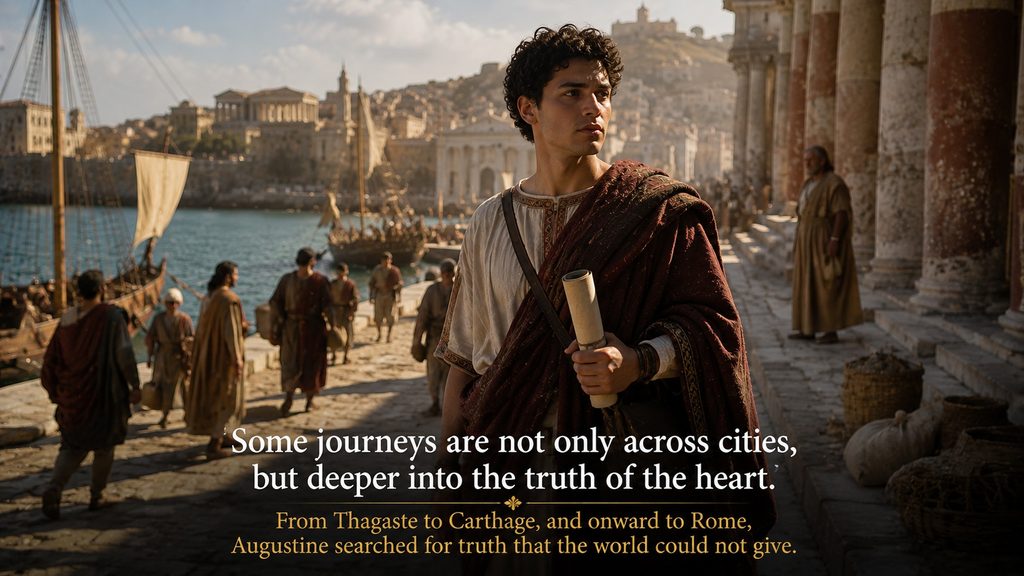
After his studies, Augustine taught rhetoric in Thagaste and Carthage. Yet his intellectual dissatisfaction continued. The answers promised by Manichaeism increasingly failed to satisfy him.
Augustine was too serious a thinker to remain content once contradictions began appearing. He wanted explanations capable of surviving examination. Eventually his ambitions carried him across the Mediterranean.
In 382 he travelled to Rome, leaving for Italy without informing Monica of his departure in advance. Monica had wanted to remain close to him, but Augustine was determined to pursue his own course.
Even this painful departure would become part of a much larger providential story. Augustine went to Rome seeking professional advancement. God was leading him toward Milan and in Milan waited a bishop named Ambrose.
Augustine Arrives in Milan
In 384 Augustine obtained an important position teaching rhetoric in Milan, then an imperial centre of enormous political importance.
By worldly standards, things were going well. He was intelligent, educated, ambitious, professionally successful, connected to influential people and yet inwardly he remained unsettled.
Augustine’s life illustrates one of the great paradoxes of the human heart: a person can possess many of the things society calls success and still know that something essential is missing.
In Milan, Augustine began listening to Saint Ambrose, the city’s celebrated bishop.
Initially, rhetoric attracted him. Augustine was a professional speaker, and Ambrose was renowned for his preaching. He wanted to hear how this bishop used language.
Then something unexpected happened. Augustine began listening not simply to how Ambrose preached, but to what he preached. Christianity began appearing differently.
Ambrose showed Augustine ways of understanding Scripture that dismantled some of the objections he had carried for years. The faith Augustine had dismissed as intellectually inadequate revealed depths he had never seriously encountered.
Meanwhile, Monica had followed her son to Milan. Once again the mother’s prayers accompanied the son’s searching mind.
The Battle Was No Longer Only in Augustine’s Mind
Gradually, Augustine’s objections to Christianity weakened though another struggle remained. By this stage, his problem was no longer simply whether Christianity could be intellectually defended. His life would have to change.
This is where Augustine becomes particularly recognizable to modern Christians.
There is a difference between being convinced that something is true and being willing to live according to that truth.
Augustine wanted God, but he also remained attached to desires and habits that made complete surrender difficult. His intellect was approaching the door. His will hesitated to enter.
He encountered Christian asceticism and learned of men and women who had abandoned wealth, sexual pleasure and worldly ambition in order to belong entirely to Christ. Their freedom disturbed him because it revealed his own bondage.
If they could surrender everything, what was preventing him? The answer was uncomfortable. Augustine was preventing Augustine.
“Take and Read”: The Moment That Changed Everything
The crisis came in 386. Augustine was in a garden in Milan, overwhelmed by the conflict within himself. He wept as the battle between his old life and the call of Christ reached breaking point. Then he heard what sounded like the voice of a child repeating words that he interpreted as:
“Take and read.”
He took up a copy of Saint Paul’s writings and opened it. His eyes fell upon Romans 13:13–14, which called the reader away from revelry, drunkenness, lust, rivalry and jealousy and toward putting on the Lord Jesus Christ.
The words struck Augustine personally, the argument was over, the long flight was ending and just like that Augustine surrendered.
This moment is important because Augustine’s conversion was not the abandonment of reason. It was the completion of a long intellectual, moral and spiritual journey in which reason had helped expose falsehood but could not, by itself, heal the divided human heart.
Augustine needed grace. The man who had spent years searching for God was beginning to understand that God had been seeking him all along.
Augustine’s Baptism by Saint Ambrose
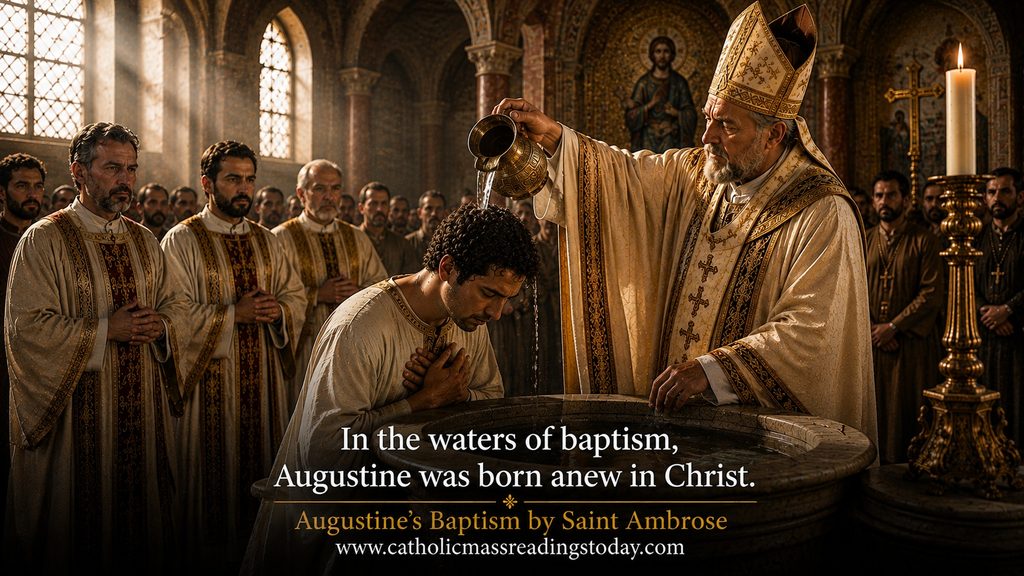
Augustine withdrew from his professional career and prepared seriously for Baptism.
During the Easter Vigil in the night between April 24 and 25, 387, Saint Ambrose baptized Augustine in Milan. Augustine’s beloved son Adeodatus was also baptized.
Imagine Monica’s joy.
For years she had watched her son move through intellectual pride, moral confusion and religious error. She had followed him geographically and spiritually, refusing to believe that his story had finished simply because the chapter she was witnessing was painful.
Now the son of her tears had entered fully into the Catholic Church, yet Monica could not have known how much further God’s answer to her prayers would extend.
She had prayed for Augustine’s conversion and God was preparing a bishop, a theologian, a Doctor of the Church and one of the most influential Christian thinkers who would ever live.
Augustine and Monica at Ostia
After Augustine’s baptism, he intended to return to North Africa and establish a community devoted to prayer, study and the service of God. The journey brought Augustine, Monica and their companions to Ostia, the port of Rome.
There mother and son shared one of the most beautiful moments recorded in the Confessions.
Standing together near a window, they spoke about eternal life and contemplated the joy of heaven. The woman who had spent so many years spiritually separated from her son could now speak with him about God as someone sharing the same faith.
Shortly afterwards Monica became ill.
Her final concern was not where her body would be buried. She asked her sons simply to remember her at the Lord’s altar wherever they might be.
Monica died at Ostia in 387.
Augustine was devastated. The mother who had accompanied so much of his journey would not accompany him physically back to Africa.
But what she had prayed for had been accomplished. Her work was finished. His was beginning.
Augustine Returns to Africa
After remaining for a time in Italy, Augustine eventually returned to North Africa.
He came back a very different man from the ambitious young rhetorician who had departed.
At Thagaste, Augustine began establishing the kind of Christian community he had dreamed about: a life centred upon prayer, common life, study of Scripture and the pursuit of God.
He disposed of his property for the benefit of the poor and gathered companions around him.
Augustine wanted contemplation. Providence had other plans.
The Day Augustine Went to Church and Left With a Vocation
Around 390 to 391, Augustine travelled to Hippo.
While attending the basilica there, he heard the elderly Bishop Valerius speaking about the diocese’s need for a priest.
The congregation knew Augustine’s reputation. Suddenly attention turned toward him and Augustine found himself brought forward and pressed into service for the Church.
He was ordained a priest. It was not the quiet future he had imagined for himself. Yet Augustine gradually recognized that God was calling him to place his enormous intellectual gifts at the service of ordinary Christian people.
This changed his life permanently. The scholar became a pastor. He still studied, wrote and debated but now he also preached to ordinary people, administered the sacraments, settled disputes, instructed catechumens, cared for his clergy, defended Catholic teaching and carried the daily burdens of Christian ministry.
Augustine Becomes Bishop of Hippo
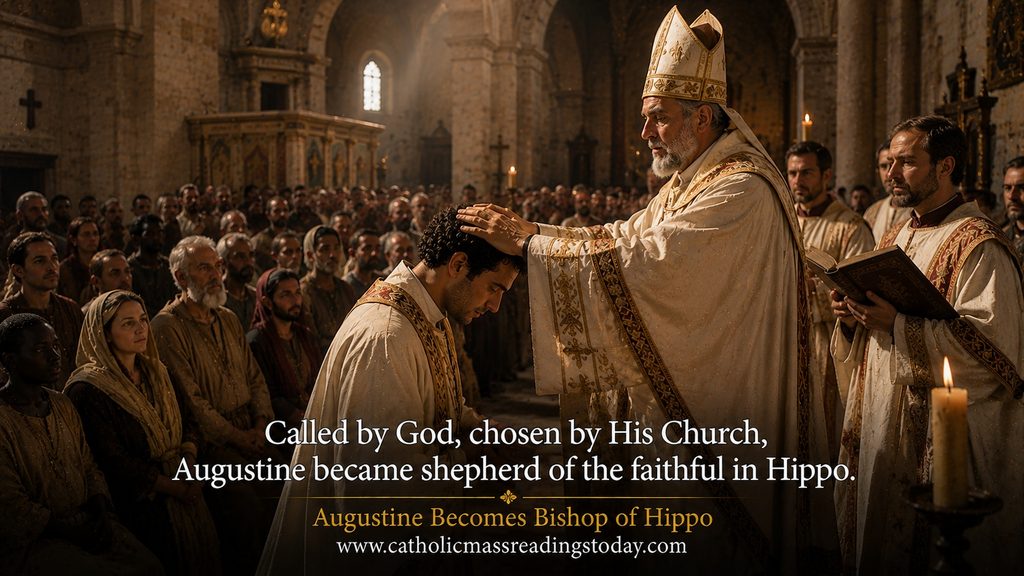
Augustine eventually became Bishop of Hippo, succeeding Valerius, and remained associated with the see until his death in 430. Hippo Regius was an important North African city, located near present-day Annaba in Algeria.
The restless young man was now responsible for shepherding souls. This is essential for understanding Augustine correctly.
We often encounter him today as a name on the spine of a theological book. His intellectual achievements were immense, but Augustine was not merely an academic theologian.
He was a bishop.
His theology grew out of preaching, pastoral responsibility, controversies affecting his people, the interpretation of Scripture, prayer and the Church’s sacramental life.
He preached constantly, wrote letters, answered questions, corrected error, counselled Christians and he confronted controversies threatening the unity and doctrine of the Church. His study desk and his bishop’s chair belonged to the same vocation.
Augustine’s Great Battle Over Grace
Among Augustine’s most important contributions was his teaching about grace.
This was not abstract theology for him. Augustine knew personally how incapable he had been of healing himself. He had possessed intelligence before his conversion, had education, had willpower and He had philosophical knowledge, yet none of these had been enough to free him completely from the divided desires within him.
Grace had accomplished what intellectual brilliance alone could not. This experience helped shape his response to the teachings associated with Pelagius, which Augustine believed gave inadequate recognition to the necessity and priority of divine grace.
Augustine insisted that salvation is God’s gift.
Human freedom is real. Human choices matter. Christians must cooperate with grace but grace comes first. God does not merely stand at a distance and tell wounded humanity to repair itself. He comes to us, calls, forgives, strengthens and He transforms.
This emphasis earned Augustine an enduring association with the theology of grace.
Augustine and the Meaning of Human Freedom
Augustine also thought deeply about free will, evil and moral responsibility.
These were not questions he had discovered only after becoming a bishop. They had troubled him since youth.
Manichaeism had once attracted him partly because it seemed to provide an explanation for evil. Catholic Christianity eventually led him toward a different understanding.
Evil is not a competing god or an eternal substance standing opposite goodness.
God is good.
Creation, insofar as it exists, is good. Evil is a corruption, disorder or deprivation of the good that ought to be present. This insight became enormously influential.
It also allowed Augustine to take human responsibility seriously without making evil an independent cosmic power equal to God.
The young man who had once blamed competing forces for the struggle within himself eventually became one of Christianity’s greatest thinkers on freedom, sin, grace and redemption.
The Confessions: Augustine Opens His Heart to the World
Among all Augustine’s writings, none has touched ordinary readers quite like the Confessions. It is difficult to classify because it is more than autobiography.
Augustine tells his story, but he tells it to God. The book is prayer, memory, theology, philosophy and examination of conscience woven together.
He revisits childhood, friendship, ambition, sexual desire, grief, intellectual pride, religious error, His mother’s tears, His conversion, and beneath all of these experiences he searches for evidence of God’s providence. The result feels surprisingly modern.
Augustine is relentlessly interested in what happens inside the human person. He asks why memory works as it does, why desire controls us, why we love, why we sin, why we grieve and why even great earthly achievements fail to satisfy completely.
At the heart of the Confessions lies Augustine’s discovery that the human person has been made for God. His life had been one long experiment in trying to satisfy an infinite hunger with finite things.
Pleasure was not enough, success was not enough, intellectual achievement was not enough, social standing was not enough, even human love, beautiful as it can be, could not bear the weight of becoming his ultimate good.
Only God could answer the deepest longing of his heart. That is why Augustine remains so contemporary. The objects with which modern people attempt to satisfy themselves have changed. The human heart has not.
The City of God and a Civilization in Crisis
Another of Augustine’s monumental works arose from catastrophe.
In 410, Rome was sacked by the Visigoths.
The psychological shock across the Roman world was immense. Rome had seemed almost untouchable. Some blamed Christianity for weakening the old Roman order.
Augustine responded with The City of God, one of the most influential works of Christian political and historical thought. He challenged the assumption that Christianity’s hope rested upon the survival of any earthly empire.
Nations rise, empires fall, political systems change, cities that appear eternal eventually crumble but The Kingdom of God is different.
Augustine distinguished between the earthly city, marked by disordered self-love, and the City of God, formed by love directed ultimately toward God.
Christians live within earthly societies and must seek justice and the common good, but no political arrangement should ever be mistaken for the Kingdom of God.
This teaching has remained remarkably important through centuries of revolution, war and political upheaval.
Augustine had watched people place extraordinary confidence in Rome.
Then Rome fell.
His answer was not despair. It was to remind Christians where their ultimate citizenship lay.
Augustine the Defender of the Unity of the Church
Augustine’s episcopal ministry unfolded amid intense theological and ecclesial disputes. North African Christianity was deeply wounded by the Donatist controversy, which had produced painful divisions among Christians.
Augustine worked vigorously for ecclesial unity and defended the Catholic understanding of the Church and sacraments. He also wrote extensively against Manichaean teachings he had once followed, against Pelagian positions on grace and against other doctrinal challenges.
Modern readers sometimes encounter the volume of ancient theological controversy and wonder why these men argued so intensely. For Augustine, doctrine was never merely intellectual sport.
What Christians believe about Christ, grace, sin, Baptism, the Church and salvation affects how Christians live. Truth mattered because souls mattered.
Faith and Reason Were Not Enemies
One of Augustine’s greatest contributions to Christian civilization was his refusal to treat faith and genuine reason as enemies. He had spent years pursuing philosophical truth before his conversion. Becoming Catholic did not require him to stop thinking.
It gave his thinking a new horizon. Reason could ask real questions about existence, morality, knowledge, beauty and truth. Faith revealed realities reason could not discover by its own power, yet these truths did not require the destruction of the intellect.
Augustine’s approach would profoundly influence medieval Christianity and later thinkers, including Saint Anselm and Saint Thomas Aquinas.
The brilliant rhetorician who once considered Scripture beneath his intellectual standards eventually devoted his mind to understanding and explaining the faith he had rejected.
Augustine’s Teaching on Love
For all the complexity of Augustine’s theology, one word repeatedly draws everything together:
Love.
The great question is not simply whether we love. Human beings inevitably love something. The question is whether our loves are rightly ordered. We can love something good in the wrong way.
We can turn money, success, pleasure, another human being or even ourselves into something we expect to provide what only God can provide. Then love becomes disordered.
For Augustine, holiness does not mean becoming less human or extinguishing desire.
It means allowing grace to heal desire so that we love God above all and everything else according to its proper place in Him. The young Augustine had possessed enormous desires. Conversion did not destroy them. Grace redirected them.
The man who once burned for worldly achievement eventually burned with love for God.
Augustine’s Humanity Makes Him an Extraordinary Saint
There is another reason Augustine has remained beloved for more than fifteen centuries.
- He never pretended that his past had not happened.
- He did not construct the image of a man who had always possessed perfect faith.
- He remembered.
- He remembered his mistakes.
- He remembered the people he had loved.
- He remembered the false ideas he had accepted.
- He remembered the grief he caused Monica.
- He remembered his ambitions.
- He remembered his resistance to God.
And then he looked back upon all of it through the eyes of grace. His past became testimony that offers enormous hope to Christians today. The Church does not teach that saints are people who never needed mercy.
Saints are people who finally allowed God’s mercy to transform them. Augustine demonstrates that our past can explain us without imprisoning us.
A person who has lived far from God can become a saint. One who has rejected Catholic teaching can become its defender. A person enslaved by desire can become free and a person who spent years running from God can eventually discover that God never stopped pursuing him.
The Bishop Grows Old
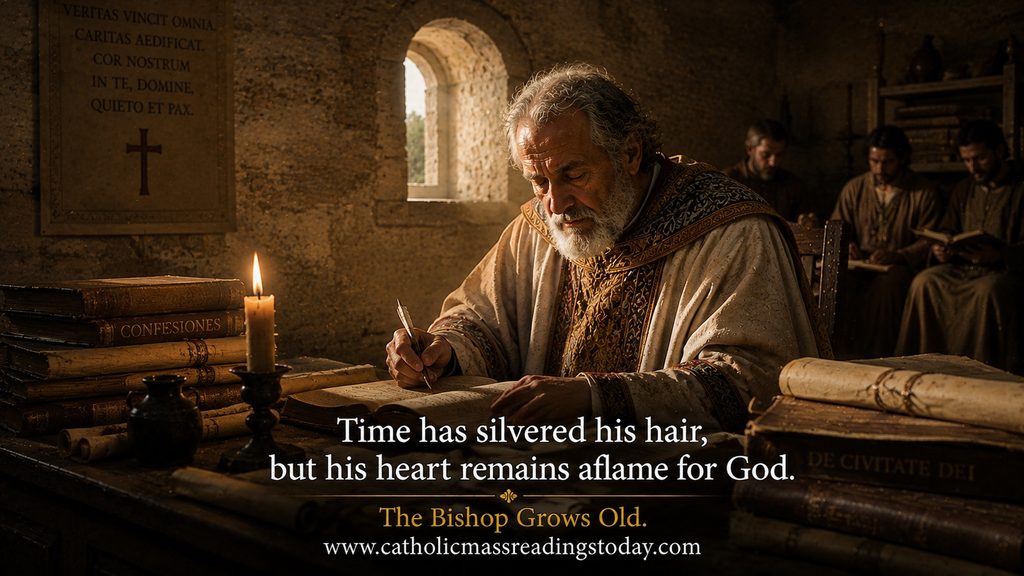
Decades passed.
The young rhetorician became an elderly bishop. By his seventies Augustine had spent much of his life preaching, writing, arguing, praying and carrying responsibility for the Church of Hippo.
In 426, conscious that he was growing old, Augustine arranged for the deacon Heraclius to succeed him and increasingly transferred administrative responsibilities to him.
But Augustine would not receive a peaceful retirement. The Roman world around him was beginning to fracture and the final chapter of his life would unfold with an invading army approaching his city.
The Vandals Come to North Africa
In the fifth century, the Vandals crossed into Roman North Africa under their king Genseric.
Cities fell, communities were displaced, churches and homes were devastated, refugees fled toward places that still offered protection and eventually the Vandals laid siege to Hippo.
Augustine was now an old man watching the world he had known collapse around him.
The situation must have carried an eerie resemblance to the questions he had confronted after the sack of Rome twenty years earlier.
What happens when institutions thought permanent begin to fall?
Where does the Christian place hope when civilization itself appears unstable?
Augustine had already given his answer. Christ does not fall when empires fall. The City of God cannot be destroyed by an invading army.
Vatican accounts describe Augustine facing the devastation of North Africa while returning to the mystery of divine Providence and reminding those around him that, while civilizations age, Christ does not.
The Death of Saint Augustine
During the siege of Hippo, Augustine became seriously ill. He knew that death was approaching. According to early accounts of his final days, the elderly bishop devoted himself intensely to repentance and prayer. This detail is especially moving.
Here was one of Christianity’s greatest theologians. A bishop, a defender of Catholic doctrine, the author of extraordinary works. A man whose sermons had instructed thousands.
Yet when death approached, Augustine did not rely upon his achievements. He turned again toward mercy. The great Doctor of Grace knew that he too was a sinner saved by grace.
On August 28, 430, at the age of seventy five, Augustine died in Hippo while the city remained under Vandal siege.
He had been born in North Africa, travelled through Carthage, Rome and Milan searching for truth. He then returned to Africa as a converted Christian and there, after decades of service as priest and bishop, his earthly pilgrimage ended.
The restless heart had finally reached the home toward which it had unknowingly been travelling all along.
Augustine’s Books Outlived the World Around Him
The Roman North Africa Augustine knew would eventually disappear.
Cities changed, political powers collapsed, the civilization surrounding him passed into history yet Augustine’s voice did not. His writings crossed centuries and continents.
The Confessions continued speaking to people wrestling with desire, guilt, memory, conversion and the search for happiness.
The City of God continued challenging societies tempted to place ultimate hope in political power.
On the Trinity became one of the great works of Western Trinitarian theology.
His writings on grace profoundly influenced Catholic thought. His sermons preserved the voice of a bishop trying to lead ordinary Christians toward holiness. His letters reveal a pastor engaged with real people and real problems.
His Retractations show something else admirable: an elderly scholar revisiting his own enormous body of work critically rather than pretending that everything he had ever written required no reconsideration. Vatican sources highlight works including On Free Choice, On the Trinity, The City of God, the Confessions and the Retractations among his vast literary legacy.
Augustine had spent his youth longing to become intellectually important.
Ironically, his influence became immeasurably greater after he surrendered his ambition to God.
Why Saint Augustine Is Called a Doctor of the Church
Saint Augustine is honoured as one of the great Doctors of the Church because of the exceptional importance of his teaching to Catholic theology and Christian understanding.
He is also counted among the great Latin Fathers of the Western Church.
The title does not mean that every sentence Augustine ever wrote constitutes infallible Catholic doctrine. It recognizes the extraordinary depth, orthodoxy and enduring usefulness of his theological contribution to the life of the Church.
His thought has influenced Catholic teaching on grace, original sin, the sacraments, the Church, human freedom, the Trinity, creation, morality, love, Scripture and the Christian understanding of history.
In 1298, Pope Boniface VIII formally numbered Augustine among the Doctors of the Church, together with Saints Ambrose, Jerome and Gregory the Great.
Yet his importance reaches far beyond theological specialists. Augustine understood the human heart.
That is why people who have never studied formal theology can open the Confessions and recognize themselves.
Saint Augustine’s Influence on the Church Today
Augustine’s spiritual heritage continues in an especially visible way through the Augustinian family and religious communities inspired by his vision of common life centred on the search for God, charity and unity.
His influence is also strikingly visible in the Church today. When Pope Leo XIV appeared on the balcony of Saint Peter’s Basilica after his election on May 8, 2025, he identified himself as “a son of Saint Augustine.” Pope Leo belongs to the Order of Saint Augustine, whose spirituality is profoundly shaped by Augustine’s search for God, communal life and service to the Church.
More than sixteen centuries after Augustine died in a besieged North African city, his spiritual family continues serving the universal Church.
That is an extraordinary legacy for a man who once wanted nothing more than to pursue his own ambitions.
What the Memorial of Saint Augustine Teaches Us Today
Perhaps the deepest reason The Memorial of Saint Augustine, Bishop & Doctor of the Church remains so important is that Augustine’s life destroys one of the most dangerous lies a person can believe:
“It is too late for me to change.”
Augustine’s story says otherwise. Your past may be complicated and so was his. You may have made decisions you regret and so did he.
You may have spent years far from God and so did he.
You may have questions about Christianity that you cannot yet resolve, Augustine understood that too.
You may love someone who seems impossibly far from faith and then remember Monica.
The story of Augustine teaches us not to confuse someone’s present condition with the final chapter of his life.
- The young man embracing Manichaeism was not the final Augustine.
- The ambitious teacher seeking prestige was not the final Augustine.
- The man struggling with chastity was not the final Augustine.
- The intellectual unable to accept Scripture was not the final Augustine.
God was still working and He is still working in human lives today.
The Restless Heart Finally Comes Home
There is something wonderfully fitting about Augustine’s entire story as a young man he travelled from one answer to another searching for happiness.
He sought it in pleasure.
In romantic love, in intellectual achievement, in philosophy, in religious speculation, in professional recognition, in Rome and in Milan. Yet every road eventually exposed the same emptiness.
His desires were simply too large for the things he was asking to satisfy them. Then Augustine discovered that his restlessness itself contained a clue.
- Why does the human heart keep reaching beyond every finite thing?
- Why can success leave us wanting more?
- Why can pleasure satisfy for a moment and then disappear?
- Why does the experience of beauty awaken a desire for something even greater?
For Augustine, the answer was God. The heart is restless because it was made for something this world cannot completely give. It was made for its Creator.
This is why Augustine belongs not merely to the ancient world but to ours.
Modern society possesses technologies Augustine could never have imagined, yet it has not solved the problem he spent his youth trying to solve.
We can communicate instantly across continents and still be lonely.
We can possess more entertainment than ancient emperors and still be bored.
We can accumulate wealth and remain afraid.
We can become famous and remain insecure.
We can surround ourselves with people and still wonder whether anyone truly knows us.
The human heart remains restless. Saint Augustine points beyond all the substitutes and says, in effect:
Do not be afraid of that restlessness. Follow it far enough, and it can lead you home.
The man who spent years running from God became one of the Church’s greatest witnesses to Him.
The sinner became a saint.
The sceptical reader of Scripture became one of its greatest interpreters.
The ambitious rhetorician became a servant of the Gospel.
The follower of religious error became a defender of Catholic truth.
The restless young man became a bishop and the bishop became a Doctor of the Church.
That is the extraordinary life the Church remembers every August 28 in The Memorial of Saint Augustine, Bishop & Doctor of the Church.
His life reminds us that grace does not merely improve people.
Grace can transform them.
And perhaps somewhere today another Augustine is still wandering.
Perhaps another Monica is still praying.
We do not yet know how that story will end.
God does.
Closing Prayer for the Memorial of Saint Augustine
O God,
You called Saint Augustine from his restless search
and drew him by Your grace
into the light of Your truth.
Through his intercession,
awaken within us a deeper hunger for You.
When we search for happiness
in things that cannot satisfy,
turn our hearts again toward Christ.
When sin holds us captive,
give us courage to repent.
When pride closes our minds to truth,
grant us humility.
When our faith is weak,
strengthen us by Your grace.
When we are tempted to despair
over those who have wandered from You,
teach us, through the example of Saint Monica,
to pray with patience and never abandon hope.
Grant wisdom to the teachers of Your Church,
fidelity to her bishops and priests,
truth to those who seek You,
and consolation to every restless heart.
Through the intercession of Saint Augustine,
help us to love Your Word,
to treasure the Holy Eucharist,
to seek truth with courage,
to serve Your Church faithfully,
and to order every love of our hearts
toward the love of You.
May we use the gifts You have entrusted to us
not for our own glory
but for the good of Your people
and the building up of Your Kingdom.
And when our earthly searching is complete,
bring us at last to that eternal rest
for which You created us,
where with Saint Augustine, Saint Monica
and all the saints,
we may behold You and praise You forever.
Through Christ our Lord.
Amen.
Saint Augustine, Bishop and Doctor of the Church, pray for us.