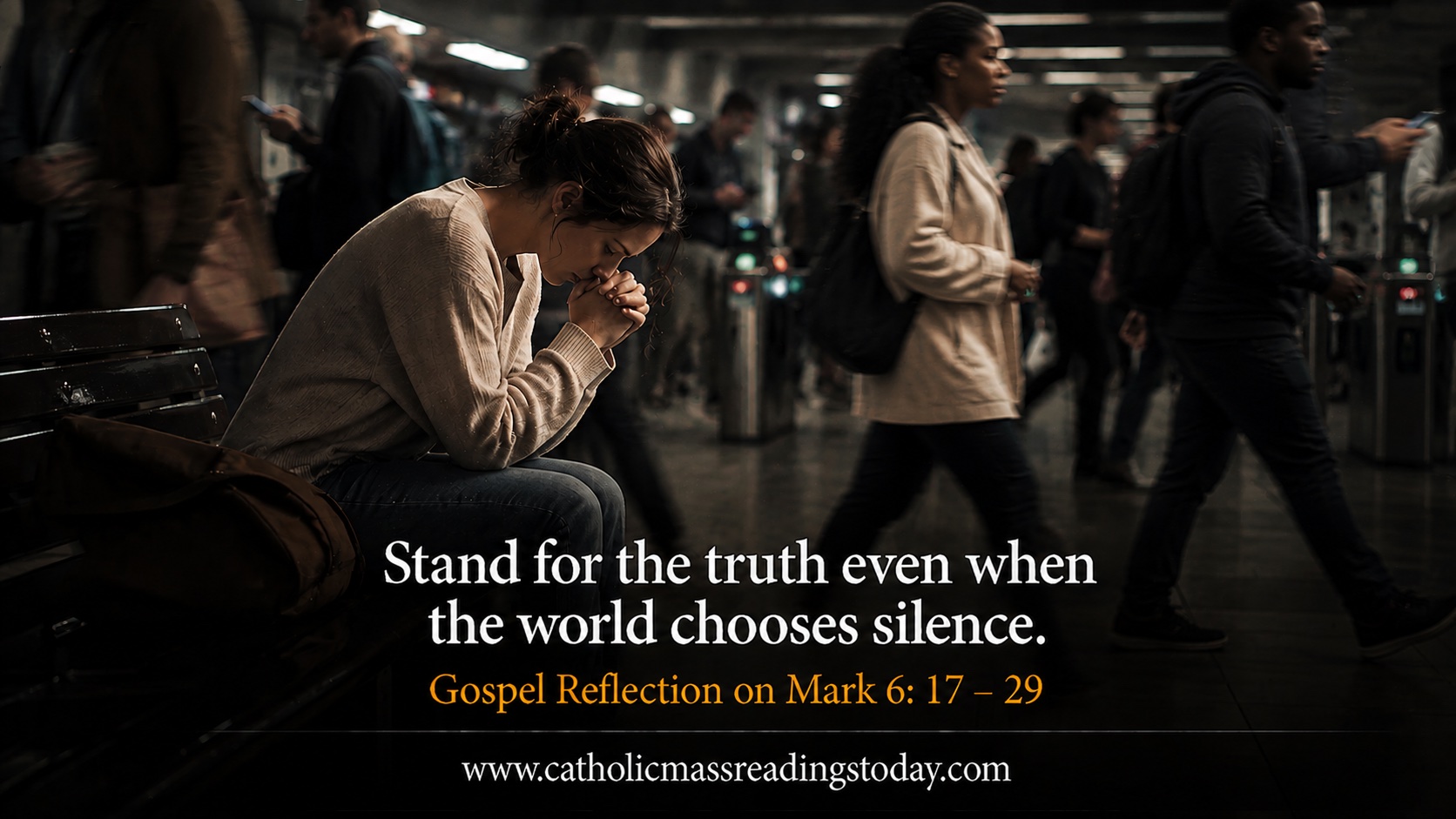
When the Truth Costs Everything
“I want you to give me at once the head of John the Baptist on a platter.”
Today’s Gospel takes us into one of the darkest moments recorded in the ministry of Saint John the Baptist. There is a prison, a royal banquet, a reckless promise, a resentful heart, a weak king and, finally, the death of a righteous man. There is no miraculous rescue. The prison doors do not open. The executioner is not stopped. John, the great prophet who prepared the way of the Lord, is put to death because he refused to remain silent before what he knew was wrong.
Yet beneath the tragedy lies one of the most powerful lessons about Christian freedom. Herod possesses the palace, the soldiers, the wealth and the authority to command another man’s death, but John is the truly free man in this Gospel. Herod can imprison John’s body, but he cannot imprison his conscience.
John the Baptist Would Not Change the Truth to Please the Powerful
John’s conflict with Herod did not arise from personal hatred or political ambition. Scripture tells us plainly why he spoke: Herod had taken Herodias, his brother Philip’s wife, and John told him, “It is not lawful for you to have your brother’s wife.” John could easily have remained silent. He could have convinced himself that confronting a ruler was too dangerous. He might have softened his message so that nobody would be offended, or decided that preserving his life and influence was more important than speaking an uncomfortable truth. But John understood that the truth does not cease to be true simply because speaking it becomes costly.
This does not mean that John hated Herod. Quite the opposite. Within the biblical understanding of repentance, calling another person away from sin is ultimately ordered toward that person’s good. John wanted Herod to turn back. His words were severe because the situation was serious, but their purpose was conversion. Here we find an important lesson for Christians today. Love cannot mean pretending that good and evil are the same, but neither can defending the truth become an excuse for cruelty, humiliation or hatred. The Christian is called to hold truth and charity together. Truth without love can become harshness; love separated from truth can become mere sentiment. In Christ, the two belong together.
Herod Heard the Truth but Would Not Surrender to It
Perhaps the most revealing part of this Gospel is that Herod was not completely deaf to John. Saint Mark tells us that Herod knew John to be “a righteous and holy man.” He feared him and protected him. Even more surprisingly, although John’s words left him perplexed, Herod heard him gladly.
There is a serious spiritual warning hidden in that sentence. It is possible to enjoy hearing the truth without allowing the truth to change us.
A person can listen to Scripture, admire the saints, attend Mass, appreciate a powerful homily and even feel deeply moved by the Word of God, while continuing to protect the very parts of life that God is asking him to surrender. Herod listened to John, but he did not obey the truth John proclaimed. He wanted to hear the prophet without accepting the conversion demanded by the prophet.
We can face the same temptation. There may be something in our lives that we already know must change: a resentment we refuse to release, dishonesty that benefits us, an immoral relationship we have learned to justify, a habit that is damaging our soul, pride that prevents reconciliation, gossip we continue to entertain, or some other compromise that we know cannot be reconciled with the Gospel. At such moments, Christianity cannot remain merely something beautiful that we hear. The Word of God asks for an answer.
Herod delayed that answer until the moment came when his weakness overwhelmed his conscience.
A Banquet Where Nobody Was Truly Free
The Gospel then takes us from John’s prison into Herod’s birthday banquet. On the surface, everything suggests success and power. Courtiers, military officers and the leading men of Galilee have gathered around the king. There is food, entertainment, prestige and celebration. Yet almost everyone in that palace is imprisoned by something.
Herodias is imprisoned by resentment. Her hatred of John has grown so deep that she desires his death. Her daughter becomes the instrument through which that resentment reaches its terrible conclusion. Herod is imprisoned by pride and by his fear of what his guests will think. Those gathered around him remain silent while an innocent man is condemned.
And beneath them, locked inside a prison cell, sits John the Baptist.
The man in chains possesses integrity. The king sitting on the throne does not.
This is one of the great reversals of today’s Gospel. The world often confuses power with freedom. Yet a person who cannot say no to pride, lust, greed, anger, resentment or public opinion is not truly free, regardless of his position or possessions. Christian freedom is something much deeper. It is the freedom to choose what is good even when doing so is difficult. It is the freedom to obey God when compromise would be easier.
John possesses that freedom. Herod does not.
“Because of His Oaths and His Guests”
When Herodias’ daughter asks for John’s head, the Gospel tells us that Herod becomes “exceedingly sorry.” This is important because Herod knows that what he is about to do is wrong. His conscience has not completely died. But another voice has become stronger. He has made his promise publicly, and now the guests are watching.
Herod chooses the approval of the room over the voice of his conscience.
That ancient banquet suddenly becomes very close to our own lives. How often do people do something they know is wrong simply because they are afraid of what others will think? A young person may join in something sinful because refusing would invite ridicule. Someone may participate in cruel gossip because remaining silent would make him stand apart from the group. A professional may compromise his integrity because dishonesty has become normal in the workplace. A Christian may hesitate to defend the dignity of human life or the teachings of the faith because he fears being considered unfashionable, intolerant or outdated.
Today, public approval can be measured almost instantly through likes, followers, comments and shares. The pressure to conform can be enormous. We can become so concerned with how we appear before other people that we forget the far more important question: How do I stand before God?
Herod would rather sacrifice an innocent man than sacrifice his pride. John would rather sacrifice his life than sacrifice the truth.
That contrast lies at the heart of today’s Gospel.
Sin Rarely Tells Us Where It Intends to Take Us
There is also a frightening progression of sin within the story. Herod’s unlawful relationship leads to John’s rebuke. Herodias allows that rebuke to become resentment. Resentment develops into hatred. Hatred waits for an opportunity. Herod makes a reckless promise. Pride prevents him from withdrawing it. Finally, an innocent man is killed.
Sin rarely tells us at the beginning where it intends to take us.
What first appears small or manageable can gradually gain power over the heart when it is deliberately tolerated. The conscience that is repeatedly ignored can become less sensitive. What once disturbed us can begin to seem normal. What we once knew required repentance can eventually become something we defend.
This is why the Church’s call to conversion is not a burden placed upon us; it is an invitation to freedom. Examination of conscience, repentance and the Sacrament of Reconciliation are gifts through which Christ breaks the chains that sin places around the human heart. God does not call us to confession because He delights in our shame. He calls us because He desires to restore us.
Herod heard the prophet and postponed conversion. The Gospel urges us not to make the same mistake. When God speaks to the conscience, the right time to return to Him is now.
John’s Silence After Death Became Louder Than Herod’s Palace
There is another extraordinary truth hidden in the death of John. From the perspective of that evening, Herod appears to have won. He gives the order, the soldier obeys, John is executed, and the prophet’s voice seems finally to have been silenced.
But history tells a very different story.
Herod’s banquet ended. His guests disappeared into history. His political influence vanished. The splendour of his court faded. Yet the voice of John the Baptist continues to be heard throughout the world. Every generation of Christians hears his call to repentance. Every year the Church remembers his witness. Every time this Gospel is proclaimed at Mass, John speaks again.
The king who tried to silence the prophet is remembered largely because of the prophet he killed.
This is the mysterious strength of a life surrendered to God. The world may silence the witness, but it cannot destroy the truth to which that witness has given his life.
John had already summarized the whole direction of his vocation when he said of Christ, “He must increase, but I must decrease.” His entire life pointed beyond himself toward Jesus. Even his martyrdom does the same.
John the Baptist Points Toward Christ Even in Death
In fact, John’s death prepares us to contemplate the Passion of Christ. John is innocent, and Jesus is innocent. John is arrested because his words disturb those in power; Jesus is arrested because His truth is rejected. Herod recognizes that John is righteous but allows him to die; Pilate recognizes the innocence of Jesus but hands Him over to crucifixion. Herod is afraid of his guests; Pilate is afraid of the crowd. Both men possess earthly authority, yet both surrender moral responsibility because they lack the courage to act according to the truth they recognize.
John remains, therefore, what he had always been: the forerunner. He prepared the way for Christ through his preaching, pointed Him out at the Jordan, and even in death foreshadowed the rejection that Christ Himself would endure.
Yet John merely bears witness to the truth; Jesus is the Truth. John’s death is the testimony of a faithful servant. Christ’s death is the sacrifice through which humanity is redeemed. And through the Resurrection of Jesus we discover something that changes how we understand John’s apparent defeat: death does not have the final word.
The final word belongs to God.
What This Gospel Says to Christians Today
This is why the courage of John the Baptist remains so necessary for Christians today. Yet his courage should never be confused with aggression. Christian courage is not the ability to insult those who disagree with us. It is not shouting more loudly than everyone else. It is not winning arguments for the sake of pride. John’s courage was the willingness to remain faithful to God when silence and compromise would have been easier.
The Church needs that kind of courage in our families, workplaces, schools, communities and public life. There are truths about the sacredness of human life that must be defended. There are truths about marriage, family and human dignity that must be witnessed to with charity. There are poor and vulnerable people whose suffering must not be ignored. There are injustices before which silence can become a form of cooperation. There are moments when forgiveness must overcome vengeance, when chastity requires sacrifice, when honesty costs us financially, and when simply acknowledging that we belong to Christ requires courage.
Most Christians will never be called to the dramatic martyrdom of John the Baptist, but every Christian is called to the daily martyrdom of dying to self.
That witness is built through ordinary decisions long before any great test arrives.
The Christian Must Form the Conscience Before the Crisis Comes
Herod’s failure teaches us why our conscience must be formed before the crisis comes. At the banquet, events move quickly. The dance is followed by the promise, the request, the embarrassment and then the command. Herod does not suddenly become weak in that moment. His decision reveals the weakness that has already been growing within him.
We cannot wait until the moment of great temptation to begin becoming people of virtue.
We learn courage by telling the truth in small matters. We learn generosity by giving when nobody is watching. We learn forgiveness by surrendering ordinary resentments. We learn chastity through daily discipline. We learn fidelity by keeping our promises when breaking them would be easier. And we learn how to stand before God by first learning how to kneel before Him.
This is why the ordinary practices of Catholic life matter so deeply. Sunday Mass, the Holy Eucharist, regular confession, daily prayer, Sacred Scripture, works of mercy and examination of conscience are not religious decorations added around our lives. Through them Christ forms our hearts. Through grace, He gradually teaches us to desire what is good and gives us strength to choose it.
Then, when the difficult hour comes, our decisions reveal what our hearts have been becoming.
When Doing What Is Right Appears to Cost Too Much
Perhaps someone reading today’s Gospel is already facing such a moment. Perhaps you know what is right, but doing it may cost you. You may need to apologize when pride tells you not to. You may need to forgive someone who has wounded you deeply. You may need to walk away from something sinful. You may need to tell the truth when a lie would protect your reputation. You may need to defend someone who is being mistreated. You may need to return to confession after many years away. You may even need to stand alone because those around you have chosen differently.
John the Baptist reminds us that fidelity has a price. But Herod reminds us that compromise has a price too.
One may cost us something in the eyes of the world. The other can cost us something within our soul.
Jesus never promised that following Him would always be comfortable. He promised something far greater. He promised life. John lost his earthly life, but he remained God’s faithful servant. Herod protected his reputation before his guests, yet the very decision intended to preserve that reputation became his lasting disgrace.
The Gospel therefore asks us to reconsider what it really means to win and what it really means to lose.
The Last Word Belongs to God
At the end of the passage, John’s disciples hear what has happened. They come for his body and lay it in a tomb. The Gospel does not describe an earthly victory. There is simply the grief of disciples burying a faithful man.
But Christians hear these words knowing another tomb is coming.
We know that Christ will also be rejected, condemned and killed. We know that His body will also be placed in a tomb.
And we know that the tomb will not hold Him.
Because of the Resurrection, we understand John’s death differently. If earthly life were everything, then John’s fidelity might seem foolish. But if we were created for eternal communion with God, then the greatest tragedy is not losing what this world can take from us. The true tragedy would be losing ourselves by abandoning the One for whom we were created.
John understood where his life belonged.
Herod could take his freedom, his comfort and eventually his earthly life. But there was one thing Herod could never take from him: his fidelity to God.
That may be the deepest invitation contained in today’s Gospel.
We should ask God not merely for dramatic courage in extraordinary circumstances, but for the courage needed today: courage for today’s temptation, today’s conversation, today’s decision, today’s act of forgiveness, today’s opportunity to defend someone, today’s invitation to repent, today’s moment when we must decide whether the approval of others matters more than the voice of conscience.
The world does not simply need Christians who are louder. It needs Christians who are freer: free from the constant need for approval, free from resentment, free from fear, free from the slavery of sin, free enough to forgive, free enough to love, free enough to speak the truth with charity and free enough, when necessary, to stand alone with Christ.
John the Baptist entered prison as a man whom Herod could bind with chains, yet he died freer than the king who ordered his execution.
And so today’s Gospel leaves us with a question that reaches far beyond Herod’s palace and enters directly into our own hearts:
When faithfulness to God and the approval of the world pull us in different directions, whose voice will we choose?
Let us Pray
Almighty and eternal God,
You gave Saint John the Baptist the courage
to prepare the way of Your Son
and to bear witness to the truth even unto death.
Strengthen us by Your grace,
that we may never place human approval
above fidelity to You.
Form our consciences by Your Word,
purify our hearts through repentance,
and give us courage to choose what is right
when compromise would be easier.
When we fear what others may think,
remind us that we stand first before You.
When resentment enters our hearts,
teach us to forgive.
When temptation invites us away from You,
strengthen us through the Holy Spirit.
And when we fall into sin,
give us the humility to return to You
through sincere repentance
and the Sacrament of Reconciliation.
Through the intercession of Saint John the Baptist,
teach us to speak the truth with charity,
to defend the dignity of every human person,
and to remain faithful to Christ
in the great and ordinary choices of our lives.
May we follow Your Son faithfully on earth
and one day rejoice with the Blessed Virgin Mary,
Saint John the Baptist and all the saints
in the glory of Your eternal Kingdom.
Through Christ our Lord.
Amen.
Saint John the Baptist, pray for us.