“New Wine Must Be Put into Fresh Wineskins”
The Bridegroom Is With Us
In today’s Gospel, the Pharisees and scribes come to Jesus with a question. They have noticed that the disciples of John fast, and the disciples of the Pharisees fast, but the disciples of Jesus eat and drink. Beneath their question is something deeper: they are trying to understand why life with Jesus seems different.
Our Lord answers them with the image of a wedding feast: “Can you make wedding guests fast while the bridegroom is with them?”
Jesus is speaking about Himself.
Throughout Sacred Scripture, the relationship between God and His people is often described in the language of a covenant of love. Now Christ presents Himself as the Bridegroom. God has not remained distant from humanity. He has come among His people. In Jesus Christ, God has drawn near.
This is why Christian faith cannot be reduced simply to rules, obligations and religious habits. At its heart is a Person. Christianity begins with an encounter with Jesus Christ.
Prayer, fasting, sacrifice and obedience have their proper place in Christian life, but they receive their meaning from our relationship with Him. We do not fast simply to prove that we are religious. We fast because we love Christ and desire that nothing should possess our hearts more than He does.
Jesus therefore continues: “The days will come, when the bridegroom is taken away from them, and then they will fast in those days.”
The Church has never abandoned fasting. Christ Himself shows that there will be a time for it. This is why fasting remains part of Catholic spiritual life, especially during Lent and on the penitential days established by the Church.
Christian fasting is not a rejection of the goodness of creation. It is an act of freedom.
We sometimes discover that things which are good in themselves can slowly begin to control us. Food, possessions, entertainment, comfort, money, technology, recognition and countless other things can occupy so much space in our hearts that we lose our hunger for God.
Fasting teaches the heart to say: Christ is greater. God is enough.
The New Wine of Christ
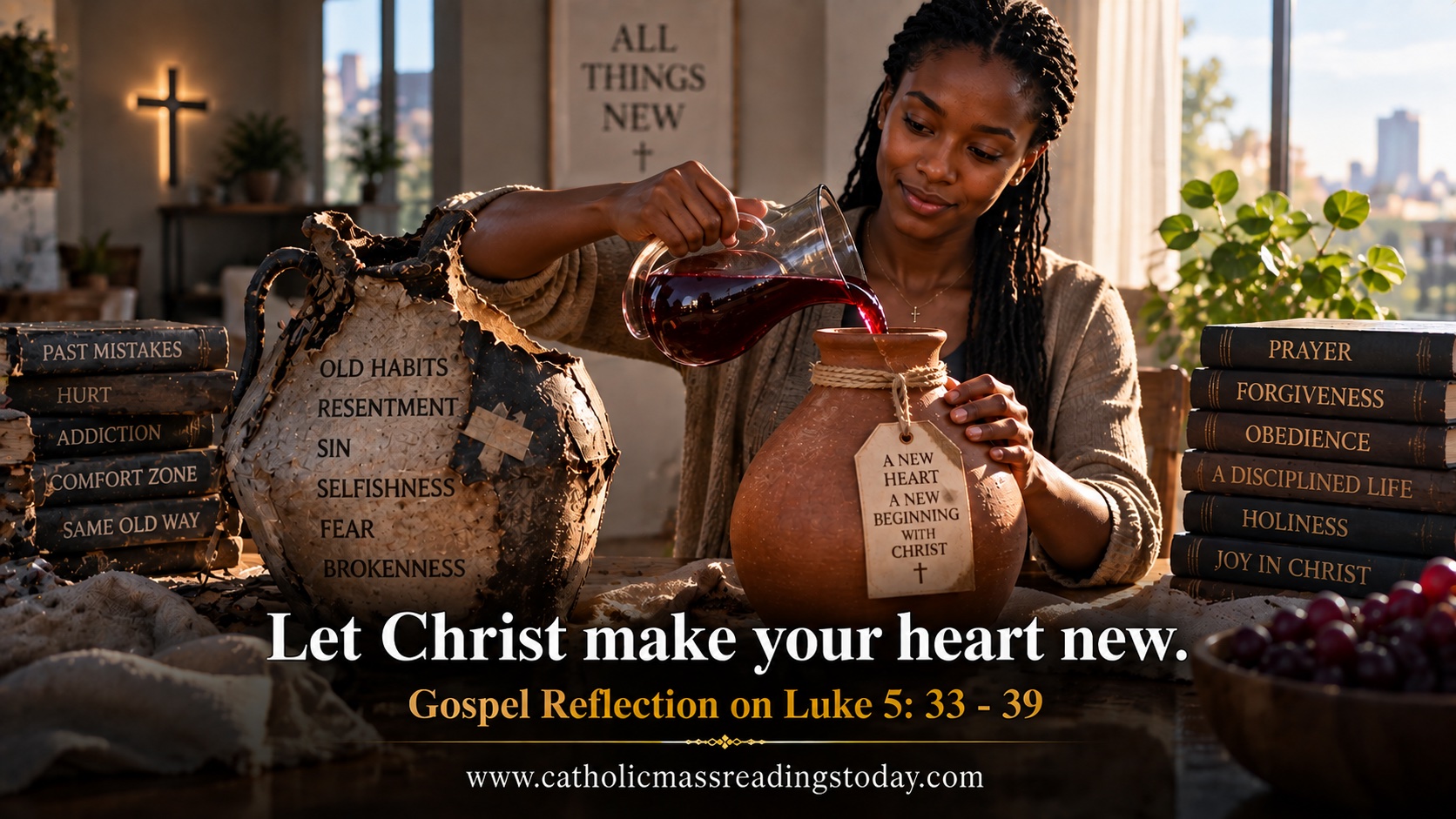
Jesus then gives another image: “No one puts new wine into old wineskins.”
In the world of Jesus, new wine continued to ferment. If it were poured into an old wineskin that had already become dry and rigid, the pressure could cause the skin to burst. New wine required a fresh wineskin capable of stretching as the wine matured.
The image is simple, but its spiritual meaning reaches deeply into our lives.
Christ has not come merely to place a religious patch over our old way of living.
He has come to make us new.
Sometimes we want Jesus in our lives, but only on the condition that He leaves everything else untouched. We want Christ without conversion. We want His comfort without His commandments, His mercy without repentance, His promises without surrender.
But the Gospel cannot simply be added as one more part of a life whose direction remains unchanged.
When Christ enters a human heart, He begins to transform it.
The new wine of the Gospel requires a heart willing to become new.
This is the work that began in us at Baptism and continues throughout our Christian life. Grace does not destroy what is truly human in us; it heals, purifies and elevates it. Christ does not take away our humanity. He restores us to the fullness for which we were created.
When the Heart Becomes an Old Wineskin
The danger described by Jesus is not confined to the Pharisees. Every Christian must listen carefully to this Gospel.
Our hearts can become like old wineskins.
They become rigid when we refuse to forgive.
They become rigid when pride prevents us from admitting that we are wrong.
They become rigid when we become so accustomed to sin that we no longer struggle against it.
They become rigid when our faith becomes merely routine, Mass without attention, prayer without the heart, religious language without conversion.
It is possible to spend many years around the things of God while resisting what God is trying to do within us.
That is why the Christian life requires continual conversion.
Every morning Christ invites us to begin again. Every sincere Confession offers a new beginning. Every worthy reception of the Eucharist draws us deeper into communion with Him. Every act of forgiveness, every hidden sacrifice and every decision to reject sin makes more room for the new life Christ desires to give us.
The question is not simply whether we have known Christ in the past.
The question is whether we are allowing Him to change us today.
Christ Does Not Simply Repair Us; He Renews Us
Jesus also speaks about the foolishness of cutting a piece from a new garment in order to repair an old one. The new piece will not truly solve the problem.
Again, Our Lord is telling us that the Gospel is not a superficial repair.
We sometimes approach God only when something has gone wrong. We ask Him to repair our marriage, solve our financial difficulty, heal an illness, help our children, restore a relationship or rescue us from a crisis. There is nothing wrong with bringing these needs to God. Indeed, He wants us to bring them to Him.
But Jesus desires something even greater.
He does not simply want to repair one damaged corner of our lives while everything else remains beyond His reach.
He wants our hearts.
Christ wants to enter our hopes and fears, our relationships and ambitions, our work and family life, our wounds and memories, our decisions and our future.
He wants the whole person.
This is the radical beauty of the Gospel. Jesus Christ does not say, “Give Me the religious part of your life.”
He says, “Follow Me.”
Do Not Be Afraid of the Newness of Christ
Sometimes we resist this newness because change frightens us.
We know the old wineskin. We are familiar with our habits, even when those habits are hurting us. We know our resentments. We know our compromises. We know the excuses we have repeated for years.
Christ calls us beyond them.
There is something deeply hopeful in this Gospel. Jesus would not ask us to become new if His grace were unable to make us new.
- No person is imprisoned forever by the past.
- No sin that is sincerely repented of is greater than the mercy of God.
- No heart is so hardened that Christ cannot soften it.
- No life is so broken that His grace cannot begin the work of restoration.
This was one of the great convictions proclaimed repeatedly by Saint John Paul II throughout his ministry: we must not be afraid to open our lives to Christ. Christ does not diminish the human person. He reveals to us the greatness of the life for which we were created.
When we surrender something to Christ, we are not losing ourselves.
We are allowing Him to lead us toward our true selves.
Making Room for the New Wine
Today’s Gospel therefore invites each of us to look quietly into our own heart.
Perhaps there is something there that has become rigid.
Perhaps there is an old resentment we have carried for too long. Perhaps there is a habit we know does not belong in the life of a disciple. Perhaps our prayer has become mechanical. Perhaps we have grown comfortable with a faith that asks very little of us.
Christ stands before us with new wine.
- He offers grace.
- He offers mercy.
- He offers a new beginning.
But He asks us to become capable of receiving what He desires to give.
This is why the Christian life is never finished. Until our final breath, God continues forming us. The Holy Spirit continues working within us, stretching the heart, purifying our desires and drawing us toward holiness.
We should never become so comfortable with yesterday’s faith that we refuse what God wants to do in us today.
The Bridegroom is Christ and the new wine is the life He gives.
And the fresh wineskin must become our own heart, humble enough to repent, free enough to surrender and open enough to receive the transforming grace of God.
Let us therefore ask ourselves today: Am I asking Jesus merely to fit into the life I have already chosen, or am I allowing Him to make my life new?
May we never be afraid of the answer.
For when Christ makes the heart new, He does not take life away from us.
He gives us life in abundance.
Let us Pray
Lord Jesus Christ,
You are the Bridegroom of Your Church
and the source of all true joy.
Renew our hearts by Your grace.
Free us from everything that has become hardened within us,
from pride that refuses correction,
from resentment that refuses forgiveness,
and from habits that keep us far from You.
Teach us the true meaning of prayer, sacrifice and fasting,
that through them our hearts may become more deeply united with You.
Pour the new wine of Your grace into our lives
and make our hearts ready to receive it.
Give us courage to leave behind whatever cannot accompany us
on the path of holiness.
May we never be afraid of the new life You offer,
but open every part of ourselves to Your transforming love.
Make us faithful disciples,
renewed in mind and heart,
and lead us at last to the eternal wedding feast
where You live and reign with the Father and the Holy Spirit,
God, for ever and ever.
Amen.