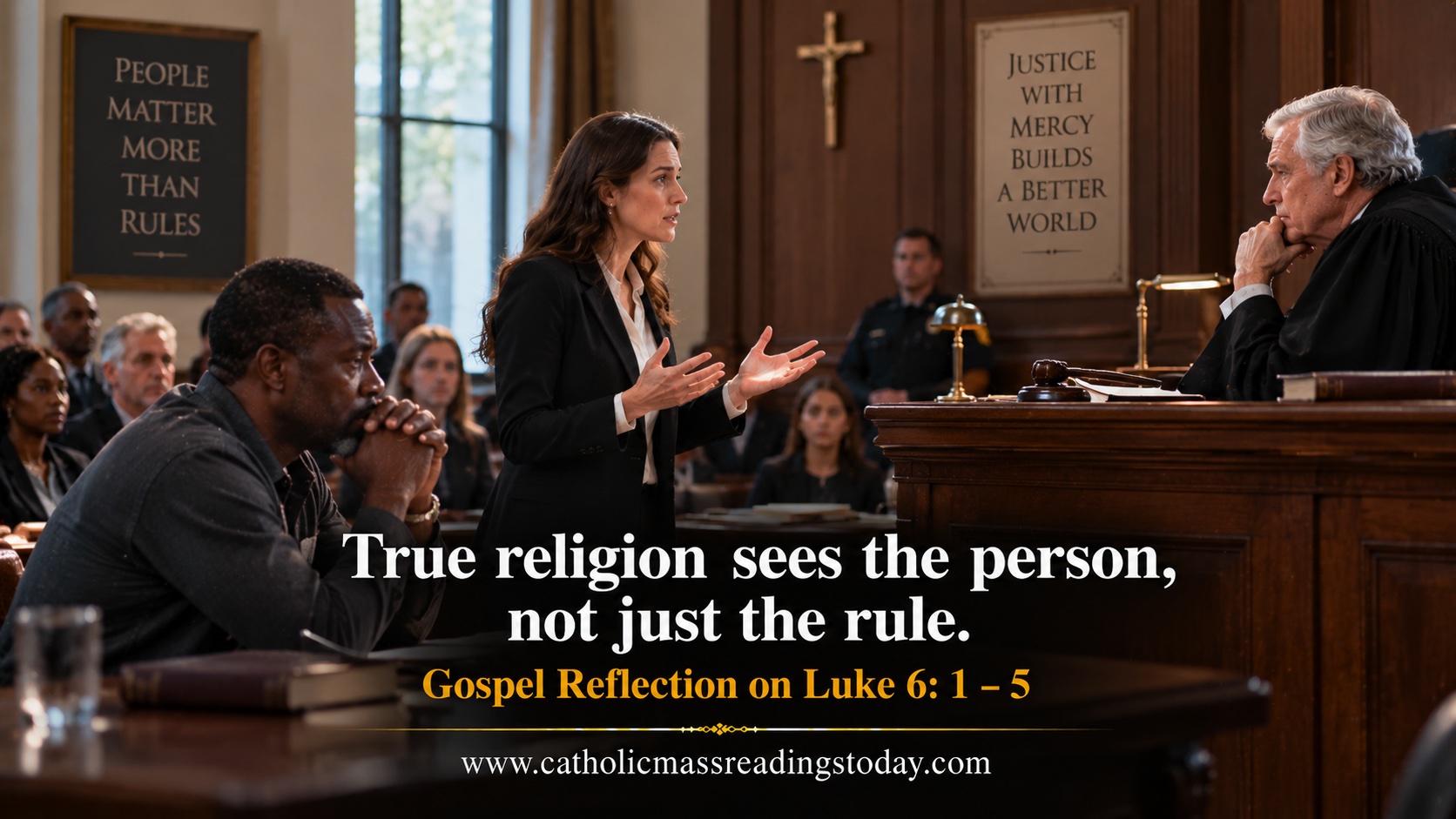
“The Son of Man Is Lord of the Sabbath”
When the Law Meets Human Need
In today’s Gospel, Jesus and His disciples are walking through the grain fields on the Sabbath. The disciples are hungry. As they walk, they pluck some heads of grain, rub them between their hands and eat.
It seems like such a small and ordinary thing. Hungry men take a little grain to satisfy their hunger.
Yet some of the Pharisees immediately object: “Why are you doing what is not lawful to do on the Sabbath?”
At first, this Gospel may appear to be simply a disagreement about religious rules. But Jesus takes us much deeper. He invites us to consider why God gives His commandments in the first place, what the Sabbath truly means, and what happens when religious observance loses sight of the God whom it is supposed to serve.
The Pharisees were right to take the Sabbath seriously. The Sabbath came from God. It belonged to the covenant and recalled God’s own rest after creation. For Israel, keeping the Sabbath was a sacred act of obedience.
The problem was not that they cared about God’s law. The problem was that they could become so preoccupied with their interpretation of the law that they failed to see the hungry people standing before them.
And whenever religion makes us less capable of seeing the human person before us, something has gone wrong.
God’s Commandments Are Given for Life
Jesus responds by reminding them of David.
When David and his companions were hungry, David entered the house of God and ate the bread of the Presence, giving some also to those who were with him. Jesus points to this episode not because God’s law is unimportant, but because the law must be understood according to the purpose for which God gave it.
God does not give commandments to crush the human person, He gives them to lead us into life.
This distinction matters greatly. We live in a time when freedom is often understood as the ability to do whatever we want. The Gospel teaches something very different. True freedom is not freedom from God. It is the freedom to become the people God created us to be.
God’s commandments protect that freedom.
The commandment against adultery protects the sacredness of marriage. The commandment against stealing protects justice and the dignity of another person’s labour and possessions. The commandment against false witness protects truth and reputation. The command to keep holy the Lord’s Day protects something our hurried world desperately needs: time for God, worship, rest, family and the renewal of the human spirit.
The law of God is therefore not the enemy of human dignity. Properly understood, it serves it.
“The Son of Man Is Lord of the Sabbath”
Jesus concludes with an extraordinary declaration:
“The Son of man is lord of the sabbath.”
These words are at the heart of today’s Gospel.
Jesus is not simply offering another opinion about how the Sabbath should be observed. He places Himself at the centre of the question. The Sabbath belongs to God, and yet Jesus declares Himself its Lord.
Once again, the Gospel confronts us with the identity of Christ. He is not merely a teacher explaining religion. He is the Son of God. The commandments find their fulfilment in Him. The Scriptures point toward Him. The covenant reaches its fullness in Him.
This is why Christian life can never be reduced merely to following regulations, at the centre of Christianity is Jesus Christ Himself.
We come to Mass not simply because Sunday attendance is an obligation. The obligation is real and important, but behind it stands something far greater: Christ is waiting for us.
- He speaks to us through His Word.
- He offers Himself to the Father in the Eucharistic Sacrifice.
- He gives us His own Body and Blood in Holy Communion.
Sunday is the Lord’s Day because it belongs to the risen Christ.
When Faith Becomes Only an Obligation
Today’s Gospel also invites us to examine our own religious life. There is always a danger that faith can slowly become a collection of things we perform without allowing them to reach the heart.
- We can attend Mass while remaining unwilling to forgive someone.
- We can know Catholic teaching while speaking cruelly about others.
- We can pray the Rosary while carrying resentment that we refuse to surrender.
- We can defend Christian morality while lacking patience with the people inside our own homes.
The answer is not to abandon prayer, the commandments, fasting, Sunday Mass or the teachings of the Church. The answer is to allow these things to accomplish what God intends through them: our conversion and sanctification. Authentic Catholic faith must change the heart.
The closer we come to Christ, the more His mercy should become visible in us. Our fidelity to truth should make us more charitable, not more arrogant. Our knowledge of the faith should make us humbler, not more judgmental. Our worship of God should make us more attentive to the dignity of the people He places before us. Otherwise, we may know the rule while missing the Lord.
The Lord’s Day in Our Busy World
There is another message in this Gospel that is particularly important today.
Modern life rarely stops.
Our phones are always within reach. Messages arrive at every hour. Work follows many people home. Shopping, entertainment, social media and endless streams of information compete for every quiet moment.
We have become very good at being busy but we are not always good at being still.
The Christian Sunday stands against this endless restlessness.
Sunday reminds us that our worth does not come simply from how much we produce. We are more than workers, consumers, schedules and responsibilities. We are sons and daughters of God.
- We need time to worship.
- We need time for our families.
- We need time to rest.
Above all, we need time to remember that our lives belong to God. This is why the Church continues to call Catholics to keep Sunday holy, with participation in the Holy Mass at its heart. This is not an outdated burden. It is a gift to a humanity that easily forgets why it exists.
When we place Christ at the centre of Sunday, the rest of the week begins to find its proper order.
Mercy Does Not Abolish Truth
We must also be careful not to misunderstand Jesus’ response to the Pharisees.
Christ is not teaching that commandments can simply be ignored whenever they become inconvenient. Jesus never separates mercy from truth.
The same Lord who shows compassion also calls sinners to repentance. The same Christ who refuses self righteous condemnation tells us to take up our cross and follow Him.
Catholic life therefore does not force us to choose between truth and mercy, in Jesus Christ, we encounter both. Truth without love can become cold and harsh. But love separated from truth can become sentimentality that leaves people trapped in what harms them.
Christ gives us something greater: truth spoken in love and mercy that leads to conversion.
This is the balance every Christian must learn.
Look at the Person Before You
Perhaps one of the simplest lessons we can carry from today’s Gospel is this: never become so concerned about being right that you stop seeing the person standing before you.
The Pharisees saw a violation.
Jesus saw hungry disciples.
How often can the same thing happen to us? We may see someone’s failure before we see their struggle. We may notice their mistake before we know their story. We may form a judgment without knowing the burden they have been carrying.
This does not mean pretending that right and wrong do not exist. It means remembering that every person we encounter has a dignity given by God. Christ always sees the whole person and those who follow Him must learn to do the same.
Let Christ Become Lord of Our Lives
At the end of today’s Gospel, everything comes back to one sentence:
“The Son of man is lord of the sabbath.”
If Christ is Lord of the Sabbath, then He must also become Lord of Monday morning, of our workplace, of our marriage, of our finances, of our friendships, of what we watch, of what we say online, of our private decisions and of those parts of our lives that nobody else sees.
Jesus does not ask for one hour on Sunday while the rest of our lives remain untouched.
He asks for our hearts and strangely enough, when we surrender our lives to Him, we do not become less free. We become more fully alive. For Christ never takes away what is truly human. He heals it, purifies it and brings it to fulfilment.
Today, therefore, let us not ask only whether we have fulfilled our religious obligations. Let us ask something deeper:
Has my encounter with Christ made my heart more like His?
If our worship leads us toward greater love of God, deeper faithfulness to His commandments, greater mercy toward others and a more sincere desire for holiness, then the Sabbath is accomplishing within us what God intended.
For the Lord of the Sabbath is not ultimately calling us merely to observe a day.
He is calling us to belong entirely to Him.
Let us pray
Lord Jesus Christ,
Son of Man and Lord of the Sabbath,
You call us from the noise and restlessness of the world
to rest our hearts in You.
Teach us to love Your commandments
and to understand them with hearts formed by Your mercy.
Protect us from a faith that remains only on our lips
while leaving our hearts unchanged.
Give us the humility to recognise our own weaknesses
before judging the weaknesses of others.
Help us to keep holy the Lord’s Day,
to approach the Holy Mass with reverence and gratitude,
and to recognise Your presence
in Your Word and in the Most Holy Eucharist.
Make us faithful to truth without becoming harsh,
merciful without abandoning what is right,
and obedient without forgetting love.
May You be Lord not only of our Sundays,
but of every day, every decision
and every part of our lives.
Lead us ever closer to the Father,
and make our hearts more like Your Sacred Heart.
You who live and reign
for ever and ever.
Amen.