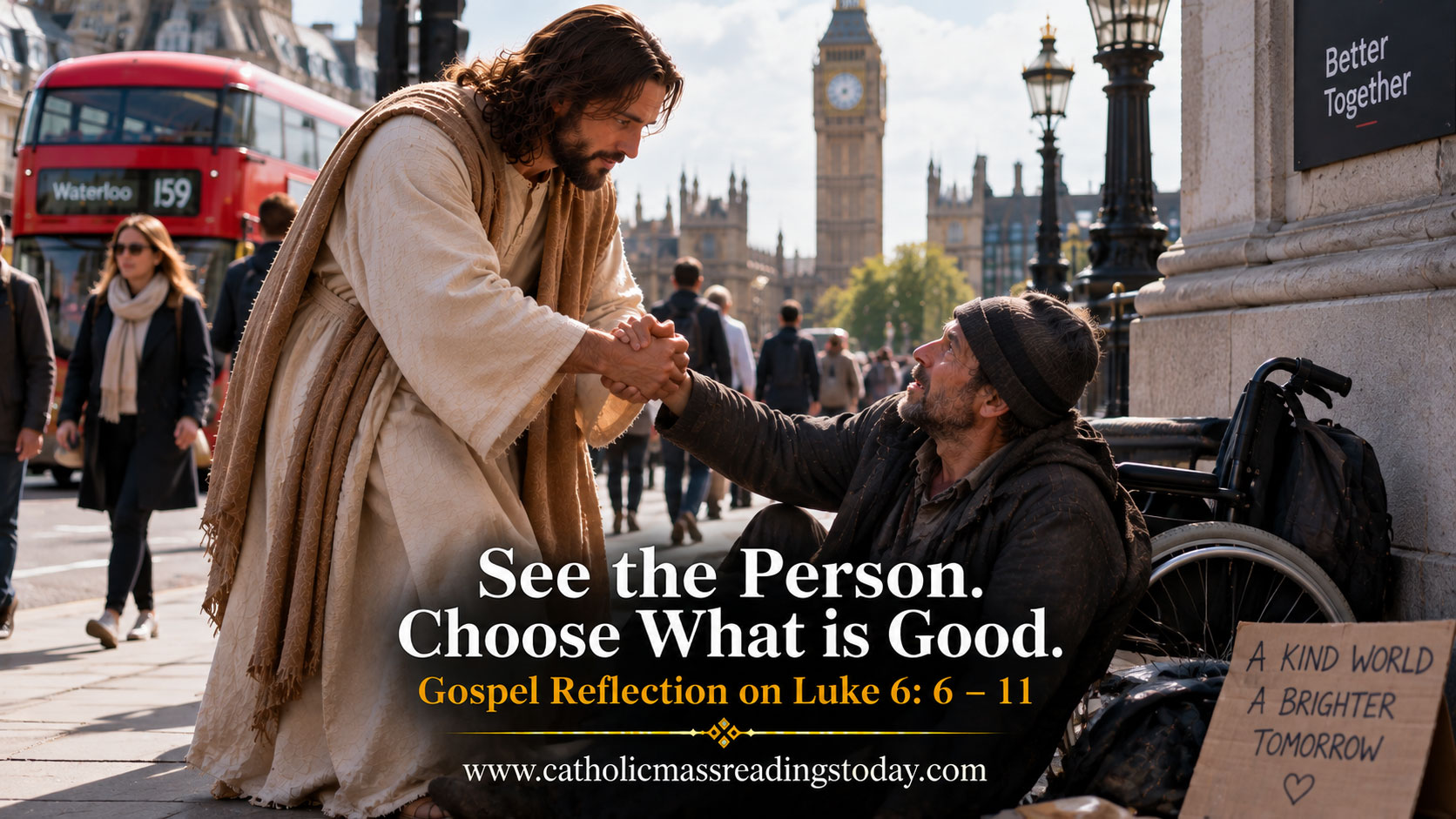
“Stretch Out Your Hand”
There is something deeply unsettling in today’s Gospel. Jesus enters the synagogue on the Sabbath, and there before Him is a man whose right hand is withered. He carries a visible weakness, perhaps one that has shaped his work, his relationships and his place within the community for many years.
Yet some of those gathered in the synagogue are hardly looking at the suffering man at all.
They are watching Jesus. Not because they want to learn from Him. Not because they hope that this wounded man might finally be healed. Saint Luke tells us that the scribes and Pharisees are watching Jesus so that they might find something of which to accuse Him.
The man’s suffering has become secondary to their argument and it is precisely into this situation that Christ speaks.
When Religion Forgets the Person
Jesus does not reject the Sabbath. He does not treat the commandments of God as unimportant. The Sabbath is holy, given by God Himself, and Jesus knows its true meaning better than anyone standing in that synagogue.
But He also knows that God’s law can never be separated from God’s love.
This is why Jesus asks the question that reaches beyond the immediate dispute: “Is it lawful on the sabbath to do good or to do harm, to save life or to destroy it?”
There is no comfortable answer for those who are waiting to accuse Him.
They have become so concerned with determining whether Jesus will violate their interpretation of the law that they cannot rejoice at the possibility that a suffering man might be restored.
This danger did not disappear with the Pharisees.
We too can know prayers, observe religious practices, defend Catholic teaching and speak passionately about what is right, yet still fail to see the wounded person standing before us.
Authentic Christianity never asks us to choose between truth and love. In Jesus Christ, truth is filled with love, and love remains faithful to truth.
“Come and Stand Here”
There is great tenderness in what Jesus does next. He tells the man, “Come and stand here.”
Imagine that moment. A man accustomed perhaps to hiding his damaged hand is brought into the centre of the synagogue. The very thing that may have caused him embarrassment is now visible to everyone.
But Christ does not bring him forward to humiliate him. He brings him forward because suffering must no longer remain invisible. Jesus places a human person at the centre of a religious argument.
It is as though He is saying: Before you debate what may or may not be done, look at your brother. Look at his suffering. Look at the life that stands before you.
The Church must always learn this gaze from Christ.
Every teaching we defend concerns real human beings. Every moral question eventually touches someone’s life, someone’s family, someone’s wounds, someone’s hope of salvation. Catholic truth must therefore never become cold. It must always carry the face of Christ, who sees the person even when everyone else sees only the problem.
“Stretch Out Your Hand”
Then comes the command at the heart of today’s Gospel:
“Stretch out your hand.” Jesus could have healed the man without asking anything of him. Yet He invites him to act. And what does Christ ask him to stretch out? Precisely what is wounded.
The man could have hidden his hand beneath his garment. He could have been ashamed of it. He could have thought, “This is the part of me that does not work. This is the part of my life I do not want others to see.”
But Jesus says, “Stretch out your hand.”
There is a profound lesson here for our own spiritual lives.
We often want to present God with the parts of ourselves that appear respectable while hiding those places where we are weakest. We bring Him our prayers, our good intentions and our accomplishments, but perhaps we keep hidden the resentment we cannot release, the relationship that is breaking down, the sin we repeatedly struggle with, the fear that controls us, or the wound we have carried quietly for years.
Yet Christ asks us to bring precisely these places to Him.
- Stretch out what is wounded.
- Stretch out what you cannot repair by yourself.
- Stretch out the part of your life you have almost given up believing can change.
The man obeys, and his hand is restored.
Grace often begins at exactly that point: when we stop hiding our wounds from Christ and place them before Him in faith.
Christ Does Not Pass By Human Suffering
There is something else we should notice. Jesus knows that healing this man will provoke opposition. He knows they are watching Him. He knows that His act of mercy will be used against Him.
And still He heals.
Christ refuses to abandon a suffering person simply because doing good will cost Him something.
This is the love revealed most completely on the Cross.
Jesus does not save us from a safe distance. He enters our wounded humanity. He accepts rejection. He bears suffering. Ultimately, He gives His life so that we might have life.
The Christian cannot therefore ask only, “What will this cost me?”
Sometimes love costs time. Forgiveness costs pride. Defending someone costs popularity. Caring for an elderly parent costs convenience. Remaining faithful to the Gospel may cost acceptance. Reconciliation may require us to take the first step when we would rather wait for the other person.
The question Christ places before us is simpler and more demanding:
What is the good that love requires of me now?
A Heart That Can No Longer Rejoice
The Gospel ends with a painful contrast.
A man’s hand has been restored. Something wonderful has happened before their eyes, yet instead of rejoicing, the scribes and Pharisees are “filled with fury.” This may be the most serious warning in the passage.
A heart can become so attached to being right, so consumed by resentment or so determined to protect its own position that even goodness becomes offensive when it comes through someone we oppose.
We should examine ourselves carefully here.
Can I rejoice when God blesses someone I do not particularly like? Can I recognize goodness in someone with whom I disagree? Can I allow Christ to challenge an opinion I have held for years? Or have pride and bitterness hardened something within me?
The greatest tragedy in that synagogue was not the man’s withered hand. Christ healed that.
The greater danger was the hardened hearts of those who saw the miracle and still refused to open themselves to Him.
Let Christ Restore What Has Withered
Today’s Gospel therefore leaves us standing before Jesus with the same invitation given to that man.
“Stretch out your hand.” Perhaps something within us has withered.
Perhaps our prayer has become dry. Perhaps affection within a marriage or family has weakened. Perhaps disappointment has slowly taken away our hope. Perhaps an old hurt has hardened into resentment. Perhaps we have become very good at judging the failures of others while becoming less capable of compassion.
Christ does not turn away from these places. He asks us to bring them to Him.
We encounter His healing grace especially in prayer, in Sacred Scripture, in the Eucharist, and in the Sacrament of Reconciliation. We encounter Him also through acts of mercy, forgiveness and charity, because the Christ who restores us sends us out to become instruments of His mercy for others.
Do not hide the withered hand from the Lord. Do not decide that because something has been wounded for a long time it must remain wounded forever.
Place it before Christ.
And when He asks you to stretch it out, trust Him enough to obey.
For Jesus Christ is still Lord of the Sabbath. He is still the Lord of life. He still enters the places where human hearts have become hardened, and He still calls us away from accusation toward mercy, from fear toward faith, and from what has withered toward the fullness of life that comes from Him.
Let us Pray
Lord Jesus Christ,
You looked with compassion upon the man whose hand was withered
and restored what human strength could not restore.
Look with mercy upon us today.
Heal what has become wounded within our hearts.
Soften what has become hardened.
Free us from pride, bitterness and the temptation to judge others without mercy.
Give us eyes that recognize the suffering of our brothers and sisters,
and hearts courageous enough to choose what is good,
even when love requires sacrifice.
When You ask us to stretch out before You the wounded places of our lives,
give us the faith not to hide them,
but to place them confidently into Your merciful hands.
Make us instruments of Your healing and peace,
so that through our words and actions
others may encounter Your compassion.
You who live and reign with God the Father,
in the unity of the Holy Spirit,
God, for ever and ever.
Amen.