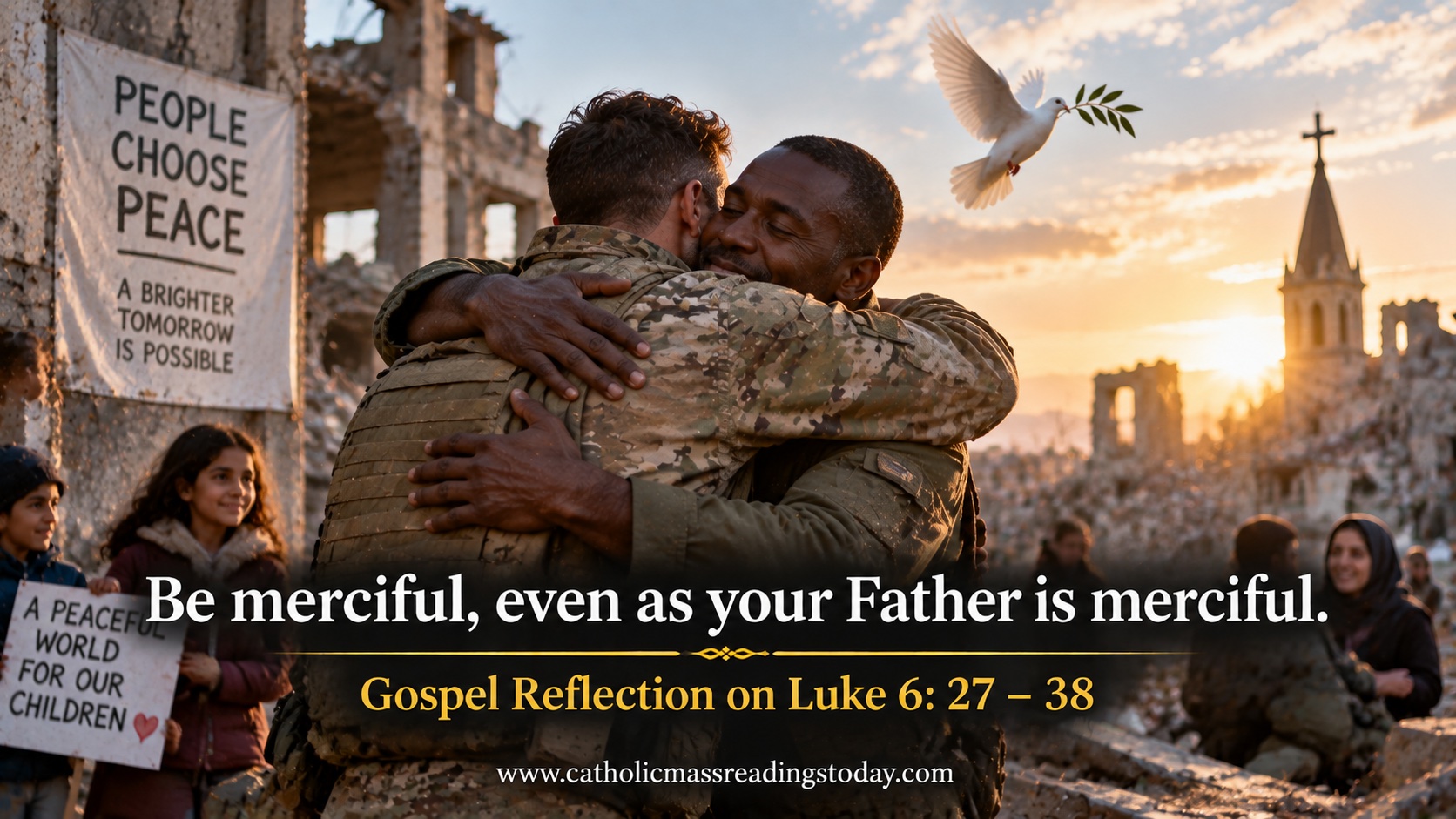
“Be Merciful, Even as Your Father Is Merciful”
There are words of Jesus that console us immediately, and there are words that disturb the comfortable places of the heart. Today’s Gospel belongs to the second kind. Christ does not simply ask us to be kind to those who are kind to us. He goes much further: “Love your enemies, do good to those who hate you, bless those who curse you, pray for those who abuse you.”
This is one of the most demanding teachings in the Gospel. Yet it also reveals something at the very heart of Christianity. Jesus is showing us what the love of God looks like when it enters a human heart and begins to transform it.
Love That Goes Beyond What Is Easy
It is natural to love those who love us. We are drawn toward people who appreciate us, respect us and return our affection. But Jesus asks His disciples to love beyond the limits of natural affection.
“If you love those who love you, what credit is that to you?” He asks.
Christian love begins to reveal its true depth when love is no longer being returned. It appears when we refuse to answer cruelty with cruelty, when we pray for someone who has wounded us, when we choose not to destroy another person’s reputation because they have damaged ours, and when resentment would be understandable but we choose instead to place the wound before God.
This does not mean pretending that evil is good. Neither does it mean allowing another person to continue abusing or harming us. The Church does not teach that mercy requires us to remain in dangerous situations or to abandon justice. We may need boundaries. We may need protection. Serious wrongdoing may need to be reported and confronted.
But even when justice is necessary, Christ asks something extraordinary of the Christian heart: do not allow the evil done to you to teach you how to become evil yourself.
The Freedom of Forgiveness
An unforgiven wound can quietly begin to govern a person’s life. We may carry the memory of what someone said or did for years. The person who hurt us may no longer even be present, yet the injury continues to occupy our thoughts and disturb our peace.
Jesus offers another way.
“Forgive, and you will be forgiven.”
Forgiveness does not erase the past. It does not declare that the wound did not matter. It means surrendering to God our desire to make another person suffer because we have suffered.
Sometimes forgiveness happens slowly. We may have to make the same decision before God many times: “Lord, I still feel the pain, but I do not want hatred to possess my heart.”
That prayer itself can become the beginning of freedom.
“Be Merciful, Even as Your Father Is Merciful”
These words stand at the centre of today’s Gospel.
Jesus does not tell us merely to become more tolerant. He gives us the Father Himself as our measure: “Be merciful, even as your Father is merciful.”
We understand mercy properly only when we remember how much mercy we ourselves have received.
Every time we approach the Sacrament of Reconciliation sincerely sorry for our sins, God does not meet us with humiliation. He meets us with forgiveness. Every time we return after wandering away, He receives us. Every time we fall and call upon Him again, His grace invites us to rise.
The Christian who remembers being forgiven gradually learns how to forgive.
We cannot stand before the crucified Christ, receive His mercy, and then decide that another human being is permanently unworthy of mercy.
Do Not Judge, and You Will Not Be Judged
Jesus then enters another difficult territory of the human heart: our tendency to judge.
“Judge not, and you will not be judged; condemn not, and you will not be condemned.”
Christ is not asking us to pretend that there is no difference between right and wrong. Christians must discern between good and evil. But there is a great difference between recognizing that an action is sinful and placing ourselves in God’s seat as judge of another person’s soul.
We rarely know the whole story of another human being.
We see someone’s failure but may not know the battle that preceded it. We hear an angry word but may not know the sorrow carried behind it. We see a person at their worst and can easily forget that God sees an entire life.
Mercy teaches us to look at another person without reducing them to their worst moment.
The Measure You Give
Jesus concludes with an image of extraordinary generosity: “Good measure, pressed down, shaken together, running over, will be put into your lap.”
God is not stingy with mercy.
And those who have encountered such generosity are called to become generous themselves.
The measure we use with others matters. If we measure everyone by their failures while demanding understanding for our own, something in our Christian life has become distorted. If we ask God for patience while refusing patience to others, today’s Gospel should make us uncomfortable.
Christ asks us to become people through whom His mercy can reach the world.
Perhaps there is someone today whom we find difficult to forgive. Perhaps there is a relationship in which bitterness has slowly taken the place of love. Perhaps there is someone we have judged without really knowing their story.
Jesus does not ask us to manufacture warm feelings toward them. He asks us to begin with something much more concrete.
Pray for them.
Place their name before God.
Ask Christ to heal what has been wounded in you and, in His time, to free your heart from resentment.
The victory of the Gospel is not achieved when we defeat our enemies. It is achieved when, through the grace of Christ, we refuse to become enemies ourselves.
And perhaps this is the question we should carry with us today: when people encounter us, especially when they have disappointed us, offended us or failed us, do they encounter only the measure of human justice, or can they also glimpse something of the mercy of the Father?
For this is the life to which Christ calls us: not simply to receive mercy, but to become merciful.
Let us Pray
Lord Jesus Christ, You have taught us to love our enemies, to bless those who curse us, to forgive those who offend us and to be merciful as our heavenly Father is merciful. Look with compassion upon our hearts and heal every wound that has become a place of anger, bitterness or resentment.
Give us the grace to forgive when forgiveness is difficult, wisdom to seek justice without hatred, and courage to respond to evil without allowing evil to take possession of us. Keep us from judging the hearts of others, and remind us always of the mercy we ourselves have received from You.
Make our hearts generous, patient and compassionate. May those who encounter us discover, through our words and actions, something of the tenderness of the Father. And when our own strength is not enough to love as You command, remain within us and love through us.
You who live and reign with God the Father, in the unity of the Holy Spirit, God, for ever and ever.
Amen.