“Not Seven Times, but Seventy Times Seven”
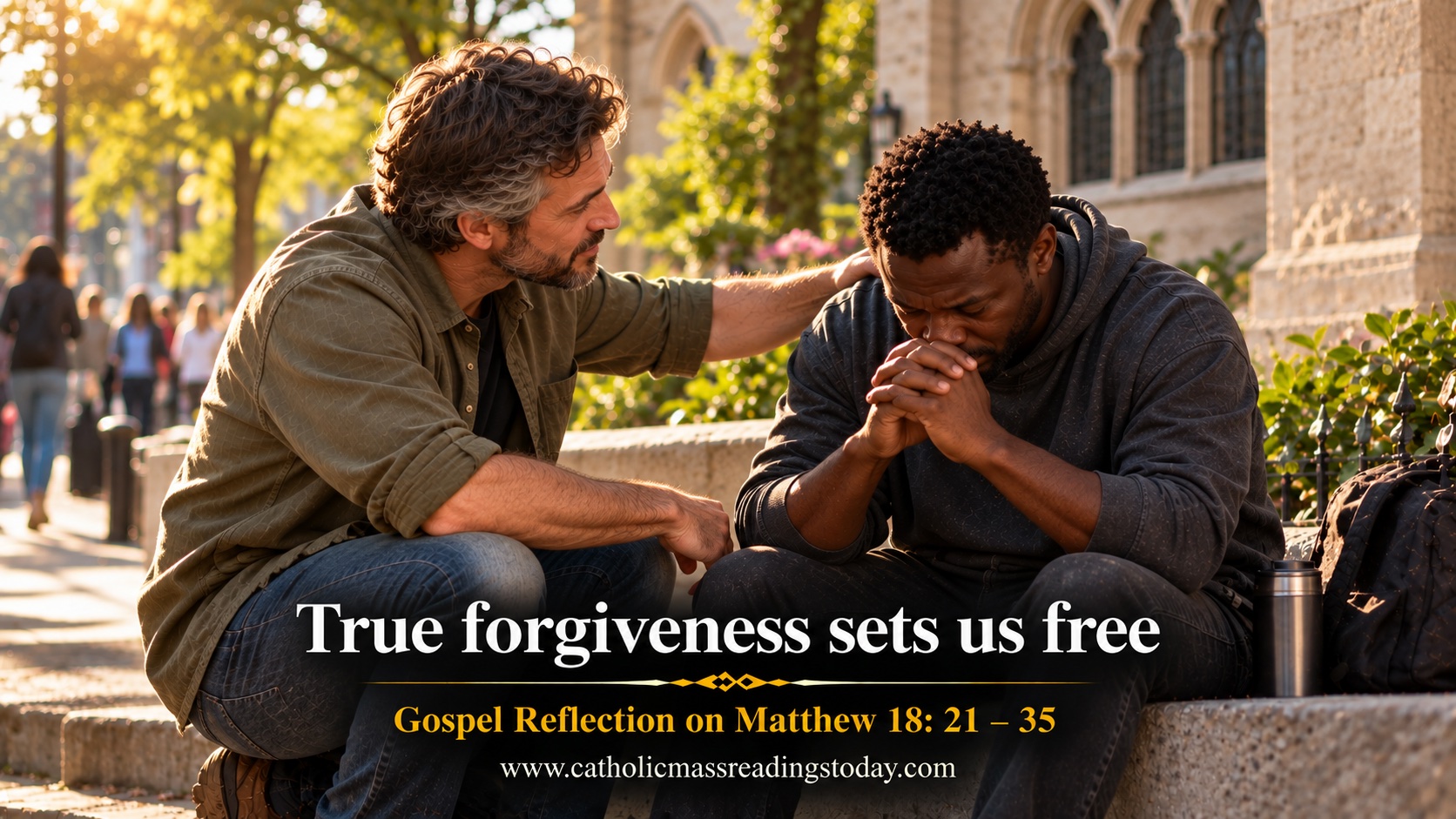
Peter approaches Jesus with a question that touches one of the most difficult parts of Christian life: How many times must I forgive someone who keeps hurting me? Peter even proposes what must have seemed remarkably generous: seven times. Yet Jesus answers, “I do not say to you seven times, but seventy times seven.”
Jesus is not giving Peter a larger number to keep in a notebook. He is telling him to stop counting. The mercy of a Christian cannot be reduced to arithmetic because the mercy we ourselves have received from God cannot be counted.
We Live Because We Have Been Forgiven
Jesus explains His teaching through the story of a servant who owes his king an enormous debt. Ten thousand talents represented a sum so vast that repayment was practically impossible. The servant falls to his knees and begs, “Lord, have patience with me, and I will pay you everything.”
There is something almost heartbreaking about those words. The man promises to repay what he could never realistically repay.
But the king does something the servant does not even dare to request. He does not merely give him more time. He cancels the debt.
This is where the parable becomes our own story.
Before Christianity asks us to forgive, it first reminds us that we are people who have been forgiven. We stand before God unable to purchase His mercy or earn back His love. Yet through Jesus Christ, especially through His Cross and Resurrection, mercy is offered to us as a gift.
Every sincere confession is an encounter with this astonishing generosity of God. We come carrying sins that are truly ours, and through the ministry Christ entrusted to His Church, we hear words of absolution. The debt is not ignored. It is forgiven.
A Christian who remembers this can never look at another person’s need for mercy in quite the same way.
When Mercy Stops at Our Own Door
The tragedy of the parable begins after the servant leaves the king.
He has just received extraordinary mercy, yet when he encounters a fellow servant who owes him a much smaller debt, he seizes him and demands, “Pay what you owe.”
The second servant then speaks words almost identical to those the first servant had spoken before the king: “Have patience with me, and I will pay you.”
The first servant should have recognized himself in those words.
But he does not.
He has received mercy without allowing mercy to change his heart.
And this is perhaps the most uncomfortable part of today’s Gospel. We can receive God’s forgiveness while still finding reasons to withhold forgiveness from someone else. We can pray the Our Father, asking God to “forgive us our trespasses, as we forgive those who trespass against us,” and yet continue carrying an old resentment that we refuse even to place before Him.
Jesus wants His mercy not simply to reach us, but to pass through us.
Forgiveness Does Not Pretend That Nothing Happened
Yet we should understand carefully what Christian forgiveness means.
Jesus is not asking us to pretend that evil is good. Forgiveness does not require us to deny the seriousness of betrayal, violence, dishonesty or abuse. Nor does forgiving someone necessarily mean that trust must immediately be restored or that a harmful relationship must return to exactly what it was before.
Reconciliation requires truth, repentance and, where possible, the rebuilding of trust. Prudence may sometimes require boundaries.
Forgiveness concerns something even deeper. It is the decision, often made repeatedly and with great difficulty, not to surrender our hearts to hatred and revenge.
There are wounds that cannot be healed in an afternoon. Sometimes we may say, “Lord, I want to forgive, but I do not yet know how.” That itself can become the beginning of prayer.
Christ does not ask the wounded person to manufacture feelings that are not there. He asks us to place the wound into His hands and allow His grace to begin freeing us from the power that resentment can exercise over the heart.
Forgiveness From the Heart
The final words of Jesus are particularly important: “If you do not forgive your brother from your heart.”
Christ wants more than polite appearances.
We may stop arguing with someone while continuing the argument within ourselves for years. We may never speak badly about the person publicly, yet secretly rejoice when something goes wrong for them. We may say, “I have forgiven,” while repeatedly reopening the wound in our imagination.
This is why forgiveness requires grace.
There are moments when we simply cannot reach such mercy through willpower alone. We need to stand before the Crucified Christ and remember the words spoken from Calvary: “Father, forgive them.”
The Cross shows us that forgiveness is not weakness. Christ forgives while suffering injustice. His mercy does not deny evil; it defeats evil without becoming evil in return.
That is the freedom He desires for us.
Stop Counting
Perhaps somewhere in our lives there is a person whose offences we have been counting.
We remember the first time, the second time and the tenth time. We remember exactly what was said, where we were standing and how deeply it hurt.
Peter asks, in effect, “Lord, when have I forgiven enough?”
Jesus answers by pointing toward the limitless mercy of God.
Seventy times seven.
Stop counting.
Not because the wound does not matter, but because your heart belongs to God and should not become a permanent home for resentment.
The Christian forgives because Christ first forgave us. We show mercy because we ourselves live every day beneath the mercy of the Father. And when forgiveness seems beyond our strength, we can ask Jesus to begin within us what we cannot accomplish alone.
For in the end, the greatest freedom is not having every debt against us repaid. It is discovering that, through Christ, we no longer need to live imprisoned by what another person owes us.
Let us Pray
Lord Jesus Christ, rich in mercy and compassion, You have forgiven us more times than we could ever count. Look with kindness upon the wounds we carry and upon those places in our hearts where anger, resentment and bitterness still remain.
Give us the grace to forgive as we have been forgiven. Where reconciliation is possible, grant us humility and courage to seek it. Where wounds are deep, give us patience as You bring healing. Protect us from hatred and from every desire for revenge, and teach us to entrust justice into Your hands.
When we find forgiveness difficult, remind us of Your Cross. When memories of past hurts return, draw us again into Your mercy. May the forgiveness we receive in the Sacrament of Reconciliation transform the way we forgive others, so that our hearts may become more like Your Sacred Heart.
Make us instruments of reconciliation in our families, our communities and our world, and lead us at last into that Kingdom where every wound is healed and Your mercy reigns forever.
Through Christ our Lord.
Amen.