“Follow Me”
There is something remarkable about the simplicity of Matthew’s call. Jesus is passing by when He sees Matthew sitting at the tax office. Matthew was a man known by his profession and, because tax collectors were widely despised, likely judged by many around him. Yet when Jesus looks at Matthew, He does not reduce him to his occupation, his reputation or his past. He sees a man who can still become something new through grace.
Jesus says only two words: “Follow me.”
And Matthew rises and follows Him.
Christ Calls Us Where We Are
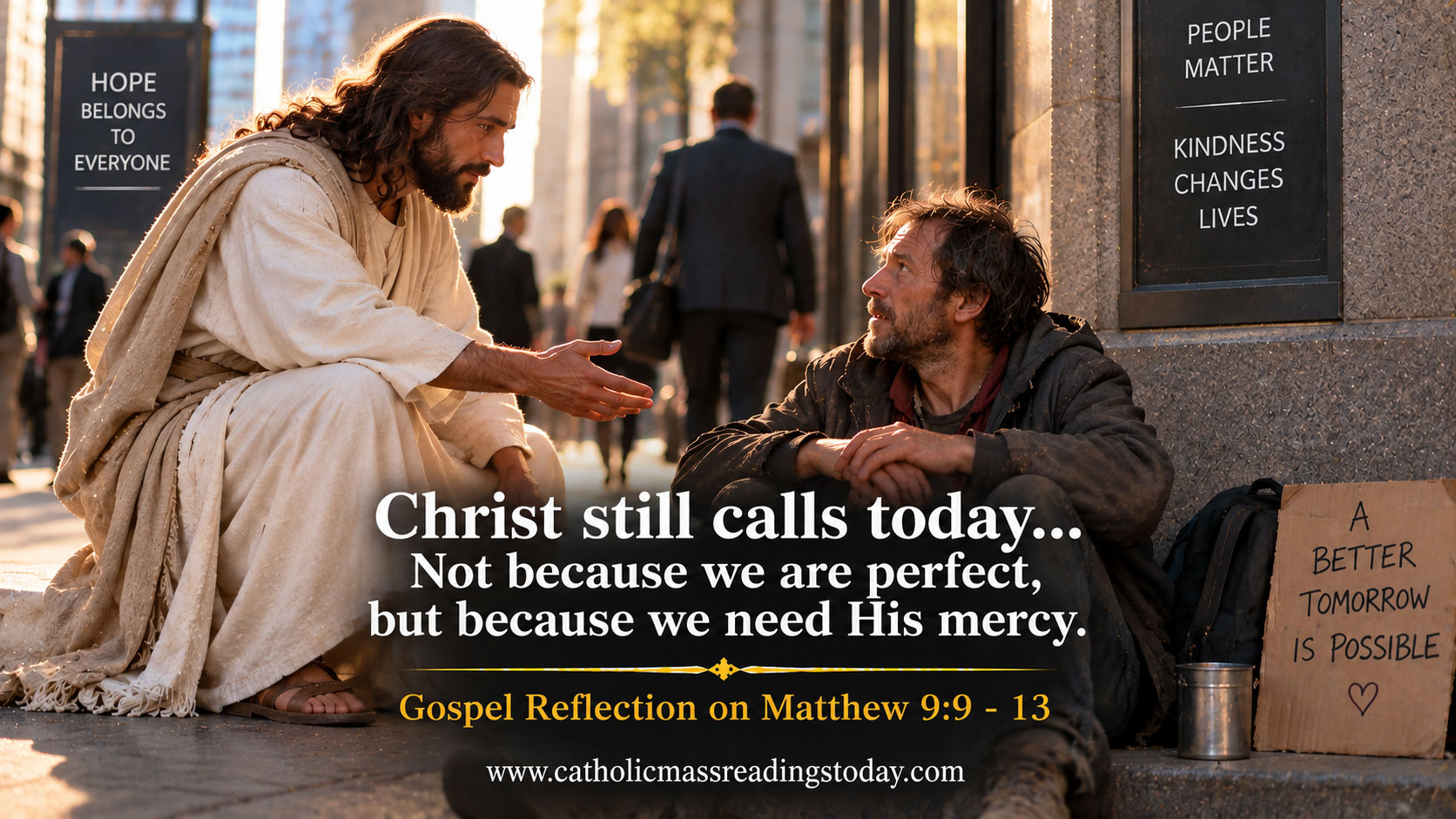
Jesus does not wait for Matthew to become perfect before calling him. He does not tell Matthew to repair his life first and return when he is worthy. Christ approaches him exactly where he is and offers him an invitation.
This reveals something essential about the mercy of God. Christ does not begin by asking us to prove that we deserve His love. Grace comes first. He enters our lives, calls us by name and invites us to follow Him.
But that invitation also asks for a response.
Matthew could have remained seated. He could have thought about everything he might lose by following Jesus: his income, his security, his familiar surroundings and the life he had built for himself. Instead, the Gospel gives us one simple sentence: “And he rose and followed him.”
Sometimes the greatest changes in our spiritual lives begin in precisely this way. Christ calls, and we finally decide to rise from the place where we have been sitting.
There may be habits we need to leave behind, sins from which we need to turn away, fears that have kept us from trusting God, or a comfortable way of living that no longer allows us to follow Christ wholeheartedly. Conversion begins when we trust Jesus enough to take that next step.
Jesus at the Table With Sinners
The Gospel then takes us from the tax office to the table. Jesus is eating with Matthew, other tax collectors and sinners.
The Pharisees are disturbed by what they see. They ask His disciples, “Why does your teacher eat with tax collectors and sinners?”
The Pharisees see people whose lives they disapprove of. Jesus sees people who need mercy.
This does not mean that Christ considers sin unimportant. His answer makes precisely the opposite point:
“Those who are well have no need of a physician, but those who are sick.”
Jesus draws near to sinners not because sin does not matter, but because sin wounds the human person and He has come to heal and save.
The Church has long recognized Christ as the Divine Physician. We do not approach Him because we have already healed ourselves. We come because we need Him. We bring before Him our sins, wounds, weaknesses and failures, trusting that His grace can accomplish within us what we cannot accomplish by ourselves.
This is why the Sacrament of Reconciliation is such a precious gift to the Catholic Church. We do not enter the confessional pretending that sin has no consequences. We enter acknowledging the truth about ourselves and trusting that the mercy of Christ is greater than the sins for which we sincerely repent.
“I Desire Mercy, and Not Sacrifice”
Jesus then tells the Pharisees:
“Go and learn what this means, ‘I desire mercy, and not sacrifice.’”
These words challenge any form of religion that performs outward acts of devotion while allowing the heart to become hard toward other people.
Our worship of God and the way we treat our neighbour cannot be separated.
We cannot continually ask Christ for mercy while refusing to show mercy to others. We cannot rejoice that God has forgiven our failures while permanently defining another person by theirs.
This does not mean pretending that wrongdoing is acceptable or that justice does not matter. Christian mercy never requires us to call evil good. Rather, mercy refuses to believe that another person’s sin has placed him or her permanently beyond the reach of God’s grace.
Matthew himself is the proof.
Others could see only a tax collector.
Jesus saw an apostle.
Christ Sees What Grace Can Make of Us
There is great hope in this Gospel for anyone who carries regret about the past.
People may remember our mistakes. They may know our failures. Sometimes we ourselves may find it difficult to forget the person we once were.
Christ sees all of this, but He also sees something more.
He sees what His grace can still make of us.
The man sitting at the tax office could not yet see the entire road ahead. He did not know everything that following Jesus would require. He simply heard the call and responded.
Our lives with Christ often unfold in the same way. We are rarely shown the whole journey at once. God gives us enough grace for the step He is asking us to take today.
Perhaps Christ is passing through our lives again today, calling us away from something that has kept us spiritually seated. Perhaps He is calling us out of sin, fear, resentment, complacency or attachment to something that prevents us from belonging more completely to Him.
And once again, the invitation is simple:
“Follow me.”
The question is not whether we have a perfect past. None of us does.
The question is whether, when Christ calls us, we are willing to rise and follow Him.
Let Us Pray
Lord Jesus Christ,
You looked upon Matthew with mercy and called him from his old life to follow You.
Look upon us with that same mercy. Heal whatever sin has wounded within us. Give us courage to leave behind whatever keeps us from You, and strengthen us to follow whenever we hear Your voice.
When we are tempted to judge others by their failures, remind us that Your grace can transform every human heart. Teach us to desire mercy, to practise mercy, and always to remember that we too live each day because of Your mercy.
Divine Physician, heal our hearts. Call us again, and give us the grace to rise from whatever holds us back and follow You faithfully.
Through Christ our Lord.
Amen.