“Who Do You Say That I Am?”
There is something deeply personal in the question Jesus asks in today’s Gospel.
He begins by asking His disciples, “Who do the people say that I am?” They answer with what they have heard from others: John the Baptist, Elijah, or one of the prophets. These are the opinions circulating among the people, the conclusions others have reached about Him.
But Jesus does not stop there.
He turns the question directly toward His disciples and asks, “But who do you say that I am?”
This is no longer a question about public opinion. It is a question of faith. It cannot be answered simply by repeating what someone else believes, what we learned as children, what we hear at Mass, or what we have read in a book. At some point, every disciple has to answer it personally.
Who is Jesus to me?
Peter’s Confession: “The Christ of God”
Peter answers, “The Christ of God.”
He recognizes that Jesus is the Messiah, the One sent by God. It is a profound confession of faith, but immediately after Peter gives the right answer, Jesus begins to teach him what that title truly means.
He speaks of suffering, rejection, death, and resurrection.
This is important because Peter has the correct title, but Jesus must still reveal its true meaning. The Christ of God is not a Messiah of earthly power, comfort, or easy victory. He is the Messiah who saves through the Cross.
That truth can challenge us too.
We often want Christ to remove every difficulty, solve every problem, and spare us from every pain. We want faith to make life easier and the path clearer. But the Gospel shows us that following Jesus does not mean living without suffering.
It means that suffering no longer has to be meaningless.
Christ enters it. He carries it. And through the Cross, He transforms it.
The Cross Is Real, but It Is Not the End
Jesus does not stop by saying that the Son of Man will suffer and be killed.
He continues:
“And on the third day be raised.”
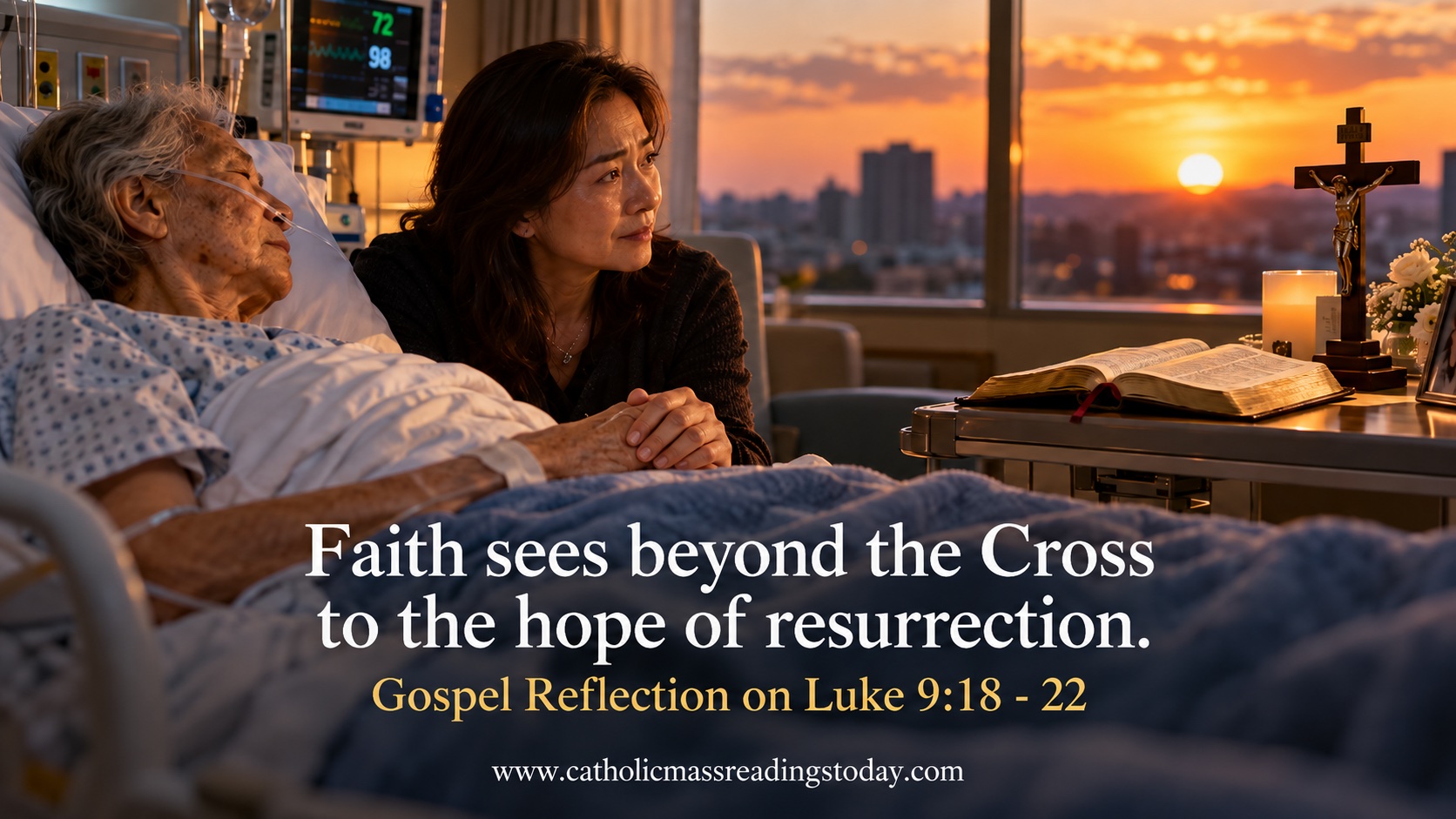
The Cross is real, but it is not the end. Suffering is real, but it does not have the final word. Death is real, but resurrection stands beyond it.
That is the hope at the heart of the Christian faith.
The Gospel does not ask us to pretend that pain is easy or that suffering should not hurt. It reminds us that, in Christ, suffering is never the final chapter.
Jesus does not deny the Cross. He passes through it.
And beyond the Cross is resurrection.
Faith Is Tested When Life Becomes Difficult
Perhaps this is where today’s Gospel becomes especially personal.
It is one thing to say, “Jesus is the Christ.”
It is another thing to trust Him when life becomes difficult.
It is another thing to trust Him when a prayer seems unanswered, when we experience rejection, when illness enters our lives, when a relationship is wounded, when grief overwhelms us, or when the road ahead is not clear.
In those moments, our answer to Jesus becomes more than words.
It becomes the way we live.
Do we still believe He is the Christ when the Cross appears?
Do we still trust Him when we cannot yet see the resurrection?
Faith becomes real precisely when we are asked to trust God in the places where we do not yet understand what He is doing.
Who Is Jesus to Me?
Peter’s confession invites us to make our own.
Not simply, “This is what the Church says about Jesus.”
But rather:
“Lord, this is who You are to me.”
- My Savior.
- My Lord.
- My hope.
The One I will follow even when the road passes through the Cross.
This does not mean our faith will never be tested. It does not mean we will always feel strong. It means that beneath the uncertainty, beneath the suffering, and beneath the questions, there remains a deeper trust:
The Cross is never the final chapter.
Following Christ Beyond the Easy Moments
It is easy to follow Christ when life is peaceful, prayers seem to be answered, and everything feels secure.
But discipleship becomes deeper when we remain with Him in the difficult moments.
- When we are rejected, we remember that He was rejected too.
- When suffering comes, we remember that He did not abandon the Cross.
- When we cannot see the way forward, we remember that resurrection followed Calvary.
The Christian life is not built on the promise that we will avoid every hardship. It is built on the promise that Christ remains with us through them.
And because He remains with us, suffering can become a place where faith matures, hope deepens, and love becomes stronger.
A Question That Must Be Answered With Our Lives
The question Jesus asks the disciples is still addressed to us:
“Who do you say that I am?”
Our answer is not given only in words.
- We answer it in the way we forgive.
- We answer it in the way we pray.
- We answer it in the way we endure suffering.
- We answer it in the way we trust God when we do not understand.
- We answer it in the way we choose to remain faithful when following Christ becomes costly.
Every day, our lives reveal something about who we believe Jesus is.
If He is truly our Lord, then we entrust ourselves to Him not only in moments of joy, but also in moments of darkness.
If He is truly our Savior, then we believe that even suffering can be transformed by His grace.
If He is truly our hope, then we refuse to believe that the Cross has the final word.
Let Us Pray
Lord Jesus Christ,
You ask each of us, “Who do you say that I am?”
Give us the faith to answer You not only with our lips, but with our lives.
Help us to recognize You as the Christ, our Savior and our Lord. When suffering comes, keep us from losing hope. When we are rejected, remind us that You were rejected too. When the road becomes difficult, give us the courage to remain with You.
Teach us to trust that beyond every Cross, You are still the God of resurrection.
Strengthen our faith, Lord, not only when life is easy, but especially when we cannot yet see what You are doing. Help us to follow You faithfully through every season of life and to trust that no suffering offered to You is ever wasted.
May our whole lives become an answer to the question You place before us:
“Who do you say that I am?”
You are our Savior.
You are our Lord.
You are our hope.
And with Your grace, we will follow You wherever You lead.
Amen.