“He Who Is Least Among You All Is the One Who Is Great”
There is something very revealing in today’s Gospel. The disciples are walking with Jesus, listening to Him, witnessing His miracles, and yet they begin arguing among themselves about which of them is the greatest.
It is such a human moment.
We compare ourselves with others. We measure our importance. We wonder who is more successful, who is more respected, who has greater influence, and who deserves more recognition. Even in the presence of Christ, the disciples find themselves caught in this very human desire to be considered greater than one another.
But Jesus turns their thinking completely upside down.
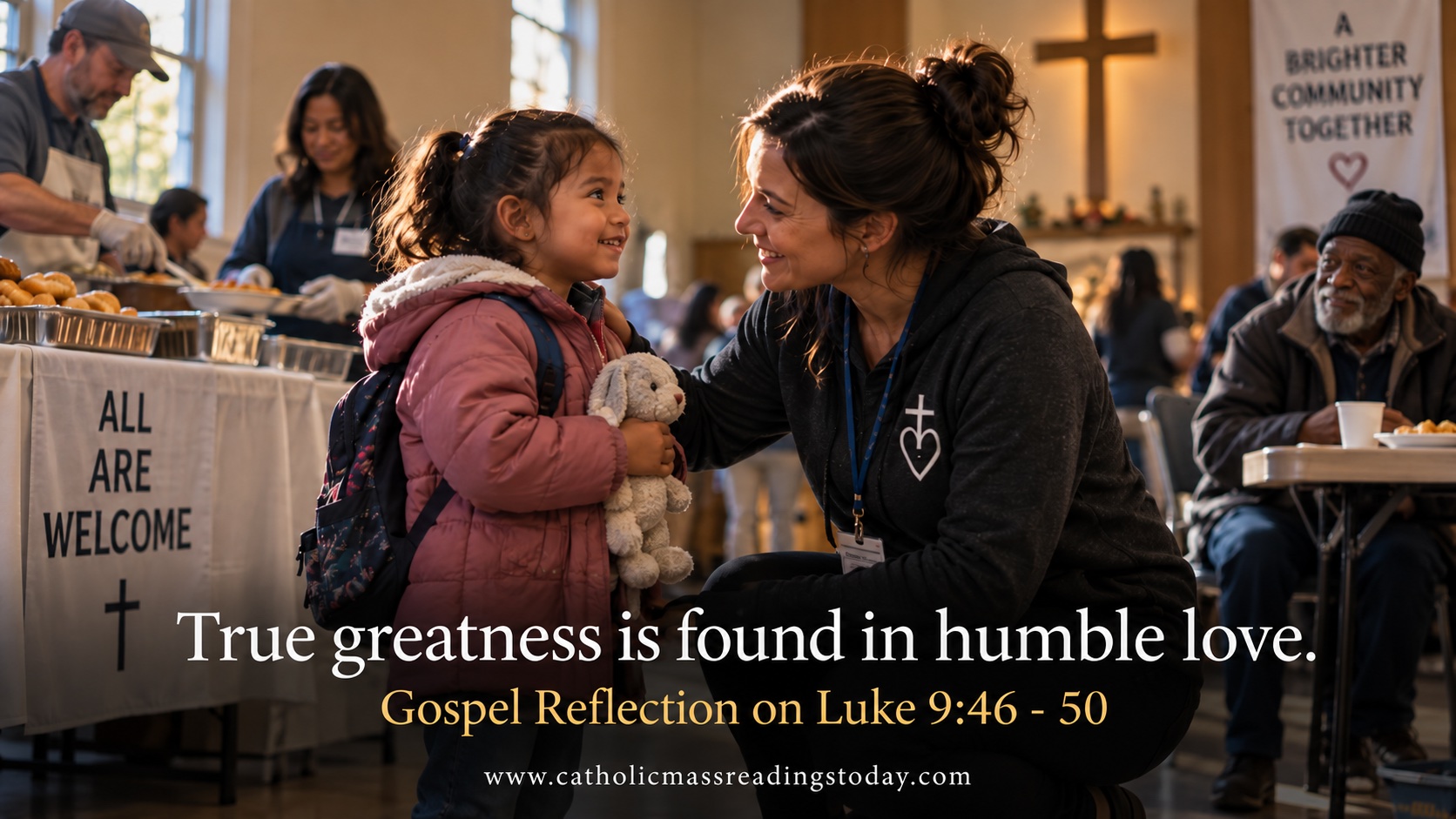
He takes a child, places the child beside Him, and says, “He who is least among you all is the one who is great.”
In the Kingdom of God, greatness does not come from being admired. It does not come from status, power, titles, or being noticed by others. The greatness Jesus speaks about is found in humility, in service, and in making room for people who may have nothing to offer us in return.
Jesus points to a child because, in that world, a child had very little social standing. A child was not someone through whom a person gained influence or prestige. Yet Jesus places the child at the centre and says that whoever receives such a child in His name receives Him.
That is a powerful teaching.
Christ places Himself close to those who are easily overlooked. He identifies Himself with the weak, the unnoticed, and the person whom others may not consider important. In doing so, He shows us that the way we receive those who seem small in the eyes of the world is connected to the way we receive Him.
The Gospel therefore asks us to look again at the way we measure importance.
God’s Kingdom does not use the same standards as the world. The world often celebrates visibility, achievement, status, and influence. Jesus points instead toward humility, welcome, service, and love.
The question is not simply who appears important.
The deeper question is whether we are willing to serve.
The Temptation to Draw a Circle
The Gospel then moves to another revealing moment.
John tells Jesus that the disciples saw a man casting out demons in His name, but they tried to stop him because “he does not follow with us.”
Once again, something very human appears.
There is a temptation to draw a circle around ourselves.
There is us, and there is them. There is our group, and there are those outside it. There are the people we recognise, the people we approve of, and the people we consider to belong.
But Jesus refuses that narrow way of thinking.
He tells John, “Do not forbid him.”
The work of God is bigger than our pride, bigger than our need to control, and bigger than the boundaries we sometimes create.
There is an important lesson here for us.
We can become so concerned with being recognised, with being right, or with belonging to the right group that we forget what Christ is actually asking of us. He calls us to humility, charity, generosity, and a willingness to recognise good even when it comes through someone we did not expect.
Sometimes God works through people we would not have chosen.
Sometimes good is being done by someone outside the circles we are most comfortable with.
The Gospel challenges us to have hearts large enough to rejoice when God is at work, even when we are not the ones receiving the credit.
What Does Greatness Look Like in the Kingdom of God?
Today’s Gospel asks us to look at greatness differently.
It is not about who has the most influence, who gets the most attention, or who appears most important.
The more important question is: Who is willing to serve?
- Who welcomes the forgotten?
- Who makes room for the person others overlook?
- Who can rejoice when God works through someone else?
- Who can do good without needing to be praised for it?
That is the greatness Jesus speaks about.
The greatness of the Kingdom is often quiet. It may never attract attention. It may be seen in a parent who sacrifices without recognition, in a person who cares patiently for someone who is ill, in someone who forgives when they could easily hold a grudge, or in someone who helps another person without ever telling anyone about it.
These things may look small to the world.
But they are not small to God.
Making More Room for Christ
Perhaps the challenge for us today is simple.
We do not need to become greater in the eyes of the world.
We need to become smaller in the ways that make more room for Christ.
That means allowing pride to decrease. It means letting go of constant comparison. It means becoming less concerned with recognition and more concerned with faithfulness.
- Humility makes room for Christ.
- Service makes room for Christ.
- Love makes room for Christ.
The more we stop trying to prove our importance, the freer we become to serve.
And the more freely we serve, the more closely our lives begin to reflect the One who came not to be served, but to serve.
This does not mean thinking badly of ourselves. Christian humility is not pretending that we have no gifts or value. It means recognising that everything we have is received from God and that our gifts are meant to be used in love, not as a way of placing ourselves above others.
Receiving Christ in the Small and Forgotten
Jesus says that whoever receives the child in His name receives Him.
That should change the way we look at people.
The person who seems insignificant may be the very person through whom Christ is asking to be received.
The person who has nothing to offer us socially, professionally, or materially may be the person through whom our humility is tested.
The forgotten, the lonely, the inconvenient, the quiet, and the overlooked all matter to God.
And if they matter to God, they must matter to us.
The Gospel therefore does not allow us to separate our love for Christ from the way we treat people.
To welcome Christ means learning to welcome those He places before us.
A Heart Free From Jealousy and Comparison
The disciples wanted to know who was greatest. John wanted to stop someone outside their group from doing good in Jesus’ name.
Both moments reveal the same struggle: the desire to compare, control, and protect our own importance.
Jesus offers another way.
He calls us to a heart that is free enough to serve without competition, generous enough to celebrate another person’s good work, and humble enough to recognise that the mission belongs to God.
We do not have to be greater than others.
We only need to be faithful.
And faithfulness often looks like something very simple: receiving the person in front of us, doing the good we can do, and giving God the glory.
Let Us Pray
Lord Jesus Christ,
Free us from the desire to be greater than others.
Teach us the humility of Your Kingdom, and help us to recognise that true greatness is found in love, service, and faithfulness.
Give us hearts that welcome those who are overlooked and hands that are willing to serve without seeking praise.
Keep us from jealousy, comparison, and the desire to control the ways in which You work through others.
Teach us to rejoice whenever good is being done in Your name, even when we are not the ones being noticed.
Make us humble enough to become small, faithful enough to serve, and loving enough to receive others as we would receive You.
May our lives make more room for You each day.
Through Christ our Lord.
Amen.