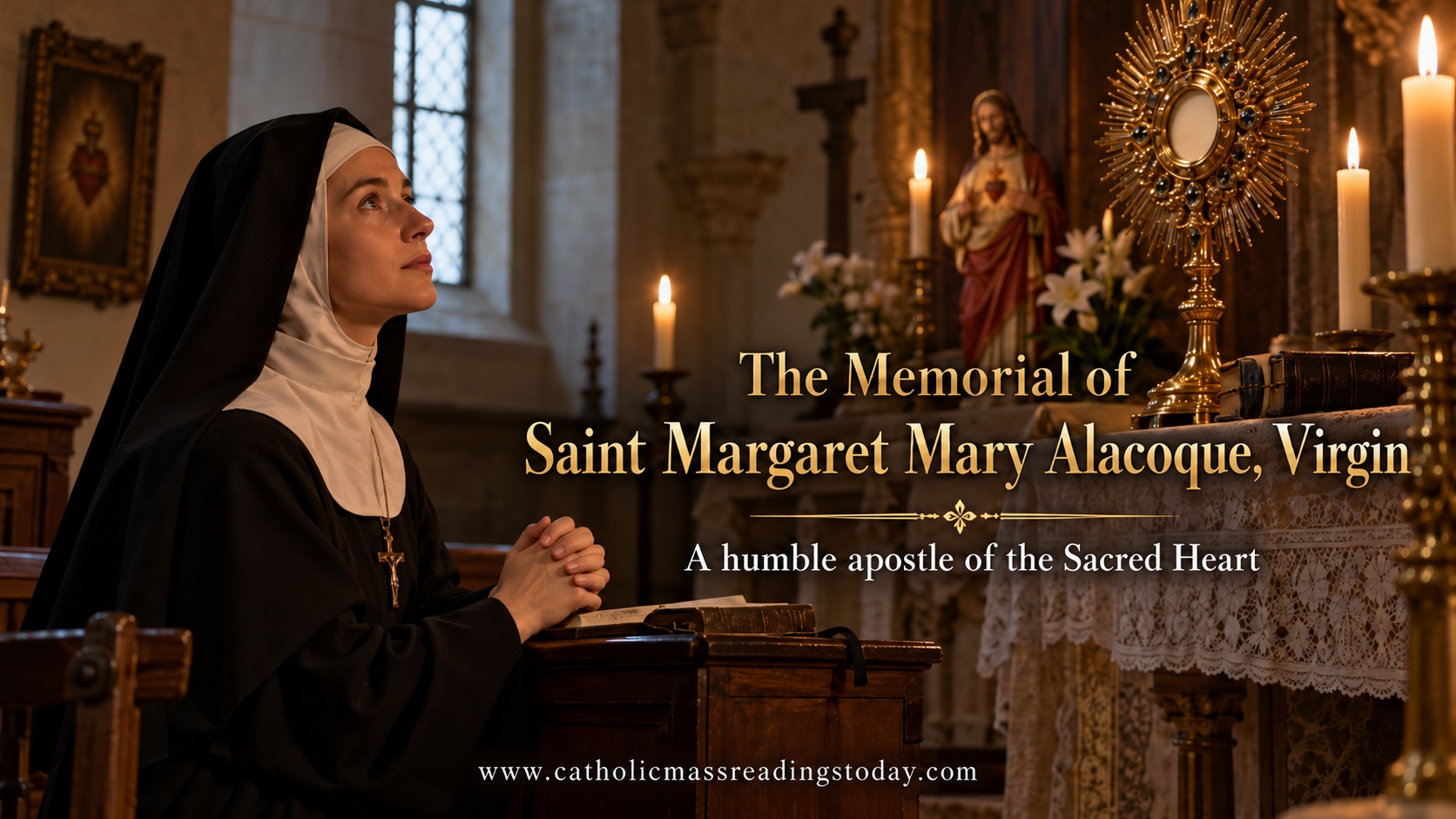
Every year on October 16, the Catholic Church celebrates the Memorial of Saint Margaret Mary Alacoque, Virgin, the seventeenth-century French Visitation nun whose life became inseparably linked with devotion to the Sacred Heart of Jesus. Her story is one of suffering, perseverance, mystical prayer, misunderstanding, obedience, and an extraordinary mission that eventually helped awaken in the Church a deeper appreciation of the personal and merciful love of Christ.
Today, Saint Margaret Mary Alacoque is remembered throughout the Catholic world as one of the great witnesses to the love of the Sacred Heart. Yet the influence she eventually exercised on Catholic spirituality would have seemed almost impossible during much of her lifetime. She lived quietly behind the walls of a convent, endured years of illness and spiritual testing, and was at times doubted even by members of her own religious community. What transformed her hidden life into a gift for the universal Church was not personal ambition or theological fame, but her conviction that Jesus had entrusted her with a message: humanity must rediscover the immensity of His love and respond with love, repentance, Eucharistic devotion, and reparation.
The life of Saint Margaret Mary Alacoque therefore deserves to be understood not merely as a collection of extraordinary mystical experiences, but as the story of a woman gradually formed by suffering and grace into an apostle of the Heart of Christ.
The Birth and Early Childhood of Saint Margaret Mary Alacoque
Saint Margaret Mary Alacoque was born on July 22, 1647, in the village of L’Hautecour, in the Burgundy region of France. She was baptized a few days later and given the name Margaret. She was one of several children born to Claude Alacoque and Philiberte Lamyn.
Her family enjoyed a respectable position in the local community, and her father worked as a royal notary and judge. Margaret’s early childhood therefore began with a certain degree of security. That stability, however, did not last.
Even as a young girl, Margaret showed a strong attraction to prayer and religious life. She later recalled having made a private promise of virginity to God at a very early age, though as a child she did not fully understand the lifelong implications of such a promise. What was already becoming evident was an unusual sensitivity to the things of God.
Her childhood faith would soon be tested through hardship.
When Margaret was still young, her father died. His death left the family vulnerable and contributed to years of difficulty. Property and financial problems followed, and Margaret, her mother, and siblings experienced tensions with relatives who exercised control over family affairs.
These circumstances left a deep impression upon her. Long before she became known as a mystic, she experienced what it meant to feel powerless, misunderstood, and dependent upon others.
Years of Illness and Suffering
Margaret was sent for part of her education to a school run by the Poor Clares. There she was attracted to the religious atmosphere and developed a strong devotion to the Blessed Virgin Mary.
At around eight years of age, however, Margaret became seriously ill. The illness affected her for several years and at times left her unable to walk normally. Her suffering was prolonged and painful.
During this period she turned intensely toward the Blessed Virgin Mary, promising that if she recovered she would devote herself more completely to religious life. Eventually her health improved, an event she attributed to Mary’s intercession.
Her recovery brought new possibilities. Margaret entered adolescence and, for a time, experienced the ordinary attractions of social life. She enjoyed attractive clothing, social gatherings, and the thought of marriage. Her family also hoped she might marry.
Yet another desire persisted beneath everything else.
She felt drawn toward Christ.
This created an intense interior struggle. On one side stood family expectations and the possibility of marriage. On the other stood the call she believed God had placed within her from childhood.
Her discernment would not be immediate. Like many saints, Margaret did not move from childhood devotion to mature holiness without uncertainty. She had to discover gradually what God was asking.
The Call to the Visitation Order
Margaret eventually became convinced that she was called to consecrated religious life. In 1671, at the age of twenty-three, she entered the Monastery of the Visitation of Holy Mary at Paray-le-Monial.
The Visitation Order had been founded earlier in the seventeenth century by Saint Francis de Sales and Saint Jane Frances de Chantal. Its spirituality emphasized humility, gentleness, charity, and loving surrender to God.
Margaret felt an immediate attraction to the monastery. According to her later recollections, she experienced a deep sense that this was the place where God wanted her.
She received the religious habit and eventually took the name by which she is now universally known: Margaret Mary.
She made her religious profession on November 6, 1672.
Her early years in the convent were not easy. Margaret Mary was sincere and deeply prayerful, but her intense spiritual experiences sometimes made her difficult for others to understand. She could become absorbed in prayer and struggled at times with ordinary community expectations.
Her superiors therefore tested her vocation carefully.
The road toward holiness would require more than mystical experiences. It would require obedience, patience, humility, and submission to the ordinary discipline of religious life.
The Interior Life of Saint Margaret Mary Alacoque
At the heart of the spirituality of Saint Margaret Mary Alacoque was an increasingly profound awareness of the love of Jesus Christ.
She was particularly drawn to prayer before the Blessed Sacrament. There she spent long periods contemplating Christ’s presence in the Eucharist.
Her spirituality became deeply Christ-centered. She did not understand the Sacred Heart simply as a physical organ considered in isolation, but as a visible and powerful symbol of the entire love of Jesus: His divine and human love, His mercy, His sacrifice, His compassion for sinners, and His longing to draw humanity into communion with Him.
This understanding would gradually become the central mission of her life.
Margaret Mary believed that Jesus wanted Christians to move beyond a merely external or fearful relationship with God and to rediscover the burning love revealed in Christ.
Her message would eventually spread far beyond her convent.
At first, however, it brought her considerable difficulty.
The First Great Revelation of the Sacred Heart
Beginning in December 1673, Margaret Mary reported a series of extraordinary encounters with Christ while praying before the Blessed Sacrament.
The first major revelation traditionally associated with her mission occurred on December 27, 1673, the Feast of Saint John the Apostle.
Margaret Mary described Jesus allowing her to rest near His Heart and revealing to her the extraordinary depth of His love for humanity. She understood that Christ desired His love to be known more widely and that she was being entrusted with a mission to make that love known.
Her writings describe the Heart of Jesus as consumed with love for humanity.
The language is intensely personal because the spirituality she received was intensely personal. Christ was not presenting humanity with an abstract theological concept. Margaret Mary understood Him to be revealing a Heart that loves, suffers rejection, seeks reconciliation, and invites sinners to return.
This became the foundation of her vocation as an apostle of the Sacred Heart.
The Sacred Heart and the Call to Reparation
As Margaret Mary’s mystical experiences continued, another theme became increasingly important: reparation.
She understood that the love of Christ was often met with indifference, ingratitude, sacrilege, and rejection. Devotion to the Sacred Heart therefore involved not merely receiving Christ’s love but responding to it.
Reparation, in this context, means offering love, prayer, worship, sacrifice, and repentance in response to sins committed against God.
Margaret Mary especially emphasized reparation connected with the Eucharist.
For her, Eucharistic adoration was not simply private consolation. It was participation in the loving response that humanity owes to Christ.
She felt called to accompany Jesus spiritually in His suffering and to invite others to console His Heart through prayer, conversion, frequent Communion, and fidelity.
This spirituality eventually became associated particularly with the Holy Hour, traditionally observed on Thursday evenings in remembrance of Christ’s agony in Gethsemane.
The First Friday Devotion
One of the most lasting aspects of Saint Margaret Mary Alacoque’s spiritual legacy is the practice commonly known as the First Friday devotion.
Margaret Mary understood that Christ desired special Eucharistic devotion on the first Friday of each month. Catholics were encouraged to receive Holy Communion in a spirit of love, reparation, and deeper union with the Sacred Heart.
Over time, the practice of receiving Communion on nine consecutive First Fridays became widely associated with the revelations entrusted to her.
The spiritual meaning of the devotion is greater than simply completing a sequence of religious observances. Its purpose is conversion of heart, faithful sacramental life, trust in divine mercy, and growing love for Jesus in the Eucharist.
Properly understood, devotion to the Sacred Heart always leads toward the sacraments, repentance, charity, and a more serious Christian life.
The Great Apparition and the Feast of the Sacred Heart
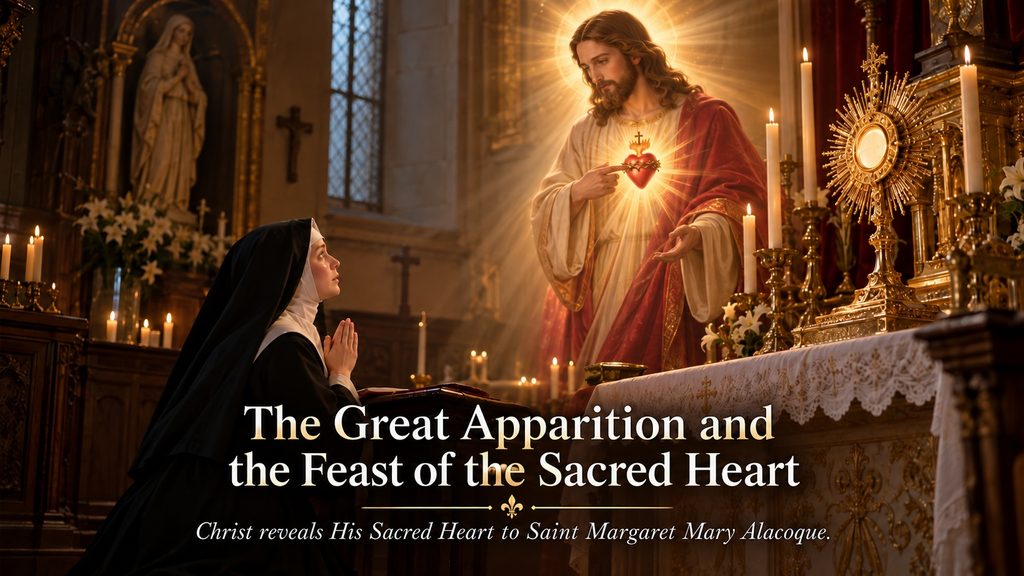
Among the visions associated with Saint Margaret Mary Alacoque, one of the most important occurred in June 1675, during the octave of Corpus Christi.
Margaret Mary reported that Christ revealed His Heart and expressed sorrow over humanity’s ingratitude despite His immense love.
She believed Jesus requested a special feast dedicated to His Sacred Heart, celebrated on the Friday after the octave of Corpus Christi.
This request eventually became historically significant.
The Feast of the Sacred Heart did not immediately become a universal celebration. Acceptance developed gradually through theological examination, local devotion, episcopal approval, and later papal action.
The devotion nevertheless spread steadily, particularly through the work of the Visitation Order and the Society of Jesus.
In 1856, centuries after Margaret Mary’s death, Pope Pius IX extended the Feast of the Sacred Heart to the universal Latin Church.
What had begun in the prayer of an obscure Visitation nun in Paray-le-Monial had become part of the liturgical life of Catholics throughout the world.
Saint Claude de la Colombière and the Testing of Margaret Mary’s Mission
For Margaret Mary, one of the most difficult aspects of her vocation was convincing others that her mystical experiences were genuine.
Some members of her community doubted her. Others misunderstood her. She herself sometimes feared deception and struggled with the responsibility she believed had been given to her.
Providence eventually brought into her life an important spiritual guide: Saint Claude de la Colombière, a Jesuit priest.
Father Claude arrived in Paray-le-Monial in 1675 and became Margaret Mary’s confessor and spiritual director.
After carefully listening to her and discerning her experiences, he became convinced of their authenticity.
His support was decisive.
Margaret Mary finally had a knowledgeable priest who understood both mystical theology and the need for careful discernment. He encouraged her to trust God’s action while remaining obedient to her religious superiors.
Saint Claude also became an important promoter of devotion to the Sacred Heart.
Their spiritual friendship therefore became one of the most significant partnerships in the history of the devotion.
Opposition, Misunderstanding, and Perseverance
The mission of Saint Margaret Mary Alacoque did not advance without resistance.
Within the monastery, reactions varied. Some sisters were skeptical of her experiences. Others may have found her claims unsettling.
Margaret Mary was therefore required to wait.
This waiting became part of her purification.
She had to learn that God’s work does not depend upon immediate recognition. She could not force others to believe her. She had to continue living the ordinary duties of religious life while entrusting the outcome to God.
Over time, attitudes within the convent changed.
Margaret Mary’s humility, perseverance, and fidelity gradually earned greater confidence. Eventually she was entrusted with responsibilities within the community, including service connected with the formation of younger sisters.
Her life demonstrates an important principle of authentic Catholic spirituality: extraordinary experiences never exempt a person from obedience, humility, or ordinary Christian duty.
For Margaret Mary, the proof of mystical prayer was found in the transformation of life.
The Sacred Heart as a Message of Divine Love
The lasting importance of Saint Margaret Mary Alacoque cannot be understood without considering what the Sacred Heart represents.
The image of the Heart of Jesus directs Christians toward the central mystery of Christianity: God loves humanity in Jesus Christ.
The pierced Heart recalls Calvary.
The flames traditionally surrounding the Sacred Heart symbolize burning divine love.
The crown of thorns recalls suffering caused by sin.
The cross rising above the Heart points toward redemption.
The wound recalls the soldier’s lance and the self-giving love of Christ poured out completely.
Sacred Heart spirituality therefore does not distract from the Gospel. Properly understood, it concentrates attention upon the Gospel itself: the Incarnation, Passion, Eucharist, mercy, repentance, and personal love of Jesus Christ.
Margaret Mary’s mission helped give this spirituality a new intensity and visibility in the Church.
The Final Years of Saint Margaret Mary Alacoque
During the later years of her life, Margaret Mary saw devotion to the Sacred Heart gradually gaining acceptance.
The opposition she had once experienced began to diminish.
Within her own monastery, the devotion became better understood and increasingly embraced. Her fellow sisters came to recognize the depth of her spiritual life.
Margaret Mary did not become a public celebrity. She remained a Visitation nun living largely within the enclosure of her monastery.
Her work was hidden.
Yet from that hidden life came a spiritual movement that would eventually reach millions.
Her health, never particularly strong, declined.
By 1690, Margaret Mary understood that death was approaching. She did not fear it. Her spiritual life had long been oriented toward complete surrender to Christ.
The Death of Saint Margaret Mary Alacoque
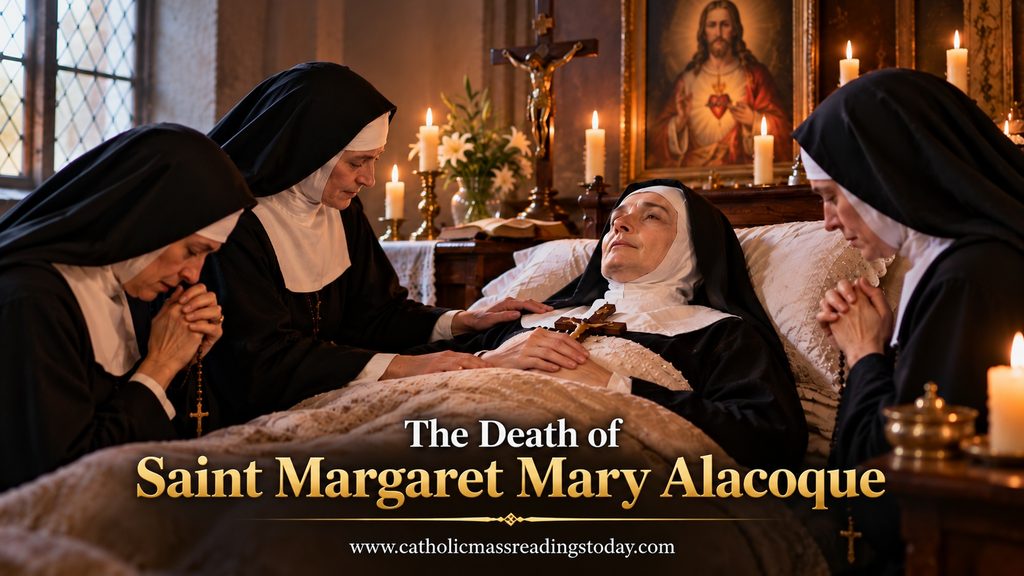
Saint Margaret Mary Alacoque died on October 17, 1690, at the Visitation monastery in Paray-le-Monial.
She was forty-three years old.
Her final illness developed quickly. Those around her recognized that her condition was serious, but Margaret Mary faced death with the same trust in Christ’s love that she had spent her life proclaiming.
Her earthly mission appeared to have ended quietly within the convent walls.
In reality, it was only beginning to reach the wider Church.
After her death, devotion to the Sacred Heart continued spreading through Visitation monasteries, Jesuit communities, devotional literature, preaching, and popular Catholic practice.
Paray-le-Monial gradually became one of the world’s important centers of Sacred Heart devotion.
From Paray-le-Monial to the Universal Church
The centuries following Margaret Mary’s death witnessed the extraordinary expansion of the devotion associated with her.
The Church approached the devotion gradually, as it does with private revelations. The underlying theology of Christ’s love and the symbolism of His Heart had roots extending far earlier than Margaret Mary’s lifetime, but her experiences gave the devotion a powerful new form and missionary energy.
Approval developed over generations.
In 1765, Pope Clement XIII approved a Mass and Office of the Sacred Heart for certain places and communities.
Then, in 1856, Pope Pius IX extended the Feast of the Sacred Heart to the universal Latin Church.
Later popes continued to encourage the devotion.
Pope Leo XIII, in the encyclical Annum Sacrum of 1899, consecrated the human race to the Sacred Heart of Jesus.
In 1928, Pope Pius XI, through Miserentissimus Redemptor, emphasized the spirituality of reparation associated with the Sacred Heart.
In 1956, Pope Pius XII, in Haurietis Aquas, offered an important theological treatment of devotion to the Sacred Heart and situated it firmly within the mystery of Christ and the Church’s tradition.
The spiritual intuition entrusted to a Visitation nun in seventeenth-century Burgundy had become part of the devotional inheritance of Catholicism throughout the world.
Beatification and Canonization of Saint Margaret Mary Alacoque
Recognition of Margaret Mary’s personal holiness also developed over time.
She was beatified by Pope Pius IX in 1864.
Several decades later, Pope Benedict XV canonized Saint Margaret Mary Alacoque on May 13, 1920.
Her canonization formally recognized what countless Catholics had already come to believe: that her life displayed heroic Christian virtue and that her witness belonged to the whole Church.
Her remains are venerated in Paray-le-Monial, where pilgrims continue to pray and reflect upon the message of the Sacred Heart.
Why Saint Margaret Mary Alacoque Is Important to the Catholic Church
The importance of Saint Margaret Mary Alacoque reaches far beyond the fact that she experienced mystical visions.
Her greatest contribution was helping generations of Catholics rediscover Christianity as a response to divine love.
She lived during a period when certain currents of religious thought could sometimes present God primarily in terms of severity and distance. Sacred Heart spirituality emphasized something essential: the Son of God possesses a Heart burning with love for humanity.
That emphasis did not eliminate the seriousness of sin.
Quite the opposite.
Margaret Mary understood sin as tragic precisely because it rejects love.
Repentance therefore becomes not simply fear of punishment but a return to the One who loves us.
Her spirituality also strengthened Eucharistic devotion. Adoration, Communion, reparation, and intimate friendship with Jesus became closely associated with the Sacred Heart movement.
For countless Catholics, this devotion transformed faith from something merely external into an intensely personal relationship with Christ.
Saint Margaret Mary Alacoque and the Eucharist
One cannot separate Saint Margaret Mary Alacoque from Eucharistic spirituality.
Many of her reported revelations occurred before the Blessed Sacrament.
The Eucharist was, for her, the privileged place of encounter with the Heart of Jesus.
She understood Holy Communion as participation in Christ’s life and love. Eucharistic adoration allowed the believer to remain with Christ, listen to Him, console Him, and offer one’s heart in return.
This relationship between the Eucharist and the Sacred Heart remains important today.
The devotion is not merely about displaying an image of Jesus.
It calls Catholics toward sacramental life.
It calls them toward confession.
It calls them toward Communion.
It calls them toward prayer before the Blessed Sacrament.
And it calls them to become people whose own hearts increasingly resemble the Heart they worship.
The Meaning of Reparation in Saint Margaret Mary’s Spirituality
The word reparation can sometimes be misunderstood.
For Saint Margaret Mary, it was fundamentally an act of love.
Christ’s love is rejected through sin. The Christian responds by offering love where there has been indifference, worship where there has been irreverence, obedience where there has been rebellion, and repentance where there has been sin.
Reparation therefore begins with conversion.
It cannot be reduced to devotional formulas while injustice, hatred, dishonesty, or serious sin remain untouched.
A heart devoted to Jesus must gradually become more compassionate.
- It must become more forgiving.
- It must care about those who suffer.
- It must learn sacrificial love.
Otherwise devotion remains external.
Margaret Mary’s own life makes this clear. Her mystical experiences required humility, patience, obedience, and charity within the ordinary frustrations of community life.
Saint Margaret Mary Alacoque and the Twelve Promises
Popular Sacred Heart devotion often associates twelve promises with Saint Margaret Mary Alacoque.
These promises developed through later devotional summaries of statements found across her writings rather than appearing as one single numbered list personally composed by Margaret Mary.
They express themes strongly present in Sacred Heart spirituality: grace for one’s state in life, peace within families, consolation in suffering, refuge in Christ, spiritual growth, and special encouragement connected with the First Friday devotion.
The promises should never be interpreted superstitiously, as though devotional practices automatically guarantee salvation regardless of repentance or how a person lives.
Catholic devotion always belongs within the larger life of faith, sacramental communion, conversion, and perseverance.
Margaret Mary’s real message points toward trust, not magical formulas.
The Memorial of Saint Margaret Mary Alacoque
The Church now celebrates the Memorial of Saint Margaret Mary Alacoque, Virgin, on October 16.
Her liturgical memorial invites Catholics to contemplate Christ’s love and ask whether that love has truly reached the center of their lives.
Margaret Mary belongs especially to the spiritual heritage of the Visitation Order, but her influence extends throughout Catholicism.
Parishes bear her name.
Religious houses draw inspiration from her.
Sacred Heart churches stand throughout the world.
Families enthrone images of the Sacred Heart in their homes.
Catholics continue the First Friday devotion.
And countless people still pray the Holy Hour.
Her influence therefore remains woven into everyday Catholic spirituality.
Saint Margaret Mary Alacoque in the Church Today
More than three centuries after her death, Saint Margaret Mary Alacoque continues to speak powerfully to the modern world.
Modern life can be extraordinarily connected technologically while leaving people deeply lonely.
People communicate constantly but may still wonder whether they are truly known and loved.
The message associated with Margaret Mary goes directly to that human hunger.
Christ knows you, Christ loves you, His Heart remains open, mercy remains possible, conversion remains possible and no life is beyond the reach of divine love.
At the same time, her spirituality challenges a culture that often treats love primarily as emotion. The Heart of Christ represents love that sacrifices itself.
Jesus loves through the Cross.
Christian love therefore means fidelity, sacrifice, forgiveness, service, and self-giving.
That lesson remains as necessary now as it was in seventeenth-century France.
A Saint Whose Hidden Life Changed the Church
One of the most remarkable aspects of Saint Margaret Mary Alacoque’s life is how little worldly power she possessed.
She was not a ruler, she did not establish a vast religious order, she did not travel throughout Europe preaching publicly, she lived behind the enclosure of a convent, yet her hidden prayer profoundly influenced Catholic spirituality.
Her story demonstrates that the fruitfulness of a life cannot be measured by public visibility.
God can use a soul hidden in prayer to touch the whole Church.
Margaret Mary accepted misunderstanding, illness, obscurity, and sacrifice. She had no way of seeing how far her mission would eventually travel.
Today the Sacred Heart of Jesus is honored on every inhabited continent.
What began in silence at Paray-le-Monial became a worldwide invitation to encounter the love of Christ.
The Enduring Legacy of Saint Margaret Mary Alacoque
The legacy of Saint Margaret Mary Alacoque, Virgin, ultimately rests on a simple truth: Christianity begins with the love of God and must become our response of love.
Her life points constantly toward Jesus.
She did not ask Catholics to center their faith upon herself.
She pointed toward His Heart.
The Sacred Heart reminds the Church that salvation is not impersonal. God did not save humanity from a distance. The Word became flesh. Christ possessed a human heart. He loved, suffered, wept, gave Himself in the Eucharist, allowed His side to be pierced, died upon the Cross, and rose again.
Margaret Mary’s spiritual mission was to remind Christians never to become accustomed to that love.
Her message remains an invitation to return love for love.
More than remembrace
The story of Saint Margaret Mary Alacoque stretches from her birth in Burgundy in 1647, through childhood suffering, her vocation to the Visitation convent, the great Sacred Heart revelations beginning in 1673, her friendship with Saint Claude de la Colombière, years of misunderstanding and perseverance, and finally her death at Paray-le-Monial in 1690.
What followed is one of the remarkable stories of Catholic devotional history.
The devotion she helped promote crossed borders and centuries, influenced popes and saints, strengthened Eucharistic spirituality, inspired churches and religious communities, and helped millions of Catholics contemplate the love of Jesus in a deeply personal way.
Her memorial on October 16 is therefore much more than remembrance of a seventeenth century mystic.
It is an invitation.
Christ still calls the human heart.
His mercy has not diminished.
His love has not grown cold.
The question Saint Margaret Mary Alacoque places before every generation is whether we will allow our own hearts to respond to His.
Prayer to Saint Margaret Mary Alacoque
O Saint Margaret Mary Alacoque,
faithful virgin and devoted apostle of the Sacred Heart of Jesus,
you were chosen to proclaim the immeasurable love
that burns in the Heart of our Savior.
Teach us to trust that love more deeply.
Help us to approach Jesus in the Eucharist
with reverence, gratitude, and sincere devotion.
Obtain for us the grace of true repentance,
a generous spirit of reparation,
and hearts willing to forgive, serve, and love.
When we feel forgotten,
remind us that we are known by the Heart of Christ.
When we fall into sin,
lead us back to His mercy.
When suffering discourages us,
help us remain faithful beside His Cross.
May our homes, our families, and our lives
find refuge in the Sacred Heart of Jesus.
And through your intercession,
may our hearts become more like His:
humble, merciful, faithful, and filled with love.
Saint Margaret Mary Alacoque, Virgin, pray for us.
Most Sacred Heart of Jesus, have mercy on us.
Amen.