God’s Invitation to the Banquet of Eternal Life
The Invitation That Reveals the Heart of God
Today’s Gospel presents us with a parable that speaks directly to the human heart and to one of the greatest mysteries of our Christian faith: God’s desire to gather His children into the joy of His eternal Kingdom.
Jesus is seated at a meal when one of the guests declares, “Blessed is he who shall eat bread in the kingdom of God!”
In response, Jesus tells the story of a man who prepares a great banquet and invites many guests. Everything is ready. The table has been prepared, the food awaits, and the host sends his servant to announce that the celebration may begin.
Yet something unexpected happens.
Those who had been invited begin making excuses. One has purchased a field and wishes to inspect it. Another has bought five yoke of oxen and must examine them. A third has recently married and says he cannot attend. The invitation is generous, but the response is disappointing.
The banquet represents the Kingdom of God, and the invitation reveals the love of our heavenly Father, who desires that all people should come to know Him and share in His eternal life.
Yet Jesus also reveals a painful truth: God continually invites us into communion with Him, but we can become so occupied with the things of this world that we fail to recognise the importance of His invitation.
The tragedy in this parable is not that the guests were forgotten or excluded. They were invited, but they allowed other priorities to take the place of what had been offered to them, and perhaps this is where today’s Gospel begins to speak most personally to each of us.
When the Good Things of Life Become Obstacles to God
There is something particularly striking about the excuses given by the invited guests.
None of them is occupied with something obviously sinful.
Purchasing land, conducting business, and entering marriage are all legitimate aspects of human life. They are responsibilities through which people provide for their families, contribute to society, and fulfil their vocations.
Jesus does not condemn these things.
Rather, He reveals what happens when even good and necessary responsibilities become more important to us than our relationship with God.
How often do we find ourselves making similar excuses?
We know that we should pray, but there is always another responsibility demanding our attention. We intend to spend time reading Sacred Scripture, but the day passes and we never find the opportunity. We recognise the importance of attending Holy Mass, yet sometimes allow convenience or lesser commitments to determine our priorities.
We may even postpone reconciliation with someone we have offended because we are waiting for a more suitable moment, and so the days become weeks, the weeks become months, and the spiritual life is gradually pushed to the margins of our existence.
The danger is not always that we deliberately reject God. Sometimes we simply become accustomed to living without giving Him the place He deserves. We continue with our work, our ambitions, and our daily activities, while the Lord who gave us life receives only what remains of our time. But today’s Gospel reminds us that the Kingdom of God cannot be treated as one more appointment to be fitted into an already crowded schedule.
God must never become an afterthought in a life that exists only because of His love.
Our work, families, possessions, and achievements are gifts that should draw us towards gratitude and holiness, not become barriers separating us from the One who has given them.
The question we must ask ourselves is not whether we have responsibilities, but whether we have allowed those responsibilities to take the place that belongs to God alone.
The Banquet Is Ready, but Are Our Hearts Prepared?
The servant announces, “Come; for all is now ready.” These words contain a beautiful expression of God’s generosity. The guests are not being asked to prepare the banquet themselves. They are being invited to receive what has already been prepared for them.
In a similar way, our salvation begins not with our own achievements, but with the initiative of God’s grace. It is the heavenly Father who first loves us. It is Jesus Christ who offers Himself for our redemption. It is the Holy Spirit who calls us to repentance and strengthens us to respond in faith.
We do not earn God’s love by becoming important or successful. We are invited to receive His mercy and allow it to transform our lives. This truth finds a particularly beautiful expression in the sacramental life of the Church.
At every Holy Mass, Christ gathers His people around the altar and nourishes them with His Word and, for those properly disposed to receive, His own Body and Blood in the Holy Eucharist.
The Eucharist is both a sacred participation in the sacrifice of Christ and a foretaste of the heavenly banquet that awaits the redeemed. Yet our participation must never become a mere outward routine.
We can be physically present in church while allowing our hearts to remain distant from the Lord. We can hear His Word without seriously considering how it should change the way we live.
We can receive countless blessings and still forget to offer Him sincere thanksgiving.
The Lord desires more than our occasional attention.
He desires our hearts.
The invitation to His banquet is therefore also an invitation to conversion, to a renewed relationship with Him, and to a life increasingly shaped by His commandments.
There Is Still Room: The Mercy of God Reaches Beyond Human Expectations
When the invited guests refuse to come, the master sends his servant into the streets and lanes of the city to bring in the poor, the disabled, the blind, and the lame.
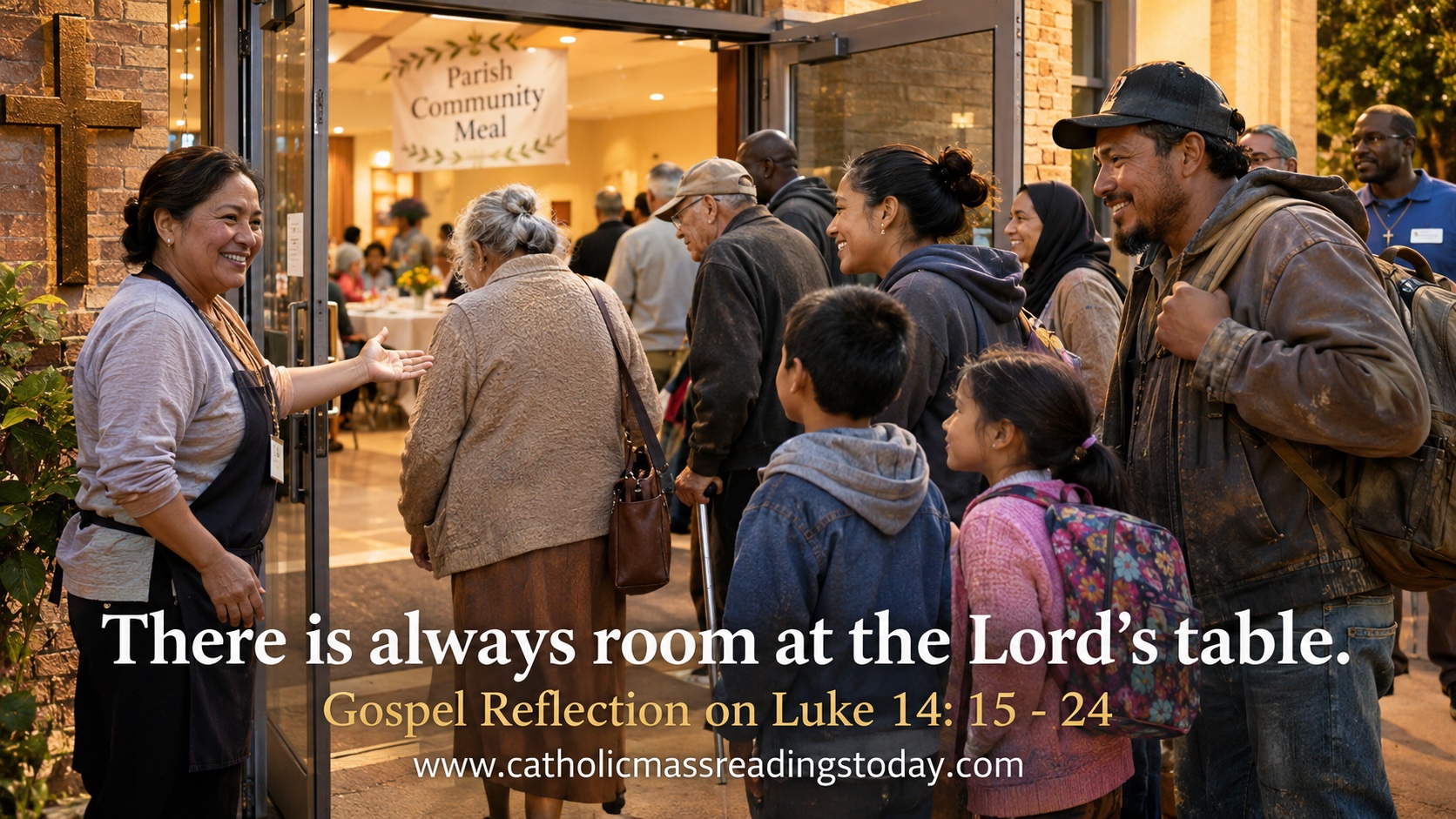
Here the parable reveals something profoundly beautiful about the Kingdom of God. Those who may have been overlooked by society are welcomed into the banquet. People who would not ordinarily expect a place at an important celebration discover that the doors have been opened to them.
In the society of Jesus’ time, poverty, illness, and disability could often leave people excluded from the privileges and recognition enjoyed by others. Yet the master does not judge his guests according to their wealth, influence, or social standing. He desires that his house should be filled.
This reflects the mercy of Jesus Christ, who welcomed sinners, showed compassion towards the suffering, and reminded the world that every human person possesses a dignity that cannot be measured by earthly circumstances.
The Church must continually remember this lesson.
Our parishes should be places where the poor are treated with dignity, where those who suffer are welcomed with compassion, and where people seeking to return to God encounter both truth and mercy. The Gospel does not permit us to regard another person as unworthy of our concern because of poverty, weakness, disability, or past mistakes.
Christ came to call sinners to repentance and to open the way of salvation to humanity.
This does not mean that conversion is unnecessary or that God’s commandments can be disregarded. Rather, it means that no person should be considered beyond the reach of divine mercy while there remains an opportunity to repent.
When the servant reports that the master’s instructions have been fulfilled, he adds a remarkable statement:
“Sir, what you commanded has been done, and still there is room.”
These words reveal the extraordinary generosity of God’s invitation.
There is still room for the person who has wandered away from the Church. There is still room for the sinner who sincerely desires forgiveness. There is still room for those who feel unworthy, forgotten, or burdened by the mistakes of their past.
The mercy of God is never exhausted by the number of people who come seeking His forgiveness. But we must be willing to respond.
Go Out to the Highways and Hedges: The Mission of the Church
The master then gives his servant a further command:
“Go out to the highways and hedges, and compel people to come in, that my house may be filled.”
These words reveal the missionary character of the Church. The invitation to salvation is not meant to remain confined to a small circle of familiar people. It must be carried beyond the places where it is already known, reaching those who have never heard the Gospel and those who have become distant from the life of faith.
The word “compel” must be understood in the light of Christ’s teaching and the dignity of human freedom. The Gospel is not an invitation to force religious belief upon anyone.
Faith must be embraced freely.
Rather, the urgency of the master’s command reminds us that the invitation is too important to be offered without conviction, perseverance, and sincere concern for those who have not yet responded.
Pope Saint John Paul II repeatedly reminded the Church of the importance of evangelisation and the need to bring the message of Christ to the people of every generation.
That mission remains ours today.
We do not have to travel to distant countries before becoming witnesses of the Gospel.
There may be someone within our own family who has stopped attending Mass. There may be a neighbour who is struggling with loneliness, a colleague who has lost hope, or a friend who no longer believes that God could forgive the mistakes of the past.
Sometimes a simple invitation to pray together, attend Mass, or speak about the mercy of Christ can become the beginning of a renewed journey of faith. Yet our words must be supported by our lives.
People are more likely to recognise the beauty of Christianity when they encounter patience, honesty, humility, and compassion in those who profess to follow Jesus.
The invitation to God’s banquet becomes more convincing when our lives reflect the love of the One who has invited us.
The Church exists to proclaim Christ, to administer His sacraments, and to lead people towards the salvation He offers.
Every Catholic shares, according to his or her vocation, in this mission.
The Danger of Refusing God’s Invitation
Although today’s Gospel contains a beautiful message of mercy, it also includes a serious warning. The master declares that those who were originally invited but refused to attend will not taste his banquet.
Jesus is reminding His listeners that God’s invitation calls for a genuine response. Divine mercy should never become an excuse for indifference.
We cannot continually postpone repentance while assuming that there will always be another opportunity to turn towards God. Every day of our lives is a gift, and none of us knows how much time remains in our earthly pilgrimage.
There may be someone we need to forgive, a sinful habit we need to abandon, or a neglected responsibility we need to fulfil. Perhaps we have become distant from the Sacrament of Reconciliation or allowed our prayer life to grow cold.
Today Jesus calls us to return. The proper response to His warning is not despair, but sincere conversion. The Lord who speaks of the consequences of rejecting His invitation is the same Lord who gave His life upon the Cross for our salvation.
His mercy is real, and so is our responsibility to respond to it.
God created us with the freedom to love Him. He calls us through His Word, His Church, and the quiet movements of grace within our hearts, but He does not destroy our freedom.
We must choose whether to welcome Him.
The greatest danger is not that God has forgotten to invite us, but that we may become so comfortable with our excuses that we stop hearing His voice.
Accepting the Invitation Today
As we reflect upon this Gospel, we should imagine ourselves among those who have received the invitation to the banquet.
The servant has arrived. The message has been delivered. The table is prepared.
What answer will we give?
Will we allow our responsibilities, possessions, and personal ambitions to become reasons for neglecting God? Or will we recognise that everything we have is temporary, while the life Christ offers is eternal?
Jesus is not asking us to abandon the legitimate duties of our families, professions, or communities. He is asking us to fulfil them with hearts that belong to God.
A Christian who places the Lord at the centre of life should become a more faithful spouse, a more loving parent, a more honest worker, and a more compassionate neighbour.
Our relationship with God should deepen our responsibilities towards others rather than diminish them.
The banquet of the Kingdom is the fulfilment of the communion for which we were created and every sincere act of prayer, every worthy reception of the Eucharist, every confession made with true repentance, and every work of charity helps prepare our hearts for that eternal joy.
Today’s Gospel therefore leaves us with a question that deserves an honest answer:
If the Lord were to call me today, would He find my heart ready to accept His invitation, or would I still be searching for another excuse?
May we never allow the passing concerns of this world to make us forget the eternal destiny that awaits us. Let us welcome Christ while the opportunity is before us, open our hearts to His transforming grace, and extend His invitation to those around us.
For the Lord desires that His house should be filled, and He continues to call His children into the joy of His Kingdom. May our answer be one of faith, gratitude, and love.
Let Us Pray
Lord Jesus Christ, our merciful Saviour, You have prepared for us the joy of Your eternal Kingdom and continually invite us to share in the fullness of Your divine life.
Look with compassion upon us today and forgive us for the many times we have allowed the passing concerns of this world to draw our hearts away from You.
Forgive us for the excuses we have made when You called us to prayer, repentance, charity, and a deeper commitment to Your holy will.
Grant us the wisdom to recognise what is truly important and the courage to place You at the centre of our lives.
Free us from pride, selfishness, and every attachment that prevents us from responding wholeheartedly to Your invitation.
Lord, You welcomed the poor, the suffering, and those who had been forgotten by others.
Teach us to recognise Your presence in every person and to extend Your mercy to those who are lonely, neglected, or burdened by the difficulties of life.
Bless Your Holy Church and strengthen all who proclaim the Gospel throughout the world.
Give us the grace to become faithful witnesses of Your love through our words, our actions, and the example of our daily lives.
Draw back to Yourself those who have wandered from the faith, console those who have lost hope, and open the hearts of those who have not yet come to know You.
May we never postpone the conversion You ask of us today.
Prepare our hearts to receive You worthily in the Holy Eucharist and help us to remain faithful to Your commandments throughout our earthly pilgrimage.
And when our journey in this world comes to an end, grant that we may be welcomed into the heavenly banquet, where You live and reign with God the Father, in the unity of the Holy Spirit, God, for ever and ever.
Amen.