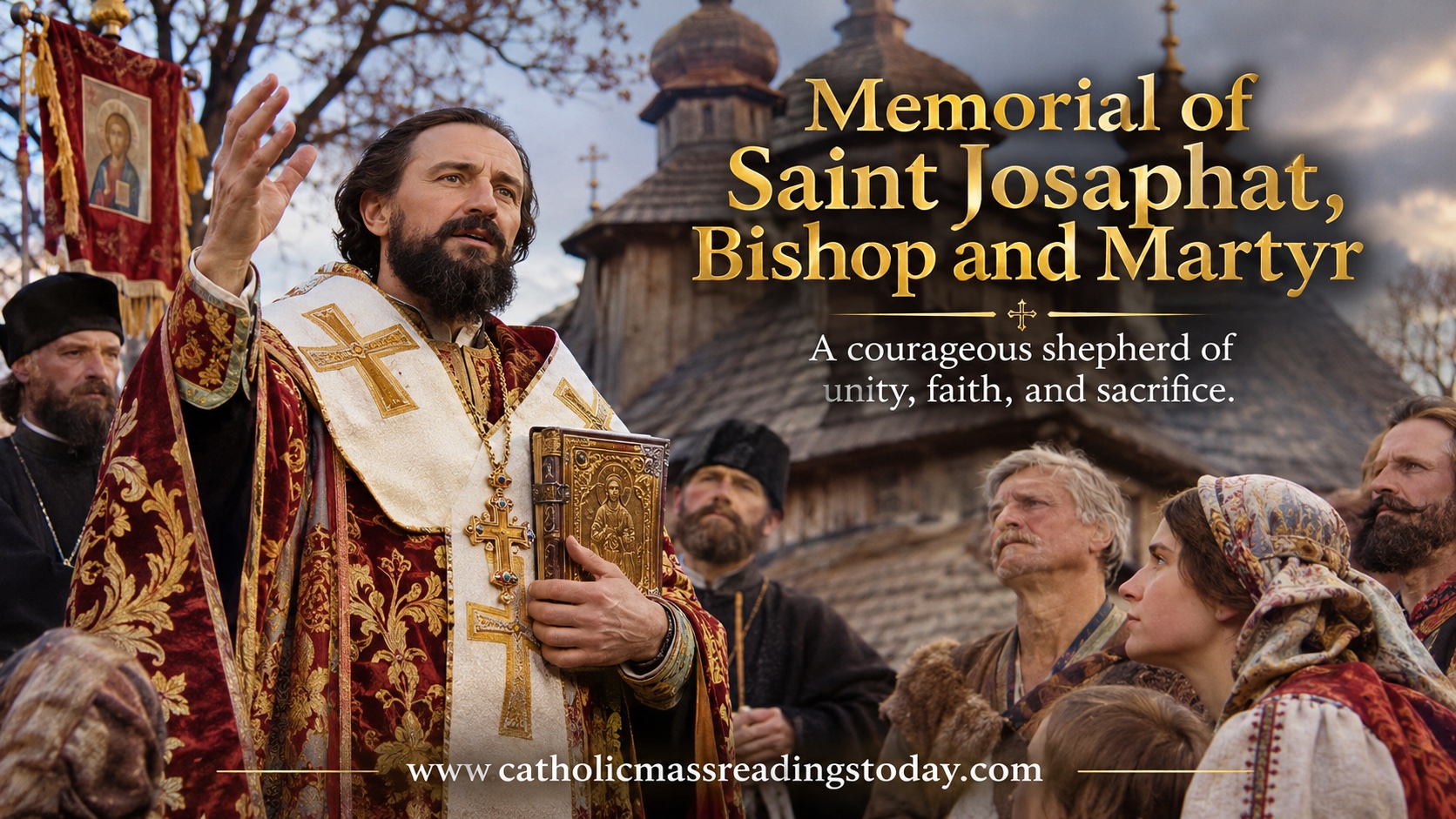
MEMORIAL OF SAINT JOSAPHAT, BISHOP & MARTYR
Every year on 12 November, the Catholic Church celebrates the Memorial of Saint Josaphat, Bishop and Martyr, remembering a courageous shepherd who devoted his life to the unity of Christians and remained faithful to his convictions even when that commitment cost him his life.
Saint Josaphat, also known as Saint Josaphat Kuntsevych or Saint Josaphat Kuncewicz, was a Basilian monk and Archbishop of Polotsk who lived between approximately 1580 and 1623. He served the Church during a period of profound religious division in Eastern Europe, when relations between Catholics and Orthodox Christians were marked by competing ecclesiastical authorities, political interference, and growing hostility.
His life was shaped by a deep love for Jesus Christ, a strong attachment to the Byzantine Christian tradition, and a conviction that unity with the Successor of Saint Peter could be achieved without abandoning the spiritual inheritance of the Eastern Churches.
Saint Josaphat became known for his devotion to prayer, his demanding monastic discipline, his concern for the poor, and his determination to reform the clergy entrusted to his care, yet his ministry was also surrounded by controversy. The religious tensions of his time eventually erupted into violence, and he was killed by an angry crowd in Vitebsk on 12 November 1623.
The Catholic Church honours him as a martyr for Christian unity, but his story also reminds us of the terrible consequences that follow when religious disagreements are allowed to become hatred.
More than four hundred years after his death, Saint Josaphat remains an important figure in Catholic history, particularly for the Eastern Catholic Churches, whose traditions demonstrate that communion with Rome does not require abandoning the richness of Eastern Christian worship and spirituality.
His witness invites us to reflect upon the unity for which Jesus prayed, the courage required to remain faithful to the Gospel, and the responsibility of every Christian to defend the truth without losing the spirit of charity.
The Birth and Early Life of Saint Josaphat
Saint Josaphat was born around AD 1580 in Volodymyr, in the historical region of Volhynia, located in present day western Ukraine.
At the time of his birth, the region formed part of the Polish Lithuanian Commonwealth, a vast political territory inhabited by people of different languages, cultures, and religious traditions.
His baptismal name was John, also recorded as Ivan or Ioann Kuntsevych.
His family belonged to the Ruthenian Christian community, whose religious life followed the Byzantine tradition. His parents were associated with the Eastern Orthodox Church, and the young John grew up surrounded by its prayers, liturgical ceremonies, sacred images, and spiritual customs.
Although accounts differ concerning the precise social standing and financial circumstances of his family, his father was involved in commercial affairs and civic life.
John’s childhood was marked by a strong religious influence, particularly through his mother.
According to traditional accounts, she frequently took him to church and encouraged him to develop a personal devotion to Jesus Christ.
The beauty of the Byzantine liturgy, the solemnity of its prayers, and the reverence shown towards sacred icons left a lasting impression upon him.
From an early age, he displayed an unusual interest in prayer and religious learning.
While other children might have been occupied mainly with the ordinary activities of daily life, John was increasingly drawn towards the quietness of the church and the spiritual meaning of Christian worship.
His attraction to the religious life was not the result of a sudden decision made in adulthood. It developed gradually through the faith he had encountered during his earliest years.
The Childhood Experience That Deepened His Love for Christ
One of the best known traditions concerning Saint Josaphat’s childhood describes an experience he had while contemplating an image of Jesus Christ crucified. According to this account, John was praying before a crucifix when he became deeply moved by the suffering and love of the Saviour.
Later devotional biographies describe him experiencing what seemed like a spark of divine love entering his heart from the wounded side of Christ.
The experience became a symbol of the spiritual transformation that would shape his entire life.
Whether understood as a mystical experience or as a traditional expression of his growing devotion, the story reveals the central place that the Crucified Lord occupied in Josaphat’s spirituality.
He came to understand that the suffering and death of Jesus Christ were not merely events from the distant past. They were the supreme revelation of God’s love for humanity.
This awareness encouraged him to develop habits of prayer, sacrifice, and compassion. The Cross would remain central to his understanding of Christian service.
For Saint Josaphat, loving Jesus Christ meant being willing to sacrifice personal comfort and worldly advancement in order to follow the Gospel faithfully.
Saint Josaphat’s Youth and His Apprenticeship in Vilnius
As John grew older, his family made arrangements for him to learn a trade. He travelled to Vilnius, then commonly known as Vilna, an important commercial and religious centre in the Grand Duchy of Lithuania. There he began working as an apprentice to a merchant.
The arrangement offered him the possibility of a stable livelihood and a respectable future in business, yet John’s deepest interests continued to lie elsewhere.
Vilnius was a city where different Christian communities lived alongside one another. Catholics, Orthodox Christians, and Protestants participated in a complicated religious environment shaped by the wider changes of the Protestant Reformation and the Catholic renewal that followed.
The city therefore exposed John to questions about Church authority, Christian doctrine, and the painful divisions that existed among believers.
He spent his free time studying religious texts, attending church services, and seeking spiritual guidance.
Despite the opportunities offered by commercial life, he gradually became convinced that God was calling him to a religious vocation.
Traditional accounts relate that his employer hoped to secure John’s future through a business partnership and marriage, but the young man declined these possibilities.
He had chosen a different path. Rather than pursue wealth or social position, John desired to offer his life entirely to the service of Jesus Christ.
The Union of Brest and the Religious World of Saint Josaphat
To understand the life of Saint Josaphat, it is necessary to understand the religious divisions that shaped the Eastern European world in which he lived. For centuries, the Eastern and Western Churches had experienced growing disagreements concerning ecclesiastical authority, theological expression, and political relationships.
The estrangement traditionally associated with the events of 1054 gradually deepened, although the history of the separation between Eastern Orthodox and Catholic Christians was considerably more complex than a single event.
By the sixteenth century, Christians in the territories of the Polish-Lithuanian Commonwealth belonged to different ecclesiastical communities.
Many Ruthenian Christians followed the Byzantine rite and maintained their historical connections with the Orthodox ecclesiastical tradition. Others increasingly supported a restoration of communion with the Bishop of Rome.
These developments culminated in the Union of Brest in 1596.
Under this arrangement, a number of Ruthenian bishops entered communion with the Catholic Church while retaining their Byzantine liturgy, ecclesiastical customs, and spiritual traditions.
The union gave rise to the Ruthenian Eastern Catholic community, from which several later Eastern Catholic Churches trace important elements of their history. However, the agreement was not accepted by every bishop, priest, monk, or member of the faithful.
Many Orthodox Christians rejected the union because they believed that it threatened their traditional ecclesiastical independence and their relationship with the wider Orthodox Church.
The disagreement was made more difficult by political involvement and disputes concerning church property, leadership, and religious rights.
In some places, communities that had previously worshipped together found themselves divided over which bishop possessed legitimate authority.
Saint Josaphat entered religious life within this atmosphere of deep uncertainty. He became convinced that communion with Rome and fidelity to the Byzantine Christian tradition could exist together.
This conviction would shape his ministry and eventually become the principal source of the conflicts surrounding his episcopal service.
Saint Josaphat Enters the Basilian Monastery in 1604
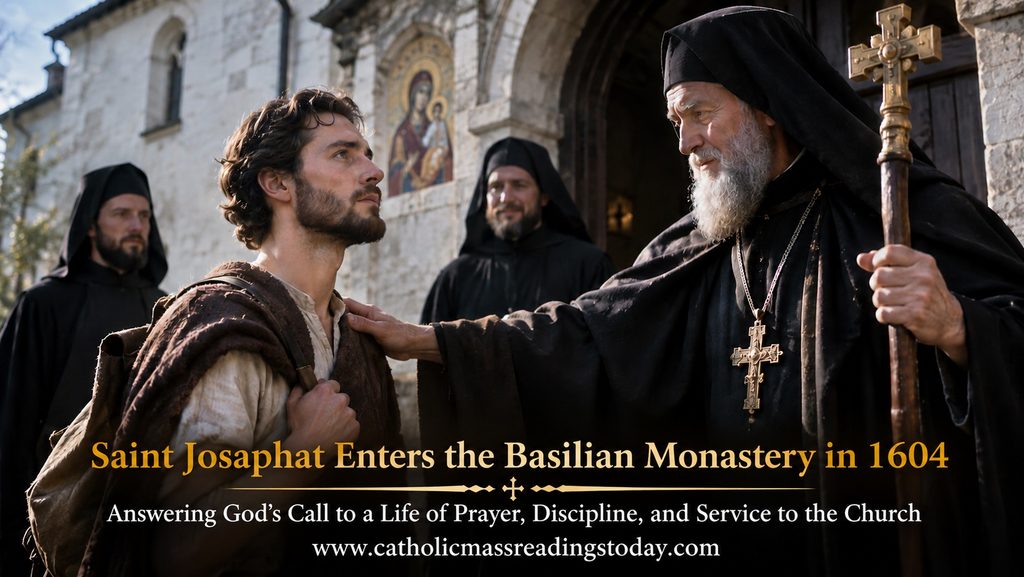
In 1604, at approximately twenty-four years of age, John Kuntsevych entered the Monastery of the Holy Trinity in Vilnius. He embraced the monastic tradition associated with Saint Basil the Great, one of the most influential Fathers of Eastern Christianity.
Upon entering religious life, he took the name Josaphat. The decision marked a decisive break with the future that had been expected of him. He left behind the possibility of commercial success and committed himself to a life centred upon prayer, fasting, obedience, simplicity, and service.
The monastery was not an easy place in which to begin his vocation. Religious life in the region was itself experiencing difficulties, and many communities needed spiritual renewal, stronger discipline, and better religious education.
Josaphat embraced these challenges with remarkable determination. He devoted long hours to prayer and studied the Scriptures, the writings of the Church Fathers, and the liturgical traditions of Eastern Christianity. He was particularly attracted to the spiritual discipline of monastic life.
Those who encountered him came to recognise a man whose religious commitment was not simply expressed through words. It could be seen in the way he lived.
He practised personal sacrifice, avoided unnecessary comfort, and sought to place the needs of the Church above his own preferences. His example gradually attracted others who desired a more faithful and disciplined religious life.
The Friendship Between Saint Josaphat and Joseph Velamin Rutsky
An important figure in Saint Josaphat’s religious development was Joseph Velamin Rutsky, also known as Józef Welamin Rutski.
Rutsky possessed a strong intellectual background and shared Josaphat’s concern for the spiritual renewal of the Eastern Catholic community.
Although the two men came from different personal backgrounds, they developed a close working relationship.
Josaphat contributed a deep familiarity with Eastern Christian prayer and monastic spirituality, while Rutsky brought considerable organisational and theological experience. Together, they worked to strengthen religious life among the Basilian monks.
Their efforts encouraged better education, greater discipline, and a more serious commitment to the responsibilities of the monastic vocation.
They understood that genuine Church renewal could not be achieved through administrative changes alone. It required the conversion of hearts.
Monks needed to become men of prayer, priests needed to serve their communities faithfully, and Church leaders needed to set examples worthy of imitation.
The cooperation between Josaphat and Rutsky became especially influential in the reform and development of the Basilian monastic tradition.
Their work helped establish a stronger foundation for the religious communities that would later contribute greatly to the life of the Eastern Catholic Churches.
The Ordination of Saint Josaphat and His Ministry as a Priest
Saint Josaphat was ordained a priest in 1609. His priestly ministry quickly became known for its spiritual seriousness and strong commitment to preaching. He understood that many of the faithful needed better instruction in Sacred Scripture, the sacraments, and the teachings of the Church.
He devoted himself to explaining the Catholic faith and encouraging people to develop a more personal relationship with Jesus Christ.
Josaphat’s preaching reflected his deep familiarity with the Byzantine spiritual tradition. He believed that the beauty of the Divine Liturgy, the teachings of the Fathers, and the prayerful life of the Church could help people grow in holiness.
He also encouraged frequent participation in worship and greater reverence towards the sacraments. His ministry attracted admiration, but it also provoked opposition.
Because he actively supported the Union of Brest, some Orthodox Christians regarded his preaching as an attempt to draw their communities away from traditional ecclesiastical authority.
Josaphat nevertheless remained committed to the position he believed was right. He also became increasingly involved in the reform of monasteries.
By 1614, he had assumed important responsibilities as an archimandrite, or monastic superior, in Vilnius.
His leadership demonstrated an ability to combine a demanding personal spiritual life with the practical responsibilities of guiding other religious.
He expected discipline from those entrusted to his care, but he also believed that leadership should be grounded in personal example.
Saint Josaphat’s Concern for the Poor and Ordinary Christians
Saint Josaphat’s religious life was marked by personal simplicity and concern for those who suffered.
Although he later occupied important positions within the Church, he remained attached to the ideals of monastic poverty. He was particularly concerned about the spiritual and material difficulties experienced by ordinary Christians.
Many communities in Eastern Europe struggled with poverty, insufficient religious education, and the instability created by political and religious conflicts.
Josaphat understood that the mission of the Church could not be limited to preserving religious institutions.
The faithful needed priests who would teach them, pastors who would listen to them, and Christian communities that would care for their most vulnerable members.
Accounts of his ministry describe a man willing to make personal sacrifices for those in need.
His concern for the poor reflected the example of Jesus Christ, who identified Himself with the hungry, the suffering, and those who had been overlooked by society.
For Josaphat, charity was an essential responsibility of Christian life. He believed that the truth of the Gospel should be reflected in the way believers treated one another.
This conviction remains particularly important when considering the difficulties that surrounded his later ministry.
The divisions of his age were serious, but the Christian calling to charity remained greater than the temptation to hatred.
The Appointment of Saint Josaphat as Bishop in 1617
In 1617, Saint Josaphat was appointed to episcopal responsibility in the Eastern Catholic Church.
He was consecrated bishop on 12 November 1617 and became associated with the Diocese of Vitebsk, with the right of succession to the Archbishopric of Polotsk.
At approximately thirty seven years of age, he was still relatively young for such a demanding office. The appointment placed him in a position of considerable responsibility. The territories entrusted to his care included communities deeply divided by religious disagreements.
Some Christians accepted the Union of Brest, while others remained committed to the Orthodox Church and rejected the authority of the Catholic hierarchy.
Josaphat understood that his new office would require courage, patience, and perseverance. The challenges were not simply theological.
Questions of Church administration, access to places of worship, property ownership, and the recognition of bishops had become sources of serious public tension.
Nevertheless, he accepted the responsibility entrusted to him. His episcopal ministry would become the defining period of his life.
Saint Josaphat Becomes Archbishop of Polotsk in 1618
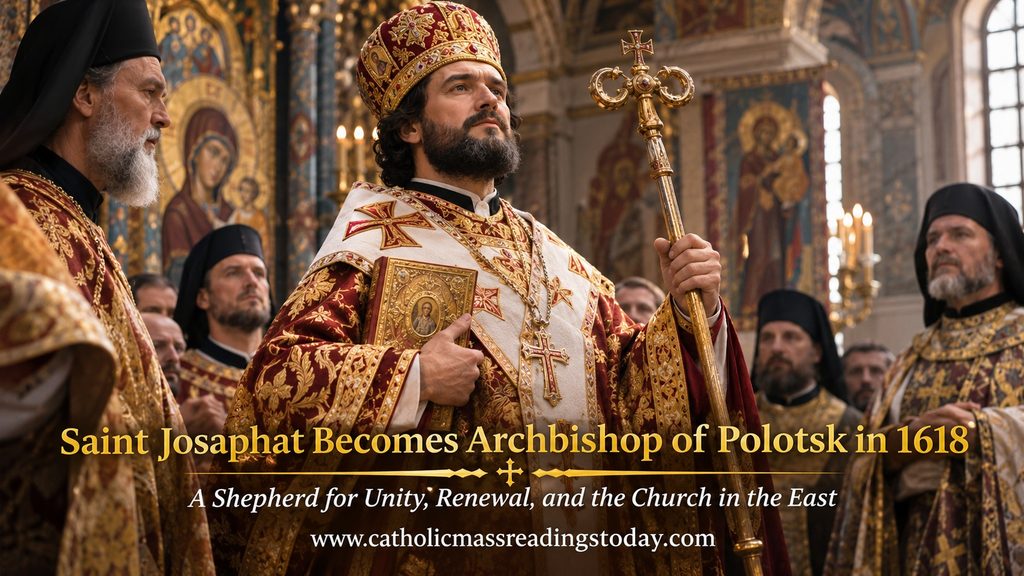
In 1618, Saint Josaphat succeeded to the Archbishopric of Polotsk, an important ecclesiastical territory in what is now Belarus. His appointment gave him responsibility for guiding a large community through a period of religious unrest.
One of his first concerns was the condition of the clergy. He believed that priests could not effectively guide the faithful unless they themselves were properly educated, disciplined, and devoted to their vocation.
Josaphat therefore encouraged better priestly formation, more faithful celebration of the Divine Liturgy, and stronger pastoral responsibility.
He sought to restore church buildings and strengthen the administration of the communities under his authority. He also worked to improve religious instruction among ordinary Christians. His ministry reflected his conviction that unity with Rome should not require the abandonment of Eastern Christian worship.
Josaphat remained deeply attached to the Byzantine liturgical tradition. He wanted the faithful to recognise that the Church’s Eastern spiritual inheritance was compatible with communion with the Catholic Church. His efforts contributed to the strengthening of Eastern Catholic religious life.
At the same time, they intensified opposition among those who rejected his jurisdiction. The situation became increasingly difficult as rival religious authorities and political interests competed for influence.
What Josaphat regarded as an effort to strengthen ecclesiastical unity was viewed by many opponents as an intrusion upon their Orthodox communities.
These disagreements would eventually contribute to the tragic events surrounding his death.
Saint Josaphat and the Struggle for Christian Unity
Saint Josaphat is often remembered as a martyr for Christian unity.
To understand this title properly, we must consider what unity meant to him and why the pursuit of it became so difficult. He believed that the Church founded by Jesus Christ should remain united in the apostolic faith and in communion with the Successor of Saint Peter.
At the same time, he considered the Byzantine Christian tradition a precious inheritance that deserved protection.
For Josaphat, unity did not mean that every Christian community had to worship in exactly the same way. He believed that different liturgical traditions could exist within one Catholic communion.
This understanding remains an important part of Catholic teaching today.
The Catholic Church includes Latin Catholics and numerous Eastern Catholic Churches, each with its own legitimate liturgical, spiritual, and disciplinary traditions.
However, the circumstances of Josaphat’s life were complicated by the close relationship between religion and political authority.
Churches and monasteries were sometimes transferred between competing jurisdictions, and decisions affecting religious communities could be enforced through secular power.
Such actions deepened resentment and made peaceful reconciliation more difficult.
Saint Josaphat was an active participant in this contested ecclesiastical environment, not simply a distant observer of it.
His determination to defend the union was genuine, but the conflicts surrounding its implementation caused suffering and division.
The Church’s commemoration of his martyrdom therefore also offers an opportunity to recognise the importance of religious freedom, mutual respect, and reconciliation.
Christian unity cannot be separated from the truth of the Gospel, but neither can it be pursued faithfully through hatred or contempt for those who disagree.
The Growing Opposition to Saint Josaphat’s Ministry
As Saint Josaphat continued his work as Archbishop, opposition to his authority increased.
In several communities, Orthodox Christians resisted the transfer of ecclesiastical jurisdiction to the Eastern Catholic hierarchy.
The presence of competing bishops and clergy created confusion concerning which religious leaders possessed legitimate authority. The atmosphere became increasingly hostile.
Religious disagreement was no longer confined to theological discussions or ecclesiastical correspondence. It affected the daily life of communities, their places of worship, and their relationships with local authorities.
Vitebsk became one of the principal centres of resistance to Josaphat’s authority.
Many inhabitants remained firmly attached to the Orthodox Church and viewed his efforts with suspicion. Tensions worsened as opposing religious leaders encouraged their followers to defend their respective communities.
Josaphat received warnings concerning the danger he faced.
Nevertheless, he continued carrying out his episcopal responsibilities. He remained convinced that he should not abandon the faithful entrusted to his care simply because his ministry had become dangerous.
His determination reflected a deep sense of pastoral duty. Yet the situation also demonstrated how easily religious convictions could become entangled with fear, political rivalry, and hostility.
By 1623, the conflict had reached a dangerous point.
The Final Journey of Saint Josaphat to Vitebsk
In November 1623, Saint Josaphat was in Vitebsk, where tensions between supporters and opponents of his ecclesiastical authority had become particularly severe.
His presence in the city was controversial. The dispute concerned not only his religious teachings but also the authority he claimed over local churches and clergy.
The city was deeply divided. Those who supported the union regarded Josaphat as their legitimate archbishop. Many Orthodox inhabitants, however, rejected that claim and believed their religious community was being threatened. The atmosphere was filled with suspicion.
Josaphat knew that his ministry involved considerable personal danger. Nevertheless, he remained committed to his responsibilities. The events that followed would bring his earthly life to a violent end.
The Martyrdom of Saint Josaphat on 12 November 1623
On the morning of 12 November 1623, a confrontation developed near the archbishop’s residence in Vitebsk.
The precise sequence of events is preserved in accounts written within an atmosphere of intense religious conflict, and historians have examined their details carefully.
According to traditional Catholic accounts, an incident involving an Orthodox priest and members of Josaphat’s household contributed to the gathering of an angry crowd.
The confrontation rapidly escalated. A mob entered the episcopal residence and attacked the archbishop. Saint Josaphat was beaten and fatally wounded. He was approximately forty three years old.
His body was subsequently desecrated and thrown into the River Dvina.
The killing shocked the Catholic community.
Josaphat had devoted his religious life to the unity of the Church, yet he died amid the very divisions he had struggled to overcome.
The Catholic Church came to recognise his death as martyrdom because of his fidelity to the faith and ecclesiastical communion he had defended.
His death also revealed the devastating consequences of religious hostility.
The tragedy should never be used to justify hatred towards Orthodox Christians, just as the violence committed against Josaphat cannot be justified by the disagreements of his time.
The martyrdom of Saint Josaphat reminds us that no religious conflict should ever lead Christians to forget the commandment of Jesus Christ to love one another.
The Recovery of Saint Josaphat’s Body and the Beginning of His Veneration
After the killing, Saint Josaphat’s body was recovered from the River Dvina. The faithful who honoured him were deeply moved by the brutality of his death.
His remains became an important focus of devotion, and accounts of his life and martyrdom began circulating among Eastern Catholic communities.
He was remembered as a bishop who had remained faithful to his mission despite repeated threats.
His reputation for holiness was strengthened by reports of spiritual favours and miracles attributed to his intercession.
The devotion surrounding Josaphat developed during a period when the Eastern Catholic community was still struggling to establish and defend its ecclesiastical identity.
His memory became closely connected with the Church’s understanding of communion with Rome and the preservation of the Byzantine religious tradition.
Yet the response to his death was not limited to devotion.
The political authorities also investigated the violence in Vitebsk, and severe punishments were imposed upon people held responsible for the uprising.
The aftermath demonstrated that the region’s religious conflict had become deeply entangled with the coercive power of the state.
In the centuries that followed, Josaphat’s remains would be moved several times as political boundaries changed and the Eastern Catholic Church experienced further periods of persecution and instability.
The Beatification of Saint Josaphat in 1643
Twenty years after his martyrdom, Saint Josaphat was beatified by Pope Urban VIII in 1643.
The recognition reflected the growing devotion to him and the Catholic Church’s judgement concerning the witness of his life and death.
His beatification was particularly significant for the Eastern Catholic communities that had emerged from the Union of Brest.
Josaphat became a powerful symbol of their commitment to preserving Eastern Christian traditions while remaining in communion with Rome.
His example encouraged the faithful to remain steadfast amid religious and political difficulties.
His name continued to spread through monastic communities, churches, religious literature, and popular devotion.
The remembrance of his martyrdom also strengthened the place of the Basilian religious tradition within the Eastern Catholic Church.
The monks who followed the spirituality of Saint Basil the Great continued their work of prayer, education, pastoral service, and spiritual renewal.
The Canonization of Saint Josaphat in 1867
Saint Josaphat was canonized by Pope Pius IX on 29 June 1867.
His canonization marked another important moment in the history of the Catholic Church’s relationship with Eastern Christianity.
He became one of the most prominent Eastern Catholic saints honoured throughout the wider Catholic Church.
His canonization recognised his martyrdom, personal holiness, and commitment to ecclesiastical communion.
It also brought greater international attention to the spiritual heritage of the Eastern Catholic Churches.
Saint Josaphat’s witness demonstrated that Catholic holiness is not confined to a single language, culture, or liturgical tradition.
The Catholic Church embraces a rich variety of legitimate forms of Christian worship, all centred upon the same Lord Jesus Christ.
The life of Saint Josaphat was therefore remembered not only as the story of an individual martyr, but also as part of the wider history of Eastern Catholic Christianity.
Saint Josaphat and Pope Pius XI’s Encyclical Ecclesiam Dei
In 1923, the Catholic Church commemorated the three-hundredth anniversary of Saint Josaphat’s martyrdom.
To mark the occasion, Pope Pius XI issued the encyclical Ecclesiam Dei on 12 November 1923.
The document reflected upon the importance of Christian unity and the example of Saint Josaphat, whose life had been dedicated to the cause of ecclesiastical communion.
Pope Pius XI presented the martyr as an intercessor for the unity of Christians and encouraged prayer for the healing of divisions within the Church.
The anniversary demonstrated that Saint Josaphat’s witness had not been forgotten despite the centuries that had passed.
His life continued to raise questions concerning the relationship between Christian truth, ecclesiastical unity, and the diversity of legitimate liturgical traditions.
These questions would remain important throughout the twentieth century as the Catholic Church developed its modern approach to ecumenical dialogue.
The Relics of Saint Josaphat in Saint Peter’s Basilica
One of the most significant events in the later history of Saint Josaphat’s devotion occurred in 1963.
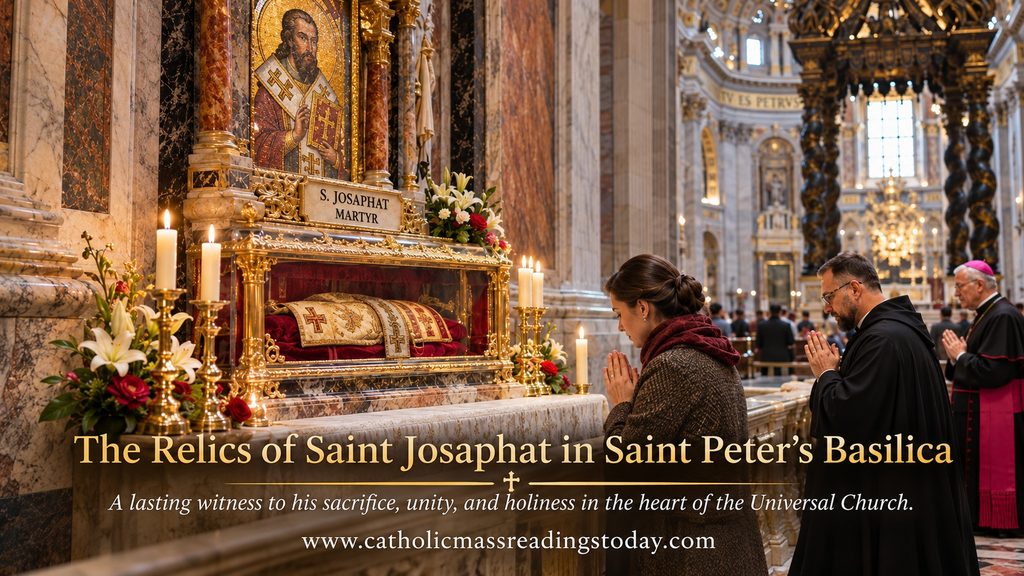
On 22 November of that year, Pope Paul VI had the saint’s relics placed beneath the altar dedicated to Saint Basil the Great in Saint Peter’s Basilica, Vatican City.
The location is especially meaningful because Saint Josaphat had followed the monastic spirituality associated with Saint Basil.
His resting place within the Vatican Basilica also reflects the close connection between his memory and the Catholic Church’s understanding of unity.
For Ukrainian Greek Catholics and other Eastern Catholics, his tomb became an important destination for pilgrimage and prayer.
Pilgrims continue to honour him as a bishop who remained devoted to his faith through suffering and persecution.
On 25 November 2013, Pope Francis welcomed Ukrainian Greek Catholic pilgrims who had come to Rome to commemorate the fiftieth anniversary of the transfer of Saint Josaphat’s relics to Saint Peter’s Basilica.
The commemoration highlighted the enduring importance of his witness and the communion shared by believers within the Catholic Church.
His tomb remains a visible reminder of the spiritual bond between the Eastern Catholic Churches and the Apostolic See of Rome.
The History of the Memorial of Saint Josaphat
The annual celebration of Saint Josaphat’s memorial developed from the devotion that followed his death and the Church’s recognition of his martyrdom.
His feast became especially important within Eastern Catholic communities, where he was remembered as a bishop, monk, reformer, and defender of ecclesiastical communion.
His commemoration subsequently became part of the wider Catholic liturgical tradition.
Today, the Roman Catholic Church observes the Memorial of Saint Josaphat, Bishop and Martyr, on 12 November, the anniversary of his death.
His celebration brings particular attention to the Catholic Church’s Eastern spiritual heritage.
It also provides an opportunity to pray for Christian unity, especially among Catholics and Orthodox Christians whose traditions share so much of the same apostolic inheritance.
The memorial is not simply a remembrance of the religious struggles of the seventeenth century.
It is an invitation to examine how Christians respond to division in the present.
Saint Josaphat lived during an age when disagreements concerning faith and authority too often resulted in hostility.
The Church now encourages Catholics to seek reconciliation through prayer, respectful dialogue, conversion of heart, and a shared commitment to the truth.
His memorial therefore calls believers to become instruments of peace rather than sources of further division.
Why Saint Josaphat Is Important to the Eastern Catholic Churches
Saint Josaphat occupies a particularly important place in the history of the Eastern Catholic Churches.
His life demonstrates the possibility of preserving Byzantine Christian worship and spirituality within communion with the Catholic Church.
He did not regard the liturgical traditions inherited from Eastern Christianity as obstacles that needed to be removed.
He understood them as precious expressions of the Christian faith.
The Divine Liturgy, sacred icons, spiritual hymns, monastic prayer, and the teachings of the Eastern Church Fathers were central to his religious identity.
His efforts to reform monastic communities also contributed to the strengthening of Basilian religious life.
The Basilian Order of Saint Josaphat continues to honour his memory and his commitment to prayer, education, and pastoral service.
Saint Josaphat’s importance extends to the recognition that the Catholic Church is enriched by different spiritual traditions.
Unity does not require the disappearance of legitimate diversity.
When rooted in the same faith and communion, different liturgical traditions can reveal the richness of the Church’s spiritual inheritance.
This remains one of the most important lessons associated with Saint Josaphat’s life.
Saint Josaphat and the Catholic Church’s Commitment to Christian Unity Today
The subject of Christian unity remains deeply important in the modern Church.
The divisions between Catholics and Orthodox Christians are painful because both communities share an ancient Christian heritage.
They profess faith in Jesus Christ, honour Sacred Scripture, celebrate the sacraments, and preserve traditions that reach back to the early centuries of Christianity. At the same time, important differences concerning ecclesiastical authority and other theological questions remain unresolved.
Saint Josaphat lived at a time when these disagreements were addressed within political conditions very different from those of today.
The Catholic Church now emphasises the importance of ecumenical dialogue, mutual respect, and the rejection of coercion in matters of faith.
The Second Vatican Council encouraged Catholics to recognise the spiritual treasures preserved in the Eastern Churches and to work sincerely towards Christian unity.
The modern Catholic understanding of ecumenism therefore invites us to remember Josaphat’s commitment to unity while also learning from the painful history surrounding his martyrdom.
We honour his fidelity without treating the suffering of other Christian communities as insignificant.
We remember his death without allowing it to become a source of renewed hostility.
And we pray for the day when the divisions separating Christians may be healed according to the will of Jesus Christ.
In the Gospel according to John, our Lord prays:
“That they may all be one.” (John 17:21)
These words remain at the heart of the Church’s desire for Christian unity.
The Importance of Saint Josaphat’s Witness in a Divided World
The life of Saint Josaphat continues to speak to a world troubled by religious hostility, political conflict, and divisions between communities.
His story reminds us that sincere convictions can exist within difficult historical circumstances.
It also warns us that faith must never be used as an excuse for hatred or violence.
Today, disagreements can spread rapidly through social media, public discussions, and political movements.
People sometimes become so determined to defeat those who disagree with them that they forget their shared human dignity.
Christians are called to respond differently.
The Gospel asks us to remain faithful to the truth while showing patience, compassion, and respect towards others.
Saint Josaphat’s martyrdom reminds us how destructive religious hatred can become when it is allowed to govern human actions.
His commitment to prayer and pastoral service also teaches that the Church’s mission cannot be fulfilled through arguments alone.
Christian faith must be visible in the holiness of our lives.
We are called to become people whose words are truthful, whose actions are charitable, and whose hearts remain open to reconciliation.
What Catholics Can Learn from the Life of Saint Josaphat
Saint Josaphat’s life invites every Catholic to reflect upon the meaning of faithfulness.
He entered religious life because he believed that Jesus Christ was worthy of his complete devotion.
He embraced prayer and sacrifice because he understood that spiritual strength comes from remaining close to God.
He accepted the responsibilities of priesthood and episcopal leadership because he believed that the Church needed shepherds willing to serve faithfully.
And he continued his ministry even when the circumstances became dangerous.
His example encourages us not to abandon our Christian responsibilities whenever they become difficult.
At the same time, the painful events surrounding his death remind us that fidelity to God must always be accompanied by humility and charity.
We should never allow our religious convictions to become an excuse for arrogance, contempt, or hostility towards others.
Within our families, parishes, workplaces, and communities, we will encounter people who disagree with us.
The challenge is to remain truthful without becoming cruel, courageous without becoming aggressive, and firm in our faith without losing compassion.
The strongest witness to the Christian faith is not simply the ability to defend what we believe, but the grace to live those beliefs with humility, courage, and love.
The Enduring Legacy of Saint Josaphat, Bishop and Martyr
More than four centuries after his death, Saint Josaphat remains a significant figure in the spiritual history of the Catholic Church.
His name is remembered in Eastern Catholic liturgies, churches, religious communities, and places of pilgrimage throughout the world.
His contributions to Basilian monastic reform continue to influence the religious tradition associated with his name.
His dedication to the Byzantine liturgical inheritance reminds Catholics that the Church’s unity embraces a rich diversity of authentic Christian traditions.
His martyrdom continues to inspire believers who suffer because of their faith.
And the divisions surrounding his death remind us of the urgent need for peace, reconciliation, and respect among Christians.
Saint Josaphat’s life was not free from controversy, and his historical setting cannot be understood without recognising the political and religious tensions of Eastern Europe in the seventeenth century.
Yet the Church honours him as a man who offered his life in fidelity to what he believed was his duty before God.
His witness calls Catholics to seek unity through faith, prayer, and charity.
As we celebrate the Memorial of Saint Josaphat, Bishop and Martyr, let us remember that the unity of the Church is not simply an institutional concern.
It is a deeply spiritual responsibility flowing from our belonging to Jesus Christ.
Every time we choose reconciliation instead of resentment, understanding instead of contempt, and charity instead of hatred, we contribute to the witness of Christian love.
May Saint Josaphat’s example encourage us to remain faithful to the Gospel and to work sincerely for peace among all who profess the name of Christ.
The greatest tribute we can offer to a martyr who desired Christian unity is to become Christians who remain steadfast in truth, generous in love, and committed to reconciliation.
Let Us Pray
O God, who strengthened Saint Josaphat, Bishop and Martyr, to remain faithful to Your Church even unto death,
Through his intercession, grant us the courage to profess our faith with humility and to remain steadfast in the truth of Your holy Gospel.
Fill our hearts with charity, heal the divisions that separate Christians, and guide all who believe in Your Son towards the unity for which He prayed.
May we never allow pride, hatred, or resentment to overcome our love for one another, but always seek peace and reconciliation in accordance with Your holy will.
Through our Lord Jesus Christ, Your Son, who lives and reigns with You in the unity of the Holy Spirit, God, for ever and ever.
Amen.
Saint Josaphat, Bishop and Martyr, pray for us.