Jesus Came to Seek and Save the Lost
There is something deeply moving about the encounter between Jesus and Zacchaeus. Here was a man who had accumulated considerable wealth, yet something was still missing from his life. He wanted to see Jesus. Perhaps he had heard about His miracles, His teachings, or the extraordinary compassion He showed towards people whom society had rejected.
Zacchaeus was a chief tax collector, a profession widely associated with dishonesty and exploitation in those days. Many people regarded him as a sinner, someone unworthy of their respect. Yet when Jesus passed through Jericho, Zacchaeus was determined not to miss the opportunity to see Him.
Being short, he could not see over the crowd. So he ran ahead and climbed a sycamore tree.
What happened next must have surprised everyone.
Jesus stopped, looked up, and called him by name: “Zacchaeus, make haste and come down; for I must stay at your house today.”
Zacchaeus had climbed the tree hoping to see Jesus. He probably never imagined that Jesus would notice him, much less choose to visit his home.
This is where we discover one of the most beautiful truths of today’s Gospel: God knows us personally, sees beyond our failures, and continues calling us towards Himself even when others have given up on us.
Many people today carry the burden of past mistakes. Some struggle with guilt over decisions they regret, broken relationships, dishonesty, or habits they desperately want to overcome. Others feel judged by their communities and believe that their past has permanently damaged their chances of living a better life.
But Jesus did not begin by publicly listing Zacchaeus’ sins. He approached him with an invitation that opened the door to conversion.
This does not mean that Jesus approved of any wrongdoing Zacchaeus may have committed. Rather, His mercy offered Zacchaeus the opportunity to recognise his sins and change his life.
The crowd could only see the tax collector they disliked. Jesus saw a man who could still be saved.
And Zacchaeus responded.
Standing before the Lord, he promised to give half his possessions to the poor and repay four times the amount to anyone he had defrauded.
His response teaches us that true repentance is more than feeling sorry for what we have done. It requires a sincere willingness to change and, wherever possible, to repair the harm we have caused.
This message speaks directly to the challenges of our world today.
We live in a time when dishonesty can sometimes appear profitable, when people are tempted to pursue wealth without considering how it is obtained, and when personal success is often measured by money, possessions, and public recognition.
Zacchaeus reminds us that wealth cannot replace peace of conscience. No amount of material success can give us the joy that comes from living honestly before God.
If we have wronged someone, our faith calls us to seek forgiveness. If we have gained something dishonestly, we should strive to make restitution. If we have neglected those in need, we are invited to become more generous.
These changes may not always be easy, but they are signs of a heart that has truly welcomed Christ.
There is another important lesson in the behaviour of the crowd. When Jesus entered Zacchaeus’ home, people complained that He had become the guest of a sinner.
How quickly we, too, can judge others by their reputation, their weaknesses, or the mistakes of their past.
Sometimes we forget that the person we condemn today may be sincerely trying to become better tomorrow.
Jesus teaches us to hate sin without losing compassion for the sinner. We must never confuse a person’s wrongdoing with the total value of that person’s life.
Every human being is created in God’s image and remains in need of His mercy.
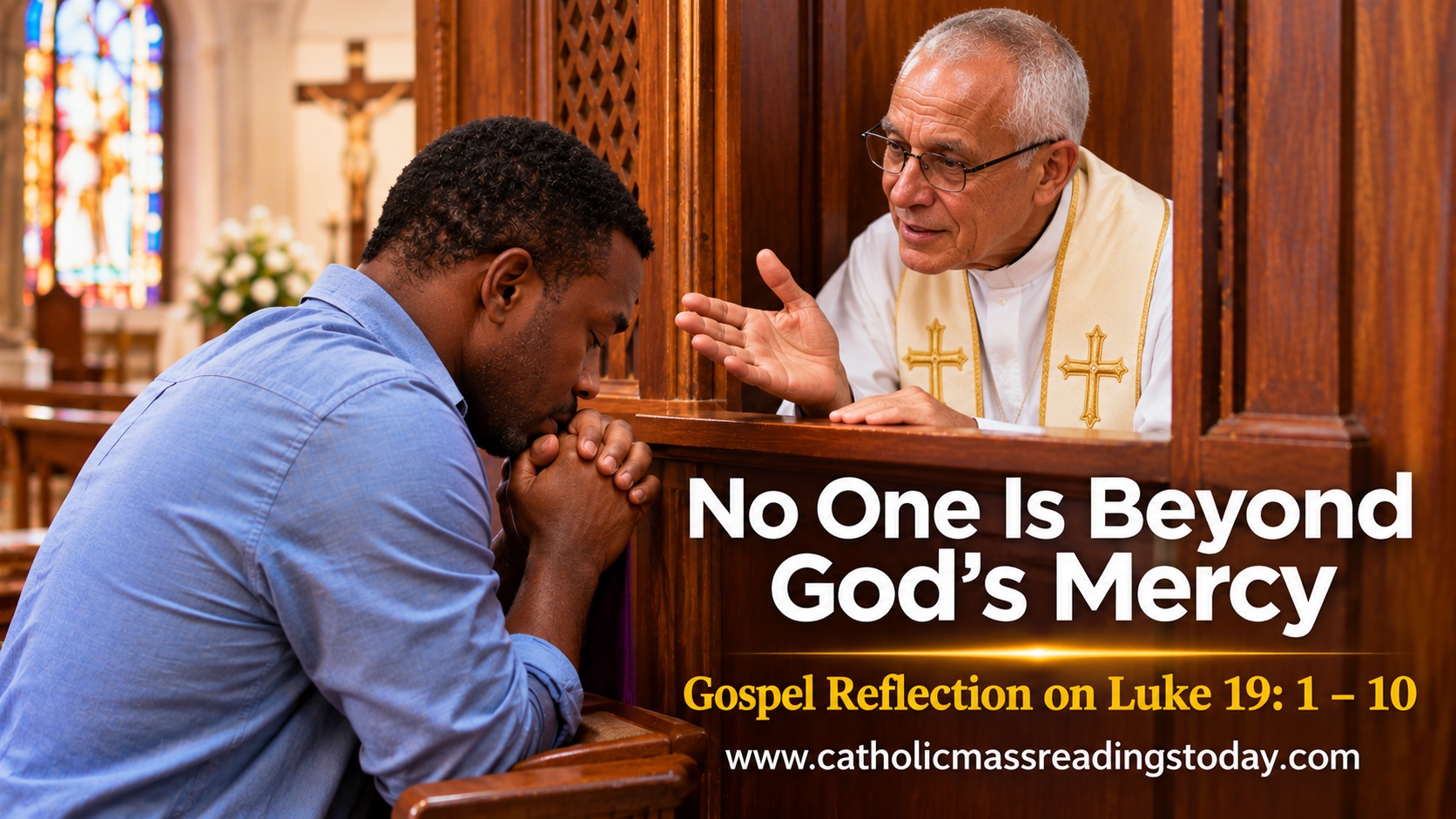
As Catholics, we encounter this mercy especially through the Sacrament of Reconciliation, where Christ welcomes the repentant sinner, forgives sins, and gives the grace to begin again.
The encounter with Zacchaeus reaches its beautiful conclusion when Jesus declares:
“Today salvation has come to this house.”
Notice that Jesus says today.
Zacchaeus did not have to wait until his life was perfect before responding to God’s invitation. He welcomed Jesus, acknowledged the need for change, and began a new journey.
We, too, should never postpone our conversion while waiting for a more convenient time.
Perhaps there is someone we need to forgive, an injustice we must correct, a sinful habit we should abandon, or a relationship with God we have neglected for too long.
The Lord calls us to begin today.
As we reflect upon this Gospel, let us ask ourselves whether we are willing to welcome Jesus into every part of our lives, including those areas where we most need His healing and forgiveness.
For the greatest gift Zacchaeus received was not the wealth he had accumulated, but the mercy of Christ that transformed his heart.
And the same Jesus continues to seek us with that same love.
“For the Son of man came to seek and to save the lost.”
These words are the heart of today’s Gospel. No one is beyond the reach of God’s mercy, and no life is beyond the possibility of change when a person sincerely turns towards Christ.
Let Us Pray
Lord Jesus Christ,
You came to seek and save the lost
and welcomed Zacchaeus with mercy and love.
Look upon us with the same compassion,
especially when we are burdened by our sins
and the mistakes of our past.
Give us humble and repentant hearts,
the courage to correct our wrongs,
and the grace to live with honesty, generosity, and love.
Teach us never to judge others without compassion,
and may we always welcome You into our hearts and homes.
Through the intercession of the Blessed Virgin Mary,
lead us along the path of conversion
and bring us to the joy of eternal life.
Amen.