Saint Elizabeth of Hungary: Her Life, Charity, Miracles, Suffering and Lasting Legacy
Saint Elizabeth of Hungary: The Remarkable Life of a Princess Who Gave Everything for Christ
Saint Elizabeth of Hungary was born into one of Europe’s powerful royal families, married a German prince while still a teenager, became the mother of three children, and devoted her wealth and influence to caring for the poor. By the time she died on November 17, 1231, at approximately twenty-four years of age, she had experienced a lifetime of love, responsibility, grief, sacrifice, and extraordinary Christian charity.
Nearly eight centuries later, the Catholic Church continues to honour her as one of the great examples of holiness lived through compassion and service.
Also known as Saint Elizabeth of Thuringia, she is remembered not simply because she gave away food and money, but because she recognised the dignity of people whom others frequently ignored. Her Christian faith influenced the way she treated her husband, raised her children, exercised authority, responded to suffering, and ultimately chose to spend her final years nursing the sick.
Her story is especially remarkable because she did not begin her spiritual journey in a monastery. She began it in a royal household, surrounded by wealth, political expectations, family obligations, and the considerable privileges of medieval aristocratic life.
Yet Elizabeth came to believe that the possessions entrusted to her carried a responsibility towards those who had little or nothing.
The Church celebrates the Memorial of Saint Elizabeth of Hungary on November 17, remembering a woman whose brief life continues to challenge Christians to recognise Jesus Christ in those who are hungry, sick, lonely, or forgotten.
The Birth of Saint Elizabeth of Hungary in 1207
Elizabeth was born in 1207, the daughter of King Andrew II of Hungary and Queen Gertrude of Merania, who belonged to the influential House of Andechs-Meran.
Through her father, Elizabeth was a member of the Árpád dynasty, the ruling family of medieval Hungary. Her ancestry placed her among Europe’s most prominent royal households, where marriages were frequently arranged to strengthen political relationships and secure alliances between territories.
The exact location of her birth remains uncertain. Older historical accounts commonly identify Pressburg, now Bratislava in Slovakia, while other traditions and modern scholarship favour Sárospatak in present-day Hungary. Although her birthplace is disputed, historians agree on her Hungarian royal origins and the year of her birth.
Hungary in the early thirteenth century was a Christian kingdom whose rulers maintained close relationships with the wider European Church. Its royal family exercised considerable political influence, but court life was also shaped by rivalries among noble families, competing territorial interests, and the responsibilities of governing a medieval kingdom.
Elizabeth’s position as a royal daughter meant that her future would be determined partly by these political concerns.
For girls born into ruling families, marriage was often much more than a private family matter. A royal marriage could unite influential houses, strengthen military alliances, establish claims to territory, and secure relationships across national boundaries.
It was within this world that Elizabeth’s future was arranged while she was still a very young child.
Nevertheless, the circumstances of her birth and upbringing would eventually contrast sharply with the life she chose for herself.
The child who could have lived comfortably within the privileges of European nobility would become known for her personal service to people experiencing poverty, hunger, and illness.
A Royal Childhood Far From Home
Around 1211, when Elizabeth was approximately four years old, arrangements were made for her to travel from Hungary to the court of Thuringia, in what is now central Germany.
The purpose was to prepare her for marriage into the ruling family of Thuringia, a politically important territory within the Holy Roman Empire.
Historical accounts describe an initial marriage arrangement involving Hermann, the eldest son of Landgrave Hermann I of Thuringia. After the younger Hermann’s death in 1216, Elizabeth’s future became linked to Ludwig, another son of the ruling family, whom she would eventually marry.
Elizabeth was brought up in the courtly environment associated with Wartburg Castle, overlooking the town of Eisenach.
Wartburg was a centre of aristocratic culture, associated with poetry, music, hospitality, and the traditions of medieval nobility.
Elizabeth received an education appropriate to her position. According to Pope Benedict XVI’s account of her life, her upbringing included languages, music, literature, and embroidery.
She was expected to understand the customs of noble households and eventually fulfil the duties of a landgravine, the wife of a territorial ruler.
Her childhood, however, was not free from tragedy.
In 1213, her mother, Queen Gertrude, was murdered by Hungarian nobles amid political tensions surrounding the royal court. Elizabeth was still a child when this occurred, and she was growing up far from her homeland.
The extent to which the young Elizabeth understood these events cannot be established, but they formed part of a childhood shaped by separation, political uncertainty, and the responsibilities imposed by royal birth.
Accounts preserved by those who later knew her describe a girl strongly attracted to prayer and religious devotion.
Her interest in helping the poor also appeared early in life.
In a society where noble rank determined much of a person’s social standing, Elizabeth gradually developed a concern for people outside the privileged world in which she lived.
Some members of the court reportedly considered her religious practices excessive or unsuitable for a young noblewoman.
Yet her devotion continued to develop, eventually becoming central to her understanding of Christian responsibility.
Marriage to Ludwig IV and the Beginning of Family Life

In 1221, Elizabeth married Ludwig IV, Landgrave of Thuringia.
She was approximately fourteen years old, while Ludwig was about twenty-one.
Their marriage had been arranged for political reasons, as was customary among medieval ruling families. Nevertheless, the surviving historical tradition portrays their relationship as affectionate and supportive.
Ludwig was responsible for governing Thuringia, maintaining political alliances, administering territorial affairs, and fulfilling obligations within the Holy Roman Empire.
Elizabeth, as Landgravine, assumed responsibilities within the ruling household and participated in the social and charitable duties associated with her position.
What distinguished their marriage was Ludwig’s willingness to support his wife’s commitment to the poor.
Elizabeth’s generosity was not always welcomed by members of the court. Some believed that she distributed too many resources or behaved in ways that diminished the dignity expected of a noblewoman.
Ludwig, however, generally defended her charitable activities.
Pope Benedict XVI, reflecting on their marriage during his General Audience of October 20, 2010, presented their relationship as an example of how Christian faith and mutual support can strengthen married life.
Elizabeth did not consider marriage an obstacle to her relationship with God.
She remained devoted to her husband and accepted her responsibilities as a mother, while continuing to care for those who depended upon her generosity.
The couple had three children.
Their first child, Hermann, was born in 1222. He later succeeded his father as Landgrave but died young in 1241.
Their daughter Sophia, born in 1224, married Henry II, Duke of Brabant, and became an important figure in the history of Hesse.
Their youngest daughter, Gertrude, was born in 1227, around the time of her father’s death. She later entered religious life and became abbess of the convent at Altenberg.
The responsibilities of raising three young children did not prevent Elizabeth from continuing her charitable work.
Instead, her family life and her religious convictions developed alongside one another.
This remains an important part of her witness. Elizabeth’s holiness was not confined to extraordinary acts of self-denial. It was also expressed through marriage, motherhood, household responsibilities, and the ordinary demands placed upon a wife and parent.
A Princess Who Saw Christ in the Poor
Elizabeth’s concern for the poor became increasingly visible during her years as Landgravine.
The society in which she lived was marked by considerable economic inequality.
Nobles owned estates and enjoyed access to food, shelter, and resources that were unavailable to much of the population. Agricultural workers, widows, people with disabilities, and those unable to work could become extremely vulnerable during periods of famine, disease, or political unrest.
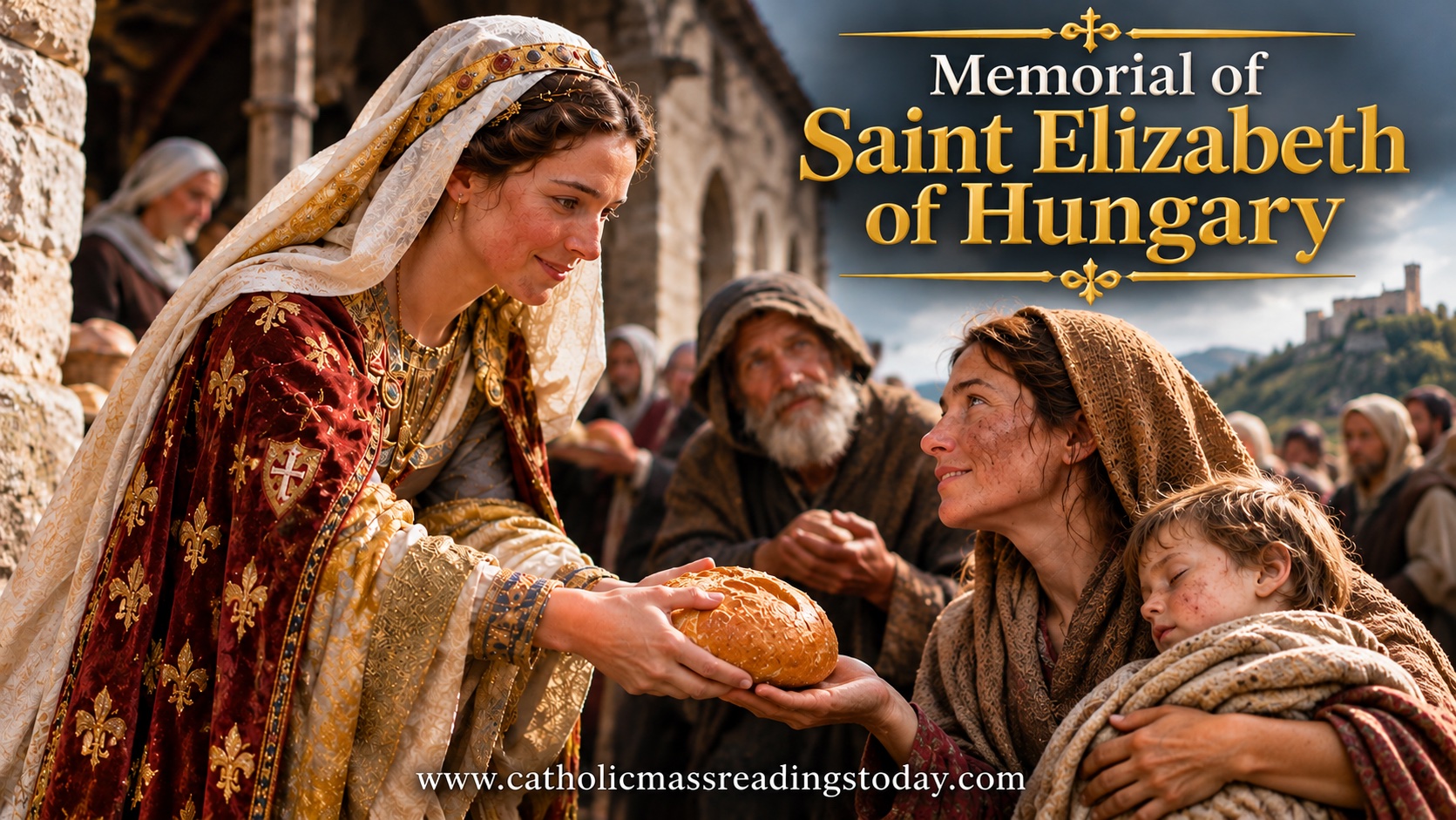
Elizabeth used the resources available to her to address some of this suffering.
She distributed food, provided clothing, helped families struggling with debt, visited the sick, and assisted those who lacked the means to care for themselves.
Her generosity was practical rather than merely ceremonial.
Instead of limiting her charitable activities to donations arranged through servants, she frequently became personally involved in distributing assistance.
Accounts associated with her attendants describe her visiting poor households, inspecting the conditions in which people lived, and supplying necessities such as food and bedding.
One of the most significant periods of her charitable work occurred in 1226.
That year, Thuringia experienced severe hardship associated with flooding, hunger, and disease.
Ludwig was away attending to political obligations in Italy, leaving Elizabeth with considerable responsibility for affairs at home.
During the crisis, she organised relief for those suffering from food shortages.
Historical accounts describe her distributing provisions from available resources and supporting large numbers of hungry people.
The Catholic Encyclopedia also records the establishment of a hospital below Wartburg Castle, traditionally described as having twenty-eight beds. Such historical numbers should be understood as figures transmitted through surviving accounts rather than modern statistical records.
Elizabeth’s service went beyond providing material assistance.
She visited the sick and took responsibility for aspects of their care.
For a woman of her social standing, this was remarkable.
Medieval aristocratic households maintained clear distinctions between the nobility and people performing manual labour. Nursing the sick, handling soiled clothing, and attending personally to vulnerable people were duties generally assigned to servants or caregivers.
Elizabeth repeatedly crossed those social boundaries.
Her actions reflected a profoundly Christian conviction: the worth of a human being does not depend on wealth, physical health, family background, or social position.
The Gospel of Matthew, particularly Matthew 25:35–40, teaches that service offered to those who are hungry, thirsty, vulnerable, or imprisoned is service offered to Christ himself.
Elizabeth’s life became a practical expression of that teaching.
She saw charitable work not simply as an obligation attached to wealth but as an opportunity to encounter Christ through the needs of others.
The Influence of Saint Francis of Assisi on Elizabeth’s Spiritual Life
Elizabeth lived during the lifetime of Saint Francis of Assisi, whose example was transforming Christian religious life across Europe.
Francis had embraced a life of poverty, simplicity, repentance, and service. His followers sought to live the Gospel with particular attention to humility and solidarity with the poor.
Franciscan friars began establishing themselves in German territories during the early 1220s.
Among those who influenced Elizabeth was Friar Rodeger, also known as Rüdiger, who introduced her more deeply to Franciscan spirituality.
Elizabeth was attracted to the example of a man who had voluntarily abandoned considerable wealth to follow Christ.
She increasingly adopted practices of simplicity, prayer, self-denial, and charitable service, while remaining within her responsibilities as a married noblewoman.
She also supported the developing Franciscan presence in Thuringia.
Her relationship with the Franciscan movement was particularly significant because it offered a way of understanding holiness that did not depend exclusively upon entering a monastery.
A Christian living in the world could pursue a serious spiritual life through repentance, prayer, humility, and works of mercy.
Elizabeth’s later association with Franciscan penitential life became one of the defining features of her religious legacy.
Although she and Saint Francis were contemporaries, there is no reliable evidence that they personally met.
Their spiritual connection developed through Francis’s followers and through Elizabeth’s commitment to the ideals they taught.
After her husband’s death, this influence would become even more pronounced.
The Miracle of the Roses: A Beloved Tradition of Saint Elizabeth of Hungary

Among the stories associated with Saint Elizabeth of Hungary, none has become more widely recognised than the Miracle of the Roses.
According to the traditional account, Elizabeth was carrying bread concealed beneath her clothing to distribute to poor families.
As she travelled, she encountered her husband, Ludwig, who asked what she was carrying.
When Elizabeth opened her cloak or apron, the bread was said to have been miraculously transformed into beautiful roses.
The story became a powerful symbol of her generosity and the divine blessing associated with Christian charity.
Throughout the centuries, artists have frequently portrayed Elizabeth holding a basket of bread, carrying roses, or offering food to those in need.
However, the Miracle of the Roses belongs to the later devotional tradition surrounding her life and cannot be established as a documented historical event.
Scholarly examination of her medieval biographies shows that the rose narrative developed within the subsequent history of her veneration and is absent from the earliest principal accounts of her life.
This distinction does not diminish the importance of the story within Catholic devotion.
The roses express something firmly supported by the historical record: Elizabeth’s exceptional concern for people experiencing poverty and her willingness to share what she possessed.
The Church remembers saints through historical testimony, liturgical prayer, sacred art, and devotional traditions. These forms of remembrance have different purposes and do not always carry the same degree of historical certainty.
In Elizabeth’s case, the underlying reality of her charity is far more important than whether the celebrated transformation of bread into roses occurred exactly as later storytellers described it.
Her enduring reputation rests upon the compassion she actually practised.
The Tragic Death of Ludwig IV in 1227
In 1227, Elizabeth’s life changed dramatically.
Ludwig prepared to participate in the crusading expedition associated with Emperor Frederick II.
The crusading movement occupied an important place in medieval European religious and political life, and participation could be regarded by rulers as both a religious undertaking and an expression of political obligation.
Ludwig departed in the summer of 1227.
Elizabeth remained in Thuringia, where she had responsibilities towards their household, territory, and young children.
Their separation would become permanent.
While travelling in connection with the expedition, Ludwig became seriously ill.
He died at Otranto, in southern Italy, in September 1227, before reaching the Holy Land.
He was approximately twenty-seven years old.
Elizabeth was only about twenty when she received the news.
The surviving accounts describe her profound grief.
The death of her husband was not simply the loss of a political protector. It was the loss of a man with whom she had shared a close marriage and who had supported her religious convictions and charitable work.
She was now a young widow with three children.
Her youngest child had been born around the time of Ludwig’s death.
Her position within the ruling family also became uncertain.
Ludwig’s brother, Heinrich Raspe, assumed political authority in Thuringia during the minority of Elizabeth’s son Hermann.
The circumstances surrounding Elizabeth’s departure from Wartburg Castle have been interpreted differently by historians.
Some traditional accounts describe her being expelled after opposition from her husband’s family. Other historical studies suggest that her departure involved a more complicated mixture of political pressure, disputes over property, and her own religious decisions.
The precise circumstances remain debated, although her loss of security and the difficulties she experienced during widowhood are well established.
Elizabeth had once occupied a secure place within one of Germany’s influential ruling households.
Now she faced uncertainty about her residence, financial resources, and future responsibilities.
Her faith did not prevent grief or make these difficulties insignificant.
Rather, the years following Ludwig’s death revealed how she responded when many of the supports she had previously relied upon were taken away.
A Young Widow Who Chose a Life of Service
After leaving the security of the Thuringian court, Elizabeth passed through a period of considerable hardship.
She received assistance from relatives and supporters, including members of her extended family connected with religious communities.
Her circumstances were further complicated by questions concerning her widow’s financial rights and the future of her children.
These were serious matters for a woman living in medieval Europe, where property, inheritance, and political authority were frequently controlled by male members of noble families.
Elizabeth eventually secured resources associated with her widow’s entitlement.
Rather than using them to restore a luxurious household, she devoted a substantial portion to charitable purposes.
She also resisted efforts to arrange another marriage.
In the religious context of her time, widowhood offered her an opportunity to pursue a more austere form of Christian life.
On Good Friday in 1228, Elizabeth made a formal act of renunciation at a Franciscan religious setting in Eisenach.
Conrad of Marburg later reported this event in correspondence associated with her canonisation history.
Elizabeth committed herself to a life of prayer, detachment from worldly prestige, and service to God.
Her children were entrusted to others for their upbringing, a decision shaped by the political, financial, and religious circumstances of her widowhood.
Historical sources do not allow us to reconstruct every detail of these family arrangements or Elizabeth’s private feelings about them.
Her commitment to religious poverty should therefore be understood within her particular circumstances, rather than presented as a general expectation that parents should surrender their family responsibilities.
For Catholics today, Elizabeth’s example is not a command to abandon possessions or family life.
It is an invitation to examine how money, social position, and personal security influence our willingness to serve others.
Her distinctive vocation led her towards a more radical form of poverty.
For other Christians, the same Gospel may be lived through faithful marriage, responsible work, raising children, supporting relatives, or caring for people in need.
Conrad of Marburg and Elizabeth’s Difficult Spiritual Journey
One of the more troubling aspects of Elizabeth’s life concerns her relationship with Conrad of Marburg.
Conrad was a priest, religious preacher, and spiritual director who exercised considerable influence over her religious practices.
He was also associated with the Church’s efforts to investigate and suppress heresy during the thirteenth century.
Conrad became Elizabeth’s spiritual director after her earlier guidance from Franciscan friars.
His approach to religious discipline was exceptionally severe.
Historical testimony describes him imposing demanding penitential practices, restricting aspects of Elizabeth’s personal life, and subjecting her to harsh treatment.
Some accounts record physical punishment.
These details should not be ignored or excused simply because Elizabeth was later canonised.
The Catholic Encyclopedia, while reflecting an older approach to religious asceticism, acknowledges Conrad’s extreme severity and the use of corporal correction.
Elizabeth’s spiritual sincerity and charitable achievements can be recognised without presenting every practice imposed upon her as morally desirable.
Her desire to follow Christ was genuine.
That does not mean that harsh spiritual control, coercion, or physical punishment should be regarded as necessary paths to holiness.
Catholic spiritual direction is properly understood as assistance given to a person seeking to discern and respond freely to God’s will.
It should respect human dignity, conscience, and the responsibilities of each person’s state of life.
Elizabeth’s story therefore requires historical honesty.
Conrad played a significant role in her religious development and later promoted her reputation for sanctity.
At the same time, aspects of his conduct remain deeply troubling when considered in light of the dignity owed to every person.
Recognising this complexity allows Elizabeth to emerge as a real historical woman rather than an idealised figure whose suffering is automatically presented as virtuous.
Her lasting example is found above all in her love of Christ, her concern for the vulnerable, and the remarkable works of mercy that defined her life.
The Hospital at Marburg and Her Final Years
In 1228, Elizabeth established a hospital at Marburg, in present-day Germany.
She dedicated the institution to Saint Francis of Assisi, whose example had so profoundly influenced her religious life.
The hospital became the centre of her work during the final years of her life.
Elizabeth had moved away from the privileges of the ruling court and was now directly involved in caring for people who were poor, seriously ill, or otherwise unable to obtain adequate assistance.
Medieval hospitals differed considerably from modern medical institutions.
They often served as places of shelter, basic nursing, food distribution, and spiritual care, particularly for people who lacked family support or financial resources.
Elizabeth performed ordinary and demanding tasks within this environment.
Accounts describe her caring for patients, cleaning them, attending to their physical needs, and undertaking work considered beneath the dignity of a former princess.
She helped people who were disfigured by illness and those whose conditions made them unwelcome in ordinary society.
Her service required patience, physical effort, and close personal contact with suffering.
Elizabeth also maintained a life of prayer.
Her religious devotion and charitable work were not separate activities competing for her attention.
Prayer helped shape the way she understood her responsibilities, while her encounters with suffering gave practical expression to the faith she professed.
Pope Benedict XVI highlighted this connection when discussing Elizabeth’s final years, describing her work among the sick as an expression of her commitment to Christ.
Elizabeth was living in a form of religious community with female companions, but her historical status should not be confused with that of a formally professed cloistered nun.
Her vocation was closely associated with the Franciscan penitential movement and with consecrated service lived in the world.
The hospital at Marburg became the place where the ideals that had guided her since childhood reached their fullest expression.
She had once brought assistance to poor families from a castle.
Now she lived much closer to the people she served.
The distance between benefactor and recipient had narrowed.
Her charity was no longer principally an act of distributing resources from a position of authority. It had become a life shared with people whose suffering required daily attention.
The Final Illness and Death of Saint Elizabeth of Hungary
By November 1231, Elizabeth’s health had seriously declined.
Her demanding life of service and religious austerity had placed considerable strain upon her body.
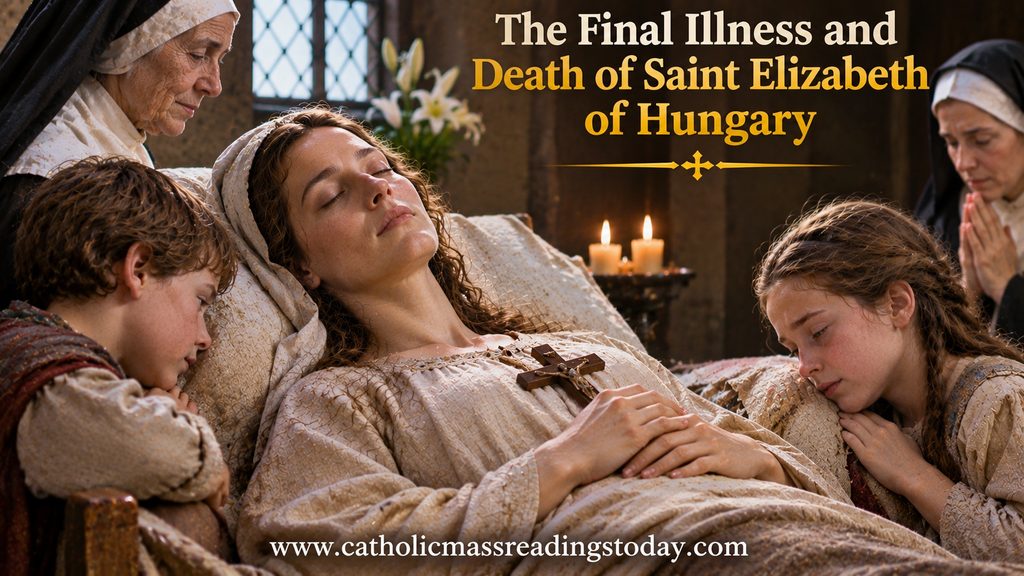
Historical accounts describe her becoming ill with a high fever.
The precise medical cause of her final illness cannot be established with certainty.
As her condition worsened, those close to her recognised that she was approaching death.
Pope Benedict XVI recounts that Elizabeth eventually requested a period of solitude so that she could devote her final moments to prayer.
She died at Marburg on November 17, 1231.
She was approximately twenty-four years old, although her exact birth date is not securely established.
Her life had been remarkably brief.
She had been a royal daughter, a child raised far from her homeland, a young wife, a mother, a landgravine, a widow, and finally a woman dedicated to the care of the poorest members of society.
Few people experience so many profound changes before reaching their mid-twenties.
Yet the significance of Elizabeth’s life cannot be measured simply by the number of events it contained.
Her enduring importance lies in the consistency with which she sought to place Christian charity at the centre of those changing circumstances.
When she had wealth, she shared it.
When she exercised influence, she used it to assist those in need.
When she experienced loss, her commitment to prayer and service continued.
Her death marked the end of a short earthly life, but the memory of her compassion spread rapidly beyond Marburg.
The woman who had cared for the sick would soon become the focus of widespread devotion among Christians seeking her intercession.
The Canonisation of Saint Elizabeth of Hungary in 1235
Following Elizabeth’s death, her reputation for holiness spread quickly.
People who had known her remembered her dedication to prayer, her extraordinary generosity, and her willingness to serve people suffering from poverty or illness.
Reports also began circulating of healings associated with prayers offered at her tomb.
These accounts became part of the investigation into her life and reputation for sanctity.
Conrad of Marburg actively promoted her cause and provided testimony concerning her religious commitments and charitable works.
Other important evidence came from women who had served Elizabeth or lived closely alongside her.
Their recollections, preserved in the collection commonly known as the Libellus de dictis quatuor ancillarum, provide valuable early testimony about her character and activities.
The canonisation investigation examined claims of miracles associated with her intercession.
Several inquiries were undertaken between 1232 and 1235.
These records are important historical evidence of what witnesses reported and what ecclesiastical investigators considered. They should not be confused with modern scientific verification of individual healing claims.
On May 28, 1235, Pope Gregory IX canonised Elizabeth at Perugia.
Only about three and a half years had passed since her death.
The speed of her canonisation reflected the extraordinary reputation she had acquired and the strong devotion that had developed around her memory.
A major Gothic church dedicated to Saint Elizabeth was subsequently constructed at Marburg.
In 1236, her remains were solemnly elevated in a ceremony attended by Emperor Frederick II.
The church and her tomb became important destinations for medieval pilgrims.
Her influence extended beyond Germany and Hungary, reaching religious communities and charitable institutions throughout Catholic Europe.
Saint Elizabeth of Hungary and the Franciscan Tradition
Saint Elizabeth holds a special place within the Franciscan family.
Her life demonstrated that the ideals associated with Saint Francis could be lived by a layperson who had experienced marriage, parenthood, political responsibility, and ordinary family obligations.
Her commitment to simplicity, repentance, prayer, and care for the poor closely reflected the spiritual movement that emerged from Assisi during the early thirteenth century.
Elizabeth is especially honoured as a patroness of the Secular Franciscan Order and the Third Order Regular of Saint Francis.
The Secular Franciscan vocation encourages Christians living in the world to follow the Gospel in the spirit of Saint Francis while remaining faithful to their particular responsibilities.
Elizabeth’s example is particularly meaningful because her journey towards holiness developed through changing circumstances.
She was not born into a religious community, nor did her entire life unfold within one.
She discovered a serious religious vocation while serving as a wife, mother, and member of a ruling household.
Her later commitment to penitential life deepened an already established pattern of prayer and service.
Franciscan communities continue to honour her on November 17, remembering her as a woman whose love for Christ found expression in solidarity with the poor.
Why Saint Elizabeth of Hungary Is Remembered Today
The influence of Saint Elizabeth extends far beyond the medieval world in which she lived.
Her name has been given to hospitals, churches, schools, charitable organisations, and religious institutions dedicated to serving people in need.
She is recognised as a patroness of Catholic charitable works and the Secular Franciscan Order. She is also traditionally invoked in connection with bakers, hospitals, and care for the poor.
These associations reflect the lasting importance of her actions.
Elizabeth’s example speaks directly to modern societies in which poverty and great wealth often exist side by side.
Millions of people struggle to obtain food, housing, medical care, and reliable family support.
Others experience loneliness, disability, bereavement, or the painful feeling that their difficulties have made them invisible.
Elizabeth understood that assistance should not reduce suffering people to objects of pity.
Her personal involvement in charitable work reflected a recognition that every person deserves attention and respect.
This remains a challenge for contemporary Christians.
Financial donations are valuable, and responsible support for charitable institutions is an important expression of Christian stewardship.
Yet charity also requires something more personal.
A visit to a lonely neighbour, patient attention to an elderly relative, practical support for a struggling family, or compassionate care for someone who is sick can become genuine expressions of Christian love.
Elizabeth’s life also speaks to those in positions of leadership.
She used the authority and resources available to her to respond to suffering.
Her example reminds employers, public officials, business owners, and community leaders that authority brings responsibilities towards the people affected by their decisions.
The Gospel principle expressed in Luke 12:48—that much is expected of those who have received much—finds a compelling illustration in her life.
Her lasting legacy is not an argument against wealth itself.
It is a challenge to use possessions and influence responsibly and to remember that human dignity cannot be measured by material success.
The Memorial of Saint Elizabeth of Hungary – November 17
Every year on November 17, the Catholic Church celebrates the Memorial of Saint Elizabeth of Hungary.
The memorial invites the faithful to remember her devotion to Christ, her generosity towards those in need, and her remarkable witness to Christian charity.
Her place in the Church’s liturgical calendar also highlights the importance of holiness lived outside the monastery.
Elizabeth was a wife and mother before becoming a widow devoted to a more explicitly penitential life.
Her example therefore speaks to people living in many different circumstances.
Married couples can reflect upon the mutual support that characterised her relationship with Ludwig.
Parents can consider the relationship between family responsibilities and Christian generosity.
Those who have lost a spouse may find encouragement in the way Elizabeth continued to seek meaning and purpose after her husband’s death.
People entrusted with wealth or influence can examine their responsibility towards others.
And those who serve in hospitals, charitable organisations, care homes, and social ministries can recognise in Elizabeth a fellow Christian whose faith was expressed through demanding, personal service.
Her memorial is an opportunity not merely to admire the past, but to make practical decisions in the present.
Christians might mark the day by offering assistance to a struggling household, visiting someone who is lonely, supporting a hospital or charitable organisation, or spending time in prayer for people experiencing hardship.
Such actions reflect the spirit of a woman whose life demonstrates that Christian holiness can be expressed through the simplest works of mercy.
What Saint Elizabeth of Hungary Teaches Us Today
The life of Saint Elizabeth of Hungary offers a lasting reminder that Christian faith must influence the way people treat one another.
Elizabeth belonged to a privileged family, but she did not regard her royal position as proof that she was more valuable than those who lacked material possessions.
Her experience challenged the social expectations of her time.
She recognised that people experiencing poverty and illness deserved care, regardless of their standing in society.
Her life also demonstrates that marriage and family responsibilities can be genuine paths towards sanctity.
The affection and mutual support she shared with Ludwig formed an important part of her early adult life.
Her charitable commitments did not begin only after she became a widow. They were already deeply rooted during her years as a wife and mother.
Elizabeth’s later suffering reminds us that holiness does not remove a person from the ordinary pain of human existence.
She experienced separation, bereavement, insecurity, and difficult relationships.
Her faith did not make these events unreal.
Rather, it provided a foundation from which she continued to respond to the needs of others.
There is also an important lesson in the difficult circumstances surrounding her spiritual direction.
Christian holiness should never require the denial of human dignity or the unquestioning acceptance of harmful treatment.
Elizabeth’s love for Christ is worthy of admiration without assuming that every hardship imposed upon her was justified.
Perhaps the greatest lesson of her life concerns the relationship between love and action.
In the First Letter of John, chapter 3, verses 17–18, Christians are challenged to recognise that love cannot remain merely a matter of words while the needs of others are ignored.
Elizabeth lived that conviction with unusual determination.
She understood that generosity involved more than sharing possessions. It also meant giving time, attention, patience, and personal care.
Her example remains relevant in families, workplaces, parishes, hospitals, and communities throughout the world.
Not everyone possesses the resources of a medieval princess.
But everyone has opportunities to recognise the dignity of another person and respond with compassion.
Saint Elizabeth’s life shows that greatness in the Christian understanding is not found in titles, wealth, or public recognition.
It is found in the faithful love of God expressed through service to others.
She lived only about twenty-four years, yet her example has endured for centuries because the needs to which she responded remain deeply human.
Wherever someone is hungry, lonely, sick, grieving, or forgotten, there is still an opportunity to practise the charity that made Elizabeth’s life remarkable.
Her memory invites us to see those opportunities not as burdens to avoid, but as occasions to love Jesus Christ more faithfully.
Prayer to Saint Elizabeth of Hungary
O glorious Saint Elizabeth of Hungary, faithful servant of Jesus Christ and loving friend of the poor, we ask you to intercede for us before our heavenly Father.
Pray that our hearts may grow in compassion, humility, generosity, and sincere love for those who suffer.
Help us to recognise Christ in the hungry, the sick, the lonely, and the forgotten, and give us the courage to serve them with kindness and respect.
Remember before God the needs of struggling families, widows and widowers, children without adequate care, and all who endure poverty or illness.
Pray that we may remain faithful to God in times of happiness and sorrow, and that we may use whatever blessings we receive for the good of others.
May your example lead us closer to Jesus Christ, our Lord and Saviour.
Amen.