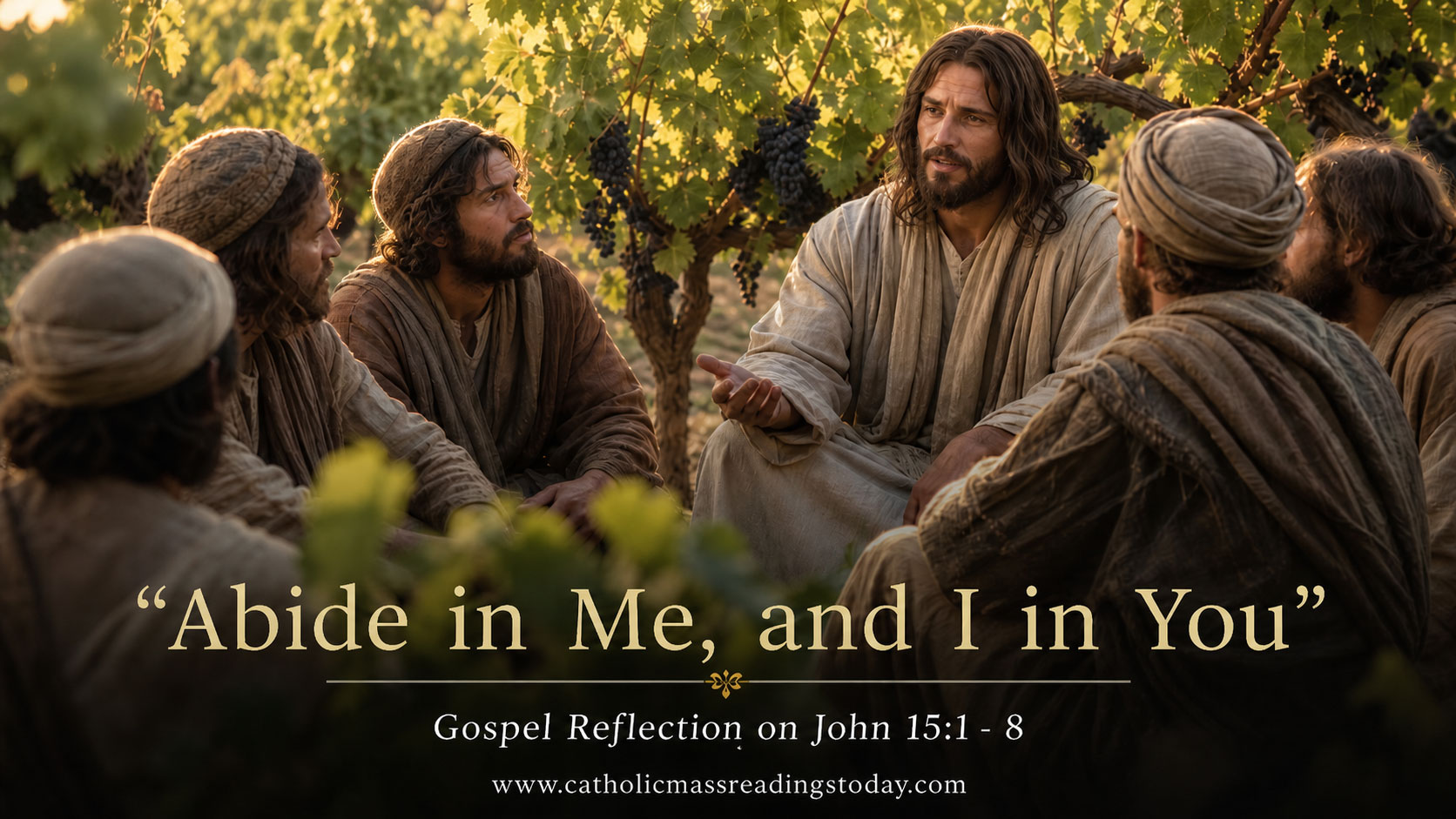
In this Gospel, the Lord gives us one of the most beautiful and searching images in all of Sacred Scripture: “I am the true vine, and my Father is the vinedresser.” These words are simple enough for a child to grasp, and yet deep enough to occupy the prayer of the Church forever. They speak of life, dependence, fruitfulness, pruning, fidelity, and communion. Above all, they speak of what it means to belong to Christ not superficially, but vitally as branches belong to the vine from which they draw their very life.
The Christian life begins here: not with self-assertion, not with achievement, not with spiritual technique, but with union. Before the disciple is asked to produce anything, he is first invited to remain. “Abide in me, and I in you.” This is the heart of the matter. Christianity is not first a project we undertake for Christ; it is a life we receive from Christ. The branch does not give life to the vine. The vine gives life to the branch.
How much confusion in the spiritual life comes from forgetting this. We are often tempted to think that holiness consists chiefly in our own effort, our own plans, our own energy, our own visible success. And then, when we become tired, dry, discouraged, or inwardly poor, we begin either to despair or to pretend. But the Lord brings us back to truth with great clarity: “Apart from me you can do nothing.”
These are not humiliating words, unless pride hears them. In reality, they are words of freedom. Christ does not say this to diminish us, but to ground us. He is teaching us that the source of all true fruitfulness is not self-reliance, but communion with Him. Without Him, much activity may still be possible, much noise may still be made, much appearance may still be maintained but the fruit that endures, the fruit that glorifies the Father, the fruit born of grace, cannot come from us alone.
This is a deeply Catholic truth. Grace is not an ornament added to our natural effort. It is the very principle of supernatural life within us. We do not save ourselves, sanctify ourselves, or make ourselves fruitful by our own power. We cooperate, yes; we respond, yes; we must strive, yes but all of this is possible only because Christ first gives life to the soul. The Church has always taught that holiness is the work of God in us, not apart from our freedom, but certainly beyond our own power.
And yet the Lord’s words are not passive. To abide in Him is not to drift. It is not vague religious feeling. It is a living, persevering, concrete communion. We abide in Christ through faith, through prayer, through obedience to His word, through the sacraments, through charity, through repentance, and through fidelity in the duties of our vocation. A soul that abides in Christ is not merely one that thinks about Him from time to time, but one that lives from Him.
The Lord also says something that can at first unsettle us: “Every branch of mine that bears no fruit, he takes away, and every branch that does bear fruit he prunes, that it may bear more fruit.” Here the Gospel becomes more demanding. Communion with Christ is not sentimental. The Father, who is the vinedresser, does not leave the branch untouched. Even fruitful branches are pruned.
This is a word every serious Christian must hear. We often ask God to make us fruitful, but we are less ready for the manner in which He does so. Pruning is not pleasant. It involves removal, simplification, loss, purification. In the spiritual life, this can take many forms: disappointments, hidden sacrifices, delayed consolations, wounds that humble us, tasks that stretch us, truths that correct us, trials that reveal what still clings too closely to self. The Father prunes not to punish, but to purify. He cuts away what hinders love so that love may become more fruitful.
How necessary this is in a world that prizes comfort and immediate results. God is not committed to our superficial ease. He is committed to our sanctification. Sometimes He must remove what we thought we needed in order to give us what we truly need. Sometimes He permits dryness in prayer so that faith may deepen. Sometimes He allows hiddenness so that pride may weaken. Sometimes He strips away success so that our identity may rest more purely in Him.
This is not cruelty. It is the severe tenderness of divine love.
The saint is not the one who avoids pruning, but the one who consents to it. The branch that resists the vinedresser remains wild and unshaped. The branch that yields, though it suffers the knife, becomes more capable of bearing fruit that lasts.
The Lord then says: “You are already made clean by the word which I have spoken to you.” This too is important. Before speaking of pruning, He reminds the disciples that His word has already begun to purify them. The word of Christ is not mere instruction. It is cleansing. It judges, heals, orders, strengthens, and makes room for grace. To listen to the Lord with humility is already to be changed by Him.
This is why Scripture must remain central in the life of the Church and in the life of every believer. We are not cleansed by our own opinions. We are not sanctified by whatever thoughts happen to please us. We are made clean by the word of Christ received in faith. A Church that neglects the word becomes weak. A Christian who no longer dwells with the word becomes vulnerable to confusion, self-deception, and spiritual exhaustion.
And then the Lord repeats the command with solemn insistence: “Abide in me.” The repetition matters. This is not one teaching among many. It is the condition of fruitfulness itself.
- To abide in Christ means to remain when emotions fade.
- To remain when prayer feels dry.
- To remain when obedience is costly.
- To remain when the world offers easier paths.
- To remain when suffering tempts the heart toward bitterness.
- To remain when we do not understand the timing of God.
Many people are willing to approach Christ when He consoles; fewer are willing to remain when He purifies. Yet true discipleship is proved precisely in abiding. The branch does not detach itself because the season is difficult. It remains, trusting that life is still flowing from the vine even when fruit is not yet visible.
This is also why the Eucharist is so central to Catholic life. In the Eucharist, the Lord not only commands us to abide; He makes abiding possible. He gives Himself as food so that His life may remain in us. The vine gives life to the branch in the most intimate way. A fruitful Christian life cannot be sustained indefinitely at a distance from the sacraments, above all from the Holy Eucharist, where communion is not metaphor only, but real and substantial.
The warning that follows is sober: “If a man does not abide in me, he is cast forth as a branch and withers.” The Lord does not hide the seriousness of separation from Him. Spiritual life does not survive indefinitely on memory, habit, or outward appearance. A branch detached from the vine does not die dramatically at once, but it does wither. So too the soul separated from Christ may still seem outwardly active for a time, but inwardly something begins to dry up: prayer becomes hollow, charity weakens, truth becomes negotiable, and the heart loses its living center.
This warning is not meant to drive us into fear, but into vigilance and humility. It is possible to become spiritually self-sufficient. It is possible to preserve a Christian identity without deep communion. It is possible to be busy in religious things and yet slowly wither within. That is why the Lord speaks plainly. He loves too much to flatter us.
But then He returns again to promise: “If you abide in me, and my words abide in you, ask whatever you will, and it shall be done for you.” This is not a promise of spiritual self-indulgence. It means that the soul abiding in Christ begins to desire what Christ desires. Its prayer becomes more conformed to His will. The deeper the union, the purer the asking. Prayer is no longer merely the presentation of private wishes, but the movement of a heart increasingly shaped by the word dwelling within it.
And what is the fruit of all this? The Lord tells us: “By this my Father is glorified, that you bear much fruit, and so prove to be my disciples.”
Fruit is the visible sign of hidden union. The Father is glorified not by appearances, not by words alone, but by lives that truly bear fruit. What is this fruit? It is, above all, holiness. It is charity, patience, truth, humility, purity, fidelity, mercy, endurance, joy in suffering, generosity in service, courage in witness, and peace rooted in God. It is also the fruit of apostolic life: souls brought closer to God, the poor consoled, the truth defended, families strengthened, the Church built up, and the Gospel made visible in the world.
The Christian does not bear fruit for himself. Fruit always has a destination beyond itself. In the same way, grace in our lives is never given merely for our own spiritual satisfaction. It is given so that the Father may be glorified and others may receive life. A fruitful disciple becomes, in a certain sense, a place where the goodness of God becomes visible.
This Gospel is therefore both consoling and demanding.
It consoles us because it tells us we do not have to invent holiness. We only need to remain close to Christ, who is Himself our life.
It demands of us because remaining in Him requires fidelity, surrender, pruning, humility, and trust.
For our own time, this passage is especially urgent. We live in a culture of speed, noise, and distraction. Many people are exhausted, but they do not know why. They try to bear fruit without abiding, to produce without prayer, to serve without communion, to witness without inner rootedness. The result is often activism without peace, zeal without depth, and weariness without fruit.
The Lord offers another way: remain in Me.
The world says: assert yourself.
Christ says: abide.
The world says: prove yourself.
Christ says: receive life from Me.
The world says: success is everything.
Christ says: fruit comes from union.
So each of us must ask, quietly and honestly: Am I abiding in Christ, or only speaking of Him? Is my life nourished by prayer, Scripture, and the sacraments? Have I consented to the Father’s pruning, or do I still cling to what He wishes to remove? Is there real fruit in my life — not only activity, but holiness?
The Gospel does not call us to anxiety about results. It calls us to fidelity in communion. If we remain in Christ, fruit will come in the time and manner appointed by the Father. Our task is not to force growth, but to stay close to the vine.
The branch need not fear its weakness if it remains united.
The disciple need not fear his poverty if he remains in Christ.
The Church need not fear the barrenness of the world if she remains faithful to her Lord.
For the vine is living.
The Father still tends it.
And grace still bears fruit where hearts remain in Him.
Let us Pray
Lord Jesus Christ,
You are the true vine,
and apart from You we can do nothing.
Keep us close to You.
When we are distracted, draw us back.
When we are dry, sustain us.
When we are proud, humble us.
When we are fearful of the Father’s pruning,
teach us to trust the love that purifies us.
Let Your word dwell in us deeply.
Cleanse our hearts by the truth You speak.
Make us faithful branches,
alive with the grace that comes from You alone.
May our lives bear fruit that glorifies the Father:
fruit of charity, humility, purity, perseverance, and peace.
And when we are tempted to rely on ourselves,
remind us gently and firmly
that all true life, all true holiness, and all lasting fruit
come only from remaining in You.
You who live and reign with the Father
in the unity of the Holy Spirit,
God for ever and ever.
Amen.