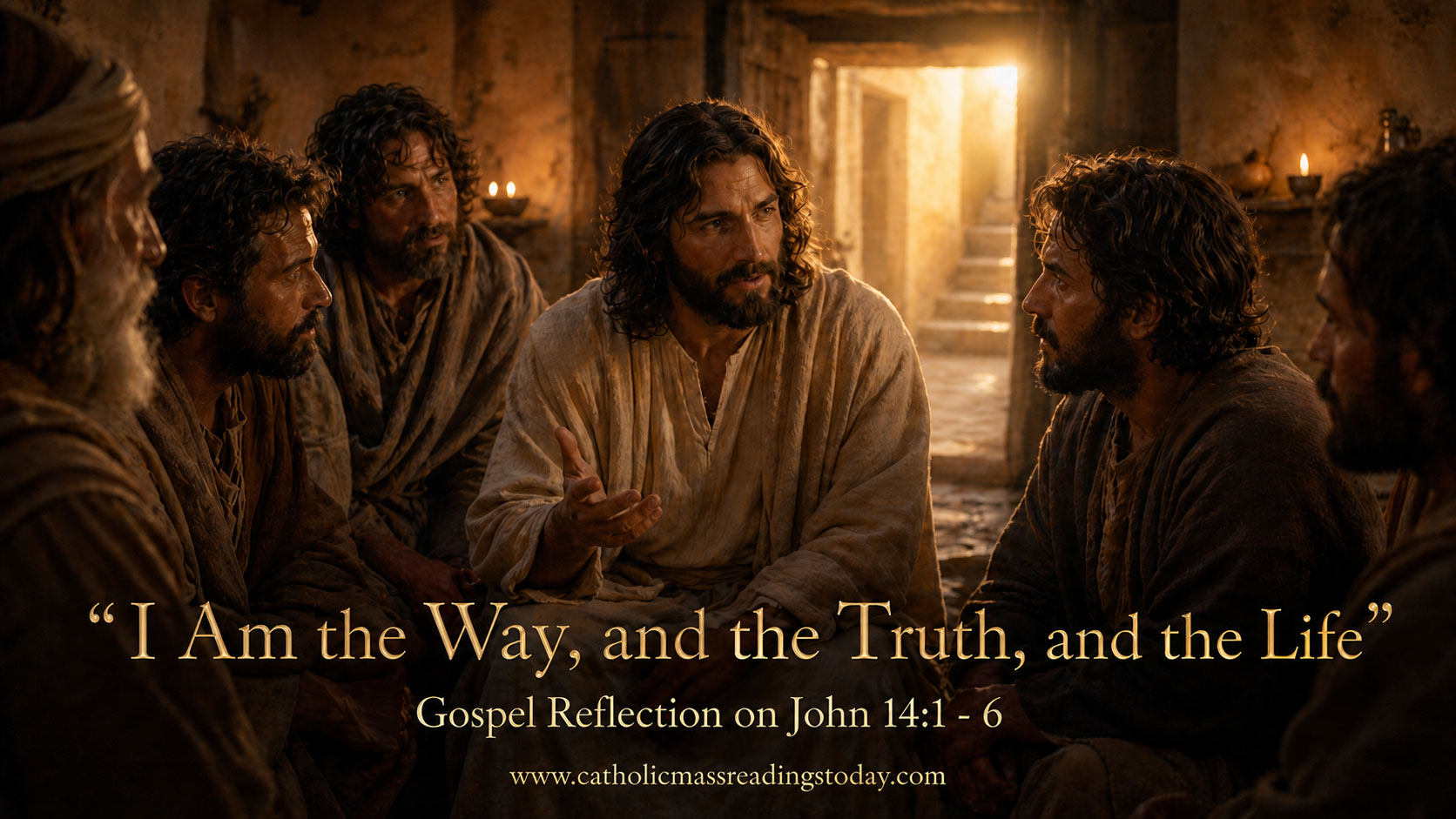
There are passages in the Gospel that seem to come to us like light in a darkened room. This is one of them. Jesus speaks to His disciples at a moment of deep unease. Their hearts are already beginning to sense that something painful is near. They do not yet understand the Cross. They do not yet grasp the mystery of His departure, His glorification, and His return to the Father. And so the Lord begins, not with reproach, but with consolation: “Let not your hearts be troubled.”
These are words the Church never ceases to need. They are words for every age, and surely for ours. We live in a time marked by anxiety, confusion, and uncertainty. Many hearts are troubled today: troubled by war, by division, by illness, by loneliness, by the instability of family life, by the loss of faith, by the burden of personal suffering, and also by the quiet fear that life may not have the meaning for which the soul longs. Into all of this, Christ speaks with tenderness and authority: “Let not your hearts be troubled; believe in God, believe also in me.”
He does not say that there is nothing to suffer. He does not deny the weight of human sorrow. Rather, He points beyond fear to trust. The answer to the troubled heart is not self-assurance, nor distraction, nor mere optimism. It is faith. Faith is not an escape from reality. It is the surrender of the heart to the One who is more real than anything that troubles us.
Jesus then opens before His disciples a horizon that is both intimate and eternal: “In my Father’s house are many rooms.” What a beautiful image this is. The Christian life is not a wandering without destination. We are not moving through history toward emptiness. We are being led toward the Father’s house. This means that heaven is not an abstract idea. It is home. It is communion. It is the fulfillment of every holy desire planted in the heart by God Himself.
And notice how personal the Lord makes it: “I go to prepare a place for you.” Not for humanity in general only, but for you. Every faithful soul can hear these words personally. Christ does not save us in the abstract. He knows each one by name. He goes before us not merely to show a route, but to prepare a place. The destiny of the Christian is not to be lost in the crowd, but to be gathered into the communion of love that is the life of God.
There is something profoundly consoling here. So many people live with the hidden fear of being forgotten, of not having a place, of not mattering. But Christ says: you have a place. The Father’s house is not closed to you. The Son Himself prepares your welcome. This is one of the deepest truths of our faith. In Christ, man does not stand before God as a stranger. He is invited into the household of God.
Yet Thomas speaks up, and thanks be to God that he does. For he gives voice to the confusion that often lives in us as well: “Lord, we do not know where you are going; how can we know the way?” Thomas is honest. He does not pretend to understand. His question is not an obstacle to faith; it becomes the occasion for a deeper revelation. This should encourage us. The Lord is not offended by our sincere questions. He does not turn away the disciple who asks from the heart. Indeed, very often it is through our admitted poverty that He teaches us most clearly.
And then comes one of the greatest declarations in all the Gospel: “I am the way, and the truth, and the life.”
The Lord does not merely tell us the way. He says that He is the way. Christianity is not first a philosophy, nor a moral system, nor a set of noble ideals. It is a Person. To be Christian is to belong to Christ, to walk with Him, to remain in Him, to be configured to Him. He is the way because in His humanity the path to the Father has been opened. In Him, God has drawn near to man, and man is led back to God.
He is also the truth. This too is essential for our time. We live in a culture that often doubts whether truth can be known at all, or whether truth is anything more than preference, feeling, or power. But Christ does not offer truth as a theory. He reveals it in Himself. In Him we see who God is, and in Him we discover who man is. Without Christ, the human person remains ultimately unintelligible to himself. With Christ, truth becomes light, not oppression; liberation, not burden.
And He is the life. Not merely a giver of life, but life itself. Every human being longs for life in fullness: a life not reduced by fear, not consumed by sin, not ended by death. This fullness is found only in communion with Christ. Apart from Him, one may exist, strive, possess, and even achieve much in the eyes of the world, yet remain inwardly poor. In Him, however, even suffering can become fruitful, and even death is transformed into passage.
The Lord concludes with words that are demanding, clear, and full of mercy: “No one comes to the Father, but by me.” These words are not given to foster arrogance in believers, but humility and gratitude. The Church does not proclaim Christ as the unique Savior because she exalts herself, but because she has received a gift she did not invent and may not dilute. The world does not need a Church uncertain of her Lord. It needs a Church humble enough to receive Him fully and courageous enough to proclaim Him lovingly.
To say that Christ is the only way to the Father is not to narrow hope, but to anchor it. For if salvation depended on our own cleverness, virtue, or power, then truly we would have reason to despair. But salvation depends on Christ, and therefore the way is open. The same Jesus who says, “I am the way,” is the one who washed feet, forgave sinners, welcomed the poor, wept with the grieving, and gave His life for the world. The way to the Father is not a cold doctrine; it is the pierced Heart of the Son.
For Catholics, this Gospel must also be heard sacramentally and ecclesially. We walk this way not alone, but within the Church, the Body of Christ. We receive the truth not as isolated individuals, but as those taught by the Word of God and guided by the apostolic faith. We share in the life of Christ above all through the sacraments, especially the Eucharist, where the One who is the Way, the Truth, and the Life gives Himself to us as food for the journey.
This Gospel therefore asks something very simple and very radical of us: not merely to admire Jesus, but to entrust ourselves to Him. Is He truly the way by which I choose to live? Is He the truth by which I judge my thoughts and actions? Is He the life from which I draw strength each day? Or have I allowed other paths, other truths, and other promises of life to claim my heart?
When the Lord says, “Let not your hearts be troubled,” He is inviting us into a deeper abandonment. He is asking us to place our future in His hands, to believe that He knows the road even when we do not, and to trust that the destination is not lost to us because He Himself is the road.
The Christian does not know everything. Thomas reminds us of that. But the Christian knows Whom he follows. And in the end, that is enough.
Let us Pray
Lord Jesus Christ,
when our hearts are troubled, draw us again to Yourself.
When fear clouds our faith, speak peace to our souls.
You are the Way:
keep us from wandering down paths that lead away from the Father.
You are the Truth:
free us from confusion, falsehood, and all that darkens the mind and heart.
You are the Life:
sustain us with Your grace,
strengthen us in suffering,
and keep alive within us the hope of heaven.
Prepare us for the place You have promised,
and teach us to live even now as children of the Father’s house.
May we follow You with trust,
cling to You with love,
and remain in You until the day
You take us to Yourself forever.
Amen.