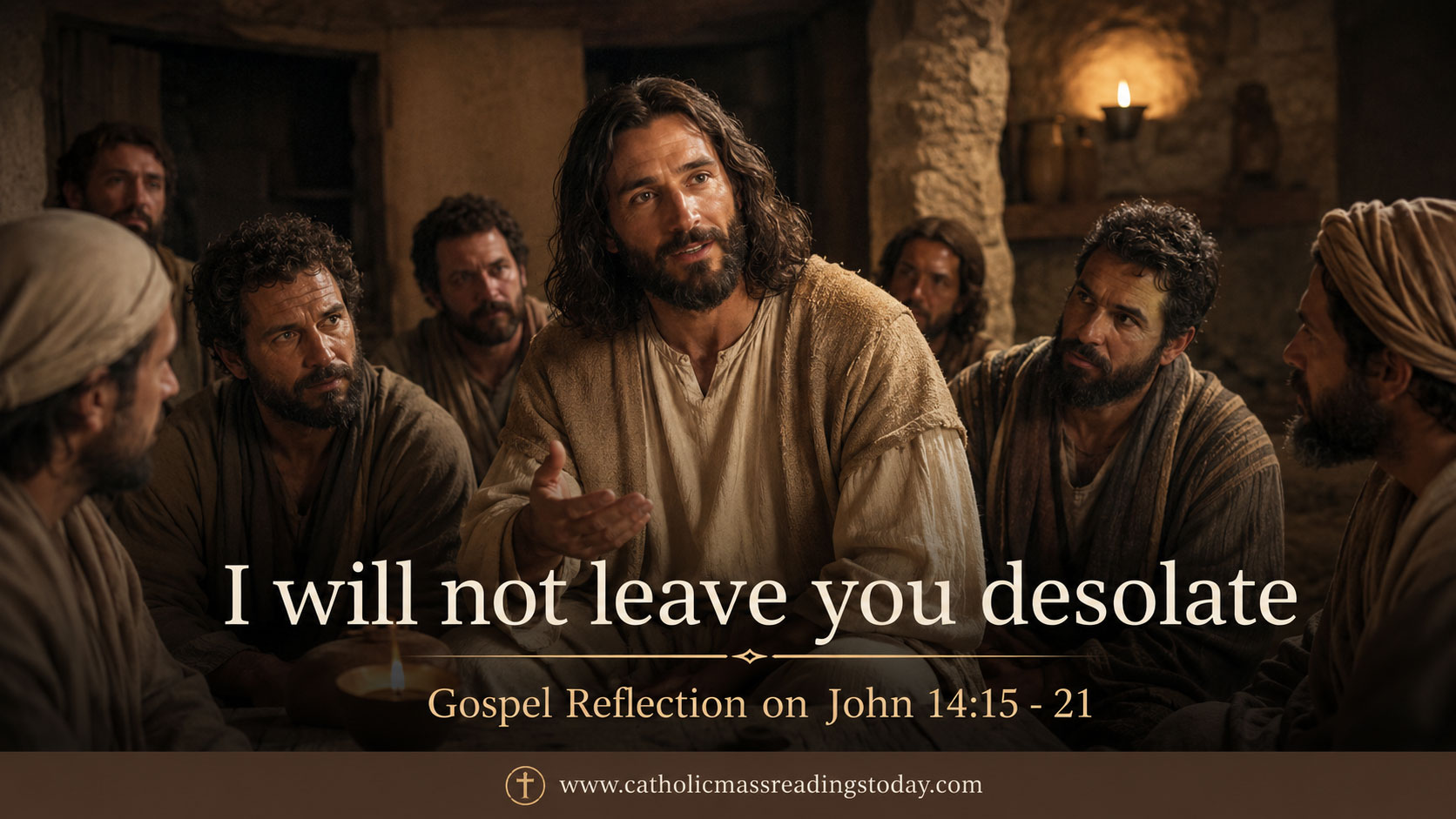
In this Gospel, the Lord Jesus speaks words that are at once tender, demanding, and full of promise. He is preparing His disciples for a moment they do not yet fully understand. He knows that His Passion is drawing near. He knows their hearts will soon be shaken. He knows they will feel the sorrow of His apparent departure. And yet He does not leave them with fear. He leaves them with truth, with love, and with the assurance of divine presence.
The passage opens with words that are simple enough for every believer to remember, yet deep enough to shape the whole Christian life: “If you love me, you will keep my commandments.”
These words are important because they purify our understanding of love. In every age, but especially in our own, there is a strong temptation to reduce love to feeling alone. Love is spoken of as sincerity, attraction, warmth, or intensity of emotion. But Jesus reveals something deeper. Love is not less than affection, but it is more than affection. Love is fidelity. Love is obedience born of trust. Love is the willing surrender of the heart to the truth of the Beloved.
Our Lord does not say, “If you love me, you will merely speak of me,” though our words about Him do matter. He says, “If you love me, you will keep my commandments.” In other words, love must take flesh in life. It must be visible in the choices we make, in the truths we refuse to betray, in the way we live when no one is watching, and in the sacrifices we accept for the sake of fidelity.
This is not harshness. It is not the replacement of love with law. It is, rather, the revelation that true love is never empty. A child who loves a parent desires not only affection but trust. A friend who loves another does not deliberately wound the bond. So too the soul that loves Christ cannot remain indifferent to His word. The commandments are not obstacles placed between us and God. They are the path by which our love is made real.
And yet the Lord does not leave the disciple with commandment alone. Immediately He speaks of gift: “And I will ask the Father, and he will give you another Counsellor, to be with you for ever.”
What a comfort there is in this. The Christian is not left to struggle by natural strength alone. The Gospel would be impossible if it depended only on human willpower. The Lord knows our frailty. He knows how easily we become tired, distracted, discouraged, divided within ourselves. He knows the instability of the human heart. And for that reason, He promises the Holy Spirit.
Here the Christian life is revealed in its full beauty: God does not only command; He also gives. He does not merely point toward holiness from a distance; He comes near to make holiness possible. The Holy Spirit is not an accessory to Christian life. He is the living presence of God within the believer, the one who strengthens, teaches, reminds, purifies, consoles, and leads.
Jesus calls Him “the Spirit of truth.” This title matters greatly. We live in a time when truth is often treated as flexible, subjective, or burdensome. Many people prefer a spirituality without definition, a religion without doctrine, a faith that consoles but never challenges. But the Spirit whom Christ sends is the Spirit of truth. He does not confirm us in confusion. He does not bless falsehood. He does not lead the Church away from Christ’s teaching. He leads us into it more deeply.
This is a necessary word for our times. True spiritual life is never opposed to truth. Genuine openness to the Holy Spirit does not mean leaving behind the commandments, the teaching of Christ, or the faith of the Church. The Spirit of truth never contradicts the Son of God. He brings to life within us what Christ has spoken. He gives us not a new Gospel, but the grace to live the Gospel faithfully.
Then the Lord says words of immense tenderness: “I will not leave you desolate; I will come to you.”
Few promises in the Gospel speak more directly to the wounded human heart. To be desolate is to feel abandoned, empty, unprotected, without light or comfort. Many souls know something of that condition. There are seasons of grief, loneliness, uncertainty, dryness in prayer, or inward trial when a person feels exposed and fragile. Jesus knows this. He sees the poverty of the human heart. And He speaks into it not with reproach, but with assurance: I will not leave you desolate.
Notice what He does not say. He does not promise that the disciples will never suffer. He does not promise a life free of tears, confusion, or persecution. But He does promise that they will not be abandoned. His presence will remain with them in a new way. Through the Holy Spirit, the Lord continues to dwell with His own.
This is one of the most consoling truths in Catholic life. Christianity is not merely loyalty to a figure of the past. It is not only admiration for a teacher who once lived. It is communion with the risen Christ, who continues to accompany His Church. He is hidden, yes, but not absent. He is unseen, but not far. The one who believes is never spiritually orphaned.
Jesus continues: “Because I live, you will live also.” These words place all Christian hope on the firmest possible foundation: the life of Christ Himself. Our hope does not depend finally on circumstance, health, success, or even our own constancy. It rests on Him. Because He lives, life is stronger than death. Because He lives, grace is stronger than sin. Because He lives, the disciple may endure trial without despair.
This is not poetry alone. It is the very center of the Christian mystery. Through baptism, through faith, through the sacramental life of the Church, the life of Christ is communicated to the believer. We do not merely follow Him from afar. We are united to Him. His risen life begins to work in us. This is why Christian existence is more than moral effort. It is participation in divine life.
And then Jesus speaks one of the most beautiful lines in all of the Gospel: “In that day you will know that I am in my Father, and you in me, and I in you.”
Here we are brought to the heart of communion. Christ is in the Father. We are in Christ. Christ is in us. This is the mystery of grace. The Christian soul is not merely instructed by God from the outside; it becomes a dwelling place of divine presence. Through sanctifying grace, God makes His home in the soul. This is why holiness is so beautiful: it is the life of God shining more freely within the human person.
At the same time, this truth helps us understand why sin is so tragic. Sin is not just the breaking of a rule. It is resistance to communion. It is the heart closing itself to the one who wishes to dwell there. And therefore the Christian life is not just about behaving better in a social sense. It is about learning to live in a way that welcomes the divine indwelling more fully.
The Lord returns once more to the union between love and obedience: “He who has my commandments and keeps them, he it is who loves me.” Again, He makes the matter plain. Love is not proved by intensity of feeling, but by fidelity of heart. The one who loves Christ will seek to remain close to His word, even when that word challenges, purifies, or asks something costly.
And yet see what follows: “He who loves me will be loved by my Father, and I will love him and manifest myself to him.”
What an astonishing promise this is. Christ does not remain hidden from the faithful soul in an absolute sense. He manifests Himself. This manifestation is often quiet rather than dramatic. It may come through a deepened peace in prayer, a clearer light in times of confusion, a hidden strength in suffering, an attraction toward holiness, or a quiet certainty of His presence. The saints often speak of this: not always visions or extraordinary experiences, but a real knowledge of the nearness of Christ.
The soul that keeps His word does not simply become more disciplined. It becomes more capable of recognizing Him.
This has profound implications for our spiritual life. Many people desire a more vivid sense of God, but they seek it first in unusual experiences. The Gospel points elsewhere. The road to deeper knowledge of Christ is fidelity. To keep His commandments in love is already to walk toward clearer communion. The heart made faithful becomes the heart made receptive.
This passage also speaks strongly to the life of the Church. The Church will manifest Christ to the world only if she remains faithful to His word. She cannot reveal Him by becoming less like Him. She cannot make Him known by neglecting His commandments, softening His truth, or surrendering to the spirit of the age. The Church becomes luminous when she is obedient in love, humble in service, and filled with the Spirit of truth.
And this same principle applies to every Christian soul. If we wish to show Christ to the world, we must first belong to Him deeply. If we want others to recognize His presence, we must become people in whom His commandments are not resented but loved, not merely quoted but lived.
There is, then, both challenge and consolation in this Gospel.
The challenge is real: love Christ enough to keep His word.
The consolation is even greater: you will not do this alone. The Holy Spirit has been promised. The Lord will not leave you desolate. Christ lives, and therefore you will live. The Father loves the one who loves the Son. And Christ Himself will come near to the faithful soul.
For Catholics, this Gospel naturally leads us toward the sacramental life. It is in prayer, in the Eucharist, in confession, in Scripture, and in daily fidelity that this communion grows. The Spirit continues to shape the believer from within. The commandments cease to feel like burdens imposed from outside and become, little by little, the form of a life lived in friendship with God.
So perhaps the deepest invitation in this Gospel is this: do not be satisfied with a distant Christianity. Do not be satisfied with admiring Jesus without obeying Him, or invoking the Spirit without receiving the truth He brings. Let love become fidelity. Let fidelity become communion. Let communion become a place where Christ makes Himself known.
For the Lord has not left His people orphaned.
He has given His Spirit.
He has given His word.
He has given His life.
And He has promised His presence.
Let us Pray
Lord Jesus Christ,
You have promised not to leave us desolate,
but to send the Holy Spirit,
the Spirit of truth,
to remain with us forever.
Teach us to love You truly,
not only with words or passing emotion,
but with faithful hearts that keep Your commandments.
When we are weak, strengthen us.
When we are confused, guide us.
When we feel alone, remind us that You are near.
When we are tempted to compromise,
grant us courage to remain faithful to Your word.
Send upon us anew the Holy Spirit,
that He may dwell in us,
teach us, purify us, and lead us into all truth.
May our hearts become a place of welcome for Your presence.
May our lives reflect the love You have shown us.
And may we live each day in the confidence
that because You live, we too shall live.
You who live and reign with the Father
in the unity of the Holy Spirit,
God for ever and ever.
Amen.