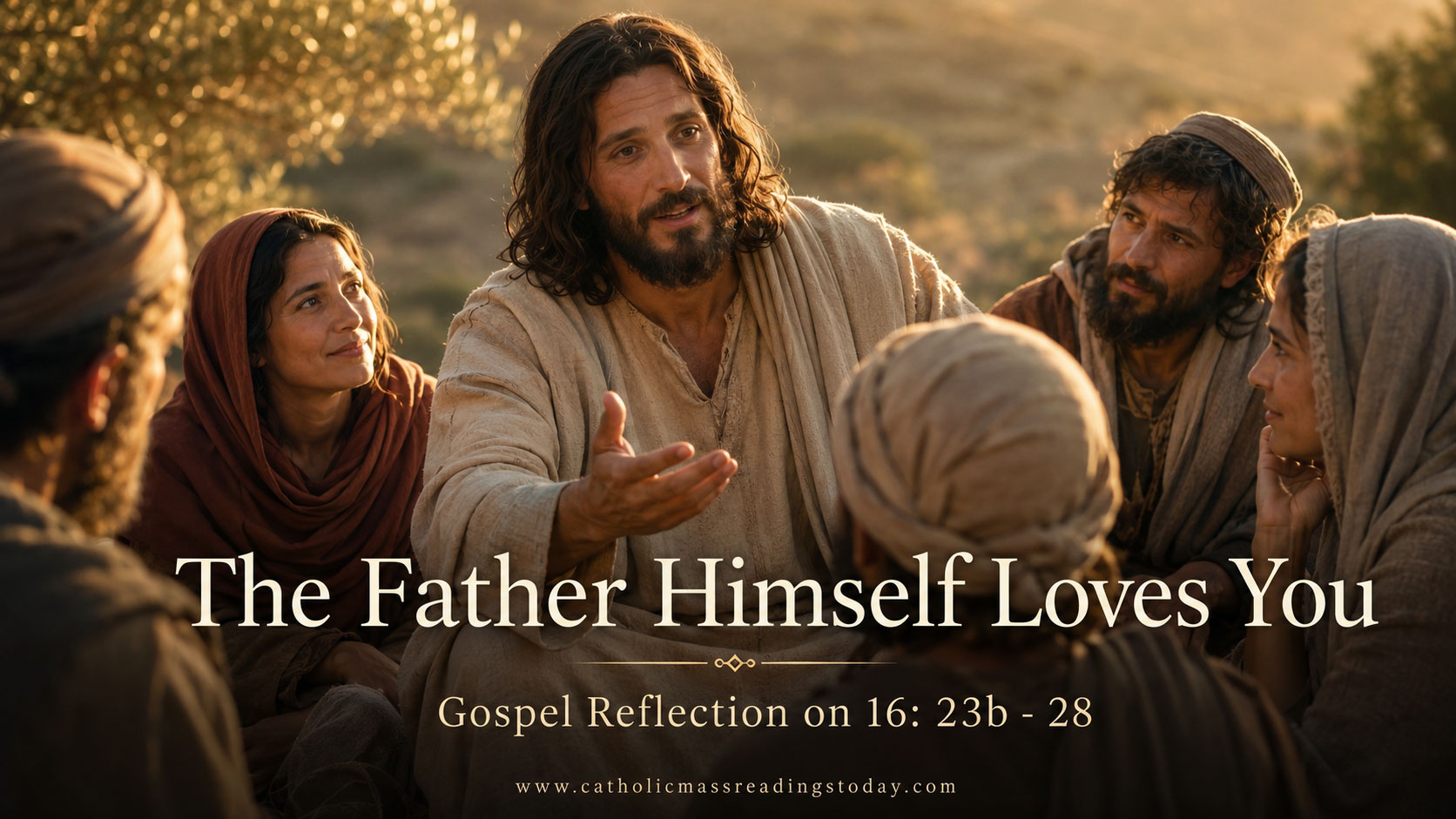
This Gospel is filled with quiet consolation. Jesus speaks to His disciples at a moment when their hearts are still troubled, yet His words are not meant to burden them further. They are meant to strengthen them. He opens before them the mystery of prayer, the love of the Father, and the deep communion into which they are being drawn.
He begins with a promise that is both simple and profound: “If you ask anything of the Father, he will give it to you in my name.” These words remind us that Christian prayer is not a lonely cry thrown into the darkness. We do not pray as strangers trying to force heaven to notice us. We pray in the name of Jesus, the Son who has opened the way to the Father.
That changes everything.
To pray in the name of Jesus does not mean merely adding holy words to the end of a request. It means praying in union with Him, with trust in Him, with hearts shaped by His will. It means approaching the Father not as distant and unwilling, but as the One whom Christ has revealed as loving, attentive, and near.
Jesus then says, “Ask, and you will receive, that your joy may be full.” This is beautiful. The Lord is not reluctant about our prayer. He invites it. He encourages it. He wants the disciple to ask. But He also reveals that the purpose of true prayer is not simply to get what we want in the narrowest sense. It is that our joy may be full. In other words, prayer is meant to draw us into deeper communion with God, where the heart finds a joy that is fuller than passing satisfaction.
This is important, because many people become discouraged in prayer. Sometimes they ask and do not seem to receive what they hoped for. Sometimes heaven feels silent. Sometimes the answer comes differently, more slowly, or more deeply than expected. But this Gospel reminds us that the purpose of prayer is not to train God to obey us. It is to teach the heart to live in trust, in dependence, and in union with the love of the Father.
Then Jesus says something especially tender: “The Father himself loves you, because you have loved me and have believed that I came from the Father.”
These words deserve to be read slowly.
The Father himself loves you.
This is the heart of the passage. The Christian life is not built on fear alone, nor on duty alone, nor on the anxious feeling that we must somehow earn our place before God. At its deepest level, it is built on this astonishing truth: the Father loves us. Not in a distant, abstract way, but personally. Intimately. Truly.
And Jesus speaks these words not to flatter the disciples, but to steady them. He wants them to know that through faith in Him they are not merely tolerated in God’s presence. They are loved there.
How much the human heart needs to hear that. Many people carry an image of God that is cold, severe, or unreachable. They imagine Him only as Judge, and forget that He is also Father. But Christ came precisely to reveal the Father. He came so that we would know that God is not a stranger to those who seek Him. In Jesus, the Father draws near.
The Lord also makes clear that this love is connected to faith: “because you have loved me and have believed that I came from the Father.” This is not because God’s love is stingy or conditional in the small human sense. It is because faith opens the heart to receive what God has always desired to give. To believe in Christ is to enter the truth of who God is. To love Christ is to be led into the very heart of the Father.
This is why the Church always insists that faith in Jesus is not optional decoration. It is the way by which we come to know the Father. Christ is not one teacher among many. He is the Son sent from the Father into the world for our salvation.
And so Jesus says plainly: “I came from the Father and have come into the world; again, I am leaving the world and going to the Father.” In one sentence, He gathers His whole mission: His eternal origin in the Father, His coming into the world through the Incarnation, and His return to the Father through His Passion, Resurrection, and Ascension.
This is the whole movement of salvation. The Son comes down to us so that we may be lifted up to God.
There is also something deeply reassuring in this. Our faith is not built on ideas alone, but on the living mission of Christ. He came from the Father. He entered our world. He shared our condition. He spoke to us of divine love. He suffered for us. And He returned to the Father not to abandon us, but to open heaven for us.
This Gospel therefore teaches us three precious things.
First, it teaches us to pray with confidence. Not arrogance, but confidence. The Christian may approach the Father because Christ Himself has invited us to do so.
Second, it teaches us that the deepest truth about God is not indifference, but love. The Father himself loves those who belong to His Son.
Third, it teaches us to see Jesus rightly: He is the One who comes from the Father and returns to the Father, bringing us into that communion.
For Catholics, this passage is a quiet invitation to renew trust in prayer. Sometimes we complicate the spiritual life too much. Jesus speaks with simplicity. Ask. Believe. Remain in My love. Trust the Father. Let your joy be made full.
Perhaps that is the grace to ask for today: a more childlike heart in prayer. A heart that does not approach God with suspicion, but with trust. A heart that believes that in Christ, heaven is open and the Father’s love is real.
Let us Pray
Lord Jesus Christ,
You came from the Father and entered our world
so that we might know the Father’s love.
Teach us to pray with confidence in Your name.
When our hearts are hesitant, strengthen them.
When our faith is weak, deepen it.
When we are burdened, remind us
that the Father Himself loves us.
Give us the grace to trust You more,
to believe more fully,
and to ask with hearts that seek not only gifts,
but deeper communion with God.
May our prayer be sincere,
our faith steadfast,
and our joy made full in You.
Amen.