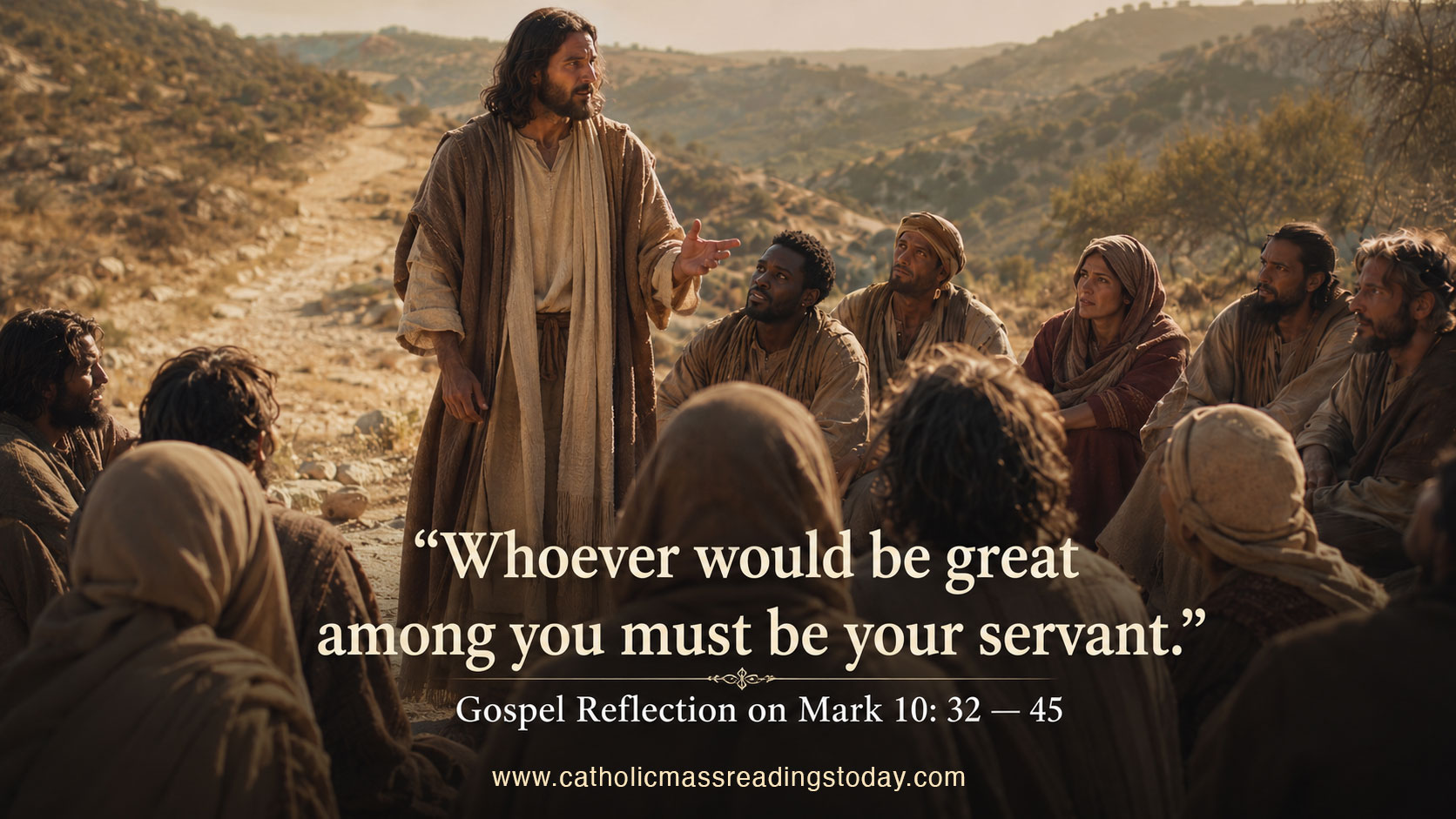
This Gospel is full of movement, tension, and truth. Jesus is on the road to Jerusalem, walking ahead of His disciples. That image alone is striking. He is not dragged unwillingly toward His Passion. He goes before them. He knows what awaits Him, betrayal, mockery, suffering, death and still He walks forward.
The disciples, the Gospel says, are amazed and afraid. And rightly so. Something in the Lord’s manner tells them that this journey is unlike the others. Jesus is not moving toward earthly triumph. He is moving toward the Cross.
Then He speaks plainly. He tells them what will happen to Him. He does not hide the cost of redemption. He does not soften the truth. The Son of Man will be delivered, condemned, mocked, scourged, killed and after three days, rise. In those few words, Jesus reveals both the depth of His suffering and the certainty of His victory.
And yet, immediately after this, James and John come forward asking for places of honor.
It is such a painfully human moment. The Lord is speaking of sacrifice, and they are thinking of status. He is revealing the mystery of self-giving love, and they are still measuring greatness in terms of rank and privilege. But before we judge them too quickly, we should recognize something of ourselves here. How often do we hear the Gospel and still cling to ambition, recognition, or the desire to be above others? How often do we want the glory of Christ without the way of Christ?
Jesus answers them with patience, but also with firmness: “You do not know what you are asking.” That is a searching line. They are asking for glory, but they do not yet understand that His glory passes through suffering. To stand near Christ is not first to be exalted with Him in human terms. It is to share His chalice, to enter His self-offering, to follow Him on the road of sacrificial love.
This is one of the central lessons of the Gospel: Christian greatness cannot be separated from the Cross.
Then, when the other disciples become indignant, Jesus gathers them all and teaches them something that remains revolutionary in every age. He contrasts the way of the world with the way of His Kingdom. The rulers of the nations, He says, exercise power by domination. They lord it over others. But “it shall not be so among you.”
Those words still challenge the Church, and every Christian heart.
The Lord does not abolish authority, but He transforms its meaning. In His Kingdom, greatness is measured not by how many serve you, but by how willing you are to serve. Leadership is not about self-exaltation. It is about responsibility, humility, and charity. To be first is to become the servant of all.
This is not weakness. It is the strength of Christ Himself.
And then comes the line that unlocks the whole passage: “For the Son of man also came not to be served but to serve, and to give his life as a ransom for many.”
Here we see the heart of Jesus. He is the Master, yet He serves. He is the Lord, yet He gives Himself. He does not save from a distance. He enters our condition, takes upon Himself our burden, and offers His life for the world.
This is the pattern of all Christian discipleship. The closer we are to Christ, the less room there is for vanity, selfish ambition, or the hunger to be seen. The more we belong to Him, the more we are shaped by His humility.
This Gospel speaks powerfully to the Catholic faithful today. In families, in parishes, in work, in ministry, in public life, the temptation to seek honor is always near. We may not ask openly for places of glory, but we often want influence, praise, or control. Jesus cuts through all of that and brings us back to the truth: if you want to be great, learn to serve.
And service in the Gospel is not mere usefulness. It is love made concrete. It is giving time, patience, forgiveness, hidden sacrifice, honest work, and steady charity without constantly needing recognition. It is choosing the good of another. It is living in a way that reflects Christ.
So this Gospel places two roads before us: the road of worldly greatness, and the road of Christ. One is built on status. The other on self-giving love. One seeks to rise above others. The other bends low in service. One fades. The other leads to life.
Jesus does not merely point to the better road. He walks it first.
And that is why this passage is not only demanding. It is also deeply consoling. The Lord never asks of us what He has not first embraced Himself. He walks ahead of us still toward sacrifice, toward obedience, toward love that gives everything and He invites us to follow.
Let us Pray
Lord Jesus Christ,
You walked ahead of Your disciples
on the road to Jerusalem,
and You embraced the Cross with love.
Deliver us from the desire for human glory
and teach us the greatness of humble service.
Purify our hearts of selfish ambition
and make us willing to serve as You served.
Give us courage to drink the chalice of fidelity,
patience to love in hidden ways,
and humility to place others before ourselves.
May our lives reflect Your mercy,
Your self-giving love,
and Your holy example.
Amen.