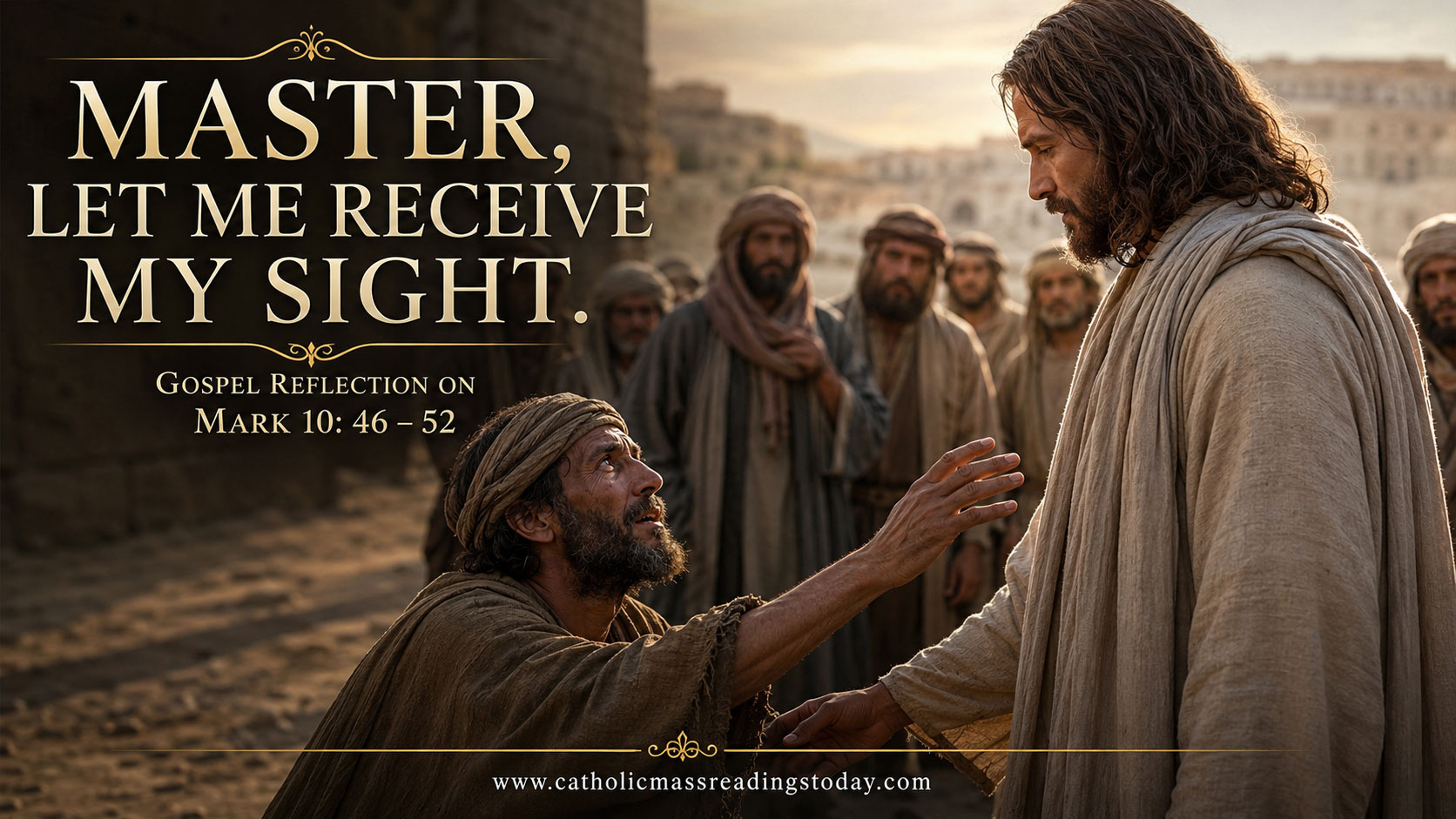
This Gospel is simple, direct, and full of hope. A blind man is sitting by the roadside while Jesus passes by. Bartimaeus has no position, no influence, no dignity in the eyes of the crowd. He is poor, dependent, and easily dismissed. Yet in this moment, he becomes one of the clearest examples of faith in the whole Gospel.
The moment he hears that Jesus is near, he cries out: “Jesus, Son of David, have mercy on me!” That cry is beautiful because it comes from both need and trust. Bartimaeus knows he cannot heal himself. He does not pretend to be strong. He does not hide his poverty. He places his misery before the Lord and asks for mercy.
This is already a great lesson for us. True faith begins when the heart stops relying on appearances and speaks honestly to God. So often we try to seem composed, capable, or self sufficient, even in prayer. Bartimaeus does the opposite. He cries out from his need, and because he does, grace draws near.
The crowd tries to silence him. That too is very human. There is always something in the world that tells the suffering, the weak, or the inconvenient to keep quiet. But Bartimaeus cries out all the more. He will not allow rebuke, shame, or discouragement to separate him from Christ.
There is something deeply moving in that persistence. Real faith does not give up easily. It clings. It cries out again. It refuses to let the passing of the Lord go unanswered.
And then comes one of the most beautiful lines in the passage: “Jesus stopped.”
The cry of one poor blind man makes the Lord stop. What a consolation this is. God is not indifferent to the voice of the one who calls on Him. Christ is never too occupied, too exalted, or too distant to hear the sincere cry for mercy.
Then Jesus says, “Call him.” The same crowd that had tried to silence Bartimaeus now tells him, “Take heart; rise, he is calling you.” Grace changes the whole atmosphere. What had been rejection becomes invitation.
Bartimaeus throws off his cloak, springs up, and comes to Jesus. That small detail matters. He leaves behind what covered him, what marked his condition, what may even have been one of the few things he possessed. In a sense, he rises with urgency and freedom. When Christ calls, he does not cling to the old place by the roadside.
Then Jesus asks him: “What do you want me to do for you?” Of course the Lord knows. But He still invites Bartimaeus to speak his desire plainly. God does not treat us as objects. He draws us into personal encounter. He asks us to name our need before Him.
And Bartimaeus replies with beautiful simplicity: “Master, let me receive my sight.”
This is more than a request for physical healing. It is the cry of every soul that longs to see rightly. In a deeper sense, all of us need this prayer. We need Christ to heal the blindness of pride, fear, resentment, selfishness, and spiritual dullness. We need to see God more clearly, to see ourselves more truthfully, and to see others with greater charity.
Then Jesus says, “Go your way; your faith has made you well.” And immediately Bartimaeus receives his sight.
But the Gospel ends with a detail that is easy to miss and very important: he “followed him on the way.” He does not simply take the gift and return to his old life. Having received sight, he becomes a disciple. This is the true completion of the miracle. Grace is given not only to relieve suffering, but to bring the person into deeper following of Christ.
That is the challenge and beauty of this Gospel. We all cry for mercy in one way or another. We all ask the Lord for healing, help, light, and peace. But when He answers, do we then follow Him on the way?
Bartimaeus shows us what living faith looks like: humble, persistent, honest, trusting, and ready to rise when called. He is poor in the eyes of the world, but rich in what matters most. He sees Christ more clearly in his blindness than many others do with healthy eyes.
And perhaps that is the grace this Gospel offers us today: not merely to admire Bartimaeus, but to pray with him. To say with sincerity, from wherever we are seated by the roadside of our own weakness:
Jesus, Son of David, have mercy on me.
Master, let me receive my sight.
Let us Pray
Lord Jesus Christ,
You stopped for Bartimaeus
and listened to his cry for mercy.
Teach us to call upon You with the same faith,
the same humility,
and the same perseverance.
Heal the blindness in our hearts.
Help us to see with faith,
to rise when You call,
and to follow You faithfully on the way.
Amen.