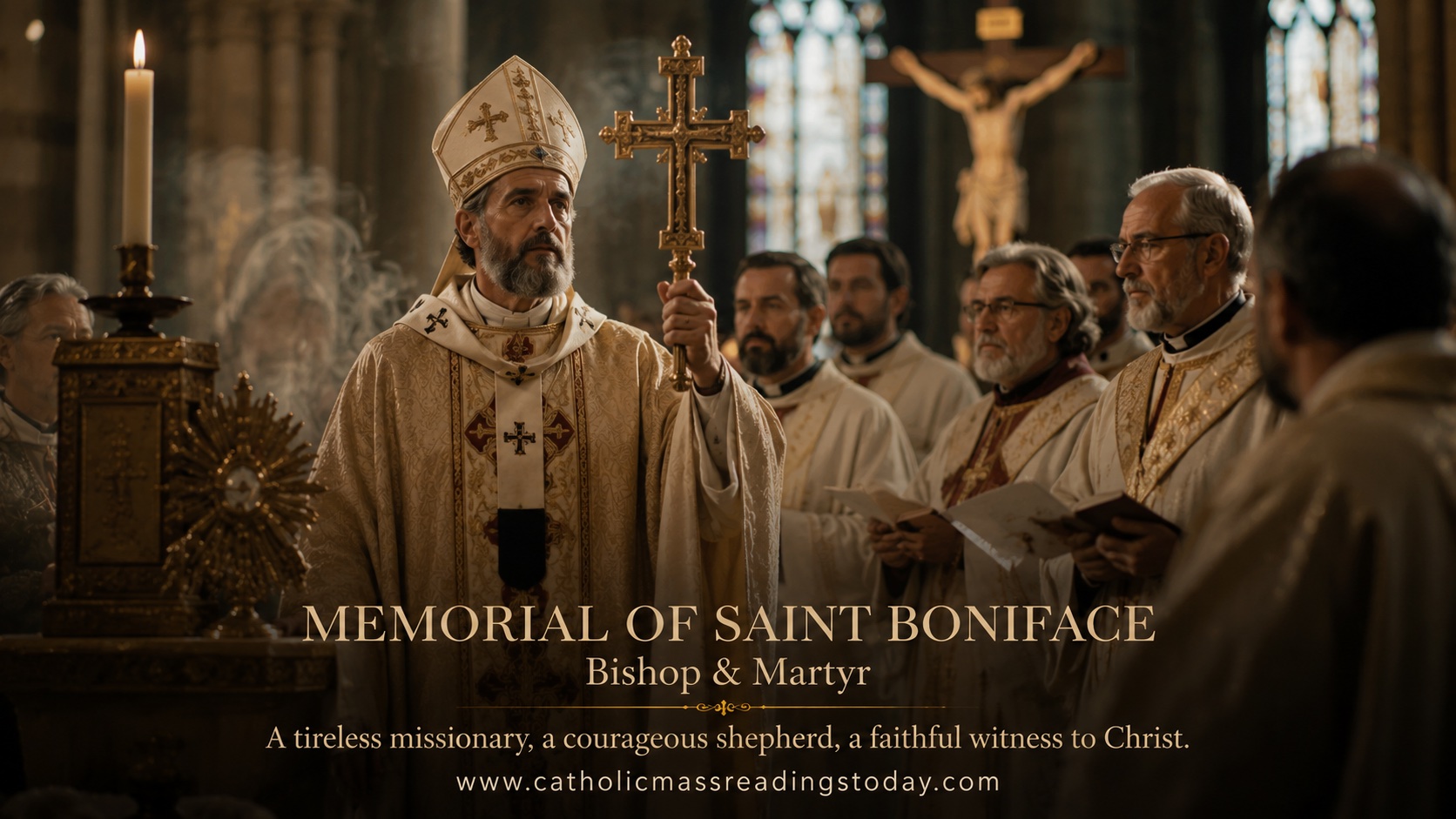
Each year, on June 5, the Catholic Church celebrates the Memorial of Saint Boniface, Bishop and Martyr, one of the greatest missionaries in the history of Christianity. Known as the “Apostle of Germany,” Saint Boniface dedicated his life to preaching the Gospel, strengthening the Church, and bringing countless souls to Christ. His courage, zeal, and unwavering faith continue to inspire Christians more than twelve centuries after his death.
Who Was Saint Boniface?
Saint Boniface was born around the year 675 in Wessex, England. He was given the name Winfrid at birth. Raised in a Christian family, he developed a deep love for God from an early age. While still a young boy, he was inspired by the witness of monks and felt called to dedicate his life to the service of the Church.
He entered a Benedictine monastery, where he received an excellent education and became known for his intelligence, holiness, and ability to teach. He was eventually ordained a priest and quickly earned respect as a preacher and scholar.
Despite enjoying a peaceful and fruitful life in England, Winfrid felt called to something greater. His heart burned with a desire to bring the Gospel to people who had never fully embraced Christianity.
The Missionary Journey Begins
Around the age of forty, Winfrid left England and traveled to the European continent as a missionary. His first attempts met with difficulties, but he remained determined to serve God’s mission.
In 719, he traveled to Rome, where he met Pope Gregory II. The Pope blessed his missionary work and gave him a new name: Boniface, meaning “one who does good.”
Armed with little more than faith, courage, and a deep trust in God, Boniface set out to evangelize regions that are now part of Germany, the Netherlands, and surrounding areas.
Bringing the Gospel to Germany
The lands where Boniface worked were often a mixture of Christian communities and pagan tribes who worshipped various gods and sacred objects.
One of the most famous events in Saint Boniface’s life occurred near Geismar in present-day Germany. There stood a massive oak tree dedicated to the Norse god Thor. The local people believed the tree was sacred and feared divine punishment if anyone damaged it.
To demonstrate the powerlessness of pagan gods and the sovereignty of the true God, Boniface publicly cut down the oak tree. According to tradition, the tree fell without any harm coming to him. The people were astonished, and many embraced Christianity.
This bold act became a turning point in his missionary efforts. It was not merely an attack on pagan beliefs but a proclamation that Jesus Christ is Lord over all creation.
A Builder of the Church
Saint Boniface understood that missionary work required more than preaching. Lasting conversion needed strong Christian communities, faithful clergy, and proper Church leadership.
He founded monasteries, established dioceses, trained priests, and promoted discipline among the clergy. His efforts helped organize the Church throughout large parts of Central Europe.
One of his most significant achievements was the founding of the famous monastery of Fulda Abbey. The monastery became an important center of prayer, education, missionary activity, and Christian culture for centuries.
Boniface also maintained close ties with the Popes in Rome, helping strengthen the unity of the Church during a period of significant political and religious challenges.
His Love for Souls
What made Saint Boniface remarkable was not simply his organizational ability but his love for souls.
He traveled extensively despite his advancing age. He endured dangerous journeys, opposition, harsh weather, and uncertainty because he wanted people to know Jesus Christ.
His letters reveal a man of deep prayer, humility, and compassion. He constantly encouraged fellow missionaries to persevere in their work and remain faithful to the Gospel.
Even when faced with setbacks and disappointments, he never lost sight of his mission.
The Martyrdom of Saint Boniface
In his later years, most people would have considered retirement. Boniface was already a respected bishop and Church leader. Yet his missionary zeal remained as strong as ever.
At approximately eighty years of age, he returned to the region of Friesland, in what is now the Netherlands, to continue preaching the Gospel.
On June 5, 754, while preparing to celebrate confirmations for newly converted Christians, Boniface and his companions were attacked by a group of armed pagans.
According to tradition, he refused to allow his followers to fight back. Instead, he encouraged them to place their trust in God.
He was killed along with more than fifty companions.
Witnesses later reported that he faced death peacefully, remaining faithful to Christ until the very end. In doing so, he crowned a lifetime of missionary service with the gift of martyrdom.
Why Saint Boniface Matters Today
Saint Boniface lived in a world very different from ours, yet his witness remains deeply relevant.
He teaches us that faith requires courage. He was willing to stand before powerful cultural and religious forces and proclaim the truth of the Gospel.
He reminds us that evangelization begins with a personal encounter with Christ. His success did not come from political influence or worldly power but from holiness, prayer, and unwavering trust in God.
He also shows us the importance of building strong Christian communities. Boniface knew that faith must be nurtured, taught, and lived if it is to flourish across generations.
Lessons from Saint Boniface
Several lessons emerge from the life of this great saint:
- Trust God even when the mission seems difficult.
- Be courageous in defending and sharing the faith.
- Remain faithful to the Church and her teachings.
- Never underestimate the power of prayer.
- Persevere in serving Christ regardless of age or circumstances.
- Place the salvation of souls at the center of Christian life.
We honor Saint Boniface
The Memorial of Saint Boniface, Bishop and Martyr, invites us to reflect on the power of a life completely surrendered to God. From the monasteries of England to the forests of Germany and the mission fields of Friesland, Boniface spent his life bringing people to Christ.
His story is one of courage, sacrifice, and unwavering faith. He helped shape the future of Christianity in Europe and gave his life for the Gospel he loved.
As we honor Saint Boniface today, may we ask for his intercession, that we too may become faithful witnesses to Christ in our own time, bringing the light of the Gospel wherever God calls us.
Saint Boniface, Bishop and Martyr, pray for us.