“Among those born of women there has risen no one greater than John the Baptist.” Matthew 11:11
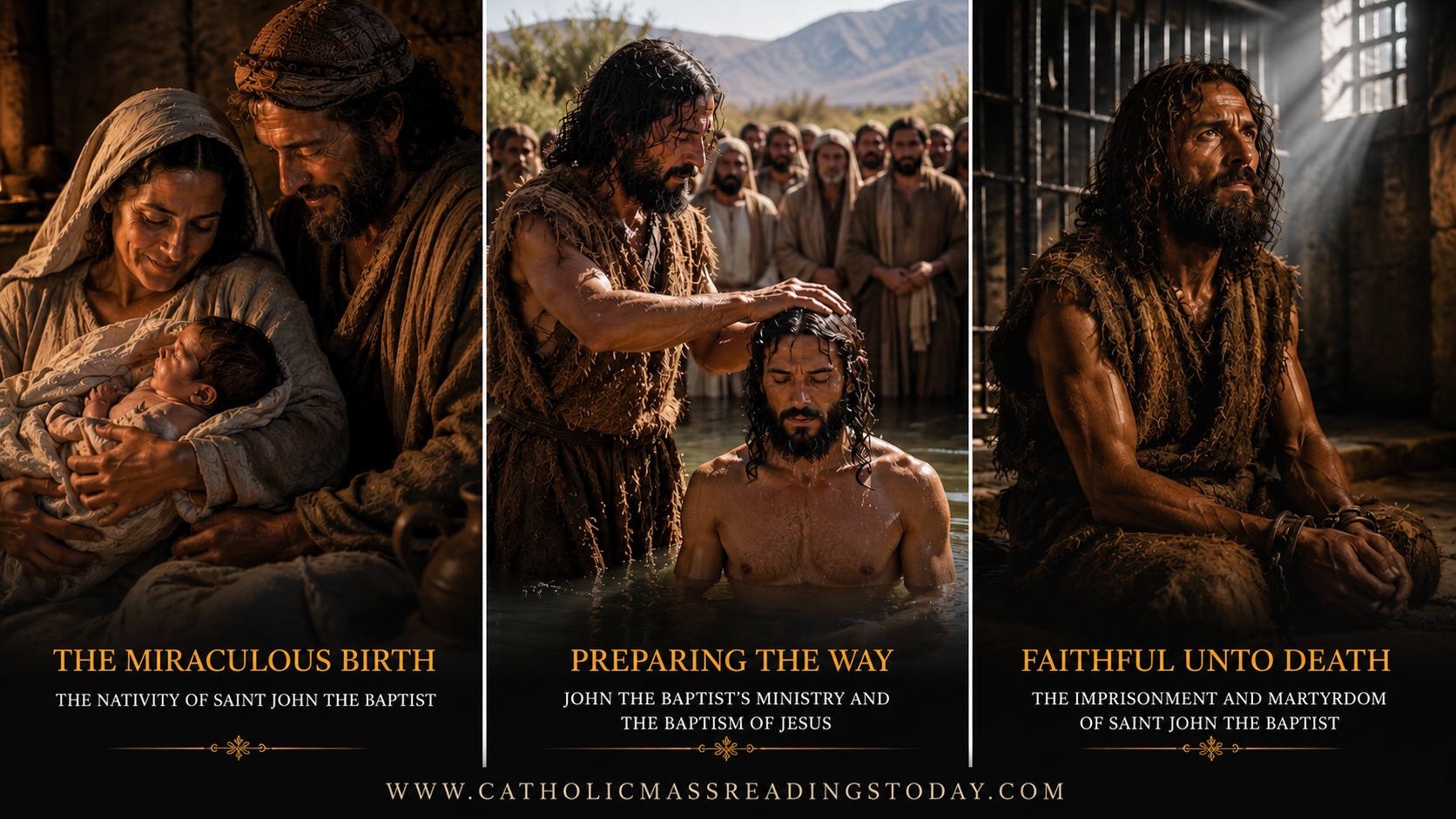
Every year on 24th June, the Catholic Church celebrates The Solemnity of the Nativity of Saint John the Baptist, one of the oldest and most significant feasts in the Church’s liturgical calendar. Unlike most saints, whose feast days commemorate the day of their death the day they entered eternal life the Church celebrates the birth of only three people: Jesus Christ (December 25), the Blessed Virgin Mary (September 8), and Saint John the Baptist (June 24). This distinction alone reveals the extraordinary place John occupies in God’s plan of salvation. The birth of Saint John the Baptist was not merely the arrival of another child into the world. It was the fulfillment of centuries of prophetic expectation. God had chosen John before his birth to prepare the way for the coming of the Messiah. His entire life, from his miraculous conception to his courageous martyrdom, pointed away from himself and toward Jesus Christ. For Catholics, this solemnity is more than a remembrance of an important biblical figure. It is an invitation to renew our own calling to prepare the way for Christ through lives of faith, humility, repentance, and courageous witness.
Why Does the Church Celebrate the Birth of Saint John the Baptist?
The Church rarely celebrates the birth of a saint because every human person is born carrying the effects of original sin. Saint John the Baptist, however, occupies a unique place in salvation history. The Gospel tells us that when the Virgin Mary visited her cousin Elizabeth, who was carrying John in her womb, the unborn child leapt for joy at the presence of Jesus. “When Elizabeth heard the greeting of Mary, the baby leaped in her womb; and Elizabeth was filled with the Holy Spirit.” (Luke 1:41)
The Church has long understood this joyful leap as the moment John was sanctified before birth by the presence of Christ Himself. Even before drawing his first breath, he had begun the mission for which God had created him to recognize and proclaim the Savior of the world. This explains why the Church honors his birth with such joy. His coming into the world announced that the long awaited Messiah was near.The Miraculous Birth of Saint John the Baptist
The story begins with two faithful servants of God: Zechariah, a priest of the Temple, and Elizabeth, a descendant of Aaron. Scripture describes them as righteous before God, faithful in observing His commandments. Yet they carried a heavy sorrow, they had no children, and both had grown old. In the Jewish world, childlessness often brought misunderstanding and quiet shame, but Zechariah and Elizabeth never abandoned their trust in the Lord. One day, while Zechariah was serving in the Temple and offering incense, the Angel Gabriel appeared beside the altar. The angel’s words changed history forever.
“Do not be afraid, Zechariah; your prayer has been heard. Your wife Elizabeth will bear you a son, and you shall call his name John.” (Luke 1:13)
The angel revealed that this child would be filled with the Holy Spirit even before birth, would turn many hearts back to God, and would go before the Lord “in the spirit and power of Elijah.” Overwhelmed by the message and doubting because of his age, Zechariah questioned the angel. As a consequence of his disbelief, he lost the ability to speak until the prophecy was fulfilled. Sometimes God allows silence to become the place where faith is renewed.“His Name Is John”
When Elizabeth gave birth, joy spread throughout the hill country of Judea. Neighbors and relatives gathered to celebrate God’s mercy. On the eighth day, according to Jewish custom, the child was presented for circumcision and naming. Everyone assumed the child would be called Zechariah after his father.Elizabeth surprised them all.
“No; he shall be called John.”
Those present objected, pointing out that none of their relatives bore that name. Turning to Zechariah, who was still unable to speak, they asked what he wished the child to be called. He requested a writing tablet and simply wrote: “His name is John.” Immediately his speech returned. His first words were not complaints about months of silence. They were words of praise. He blessed God. This moment reminds us that obedience always bears fruit. Zechariah’s restored voice became an instrument of thanks giving because he finally surrendered completely to God’s will. The name John comes from the Hebrew Yohanan, meaning: “The Lord has shown favor.” How fitting that the one who would announce God’s greatest gift to humanity would himself bear a name proclaiming God’s mercy.A Child Prepared for a Mission
The Gospel concludes the infancy narrative with remarkable simplicity:
“And the child grew and became strong in spirit; and he was in the wilderness until the day of his manifestation to Israel.” (Luke 1:80)
The wilderness became John’s school of holiness. Far from the noise of cities and the pursuit of recognition, he learned to listen to the voice of God. He embraced a life of simplicity, fasting, and prayer. Dressed in camel’s hair and sustained by locusts and wild honey, John lived as the prophets of old had lived, free from worldly distractions and wholly devoted to the Lord. His hidden years remind us that God often prepares His greatest servants in silence before sending them into public mission. In today’s world, where constant activity and endless noise compete for our attention, John’s example invites us to rediscover the value of quiet prayer. We cannot speak convincingly about Christ unless we have first learned to listen to Him.The Voice Crying in the Wilderness
When the appointed time arrived, John emerged from the wilderness with a message that was both simple and urgent:
“Repent, for the kingdom of heaven is at hand.” (Matthew 3:2)
Crowds traveled from Jerusalem, Judea, and beyond the Jordan to hear him preach. Soldiers, tax collectors, religious leaders, and ordinary people all came seeking direction. John did not flatter his listeners or soften the truth. He called every person to conversion of heart. Yet his message was never one of despair.Repentance, for John, was not merely feeling sorry for sin. It was turning back to the God whose mercy was greater than every human failure. His baptism in the Jordan River became an outward sign of an inward desire to begin anew. Today, the Church continues this same call. Every celebration of the Sacrament of Reconciliation echoes John’s voice, inviting us to prepare our hearts for Christ through sincere repentance and renewed faith.Humility: John’s Greatest Virtue
Perhaps no quality shines more brightly in Saint John the Baptist than his humility. As his popularity grew, many wondered whether he himself might be the long awaited Messiah. John refused every opportunity to draw attention to himself. Instead, he pointed beyond himself to Jesus. He declared:
“He who is coming after me is mightier than I, whose sandals I am not worthy to carry.” (Matthew 3:11)
Later, after baptizing Jesus in the Jordan and witnessing the Holy Spirit descend upon Him, John spoke words that have echoed through the centuries:“He must increase, but I must decrease.” (John 3:30)
These words summarize not only John’s mission but the vocation of every Christian. Authentic discipleship is never about making ourselves more visible. It is about allowing Christ to become more visible through us. In an age often driven by recognition, influence, and personal achievement, Saint John reminds us that true greatness is found in directing every heart toward Jesus rather than ourselves.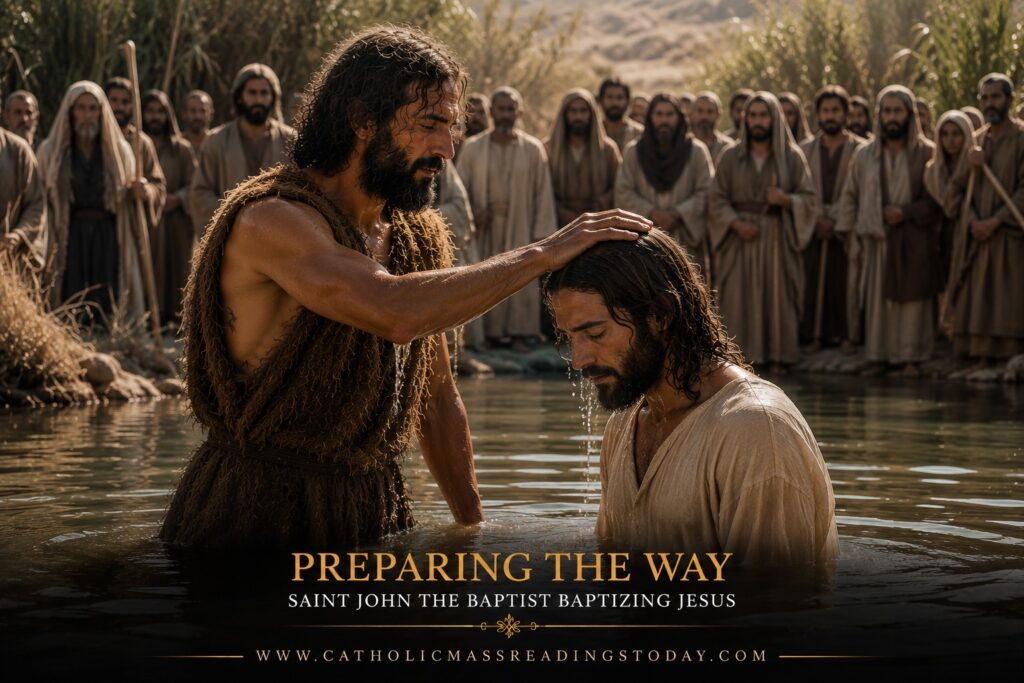
The Baptism of Jesus: The Moment John’s Mission Reached Its Fulfillment
Among all the moments in the life of Saint John the Baptist, none was greater than the day Jesus came to the Jordan River to be baptized.
John immediately recognized that he stood before someone far greater than himself. Knowing his own unworthiness, he protested:
“I need to be baptized by you, and do you come to me?” (Matthew 3:14)
Yet Jesus insisted, saying that it was fitting “to fulfil all righteousness.” As John obediently baptized Him, heaven itself responded.
The Holy Spirit descended upon Jesus like a dove, and the Father’s voice proclaimed:
“This is my beloved Son, with whom I am well pleased.“ (Matthew 3:17)
John became the first public witness to the revelation of the Holy Trinity, the Father speaking from heaven, the Son standing in the Jordan, and the Holy Spirit descending upon Him.
For this reason, the Church remembers John not only as a prophet but as the one chosen to introduce the Messiah publicly to Israel.
His mission had always been to prepare the way. Now, with quiet joy, he stepped aside so that Christ could be seen.
“Behold, the Lamb of God”
The following day, seeing Jesus again, John uttered words that Catholics hear at every Holy Mass before receiving Holy Communion:
“Behold, the Lamb of God, who takes away the sin of the world.” (John 1:29)
These words are among the most profound in all of Sacred Scripture.
John identified Jesus not merely as a teacher or miracle worker, but as the true sacrificial Lamb foretold throughout the Old Testament. He recognized that Christ had come to offer Himself for the salvation of humanity.
Each time we participate in the Eucharist and hear those same words, the Church invites us to respond with the same faith and reverence shown by John the Baptist.
Even today, John’s voice continues to prepare believers to encounter Christ.
A Prophet Who Feared No One but God
Saint John the Baptist was courageous because his loyalty belonged entirely to God.
He spoke the truth without concern for popularity, personal safety, or political consequences.
This courage became especially evident when he publicly condemned King Herod Antipas for taking Herodias, the wife of his brother Philip, as his own.
John declared plainly:
“It is not lawful for you to have her.” (Mark 6:18)
He did not attack Herod out of anger or hatred. Rather, he spoke as a prophet whose love for truth outweighed any fear of earthly power.
Authentic love always seeks the good of another, even when speaking the truth is difficult.
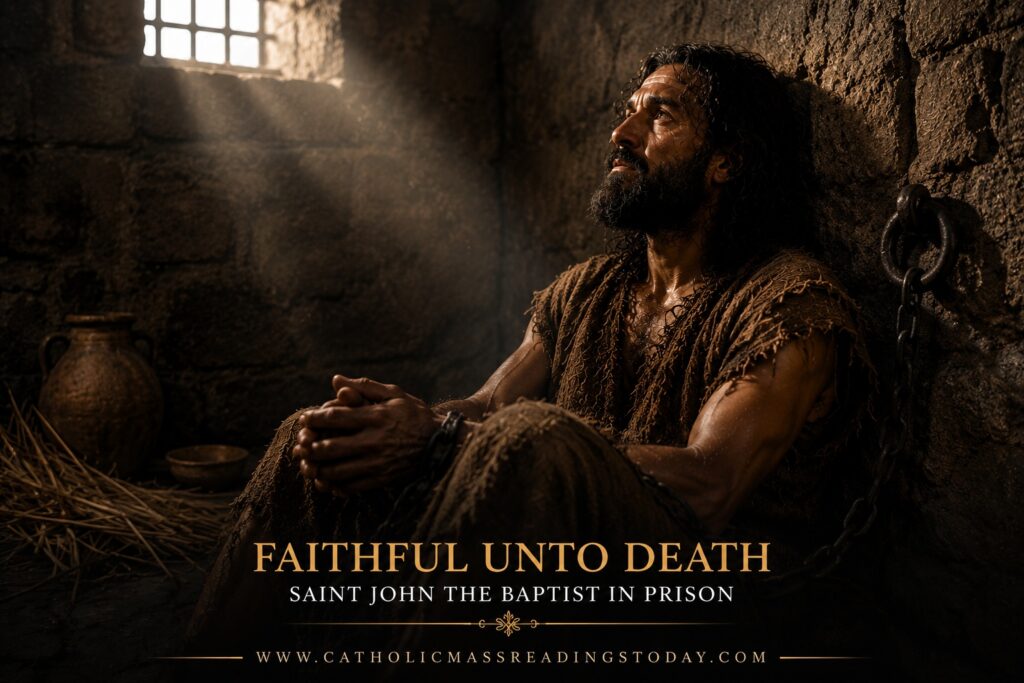
Because of his fearless witness, John was arrested and imprisoned.
Although confined within the walls of Herod’s fortress, his spirit remained free.
His chains could restrain his body, but they could never silence his fidelity to God.
The Martyrdom of Saint John the Baptist
John’s imprisonment eventually led to his martyrdom.
During a banquet celebrating Herod’s birthday, the daughter of Herodias danced before the guests. Delighted by her performance, Herod rashly promised to grant whatever she requested.
Prompted by her mother, she asked for the head of John the Baptist on a platter.
Although distressed, Herod chose to protect his pride before his guests rather than do what was right.
John was executed in prison.
His head was brought into the banquet hall, while the prophet who had lived entirely for God entered eternal glory.
The contrast is striking.
Inside the palace there was luxury, music, and celebration.
Inside the prison there was silence, suffering, and apparent defeat.
Yet history remembers the prophet far more than the king.
John’s death reminds us that earthly success is temporary, but fidelity to Christ lasts forever.
The Church venerates him as one of her earliest martyrs because he gave his life defending both God’s truth and the sanctity of marriage.
Why Jesus Called John the Greatest
Jesus once made an extraordinary statement about John:
“Among those born of women there has arisen no one greater than John the Baptist.” (Matthew 11:11)
These words were not spoken because John performed spectacular miracles.
In fact, Scripture records no miracles performed by him.
His greatness came from something even more important.
He lived entirely for God.
He accepted the mission entrusted to him without seeking recognition.
He remained faithful when success faded.
He spoke the truth when silence would have been safer.
He rejoiced when others followed Jesus instead of himself.
His entire life became a signpost pointing toward Christ.
That is true holiness.
Why the Nativity of Saint John the Baptist Is So Important
Only three birthdays are celebrated in the Church’s liturgical calendar:
- The Nativity of Our Lord Jesus Christ (25 December)
- The Nativity of the Blessed Virgin Mary (8 September)
- The Nativity of Saint John the Baptist (24 June)
This unique honor reflects John’s singular place in salvation history.
He stands at the meeting point between the Old Covenant and the New.
He is the last of the great prophets, yet also the first witness to the public ministry of Christ.
Everything the prophets had long foretold began to unfold before John’s own eyes.
He bridges centuries of expectation and fulfillment.
As St. Augustine beautifully observed
“John is the voice. Christ is the Word.”
The voice exists only to proclaim the Word.
When the Word has been heard, the voice willingly falls silent.
This is precisely how John understood his mission.
Lessons Catholics Can Learn Today
The witness of Saint John the Baptist remains remarkably relevant.
Our world is filled with competing voices that seek our attention. Social media, entertainment, politics, and countless opinions often drown out the gentle voice of God.
John invites us to recover what truly matters.
He teaches us to live with simplicity rather than excess.
To seek holiness before popularity.
To value truth above comfort.
To prepare our hearts continually through repentance.
To place Christ at the center rather than ourselves.
His life reminds us that every Christian has a mission.
Most of us will never preach beside the Jordan River.
Yet we prepare the way for Christ every time we forgive instead of retaliating, serve instead of seeking recognition, defend the dignity of others, remain faithful to our vocation, or quietly witness to the Gospel in our daily lives.
Holiness is rarely found in extraordinary moments.
More often, it grows through ordinary acts of faithful love offered day after day.
A Saint for Our Time
Perhaps the greatest challenge facing modern Christians is not hostility toward faith but distraction.
We can become so occupied with success, possessions, schedules, and personal ambitions that we lose sight of the One whom John spent his entire life proclaiming.
His example calls us back to simplicity.
He reminds us that our identity is found not in what we own or accomplish but in belonging to Christ.
His famous words remain a beautiful examination of conscience for every believer:
“He must increase, but I must decrease.”
Those words remain as necessary today as they were two thousand years ago.
When Christ increases within us, fear gives way to courage, pride gives way to humility, and selfishness gives way to joyful service.
That is the lasting legacy of Saint John the Baptist.
The Enduring Legacy of Saint John the Baptist
More than two thousand years after his earthly life, Saint John the Baptist continues to inspire Christians across the world. His voice has long since fallen silent, yet his message remains as urgent today as it was on the banks of the River Jordan.
In every age, the Church has looked to John as the model of authentic discipleship. He teaches us that greatness is not measured by power, wealth, or influence, but by faithfulness to God’s will. His life reminds us that every Christian has a mission to prepare hearts for Christ, not only through words but through the witness of a holy life.
John never performed spectacular miracles. He never sought fame or built an earthly kingdom. Instead, he pointed every person he encountered toward Jesus.
His famous words remain a guiding principle for every believer:
“He must increase, but I must decrease.” (John 3:30)
Those words summarize the Christian vocation. The closer we draw to Christ, the less our lives become about ourselves and the more they become reflections of His love, mercy, and truth.
Today, when society often encourages self promotion, constant recognition, and personal success above all else, Saint John the Baptist offers a refreshing alternative. He reminds us that genuine joy is found in helping others encounter Jesus.
Lessons We Can Learn from Saint John the Baptist Today
The Solemnity of the Nativity of Saint John the Baptist is not simply about remembering history. It is an invitation to examine our own lives.
1. Listen Before You Speak
John spent years in the wilderness before beginning his public ministry.
Before proclaiming God’s Word, he first learned to listen to God’s voice.
In a world filled with constant noise and endless distractions, Catholics are invited to rediscover silence. Prayer is not merely speaking to God but allowing God to speak to us.
2. Live with Humility
John possessed extraordinary influence, yet never sought personal glory.
Instead, he constantly pointed people toward Christ.
Every Christian leader, parent, teacher, friend, and disciple is called to do the same.
Whenever our actions draw others closer to Jesus rather than ourselves, we imitate Saint John the Baptist.
3. Never Compromise the Truth
John loved people enough to tell them the truth.
Even when it cost him his freedom and eventually his life he refused to remain silent in the face of sin.
Modern Christians are called to speak the truth with charity, compassion, and humility, never using truth as a weapon, but always as an expression of genuine love.
4. Prepare the Way for Christ Every Day
John prepared the world for Jesus’ first coming.
Today, the Church continues preparing the world for Christ’s return.
We do this by:
- forgiving those who have hurt us,
- living honestly,
- defending the dignity of every human person,
- caring for the poor,
- remaining faithful to prayer,
- receiving the Sacraments regularly,
- and sharing the Gospel through the witness of our daily lives.
Catholic Devotion to Saint John the Baptist
Throughout the centuries, devotion to Saint John the Baptist has flourished across the universal Church.
Churches, cathedrals, monasteries, schools, hospitals, and entire cities bear his name.
He is honoured as:
- the Patron Saint of converts,
- the Patron Saint of baptism,
- the Patron Saint of many religious communities,
- and the Patron Saint of numerous countries and dioceses throughout the world.
Catholics often seek his intercession when praying for:
- courage to defend the truth,
- strength during persecution,
- deeper conversion,
- humility,
- faithful preparation for the coming of Christ,
- and perseverance in living the Gospel.
His feast day reminds us that holiness is not reserved for extraordinary people.
God continues to call ordinary men and women to extraordinary faithfulness.
Frequently Asked Questions About the Solemnity of the Nativity of Saint John the Baptist
Why is the birth of Saint John the Baptist celebrated?
Unlike most saints, whose feast days commemorate their entrance into heaven, Saint John the Baptist’s birth is celebrated because of his unique role in salvation history. He was chosen before birth to prepare the way for Jesus Christ and was sanctified in his mother’s womb when Mary visited Elizabeth.
When is the Solemnity of the Nativity of Saint John the Baptist celebrated?
The Catholic Church celebrates the Solemnity of the Nativity of Saint John the Baptist every year on 24 June.
Why is Saint John the Baptist so important?
Saint John is the final prophet of the Old Covenant and the immediate forerunner of Jesus Christ. He prepared the people through preaching repentance, baptized Jesus in the Jordan River, and publicly identified Him as the Lamb of God.
Why did Saint John the Baptist die?
John was imprisoned and later beheaded after courageously condemning King Herod’s unlawful marriage to Herodias. He became a martyr because he remained faithful to God’s truth despite the personal cost.
What did Saint John the Baptist eat?
According to Scripture, John lived in the wilderness, wearing clothing made of camel’s hair and eating locusts and wild honey (Matthew 3:4), reflecting his life of simplicity and total dependence upon God.
What can Catholics learn from Saint John the Baptist?
Catholics can learn:
- humility,
- courage,
- faithfulness,
- repentance,
- simplicity,
- obedience,
- and the importance of always pointing others toward Jesus Christ.
Trust God’s plan
The Solemnity of the Nativity of Saint John the Baptist is a joyful celebration of God’s faithfulness.
Before Jesus began His public ministry, God prepared the world through a humble servant whose only desire was that others would know the Savior.
John teaches us that the greatest life is not one spent seeking applause but one spent leading others to Christ.
His courage challenges us to stand for truth.
His humility reminds us to seek God’s glory rather than our own.
His unwavering faith encourages us to trust God’s plan even when we cannot fully understand it.
As we celebrate his birth, may we ask ourselves the same question that echoed through the hills of Judea after John’s birth:
“What then will this child be?” (Luke 1:66)
Perhaps today the question becomes:
“What kind of disciple will I become?”
May our answer be found in lives marked by holiness, charity, humility, and unwavering faith, so that, like Saint John the Baptist, everything we do points the world toward Jesus Christ.
Let us Pray
In the Name of the Father, and of the Son, and of the Holy Spirit. Amen.
Heavenly Father,
We thank You for the gift of Saint John the Baptist, whose life was completely devoted to preparing the way for Your Son. Through his example, teach us to live with humility, to speak the truth with charity, and to place Christ at the center of everything we do.
Grant us the courage to remain faithful when the world tempts us to compromise, the wisdom to recognize Your voice amid life’s distractions, and the grace to become joyful witnesses to the Gospel in our homes, workplaces, and communities.
Like Saint John, may we decrease so that Christ may increase within us. Help us to lead others not to ourselves but always to Jesus, the Lamb of God who takes away the sins of the world.
Through the intercession of Saint John the Baptist, strengthen our faith, deepen our hope, and inflame our hearts with love for You, so that one day we may rejoice forever in Your heavenly Kingdom.
We ask this through Christ our Lord.
Amen.