Why does the priest wear green on one Sunday, purple during Lent, white at Easter, and red on Pentecost? These are not random choices or simply matters of tradition. Every liturgical colour used by the Catholic Church has a rich history and a profound spiritual meaning. They teach the faithful, express the mysteries being celebrated, and help us enter more deeply into the rhythm of the Church’s worship throughout the year.
For nearly two thousand years, the Catholic Church has used signs and symbols to proclaim the Gospel. Among the most visible of these signs are the liturgical colours worn by priests, deacons, bishops, and other ministers during the celebration of the Holy Mass and the Sacraments. Long before a word is spoken from the sanctuary, the colour of the vestments quietly announces the character of the celebration.
We explore the history, symbolism, development, and continued importance of liturgical colours in the Catholic Church.
What Are Liturgical Colours?
Liturgical colours are the colours prescribed by the Catholic Church for vestments, altar coverings, liturgical banners, and certain sacred decorations used during the Church’s liturgical celebrations.
Rather than serving merely as decoration, they form part of the Church’s sacred language. Like stained glass windows, sacred music, incense, or the ringing of bells, these colours communicate spiritual realities that words alone cannot fully express.
Each colour reflects a particular aspect of Christ’s saving work and helps the faithful enter into the mystery being celebrated.
Why Does the Catholic Church Use Liturgical Colours?
The Church understands that we learn not only through hearing but also through seeing.
God frequently used visible signs throughout Sacred Scripture.
- The rainbow became the sign of God’s covenant with Noah.
- The blood of the Passover lamb marked Israel’s deliverance.
- The burning bush revealed God’s holy presence.
- The cloud and pillar of fire guided His people through the desert.
In the same way, the Church continues to use visible signs to strengthen the faith of believers.
Liturgical colours help Catholics immediately recognize the spiritual focus of a particular celebration.
Without hearing a single reading, a person entering a church immediately understands whether the Church is celebrating:
- Christ’s Resurrection
- A martyr’s witness
- A season of repentance
- Ordinary Time
- The coming of the Holy Spirit
- A Marian feast
The colours become silent teachers of the faith.
The History of Liturgical Colours
The Early Church
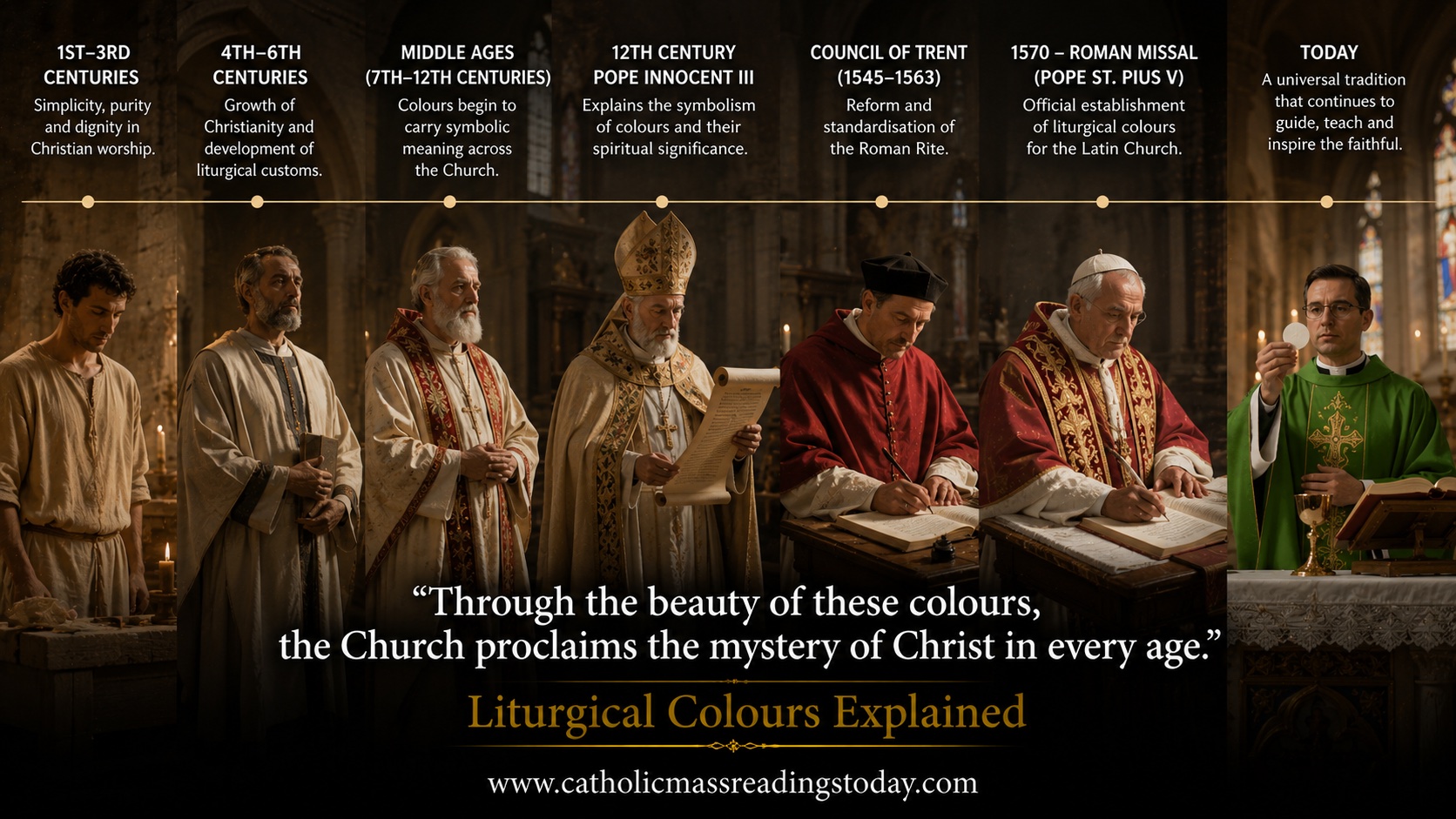
During the first centuries of Christianity, priests generally celebrated the Sacred Mysteries wearing dignified clothing appropriate for worship. There was no universal colour system.
The emphasis was placed on the cleanliness, beauty, and dignity of the garments rather than their colour.
As Christianity spread throughout the Roman Empire, local churches gradually developed their own customs.
The Middle Ages
By the twelfth century, colours had begun acquiring symbolic meanings throughout Western Christianity.
Different dioceses often followed different traditions.
For example:
- Rome sometimes used one colour.
- France preferred another.
- England maintained several local customs.
The need for unity eventually led to standardisation.
Pope Innocent III
Around the year 1200, Pope Innocent III wrote extensively about the symbolism of liturgical colours.
His writings greatly influenced the development of the Roman liturgical tradition.
Although practices still varied, his explanations laid the foundation for what eventually became the universal Roman system.
The Roman Missal
Following the Council of Trent (1545 – 1563), Pope Saint Pius V issued the Roman Missal in 1570.
This officially established the standard colours for the Roman Rite, bringing consistency throughout much of the Catholic world.
Over the centuries, minor adjustments have been made, but the essential colour system remains largely unchanged today.
The Main Liturgical Colours
White
White is the colour of joy, purity, victory, light, and glory.
It celebrates Christ’s triumph over sin and death and reminds the faithful of heavenly life.
White is used during:
- Christmas Season
- Easter Season
- Solemnities of the Lord (except those of His Passion)
- Feasts of the Blessed Virgin Mary
- Angels
- Saints who were not martyrs
- Weddings
- Baptisms
- First Holy Communion
- Ordinations (often)
- Eucharistic Adoration
- Funeral Masses (in many countries)
White reminds us that Christ is risen.
It points toward eternity and the promise of heaven.
Red
Red is one of the Church’s most striking colours.
It symbolizes:
- the Holy Spirit
- fire
- divine love
- sacrifice
- the blood of martyrdom
It is worn during:
- Palm Sunday
- Good Friday
- Pentecost
- Feasts of Apostles
- Feasts of Evangelists
- Celebrations of Martyrs
Red reminds Catholics that authentic discipleship often requires sacrifice.
It also recalls the tongues of fire descending upon the Apostles at Pentecost.
Green
Green represents hope, spiritual growth, perseverance, and the steady growth of Christian life.
It is the colour most frequently seen throughout the year because it is worn during Ordinary Time.
Ordinary Time does not mean “unimportant.”
Rather, it is the season during which the Church reflects on Christ’s public ministry and invites believers to mature in holiness through ordinary daily living.
Green reminds us that sanctity grows gradually, much like a healthy tree or flourishing field.
Violet (Purple)
Purple symbolizes:
- repentance
- preparation
- penance
- expectation
- conversion
It is worn during:
- Advent
- Lent
- Penitential celebrations
- Reconciliation services
Although Advent and Lent both use violet, their focus differs.
During Advent, purple reflects hopeful preparation for Christ’s coming.
During Lent, it expresses repentance and spiritual renewal.
Rose
Rose is among the rarest liturgical colours.
It may replace violet on only two Sundays each year:
Rose symbolizes joyful anticipation.
It reminds the faithful that even during seasons of penance, Easter and Christmas are drawing near.
Black
Although used less frequently today, black remains an approved liturgical colour in the Roman Rite.
Traditionally it has been worn for:
- Funeral Masses
- All Souls’ Day
Black expresses mourning while also acknowledging the seriousness of death.
Today many dioceses prefer white or violet for funerals because of their stronger emphasis on Christian hope and the Resurrection.
Gold
Gold is not officially a separate liturgical colour.
Instead, it may replace white, red, or green on particularly solemn celebrations where local custom permits.
Gold emphasizes:
- majesty
- glory
- honour
- kingship
It is often seen on Christmas, Easter, and major diocesan celebrations.
When Do the Colours Change?
The Church changes liturgical colours according to the Liturgical Calendar.
Major changes occur during:
- Advent
- Christmas
- Ordinary Time
- Lent
- Holy Week
- Easter
- Pentecost
- Saints’ feast days
- Solemnities
- Special liturgical celebrations
These changes help the faithful experience the unfolding mystery of salvation throughout the entire year.
The colours become visual markers that guide Catholics through Christ’s life, death, Resurrection, and the mission of the Church.
Liturgical Colours in the Sacraments
Colours also accompany many of the Church’s sacramental celebrations.
Examples include:
- Baptism: White, symbolizing new life and purity.
- Confirmation: Red, representing the gifts of the Holy Spirit.
- Marriage: Usually white or festive colours, expressing joy.
- Holy Orders: Commonly white or festive vestments.
- Funerals: White, violet, or black, depending on local custom and pastoral practice.
These colours reinforce the spiritual meaning of each sacrament.
Eastern Catholic Traditions
The Eastern Catholic Churches often follow different liturgical customs.
Many Eastern traditions do not prescribe colours as strictly as the Latin Church. Instead, they distinguish between bright vestments for festive celebrations and darker vestments for penitential seasons.
Although the colour schemes may differ, the underlying purpose remains the same: to glorify God and help the faithful enter more deeply into the sacred mysteries.
Common Questions About Liturgical Colours
Why is green called “Ordinary Time”?
The word ordinary comes from the Latin ordinalis, referring to numbered weeks of the liturgical year. It does not mean “common” or “less important.” Green reflects the steady growth of the Christian life during these weeks.
Why does Advent use purple instead of blue?
In the Roman Rite, violet is the prescribed liturgical colour for Advent because it expresses preparation and hopeful expectation. While blue is associated with the Blessed Virgin Mary in some cultural traditions, it is not the standard Advent colour in the Roman Rite, except where a special indult has been granted.
Why are there only a few liturgical colours?
The Church seeks simplicity and clarity. A small number of carefully chosen colours enables the faithful to recognize the liturgical season immediately while preserving the unity of worship throughout the world.
What Liturgical Colours Teach Us Today
In today’s fast moving world filled with constant distractions, the Church’s liturgical colours gently remind us that our spiritual lives unfold according to God’s rhythm rather than our own. They teach us to rejoice, to repent, to hope, to persevere, and to celebrate, allowing the mysteries of Christ’s life to shape our own.
Each time we enter a Catholic church, the colour worn at the altar quietly invites us into the grace of that particular season. White proclaims the joy of the Resurrection, red recalls the fire of the Holy Spirit and the courage of the martyrs, green encourages daily growth in holiness, and violet calls us back to conversion. Together, these colours proclaim the Gospel without speaking a word.
The Church has preserved this beautiful tradition for centuries because it continues to lead hearts toward Christ. By understanding the meaning behind these sacred colours, we participate more consciously in the liturgy and discover that even the smallest details of Catholic worship point us toward the glory of God.
Whether you are attending Mass for the first time or have worshipped in the Church for many years, the next time you notice the colour of the priest’s vestments, remember that the Church is inviting you to enter more deeply into the mystery being celebrated. Through these sacred signs, the liturgy becomes not only something we observe but something we live, week after week, season after season, until we are gathered into the eternal worship of heaven.