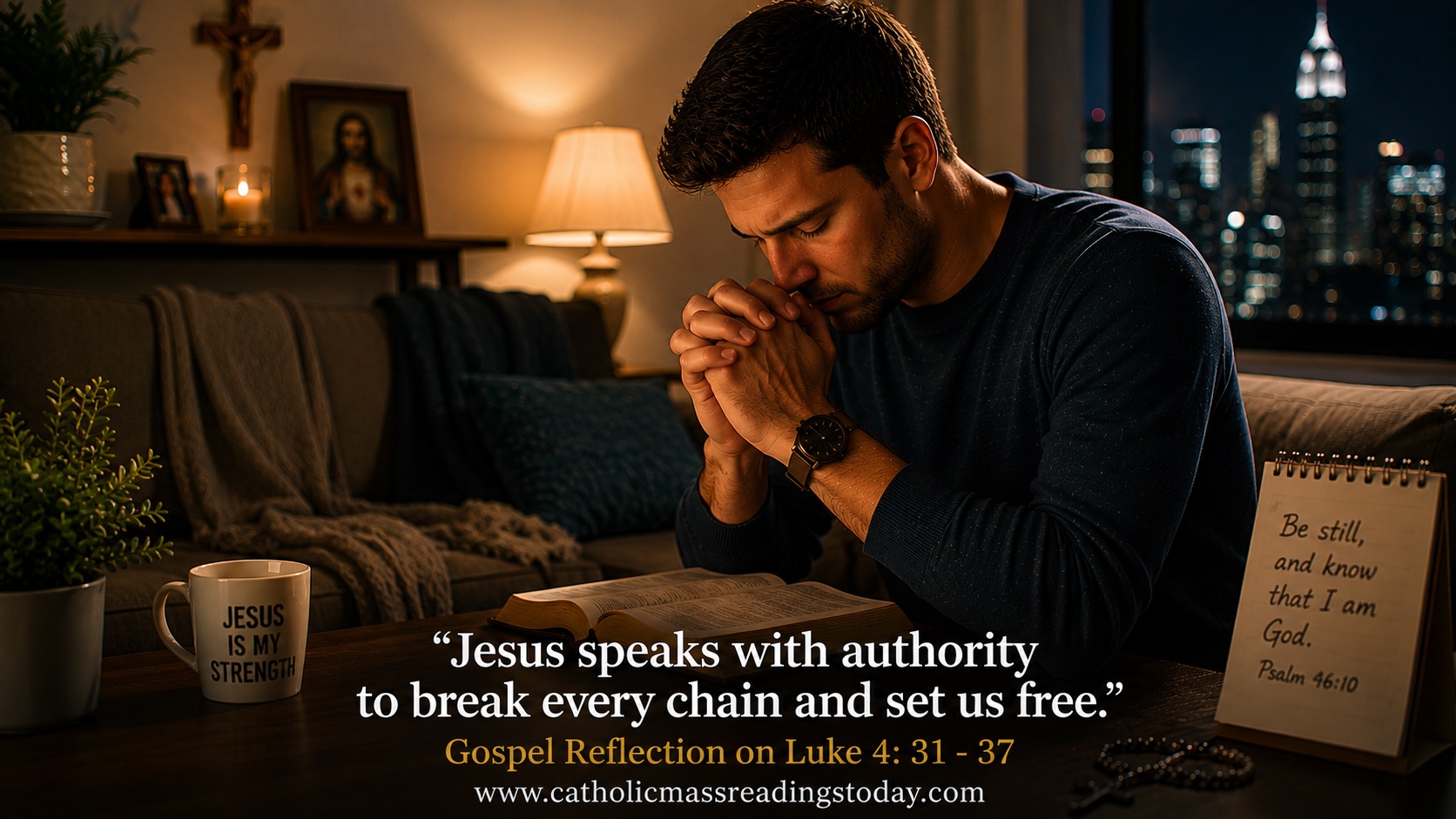
“I Know Who You Are, the Holy One of God.”
Today’s Gospel takes us into the synagogue at Capernaum, where Saint Luke presents an encounter that reveals something fundamental about Jesus Christ. The people have gathered on the Sabbath expecting what may have seemed like an ordinary day of prayer and listening to Scripture. Jesus begins to teach, and almost immediately they recognize that something is different. His words do not sound like the words of an ordinary teacher. Saint Luke tells us that “they were astonished at his teaching, for his word was with authority.”
Then the peaceful gathering is suddenly interrupted. A man possessed by an unclean spirit cries out before everyone: “Ah! What have you to do with us, Jesus of Nazareth? Have you come to destroy us? I know who you are, the Holy One of God.”
Jesus does not enter into a long discussion with the spirit. He does not negotiate with evil. He simply commands: “Be silent, and come out of him!”
The man is thrown down, but the demon leaves him without doing him harm. Those watching are amazed. They ask one another, “What is this word? For with authority and power he commands the unclean spirits, and they come out.”
At the heart of this Gospel is therefore not the power of evil. It is the infinitely greater authority of Christ. The darkness appears, but only so that we may see more clearly the light that overcomes it.
The Authority of Jesus Is Unlike Any Other Authority
The people of Capernaum are astonished because Jesus teaches “with authority.” This is important. Jesus does not merely offer religious opinions. He does not speak as one teacher among many, suggesting one possible way of understanding God.
He speaks with the authority of the Son.
Throughout the Gospel we encounter this authority again and again. Jesus forgives sins. He commands the wind and sea. He heals disease. He raises the dead. He commands evil spirits. He interprets the Law not merely as a scholar commenting upon it, but as the One in whom the Law reaches its fulfilment.
Yet the authority of Jesus is never the authority of a tyrant. He does not use power to dominate people. His authority restores.
When Jesus exercises authority over the possessed man, He does not destroy the man. He destroys what enslaves him.
That distinction reveals the heart of Christ.
Sin enslaves. Christ liberates.
Evil wounds. Christ heals.
The devil seeks to separate. Christ restores communion.
The powers of darkness degrade human dignity while Christ gives the human person back to himself.
This is divine authority: power exercised in the service of truth, freedom and love.
The Demon Recognizes Jesus, but Recognition Is Not Faith
There is a striking irony in today’s Gospel. The unclean spirit knows exactly who Jesus is:
“I know who you are, the Holy One of God.”
It recognizes something that many human beings have not yet understood. But knowing the identity of Jesus is not the same thing as believing in Him.
This distinction is extremely important for Christian life. Faith is more than possessing correct information about God. We can know the Creed, understand Catholic teaching, quote Scripture and be familiar with the commandments while still keeping Christ at a distance from the deepest parts of our lives.
The demon knows who Jesus is, but it does not love Him. Christian faith must go further. To believe in Jesus means entrusting ourselves to Him. It means allowing His Word to judge our choices, His grace to transform our hearts and His will to become the measure of our lives.
The question is therefore not simply, “Do I know who Jesus is?”
The deeper question is: “Have I given my life to the One whom I confess to be Lord?”
A Catholic can say every Sunday, “I believe in one Lord Jesus Christ,” and yet spend the rest of the week resisting Him whenever His teaching becomes difficult.
Today’s Gospel invites us to close the distance between what our lips profess and what our lives reveal.
“Be Silent, and Come Out of Him!”
Jesus’ response to the unclean spirit is remarkably brief:
“Be silent, and come out of him!”
There is no struggle between equal forces. Christ and evil do not stand opposite one another as two comparable powers battling for supremacy. Jesus commands and the demon obeys.
For Christians, this is a source of profound hope. Evil is real. The Church has never taught us to treat it lightly. Scripture speaks seriously about Satan, temptation and the spiritual battle that accompanies human life. But Christianity is not a religion of fear.
Jesus Christ is Lord.
The Cross and Resurrection have already revealed the final destiny of evil.
This does not mean Christians will never experience temptation or spiritual struggle. It means we face those struggles knowing that victory does not ultimately depend upon our strength alone.
Our confidence rests in Christ. We should therefore be careful about becoming fascinated with darkness. Sometimes people become so interested in demons, extraordinary manifestations of evil or frightening spiritual stories that the centre of attention quietly shifts away from Jesus.
The Gospel does the opposite. The possessed man is not the centre. The demon is certainly not the centre either. Christ is the centre.
The Church’s response to evil must always lead us toward Him.
There Are Forms of Captivity We See Every Day
The dramatic possession described in this Gospel is extraordinary, and the Church approaches claims of demonic possession with seriousness and careful discernment. We should not casually label psychological illness, addiction, unusual behaviour or ordinary human suffering as demonic possession.
Yet the Gospel also invites us to think more broadly about the things that enslave the human heart.
Our modern world contains many forms of captivity.
A person can become so dependent upon alcohol or drugs that what once promised escape becomes a prison. Another can become trapped by pornography until relationships and the ability to love are deeply wounded. Someone can become consumed by gambling, anger, greed, envy or resentment. Even the desire for approval can become a form of slavery when our peace depends entirely upon what other people think about us.
Technology itself, which can accomplish enormous good, can become disordered when we can no longer sit quietly, pray, speak to our families or remain alone with our thoughts without reaching for a screen.
Anything that gradually takes away our freedom to choose what is good deserves serious attention.
Christ comes to restore freedom. He does not want us merely to appear free before other people. He wants us to become free within.
Christ Does Not Humiliate the Wounded Man
Notice also how Jesus treats the possessed man. The man cries out publicly. The entire synagogue witnesses his terrible condition. Yet Jesus does not ridicule him, condemn him or turn his suffering into a spectacle.
Jesus separates the person from the evil that afflicts him. This has enormous significance for the way Christians should look at wounded people.
A person is not his addiction.
A person is not her worst mistake.
A human being is not reducible to a criminal record, a failure, a broken relationship or a season of terrible choices.
Sin must be called sin. Evil should never be disguised as good. But Catholic faith also insists upon something equally important: the sinner remains a human person created in the image and likeness of God and called to redemption.
Jesus confronts evil without ceasing to love the person. The Church must strive to do the same.
Truth without charity can become cruelty. Charity without truth can become sentimentality. Christ shows us another way: the truth that liberates because it is spoken and lived in love.
The Word of Christ Still Has Power
The people ask, “What is this word?” That question reaches beyond the synagogue of Capernaum.
What is this Word that commands evil and restores a human being?
Saint John’s Gospel gives us the deepest answer: Christ Himself is the eternal Word made flesh. The Word that created the universe has entered human history.
This is why Catholics should never approach Sacred Scripture as though it were merely inspirational literature. When Scripture is proclaimed in the liturgy, Christ speaks to His people through His Word.
His Word consoles, but it also confronts. It heals, but it also exposes wounds that need healing. It encourages, but it also calls us to repentance.
Sometimes we want a Christianity that comforts us without changing us. But Christ loves us too much for that.
His Word enters the places we would prefer to keep hidden and says, in effect: this cannot remain here if you want to be free.
- Perhaps it is bitterness.
- Perhaps dishonesty.
- Perhaps an immoral relationship.
- Perhaps pride.
- Perhaps a refusal to forgive.
- Perhaps a secret habit that is slowly controlling us.
The Word of Christ does not expose these things in order to humiliate us. He exposes them because He wants to free us.
Freedom Begins When We Allow Christ Into the Places We Hide
One of the great temptations of spiritual life is to give Jesus access only to the respectable parts of ourselves.
We bring Him our prayers, our Sunday Mass attendance, our charitable acts and our good intentions. But there may be another room within the heart whose door remains closed.
Behind it may be an old wound.
- A resentment.
- A shameful memory.
- A temptation.
- A sin we have repeatedly excused.
- A fear we do not want anyone to see.
Christ stands before the whole person. He does not ask us to pretend that darkness is absent. He asks us to bring it into His light. This is why sincere examination of conscience is so valuable. It is also why the Sacrament of Reconciliation remains one of Christ’s great gifts to His Church.
Confession is not a place where perfect people report their achievements. It is where sinners place their wounds before the mercy of God.
The priest pronounces absolution, but it is Christ who forgives through the ministry He entrusted to His Church.
There are few words more liberating than those heard after an honest confession: “I absolve you from your sins.” The Lord who commanded, “Come out of him,” still desires to remove from us whatever separates us from His grace.
The Man Was Thrown Down, but He Was Not Harmed
Saint Luke includes a beautiful detail. The demon throws the man down before leaving him, but the man is left “having done him no harm.”
Even at the moment of liberation, there is turmoil. This can tell us something about conversion.
Leaving sin behind is not always emotionally easy. Sometimes freedom initially feels painful because we have grown accustomed to our chains.
- Ending a destructive relationship can hurt.
- Giving up an addiction can involve a long struggle.
- Forgiving someone may reopen wounds before healing begins.
- Making an honest confession after many years can require tremendous courage.
- Changing a dishonest way of doing business may cost money or reputation.
- Following Christ can disturb arrangements we have spent years building around ourselves.
But not every disturbance is destruction. Sometimes God is unsettling what has kept us captive. The discomfort of conversion should not be confused with the absence of grace.
There are moments when Christ must lead us through something difficult precisely because He intends to bring us somewhere freer.
The Sacraments Draw Us Into the Victory of Christ
Catholic life gives us concrete ways of remaining close to the authority and grace of Jesus.
In Baptism, we are claimed for Christ and brought into His Body, the Church. In Reconciliation, sins are forgiven and communion with God is restored. In the Eucharist, we receive not merely a symbol of Christ but Christ Himself—Body, Blood, Soul and Divinity.
These are not religious accessories added to Christian life. They are encounters with grace.
The Eucharist is especially important when we reflect upon today’s Gospel. The One whose word astonished Capernaum, the One before whom evil could not stand, comes to us with extraordinary humility beneath the appearances of bread and wine.
How remarkable that divine authority approaches us in such gentleness.
Christ could overwhelm us, instead, He feeds us. The Holy One of God makes Himself our food so that His life may become increasingly alive within us.
This is why the Eucharist should never become routine. Every worthy Holy Communion is an invitation to say:
Jesus, rule in me. Let nothing have greater authority over my heart than You.
Whose Voice Has Authority in My Life?
The people were astonished because the word of Jesus possessed authority. This raises a question that becomes increasingly urgent in modern life:
Whose voice has authority over me?
Every day countless voices compete for our attention. Advertisers tell us what we should desire. Social media tells us what deserves our outrage. Celebrities tell us what success should look like. Political movements compete for our loyalty. Popular culture constantly proposes new definitions of happiness, identity, freedom and truth.
Not every voice is evil, and there is wisdom to be found in many places. But none of these voices can take the place that belongs to Christ.
The Christian conscience cannot simply be formed by whatever happens to be popular.
Our conscience must be formed in truth, through Sacred Scripture, the teaching of Christ entrusted to His Church, prayer and the grace of the Holy Spirit.
Jesus is not one voice competing among thousands.
He is the Lord.
And sometimes discipleship means allowing His voice to contradict the loudest voices around us.
We Need Not Live in Fear
There are people who carry deep fear: fear about the future, fear about their children, fear about illness, fear about death, fear about the state of the world and sometimes fear about spiritual evil itself.
Today’s Gospel does not tell us that darkness is imaginary. It tells us something much more powerful:
darkness is not sovereign.
Christ is.
The Christian does not walk through life believing that nothing bad can happen. The Cross itself prevents such a shallow understanding of faith. Rather, we walk knowing that nothing—not suffering, temptation, persecution, sin sincerely repented of, nor even death itself—can have the final word over those who belong to Christ.
The Crucified One has risen. That is why Christian hope is stronger than optimism. Optimism says that perhaps circumstances will improve.
Christian hope says that Jesus Christ is Lord even when circumstances do not improve as we hoped.
Let Christ Speak With Authority in Us Today
The Gospel ends by telling us that reports about Jesus spread throughout the surrounding region. People had witnessed something that could not simply be forgotten. A suffering man had been restored, evil had been commanded to leave, and the people had encountered an authority unlike anything they had known.
But the Gospel cannot remain only their story.
Today Christ stands before our hearts. Perhaps there is something within us that needs His command.
Perhaps there is fear that has ruled us for too long. Perhaps resentment has become so familiar that we no longer notice how deeply it affects us. Perhaps a sinful habit has gradually convinced us that change is impossible. Perhaps we know much about Jesus but have never fully surrendered ourselves to Him.
Then today’s Gospel brings us back to one essential truth:
Jesus Christ is the Holy One of God.
- We do not have to pretend that we are stronger than every temptation.
- We need to remain close to the One who is.
- We do not have to heal every wound by ourselves.
- We bring those wounds to Christ.
- We do not have to earn God’s mercy.
- We receive it with repentance and faith.
The unclean spirit knew who Jesus was and trembled before His authority. The Christian is invited to know Him in a completely different way: not merely to recognize His power, but to love Him, trust Him and surrender to Him.
And perhaps this should become our prayer today:
Lord Jesus, let Your voice have greater authority in my life than my fears, my desires, my wounds, my sins and the opinions of the world. Speak Your word into whatever keeps me from being truly free, and make my heart entirely Yours.
For when Christ truly becomes Lord of the heart, His authority does not enslave us.
It sets us free.
Let us Pray
Almighty and eternal God,
You sent Your beloved Son, Jesus Christ,
the Holy One of God,
to overcome the power of sin
and restore Your children to freedom.
Grant us the grace
to recognize the voice of Your Son
and to receive His Word with faith.
Where there is darkness within us,
bring the light of Christ.
Where sin has wounded us,
grant repentance and healing.
Where fear has taken hold of our hearts,
strengthen us with hope.
Where resentment has imprisoned us,
teach us to forgive.
Protect us from every evil
and keep us faithful to the grace
we received in Baptism.
Give us humble and contrite hearts,
that we may frequently seek Your mercy
in the Sacrament of Reconciliation
and approach the Holy Eucharist
with reverence, gratitude and love.
May the Holy Spirit form within us
the mind and heart of Christ,
so that His truth may guide our decisions,
His love may govern our relationships,
and His voice may have authority
over every part of our lives.
Through the intercession
of the Blessed Virgin Mary,
Mother of God and our Mother,
keep us close to her Son
through every temptation and trial,
until we come to the freedom and joy
of Your eternal Kingdom.
Through Christ our Lord.
Amen.
Mary, Mother of the Church, pray for us.