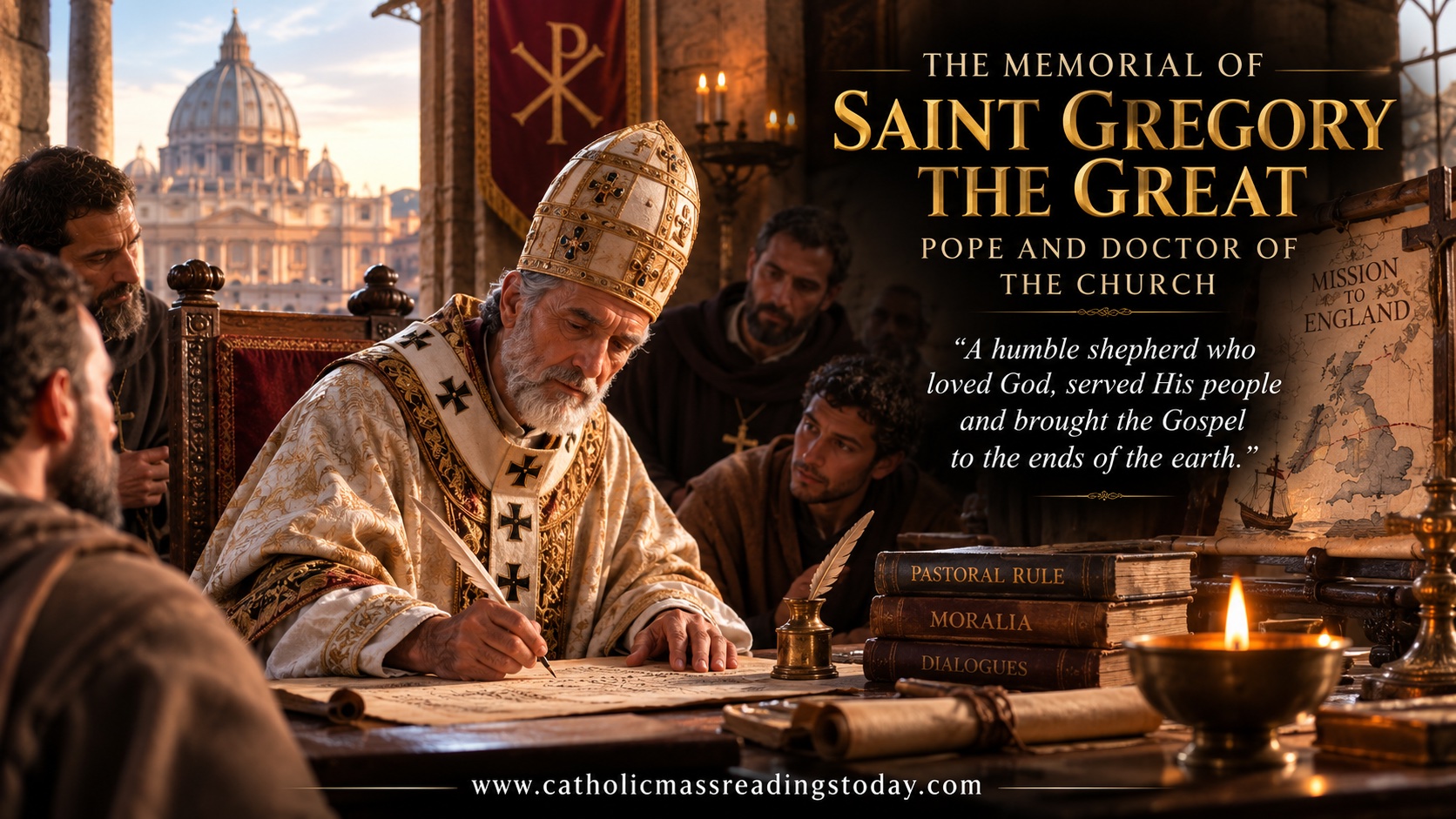
Every year on September 3, the Catholic Church celebrates the Memorial of Saint Gregory the Great, Pope and Doctor of the Church, one of the most remarkable pastors ever to occupy the Chair of Saint Peter.
Few saints have left their mark upon so many different areas of Catholic life. Saint Gregory the Great was a civil administrator who abandoned privilege for the monastery, a monk who longed for silence but was called into public service, a reluctant pope who became one of the greatest shepherds in the history of the Church, a defender of the poor, a missionary pope, an influential teacher of pastors and one of the great spiritual writers of the early medieval Church.
He lived at a moment when the old Roman world seemed to be falling apart around him. Political authority was fragile. Italy suffered invasion, disease and poverty. Rome itself had lost much of its former greatness. Yet Gregory did not spend his life mourning a disappearing world. He asked what Christ required of the Church in the world that was actually emerging.
That question helped make Saint Gregory the Great not simply a pope remembered by historians, but a saint whose example remains strikingly relevant to Catholics today.
The Birth and Early Life of Saint Gregory the Great
Saint Gregory was born in Rome around the year 540, into a wealthy and distinguished Roman Christian family.
He grew up during an unsettled period in the history of Italy. The magnificent Rome of the Caesars was no longer the centre of an all-powerful Western empire. Wars, invasions, political instability and economic decline had transformed the city.
Gregory nevertheless belonged to a family with considerable social standing and a deep Christian heritage. Pope Benedict XVI later noted that his parents, Gordian and Silvia, were both venerated as saints, while other members of his family were known for lives of Christian devotion.
Gregory therefore grew up at the meeting point of two worlds: the surviving traditions of Roman public service and the increasingly influential Christian culture that was reshaping Europe.
He received the education expected of a young Roman aristocrat and eventually entered public administration.
His intelligence and administrative ability quickly became evident.
Around the age of thirty, Gregory attained the prestigious position of Prefect of Rome, one of the highest civil offices in the city. Benedict XVI described him as distinguished by both administrative ability and moral integrity.
For a young man of his background, it represented extraordinary success.
Yet Gregory discovered that worldly advancement could not satisfy the deepest desire of his heart.
From the Palace to the Monastery
Gregory gradually became convinced that God was calling him away from political prestige and toward a life centred upon prayer.
After the death of his father, he embraced the monastic life. His family home on Rome’s Caelian Hill was transformed into the monastery of Saint Andrew.
It was a dramatic change. The man who had administered the affairs of Rome now sought silence, Scripture, prayer, discipline and communion with God.
Gregory would later look back upon these monastic years with deep affection. The monastery offered him something political office never could: sustained contemplation of God.
This part of his life is essential for understanding the pope he would eventually become.
Gregory’s later greatness did not come simply from administrative brilliance. His public ministry was rooted in an interior life. Before he became one of the Church’s great pastors, he had learned to listen.
The tension between contemplation and action would remain one of the defining themes of his spirituality.
He understood that Christian service cannot survive indefinitely if it is separated from prayer. The pastor must serve people, make decisions and confront difficult realities, but he must continually return to God, because otherwise even religious activity can become merely human activity.
Gregory wanted the monastery but God had other plans.
Called Back into the Service of the Church
Gregory’s abilities were too valuable to remain unnoticed. He was eventually ordained a deacon and sent to Constantinople as a papal representative at the imperial court. Even while carrying out diplomatic responsibilities, however, he tried to preserve something of the simplicity and discipline of monastic life.
Eventually he returned to Rome and once again lived at Saint Andrew’s monastery while also serving the Church closely.
Then disaster struck.
A severe plague swept through Rome, and Pope Pelagius II died during the epidemic. The clergy, people and Roman authorities turned toward Gregory. They wanted him as the next Bishop of Rome. Gregory did not want the office.
This reluctance was not theatrical humility. Everything we know about his spiritual character suggests that he genuinely preferred the contemplative life. He understood the immense responsibility of caring for souls and feared the dangers that authority could bring to the spiritual life.
Nevertheless, the call became unavoidable.
In 590, Gregory became Bishop of Rome, the 64th pope of the Catholic Church. His pontificate formally began on September 3.
The monk who had sought solitude now carried responsibility for the Church of Rome and, increasingly, responsibilities that extended far beyond ordinary ecclesiastical administration.
A Pope in a City Surrounded by Crisis
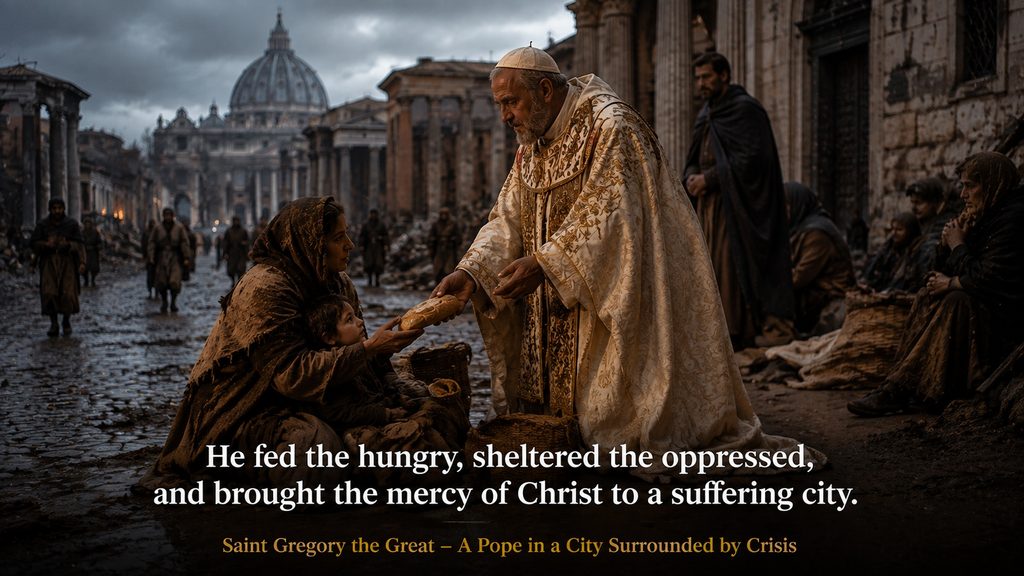
Gregory did not inherit an easy Church or a peaceful society.
Rome faced disease, hunger and political uncertainty. Much of Italy was caught between Byzantine imperial interests and the expanding Lombards. Civil institutions were often unable to meet the needs of ordinary people.
Gregory therefore found himself performing responsibilities that today might appear to belong as much to civic government as to the papacy but he approached them as a pastor.
Church resources were used to assist the poor. Church estates had to be administered carefully. Food supplies mattered because hungry families mattered. Refugees and those suffering because of war could not simply be treated as somebody else’s problem.
For Gregory, care for souls could never be separated completely from care for suffering human beings.
His previous administrative experience, which might once have seemed part of a life he had abandoned, suddenly became enormously useful.
God had not wasted those years.
The skills Gregory had acquired as a Roman administrator were now being placed at the service of the Gospel.
There is a lesson here for every Christian vocation. God can use experiences that appear unrelated to our spiritual lives. Professional knowledge, education, difficult experiences, talents and even unexpected changes of direction may later become instruments through which we serve Him.
Saint Gregory the Great and the Poor
One of the most attractive dimensions of Gregory’s pontificate was his concern for the poor.
For him, Christian charity was not an optional addition to the Church’s mission. The poor belonged at the heart of pastoral concern.
This flowed from a deeply Catholic understanding of stewardship. Wealth ultimately belongs to God, and those entrusted with abundance have obligations toward those who lack what they need.
The pope therefore sought practical ways of providing assistance.
This makes Gregory remarkably relevant in our own age. We live in societies capable of extraordinary wealth while people continue to experience hunger, homelessness, displacement and isolation.
The Memorial of Saint Gregory the Great challenges Catholics to ask whether our faith actually reaches the suffering person.
It is possible to defend Christian truth eloquently while becoming indifferent to the person directly before us.
Gregory’s life refuses that separation.
Truth and charity belong together.
“Servant of the Servants of God”
Gregory is famously associated with the papal expression Servus servorum Dei “Servant of the servants of God.”
The phrase captures something essential about his understanding of authority.
Christian leadership is not fundamentally about privilege. It is service.
This teaching comes directly from Christ, who told His disciples that greatness in His Kingdom is found not in domination but in service.
Gregory knew that ecclesiastical office could become spiritually dangerous if authority became a source of vanity. A bishop could preach humility while secretly desiring honour. A pastor could speak about Christ while slowly placing himself at the centre.
Gregory therefore insisted that those entrusted with souls must constantly examine their own hearts.
The lesson extends beyond bishops and priests.
Parents exercise authority. Teachers exercise authority. Employers and managers exercise authority. Political leaders exercise authority. Anyone entrusted with responsibility for another person must eventually decide whether authority will be used for self-importance or service.
Saint Gregory reminds the Church that Christian leadership becomes most authentic when the leader is willing to kneel.
The Pastoral Rule and Gregory’s Vision of the Good Shepherd
Among Saint Gregory’s most influential writings is his Pastoral Rule, a work that became enormously important in the formation of bishops and clergy.
Gregory understood pastoral ministry as something demanding both spiritual maturity and practical wisdom.
People are not identical.
The grieving person does not need to be approached in precisely the same way as the proud person. The discouraged need encouragement. The complacent may need awakening. The wounded need compassion. Those entrusted with authority sometimes need correction.
Pastoral care therefore requires more than repeating correct statements. It requires knowing human hearts well enough to communicate truth with charity.
Gregory’s ideal pastor must also resist the temptation to become consumed by activity. A shepherd who never prays eventually begins drawing from an empty well.
For Gregory, contemplation and action had to remain united.
Pope Benedict XVI later described this aspect of Gregory’s teaching as a balance in which love rises toward God while also bending compassionately toward the needs of one’s neighbour. The Second Vatican Council would later draw inspiration from Gregory’s pastoral vision.
This helps explain why Gregory was eventually honoured as a Doctor of the Church. His writings did not merely address the problems of his own century. They continued forming Christian pastors for generations.
Saint Gregory the Great and the Mission to England
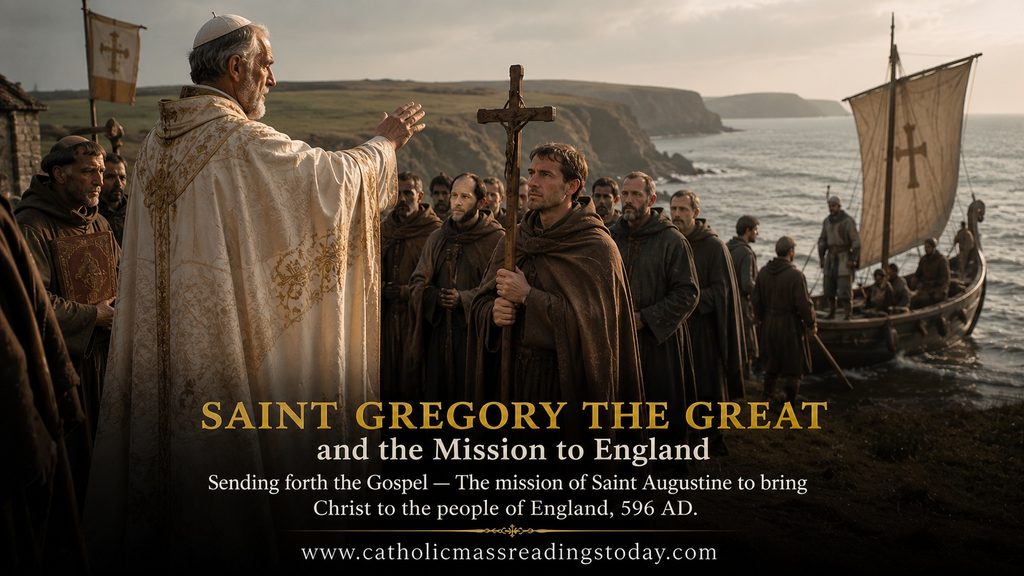
One of the most consequential decisions of Gregory’s pontificate concerned a land far from Rome.
Gregory desired the evangelisation of the Anglo-Saxon peoples of England.
In 596, he sent a group of monks under Saint Augustine, later known as Saint Augustine of Canterbury, to preach the Gospel there.
It was an extraordinary missionary undertaking.
The missionaries eventually reached the kingdom of Kent, where their work gained the support of King Æthelberht and his Christian wife, Queen Bertha. The mission became a decisive chapter in the development of Christianity among the Anglo-Saxons.
Gregory did not personally travel to England.
Yet his missionary vision crossed the sea.
This is another important lesson from his life. We do not have to accomplish every work personally in order to serve God’s mission. Sometimes leadership means recognising another person’s gifts, sending them, supporting them and allowing God to work through them.
Gregory understood that the Church could never become satisfied with preserving faith only among those who already possessed it.
The Gospel must be carried outward.
Gregory and the Evangelisation of a Changing Europe
The mission to England was part of a much wider vision.
The Western Roman Empire had disappeared, and new peoples and kingdoms were emerging across Europe. Some might have looked upon these changes only as the collapse of civilisation.
Gregory saw missionary possibility.
He sought constructive relationships with peoples including the Lombards and encouraged evangelisation rather than treating Europe’s changing political landscape merely as an enemy to be defeated.
Benedict XVI observed that Gregory recognised the possibility of a new civilisation emerging from the meeting of Roman heritage, new European peoples and the transforming power of Christianity.
That vision would prove enormously important.
Gregory lived between worlds.
He inherited antiquity, but his ministry helped prepare the Church for medieval Europe.
Saint Gregory the Great and Sacred Music
The name of Saint Gregory is also inseparably associated with Gregorian chant.
Here some historical care is necessary.
It would be too simplistic to say that Gregory personally composed the entire body of music now called Gregorian chant. The musical tradition developed over a longer period.
Nevertheless, Gregory became strongly associated with the organisation and development of Roman liturgical chant, and the tradition eventually bore his name. The USCCB notes his connection with the Antiphonarium and the development of the sacred musical tradition subsequently known as Gregorian chant.
This association reflects something important about Catholic worship.
Sacred music is not merely decoration placed around the liturgy.
At its best, it helps lift the human heart toward God. The beauty of worship should serve prayer rather than performance.
Centuries after Gregory’s death, the solemn simplicity of Gregorian chant continues to be heard in monasteries, seminaries, churches and cathedrals throughout the world.
Gregory the Teacher and Doctor of the Church
Gregory was an extraordinarily productive writer despite the relentless responsibilities of his pontificate.
In addition to the Pastoral Rule, he produced homilies, letters, theological and spiritual works, a major commentary on the Book of Job known as the Moralia, and the Dialogues, which preserve accounts of holy men and women of Italy, including material concerning Saint Benedict.
Hundreds of his letters survive and offer an unusually detailed picture of the problems confronting a pope at the end of the sixth century.
His correspondence ranges across Church discipline, episcopal responsibilities, monastic life, diplomacy, property, pastoral problems, missionary work and the needs of the poor.
His theology was never simply an academic exercise.
Gregory wanted Christian truth to transform Christian life.
This combination of learning, pastoral wisdom and holiness eventually secured his place among the great Doctors of the Western Church.
His Final Years and Death
The responsibilities of the papacy weighed heavily upon Gregory, whose health was never particularly strong.
Years of demanding work, illness and physical suffering gradually weakened him. Yet he continued governing the Church and writing as his strength permitted.
Saint Gregory the Great died in Rome on March 12, 604, after approximately fourteen years as pope. The Holy See records his pontificate as lasting from September 3, 590 until March 12, 604.
His death appears to have resulted from the accumulated effects of longstanding poor health rather than martyrdom or a sudden violent event.
He was buried in Saint Peter’s Basilica.
The Church would remember him not simply as Gregory I but as Gregory the Great — Gregorius Magnus.
That title was not given because he accumulated wealth or conquered territories.
His greatness was the greatness of service.
Why Saint Gregory the Great Is a Doctor of the Church
The title Doctor of the Church is reserved for saints whose teaching has particular importance for the life and understanding of the Catholic faith.
Gregory deserves that title because he understood how doctrine, prayer and pastoral life belong together.
He teaches us that contemplation should produce charity, that authority should become service, that knowledge of Scripture should shape everyday decisions, and that pastoral responsibility requires both truth and compassion.
His Pastoral Rule became especially influential because Gregory understood that shepherding souls requires holiness from the shepherd himself.
A priest cannot simply tell others to pray while neglecting prayer.
A bishop cannot preach humility while seeking personal glory.
A Christian cannot proclaim charity while treating neighbours without compassion.
The Gospel must first pass through the heart of the person who wishes to proclaim it.
Why the Memorial of Saint Gregory the Great Matters Today
The Church does not celebrate Saint Gregory merely because he was an important historical pope.
We celebrate him because his life continues to ask uncomfortable and necessary questions of us.
What does leadership look like when shaped by Christ?
What happens when personal ambition is replaced by service?
How should Christians respond when society is changing rapidly?
What does the Church owe to the poor?
How can prayer survive amid enormous responsibilities?
And are we still willing to carry the Gospel beyond the comfortable boundaries of our own communities?
Gregory faced a world marked by instability, disease, political tension and social transformation. He did not respond by abandoning the world.
Nor did he allow the Church simply to imitate it.
He served it.
He preached Christ, cared for the vulnerable, formed pastors, encouraged missionaries and continually returned to prayer.
That combination remains urgently necessary.
What Saint Gregory the Great Teaches Catholics Today
Perhaps the most important lesson of Gregory’s life is that holiness does not require us to choose between loving God and serving the world.
- True contemplation should make us more attentive to human suffering.
- True authority should make us more willing to serve.
- True knowledge should make us humbler.
- True worship should draw us more deeply toward God.
- And true faith should make us missionaries.
Gregory did not seek greatness. Indeed, he repeatedly longed for the quiet monastery he had left behind, yet when God placed responsibility upon him, he accepted it.
There may be moments in our own lives when God asks something similar. We may be called into responsibilities we never expected. Parenthood, leadership, illness, caring for an elderly relative, serving a parish, helping someone in crisis or accepting a difficult vocation can interrupt the life we imagined for ourselves.
Gregory teaches us not to ask only, “Is this what I wanted?”
The Christian must also ask:
“Lord, is this where You are asking me to serve?”
Sometimes our greatest contribution to God’s Kingdom begins with accepting a responsibility we would never have chosen for ourselves.
How Catholics Can Celebrate the Memorial of Saint Gregory the Great
The most fitting way to honour Saint Gregory is not merely to know facts about him but to imitate the virtues that made him holy.
Where possible, Catholics can participate in the Holy Mass on September 3 and give thanks for the pastors, missionaries and teachers through whom the faith has been handed down across generations. The Church’s liturgy identifies the day specifically as the Memorial of Saint Gregory the Great, Pope and Doctor of the Church.
It is also a fitting day to pray especially for the Pope, bishops and priests. Gregory understood perhaps better than most how heavy pastoral responsibility can become. Our shepherds need the prayers of the faithful.
Families might also read a passage of Sacred Scripture together, pray for missionaries, assist someone experiencing poverty or loneliness, or listen prayerfully to Gregorian chant.
Teachers, musicians, Church leaders and those entrusted with public responsibilities can especially ask for Gregory’s intercession.
But perhaps the finest celebration would be something very simple: perform one act of service that nobody is likely to notice.
That would be profoundly Gregorian.
Saint Gregory’s Enduring Legacy
More than fourteen centuries separate us from the Rome of Gregory the Great, yet remarkably little separates us from some of the questions he faced.
Civilisations change. Governments rise and fall. Technology transforms daily life. Human institutions pass through periods of confidence and crisis.
- The mission of the Church remains.
- Christ must still be proclaimed.
- The poor must still be loved.
- The lost must still be sought.
- Pastors must still be shepherds rather than celebrities.
Those with authority must still remember that Christian leadership means service, and beneath all the activity of the Church there must still be men and women who know how to become silent before God.
This is why Saint Gregory the Great remains great.
- He possessed intelligence but learned humility.
- He possessed authority but chose service.
- He loved contemplation but accepted responsibility.
- He inherited a troubled world but refused to surrender hope.
- He guarded the faith he had received while courageously carrying that faith toward peoples who had not yet heard the Gospel.
On this Memorial of Saint Gregory the Great, Pope and Doctor of the Church, we remember not merely an extraordinary pope from a distant century. We remember what God can accomplish through a person who allows prayer, truth, responsibility and charity to become one life.
Saint Gregory never wanted worldly greatness.
He wanted God and because he sought God and served God’s people, history remembers him by the name that generations of Christians came to believe he deserved:
Gregory the Great.
Prayer to Saint Gregory the Great
O God,
who care for Your people with gentleness
and rule them in love,
through the intercession of Saint Gregory the Great,
grant wisdom and holiness
to those whom You have called
to shepherd Your Church.
Give to our Holy Father the Pope,
our bishops and priests
the heart of Christ the Good Shepherd.
Teach those who exercise authority
to seek service rather than honour,
and give all Your faithful
a generous love for the poor,
a hunger for Your Word
and courage to proclaim the Gospel.
Through the example of Saint Gregory,
teach us to unite prayer with action,
faith with charity
and truth with humility.
May we serve You faithfully in this life
and, when our earthly work is finished,
come at last into the joy of Your eternal Kingdom.
Through Christ our Lord.
Amen.
Saint Gregory the Great, Pope and Doctor of the Church, pray for us.