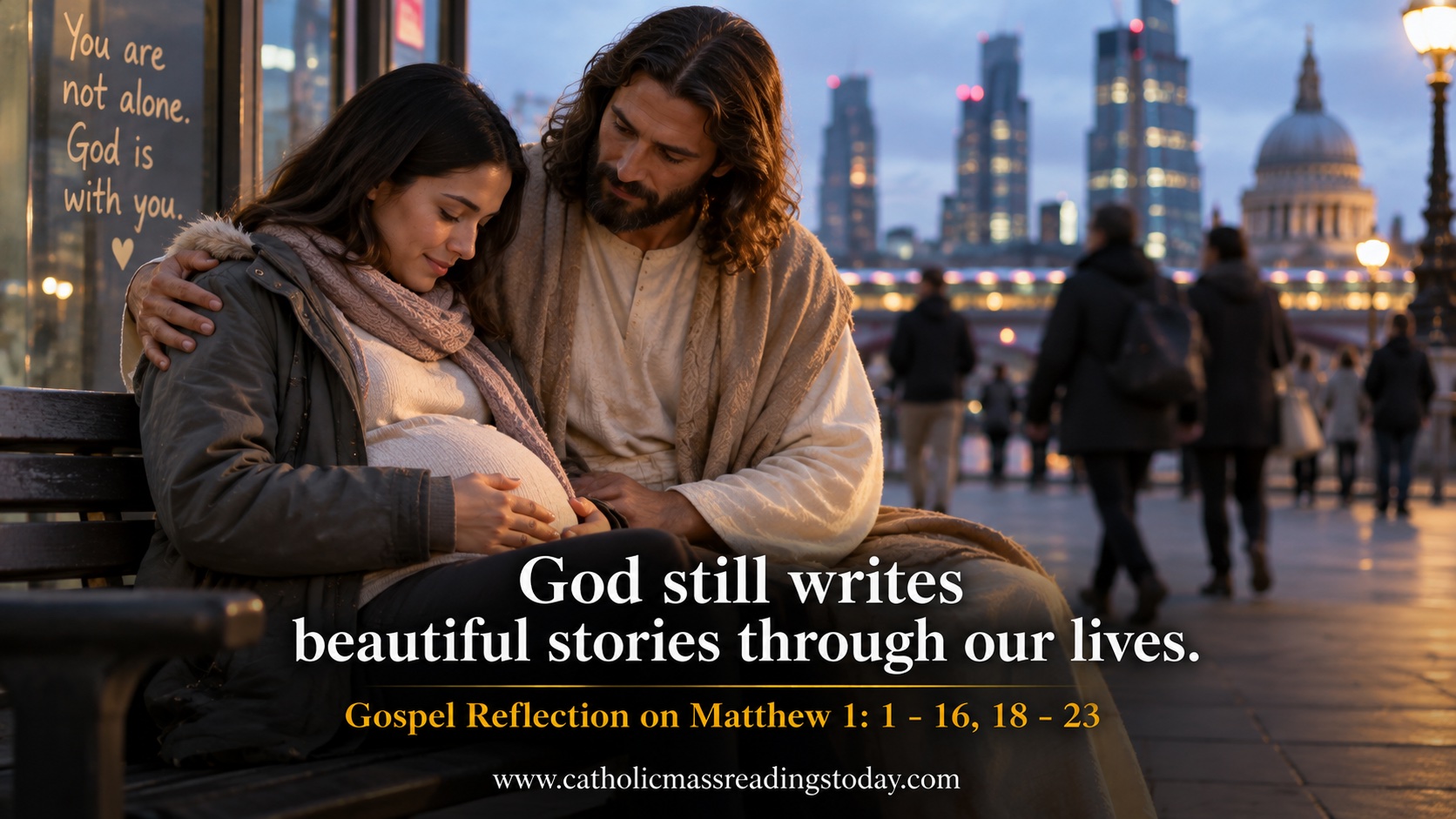
“God With Us”
At first, the long genealogy with which Saint Matthew begins his Gospel may seem like little more than a succession of unfamiliar names. Yet the Church does not proclaim these names without purpose. Behind every name there is a life, a family, a struggle, a promise, a failure, an act of faith. Together they tell us something beautiful about the way God enters human history.
God does not save humanity from a distance. He enters our story.
God Works Through Real Human History
Matthew begins with Abraham and leads us through David, through the exile in Babylon, through generations of hope and disappointment, until we arrive at Joseph, “the husband of Mary, of whom Jesus was born, who is called Christ.”
This family history is not spotless. There are saints within it, but there are also sinners. There are moments of extraordinary faith and moments of grave human weakness. There are kings and ordinary people, Jews and Gentiles, periods of prosperity and periods of exile.
And still God works.
This should give great hope to every Christian family.
We sometimes imagine that God can accomplish His purposes only when everything in our lives is orderly. We may look at our families and see old wounds, broken relationships, mistakes, disappointments or decisions we wish had been different. We may even wonder whether our failures have somehow placed us outside God’s plan.
The genealogy of Christ tells us otherwise.
God does not approve of sin, nor does He call evil good. But neither is human weakness powerful enough to defeat His saving purpose. Divine Providence can take even the tangled threads of human history and patiently lead them toward redemption.
Saint Paul expresses this mystery when he tells us that “in everything God works for good with those who love him.” This does not mean that everything that happens is good. It means that God is so faithful that even suffering, failure and human weakness cannot prevent Him from bringing forth grace when we place ourselves in His hands.
Joseph, the Just Man
Then the Gospel suddenly becomes deeply personal.
Joseph discovers that Mary, to whom he is betrothed, is with child.
We should not pass too quickly over the suffering contained in those few words.
Joseph does not yet understand what God is doing. The woman he loves is expecting a child, and the explanation of this mystery has not yet been revealed to him. His plans for marriage, family and the future suddenly appear to have collapsed.
Yet Scripture calls him “a just man.”
His justice is revealed not through anger, revenge or public humiliation, but through mercy. Even while confused and wounded, Joseph refuses to expose Mary to shame. He resolves to send her away quietly.
There is already something profoundly Christ-like in this.
How often, when we are hurt, do we immediately want to defend ourselves? How easily disappointment becomes accusation, and accusation becomes condemnation. Joseph shows us another way. Before he understands the mystery, he chooses not to destroy another person’s dignity.
This is a lesson our world desperately needs.
The Christian must never take pleasure in another person’s humiliation. Truth matters. Justice matters. But the dignity of the human person also matters. Even correction must be guided by charity.
“Do Not Fear”
Then God intervenes. “Joseph, son of David, do not fear to take Mary your wife.”
How often these words appear, in one form or another, throughout salvation history: Do not fear.
God speaks them when He is about to ask someone to trust beyond what can presently be understood.
Joseph is not given an explanation for every difficulty that lies ahead. He is given enough light to take the next faithful step.
“That which is conceived in her is of the Holy Spirit.”
Here we stand before one of the great mysteries of our faith. Jesus Christ is not merely another figure within the human genealogy that Matthew has just recounted. He truly enters that genealogy, truly takes flesh from the Virgin Mary and truly becomes man, yet His conception is the work of the Holy Spirit.
The eternal Son of God enters human history, the Word becomes flesh, the Creator enters His creation.
God comes among us not surrounded by earthly power, but hidden within the womb of a young woman who has said yes to Him.
This is why the Church approaches the mystery of the Incarnation with such reverence. The child Mary carries is truly God and truly man. From the first moment of His conception, the Son of God has united Himself to our humanity.
Human life is therefore never insignificant in the eyes of God.
“You Shall Call His Name Jesus”
The angel tells Joseph what the child’s name will be: “You shall call his name Jesus, for he will save his people from their sins.”
His very name reveals His mission. Jesus comes to save.
Humanity’s deepest problem is not merely political instability, poverty, illness or conflict, serious though these realities are. At the deepest level, humanity needs reconciliation with God. Sin has wounded our relationship with our Creator, with one another and even within ourselves.
Christ comes into the world to restore what sin has broken.
The child whom Joseph is commanded to receive will one day carry the Cross. The wood of Bethlehem already points toward the wood of Calvary. The Son whom Mary bears will offer Himself for the salvation of the world and rise again so that death itself may no longer have the final word.
This is why Christianity is fundamentally a proclamation of hope.
God has come looking for us.
Emmanuel – God With Us
Saint Matthew then gives us the name that gathers the entire Gospel into a few words:
“Emmanuel.”
God with us, not God watching us from afar, not God with us only when we are successful, not God with us only when prayer feels easy or when life unfolds according to our plans.
God with us.
- With us in the hospital room.
- With us beside the grave of someone we love.
- With us when a marriage is struggling.
- With us when a parent worries about a child.
- With us when work disappears and the future becomes uncertain.
- With us when we carry guilt and approach the Sacrament of Reconciliation asking for mercy.
- With us in the silence of prayer.
Above all, with us in the Holy Eucharist, where the same Jesus Christ who took flesh from the Virgin Mary gives Himself to His Church under the appearances of bread and wine.
This is not simply a beautiful religious thought. It is the heart of Christian life. We are not alone.
Mary and Joseph Teach Us How to Receive Christ
Mary receives the mystery through faith. Joseph receives it through obedience.
Neither is given an easy road.
Mary says yes without knowing everything that her yes will cost. Joseph rises and acts upon the word God has given him. Together they teach us that faith is more than understanding God’s plan. Faith means entrusting ourselves to God even when we cannot yet see the whole road ahead.
Perhaps this is the invitation of today’s Gospel for each of us.
There may be something in your life that you do not understand. A prayer may remain unanswered. A plan may have failed. A family situation may trouble you. The future may look different from what you expected.
Joseph would understand that feeling.
But God asks us, as He asked Joseph, not to allow fear to have the final word.
We may not know what tomorrow will bring, but we know who walks with us into tomorrow.
Emmanuel.
God with us.
And when God is with us, even the most uncertain road can become a road of grace.
Let us Pray
O God,
who in the fullness of time
sent Your only-begotten Son into the world,
born of the Virgin Mary
and conceived by the power of the Holy Spirit,
strengthen our faith in Your loving Providence.
Through the intercession of the Blessed Virgin Mary,
grant us hearts ready to receive Your will;
and through the example of Saint Joseph,
teach us to obey You with courage, humility and trust.
When we do not understand the path before us,
deliver us from fear.
When our families carry wounds,
bring healing and reconciliation.
When our sins weigh upon us,
lead us to the mercy of Your Son.
May Jesus, our Emmanuel,
remain with us in our joys and sorrows,
in our homes and families,
in our work and suffering,
and at every moment of our lives.
Make us faithful witnesses to the truth
that in Jesus Christ You have come among Your people
to save us from our sins
and lead us into everlasting life.
Through Christ our Lord.
Amen.