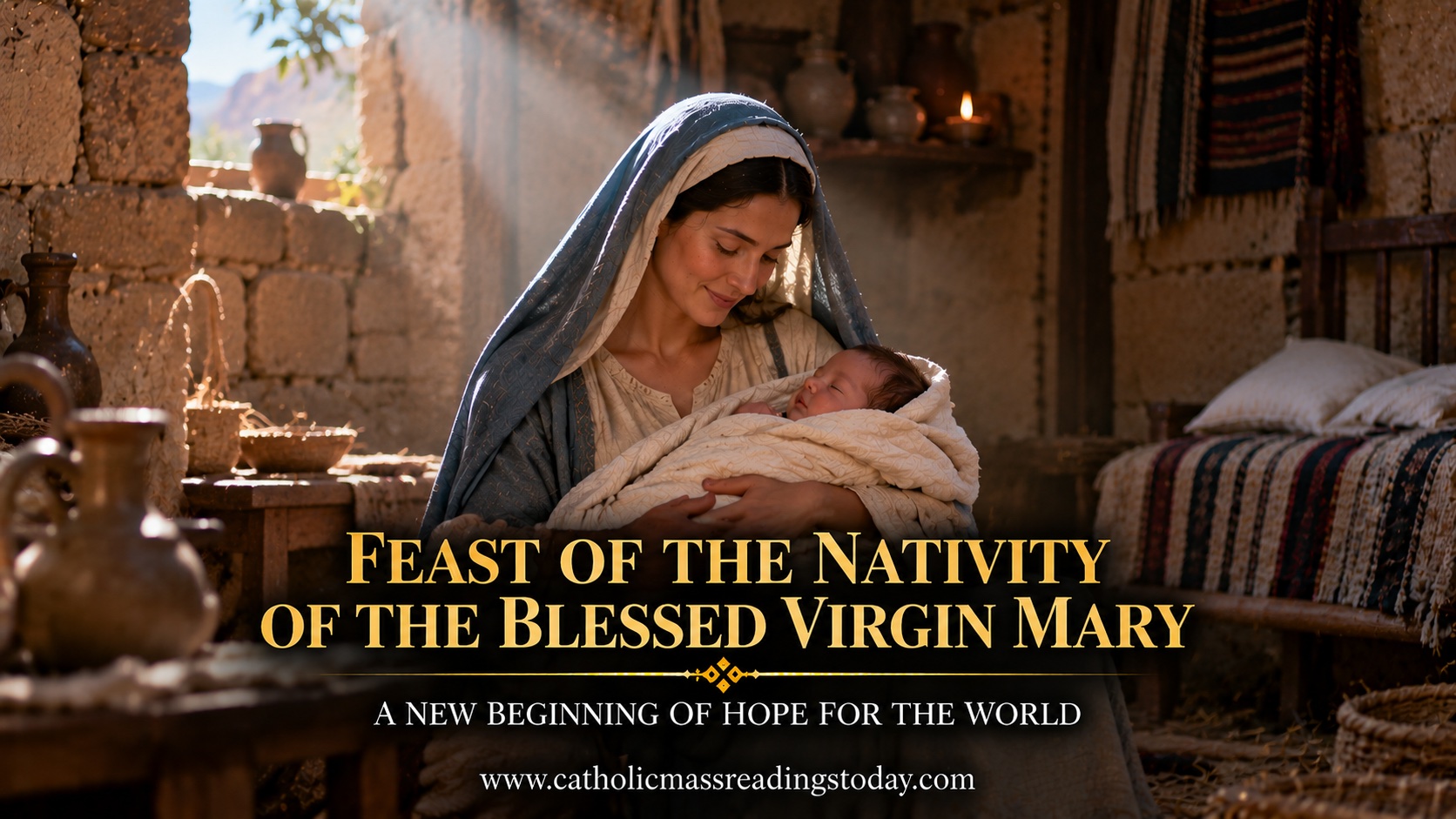
Every year on September 8th, the Catholic Church celebrates with great joy the Feast of the Nativity of the Blessed Virgin Mary. It is the day on which the Church remembers the birth of the woman whom God, in His providence, chose to become the Mother of Jesus Christ.
At first glance, the birth of a child in an ordinary Jewish family might have appeared to be a small event, noticed only by relatives and neighbours. There were no crowds waiting. There were no royal announcements. The world did not yet know the name of Mary, and yet, in the quiet unfolding of God’s plan, something extraordinary had begun.
The little girl whose birth the Church celebrates would one day hear the angel Gabriel announce that she had found favour with God. She would freely answer, “Let it be to me according to your word.” She would carry the Son of God beneath her heart, give birth to Him at Bethlehem, present Him in the Temple, search for Him in Jerusalem, stand beside Him at Calvary, and remain with the disciples as the young Church awaited the Holy Spirit.
This is why the Feast of the Nativity of the Blessed Virgin Mary is ultimately filled with hope. We rejoice at Mary’s birth because her life belongs inseparably to the mystery of Jesus Christ and His saving work.
Saint John Paul II beautifully described the child Mary as the “purest dawn of the Redemption.” The image is fitting: Mary is not the sun; Christ is. But her coming announces that the sunrise is approaching.
Why Does the Catholic Church Celebrate Mary’s Birthday?
The Church’s liturgical calendar does something remarkable with birthdays.
For most saints, we commemorate the date of their death, their entrance into eternal life. Yet the Roman Calendar celebrates three earthly births in a special way: the Nativity of Jesus Christ on December 25th, the Nativity of Saint John the Baptist on June 24th, and the Nativity of the Blessed Virgin Mary on September 8th.
That alone tells us something about Mary’s unique place in salvation history.
Catholics do not celebrate Mary instead of Christ. We celebrate what God accomplished in Mary for the sake of Christ and for our salvation.
Everything authentic in Catholic devotion to the Blessed Virgin ultimately points beyond Mary to her Son.
When Elizabeth cries, “Blessed are you among women,” she immediately continues by speaking of “the fruit of your womb.” When Mary herself proclaims that all generations will call her blessed, she explains why: “for he who is mighty has done great things for me.”
The centre remains God.
The Nativity of Mary therefore celebrates the beginning of a human life that would become completely available to the will of God.
What Does the Bible Tell Us About the Birth of Mary?
It is important to distinguish clearly between Sacred Scripture and ancient Christian tradition.
The canonical Gospels do not describe Mary’s birth. They do not tell us the date or exact location of her birth, and they do not name her parents.
The names Joachim and Anne, familiar to generations of Catholics as Mary’s parents, come from early Christian tradition, particularly the Protoevangelium of James, an apocryphal Christian work dating from around the second century.
“Apocryphal” is important here. The Protoevangelium of James is not part of the inspired canon of Sacred Scripture. Catholics should therefore not treat every detail contained in it as though it were Gospel history.
Nevertheless, it witnesses to very early Christian interest in the family and childhood of the Mother of Jesus, and the names Joachim and Anne became deeply established within Christian tradition. Vatican sources themselves note this distinction when explaining the origins of today’s feast.
The Church therefore celebrates a theological reality much greater than any particular legendary detail surrounding Mary’s childhood: Mary was truly born, she truly belonged to our human family, and God prepared her for an incomparable vocation within His plan of salvation.
Saints Joachim and Anne and the Childhood of Mary
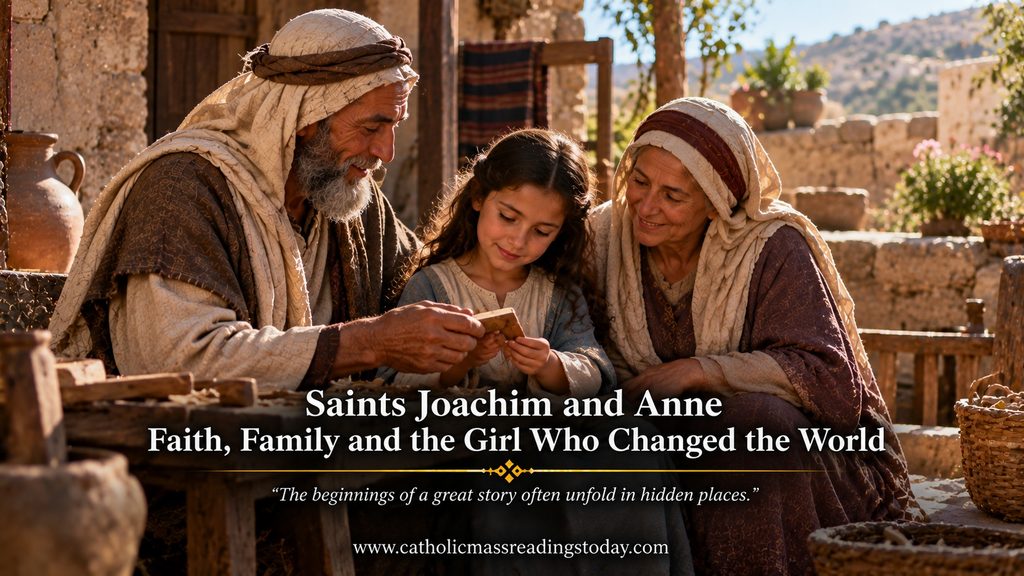
According to ancient Christian tradition, Mary’s parents were Saint Joachim and Saint Anne.
They have been honoured for centuries as the parents who welcomed Mary into their home and raised the child who would become the Mother of the Messiah.
We know very little historically about their daily lives. Yet contemplating them reminds Christian parents of something important.
Joachim and Anne could not have seen everything that lay ahead.
They could not have stood beside Mary’s cradle and comprehended Bethlehem, Nazareth, Cana, Calvary and Pentecost all at once.
They simply had a child to love, protect and form in faith.
How many parents experience something similar?
A mother holding her newborn child does not know where that child’s life will lead. A father teaching his young son or daughter to pray cannot know what vocation God may eventually place within that heart.
The Nativity of Mary therefore carries a beautiful message for families: never underestimate what God may accomplish through the faithful love given to a child.
A home filled with prayer, tenderness, discipline, forgiveness and faith can become the hidden place in which God prepares something far greater than anyone can presently see.
The Ancient History of the Feast of the Nativity of the Blessed Virgin Mary
The Feast of the Nativity of the Blessed Virgin Mary is not a modern Catholic devotion. It is one of Christianity’s ancient Marian feasts.
Its early development is closely associated with Jerusalem and a church dedicated to Mary near the traditional site connected with the home of Joachim and Anne. Vatican News traces the feast to the dedication of this Marian church in Jerusalem, associated with the site where tradition placed Mary’s birth; the present church there is the Basilica of Saint Anne.
Evidence for celebration of Mary’s Nativity appears in the Christian East by the sixth century. The feast subsequently entered the Roman tradition, and Pope Sergius I, whose pontificate lasted from 687 to 701, was associated with its liturgical observance in Rome. Vatican News places its Roman celebration in the eighth century under Sergius I, while historical liturgical sources trace its adoption in Rome into the preceding century and note the procession he prescribed for it.
From Rome, its celebration became established more widely throughout the Western Church.
What began as an ancient Eastern celebration thus became part of the common liturgical inheritance of Catholics across the world.
Why September 8th?
The Church celebrates Mary’s birth on September 8th.
We do not possess a historical birth certificate establishing September 8th as Mary’s actual date of birth. The feast day belongs to the Church’s liturgical tradition rather than to a documented chronology of Mary’s infancy.
There is, however, a beautiful relationship within today’s Catholic calendar.
The Church celebrates the Solemnity of the Immaculate Conception on December 8th and Mary’s Nativity exactly nine months later, on September 8th.
These two celebrations must not be confused.
The Immaculate Conception refers not to Jesus being conceived in Mary’s womb, but to Mary herself being conceived without original sin, preserved by God’s grace from the first moment of her existence in view of the merits of Jesus Christ.
Nine months later, the Church celebrates her birth.
Thus the liturgical calendar itself leads us from Mary’s conception to her nativity.
Mary’s Birth and the Immaculate Conception
The Nativity of Mary takes on still greater meaning when viewed in the light of the dogma of the Immaculate Conception.
Mary needed salvation just as every human being does. The difference is the extraordinary manner in which God gave that grace to her. By a singular grace and privilege, and in view of the merits of Jesus Christ, Mary was preserved from original sin from the first instant of her conception.
Christ is therefore Mary’s Saviour too. Her holiness does not compete with the saving work of Jesus; it demonstrates its power. Before Mary could accomplish anything herself, grace had already acted. That is an important lesson for every Christian.
Our relationship with God begins not with what we accomplish for Him, but with what He has first done for us.
Grace comes first.
Mary’s entire life becomes a response to that grace.
The Dawn Before the Coming of Christ
The Church rejoices at Mary’s birth principally because of the One who will be born from her.
This is why Saint John Paul II’s description of Mary as the “purest dawn of the Redemption” is so powerful.
Think of the first light appearing before sunrise. The darkness has not completely disappeared, but its defeat has begun. The horizon is changing. Morning is coming.
Mary’s birth is like that dawn.
Humanity still waits for the Messiah. Bethlehem has not yet happened. The angels have not yet sung to the shepherds. Christ has not yet walked the roads of Galilee. Calvary and the empty tomb still lie in the future.
But the woman from whom the Saviour will take His human flesh has entered the world. The dawn has appeared.
Christ, the true Sun of Justice, is coming.
Mary Is One of Us
There is another reason today’s feast should touch us deeply.
Mary was not an angel who descended from heaven.
- She was human.
- She was born.
- She grew.
- She belonged to a family.
- She learned, prayed, worked and lived within the ordinary circumstances of human existence.
Saint John Paul II reflected on precisely this dimension of the feast, describing Mary as our sister in the human family, while at the same time recognizing her unique vocation as the Mother of Christ and our mother in the spiritual order.
This makes Mary wonderfully close to us.
Catholics do not honour an imaginary figure removed from ordinary human life. We honour a real woman whose greatness consisted not in worldly power but in allowing God to act completely within her life.
Her path tells us that holiness is possible in human life.
- It can grow within a home.
- It can exist in hiddenness.
- It can take shape through ordinary duties.
- It can begin with a quiet yes.
The Nativity of Mary and the Dignity of Every Human Life
Today’s feast also carries a powerful message about the dignity of human life.
When Mary was born, nobody looking at that infant could have seen with human eyes everything God would accomplish through her, and so it is with every child.
We cannot measure the value of a human life by wealth, health, intelligence, social position, productivity or future achievements. Every human person possesses dignity because he or she is created in the image and likeness of God. The newborn child who seems insignificant to the world is already known and loved by God.
This is why Catholic teaching insists so strongly upon the dignity of human life from conception until natural death.
The Feast of Mary’s Nativity asks us to look again at children, mothers, families, the unborn, the vulnerable and those whom society may overlook, and to remember that no human life is ordinary in the eyes of God.
Mary’s “Yes” Was Prepared Through a Lifetime of Faith
When we hear the story of the Annunciation, Mary’s response can appear almost instantaneous:
“Behold, I am the handmaid of the Lord.”
But such a yes does not emerge from nowhere.
Mary’s fiat reveals a heart already turned toward God. Her answer was spoken at one decisive moment, but behind it stood a life receptive to grace. There is an important spiritual lesson here.
Great acts of faith are often prepared through thousands of small acts of faithfulness.
A person who prays when nobody notices, forgives when it is difficult, attends Mass faithfully, resists temptation, serves his or her family, receives the Sacraments and quietly chooses God’s will is being prepared for moments that cannot yet be foreseen.
We often want to know God’s entire plan before agreeing to follow Him.
Mary teaches the opposite. Give God today’s yes. Tomorrow’s grace will come tomorrow.
What the Feast of the Nativity of the Blessed Virgin Mary Means for Catholics Today
September 8th is therefore more than an opportunity to remember an event from Mary’s life.
It asks something of us.
Mary’s birth reminds us that God often begins His greatest works quietly.
The world tends to notice spectacular beginnings. God frequently chooses hidden ones.
Bethlehem was hidden, Nazareth was hidden and also much of Mary’s life was hidden, yet heaven was at work.
Perhaps something in your own life presently seems small: raising children, caring for an elderly parent, rebuilding a marriage, beginning again after failure, returning to Confession, learning to pray again, remaining faithful through illness, quietly serving your parish, or simply trying to become a better Christian one ordinary day at a time.
Do not despise small beginnings. God sees further than we do.
The infant Mary could not yet speak her great fiat, but the story that would lead to that fiat had already begun.
How Catholics Can Celebrate the Feast of the Nativity of the Blessed Virgin Mary
The most fitting way to celebrate Mary’s birthday is to do what Mary herself always does: lead us toward Jesus Christ.
Catholics who are able can participate in Holy Mass, listen attentively to the Scriptures appointed for the feast and thank God for the gift of the Mother of His Son.
It is also a beautiful day to pray the Holy Rosary, particularly the Joyful Mysteries, contemplating the Annunciation, Visitation, Nativity of Jesus, Presentation and Finding of Jesus in the Temple.
Families may mark the day simply at home, perhaps by placing flowers near an image of the Blessed Virgin, praying the Hail Mary together, reading the Gospel, or teaching children why Catholics love Mary.
Those devotions should never end merely in sentimentality.
The greatest birthday gift we could offer Our Lady is a life brought closer to her Son.
- Forgive someone.
- Return to prayer.
- Go to Confession.
- Help someone quietly.
- Protect the dignity of another person.
- Say yes to something God has been asking of you.
That is how Marian devotion becomes Christian discipleship.
The Feast Is Still Celebrated in Jerusalem
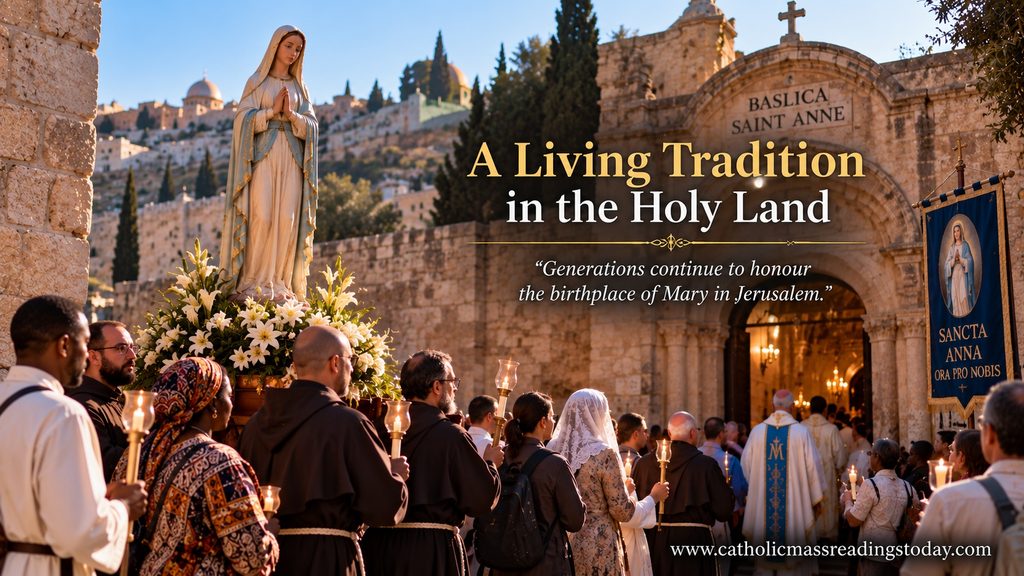
The ancient connection between this feast and Jerusalem remains alive today.
At the Basilica of Saint Anne in Jerusalem, associated by Christian tradition with Mary’s birthplace, September 8th continues to be marked by the Eucharistic celebration of the Nativity of the Blessed Virgin Mary. The Franciscans of the Custody of the Holy Land have also maintained a traditional pilgrimage there, including prayer at the crypt associated with Mary’s birth.
There is something moving about that continuity.
Centuries have passed. Empires have risen and fallen. Jerusalem has endured war, division and enormous suffering.
Yet Christians still gather and remember the birth of Mary, and through Mary, they proclaim hope.
A Feast of Hope for a Troubled World
Our world knows darkness. Families suffer. Wars continue. Children experience violence. Many people live with anxiety about tomorrow. Others feel abandoned, lonely or uncertain about their future.
The Nativity of Mary does not pretend that darkness is unreal. It tells us that darkness does not have the final word.
Dawn can begin while much of the world is still dark. God began preparing the coming of His Son long before most people could recognize what He was doing. He continues to work in ways we cannot always see.
This is Christian hope, not the belief that nothing painful will happen, but confidence that God remains faithful within human history.
Mary’s birth announces that God’s promises are moving toward fulfilment.
From Mary’s Birth to Bethlehem and Calvary
Ultimately, we cannot understand the Feast of the Nativity of the Blessed Virgin Mary if we stop with Mary.
Her entire life points toward Jesus.
- She receives Him at the Annunciation.
- She carries Him to Elizabeth.
- She gives birth to Him at Bethlehem.
- She presents Him in the Temple.
- She tells the servants at Cana, “Do whatever he tells you.”
- She stands beneath His Cross.
- She remains with His disciples in prayer.
- Mary never takes the place of Christ.
- She brings us to Him.
This is the heart of authentic Catholic Marian devotion.
When the Church celebrates Mary’s birth, she is already looking toward the birth of Jesus.
When she honours Mary’s faith, she is praising the grace of God at work within her.
When she calls Mary blessed, she is echoing Scripture itself.
And when Christians turn to Mary as Mother, we ask the woman who gave Jesus to the world to help us belong ever more completely to Him.
Happy Birthday, Blessed Mother
Today, therefore, there is a beautiful simplicity beneath all the history and theology.
It is Mary’s birthday and Catholics throughout the world rejoice.
- We thank God for the life of the young woman of Nazareth whose humble obedience changed human history.
- We thank Him for her faith.
- We thank Him for her motherhood.
- We thank Him for her intercession.
Above all, we thank God because through Mary Jesus Christ came into the world.
On this Feast of the Nativity of the Blessed Virgin Mary, may we ask for something of Mary’s heart: her humility when God called, her courage when the road was uncertain, her faithfulness when suffering came, and her unwavering desire to lead everything toward her Son.
The world did not know what had happened when Mary was born.
But heaven knew. The dawn had begun and the Sun was coming.
Prayer on the Feast of the Nativity of the Blessed Virgin Mary
O God,
who prepared the Blessed Virgin Mary
to become the Mother of Your only-begotten Son,
we thank You for the gift of her life
and rejoice on the feast of her holy Nativity.
Through her intercession,
increase our faith, strengthen our hope
and make our hearts obedient to Your will.
Teach us, after the example of Mary,
to receive Your Word with humility,
to carry Christ faithfully within our hearts
and to bring His love to those whom we meet.
Bless our families,
protect every human life,
comfort those who suffer
and lead those who have wandered from You
back into the embrace of Your mercy.
Blessed Virgin Mary,
Mother of God and our Mother,
pray for us that our lives may always lead others
to your Son, Jesus Christ.
Through Christ our Lord.
Amen.