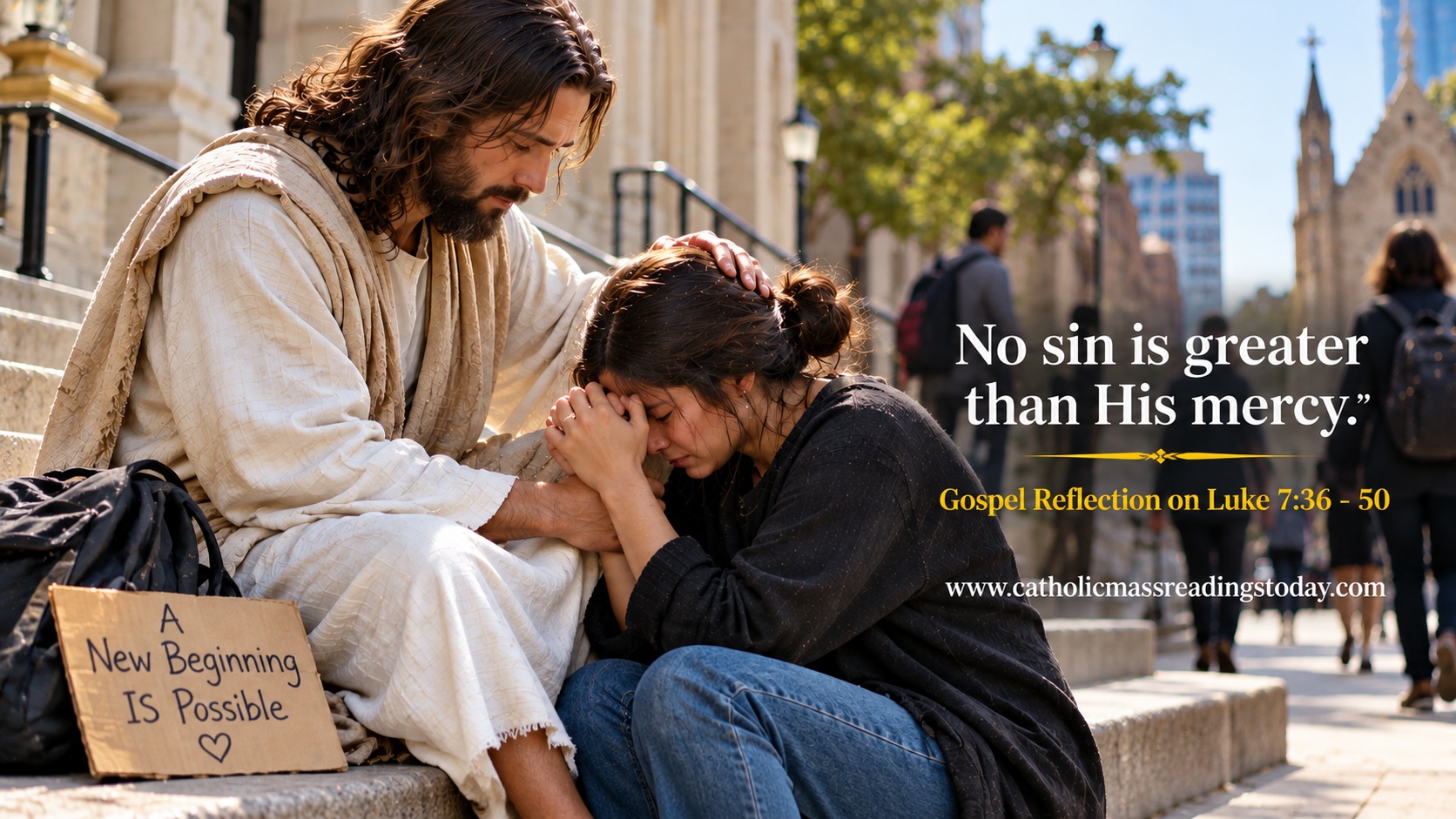
“Her Sins, Which Are Many, Are Forgiven, for She Loved Much”
There is something deeply beautiful in this encounter between Jesus and the woman who comes to Him in tears. Everyone in the room seems to know her by her past. They know her reputation. They know her sins. Simon looks at her and sees only the woman she has been.
But Jesus looks at her and sees something more.
He sees her repentance. He sees her tears. He sees her faith. He sees a heart returning to God.
Jesus Sees Beyond Our Past
The woman enters the Pharisee’s house carrying an alabaster flask of ointment, but she is also carrying something much heavier: the burden of her past.
She does not try to defend herself before Jesus. She offers no excuses and makes no attempt to explain what she has done. Instead, she comes to Him with a repentant heart. Her tears fall upon His feet. She wipes them with her hair, kisses them and anoints them with the precious ointment she has brought.
Simon sees all this and quietly judges her.
Jesus sees all this and recognizes repentance.
That difference is at the heart of today’s Gospel.
Simon sees a sinner. Jesus sees a woman seeking mercy.
How often do we look at someone and see only what they have done? A mistake, a scandal, an addiction, a broken relationship or a painful chapter of the past can become the label by which we remember a person. Sometimes we even do this to ourselves. We carry our failures for so long that we begin to believe they have become our identity.
But Christ does not look at us only through the worst thing we have ever done.
Jesus Does Not Excuse Sin, He Forgives It
Notice what Jesus does not say to the woman. He does not tell her that her sins do not matter. He does not pretend that nothing has happened. He does something far greater.
He forgives her.
This is the mercy of God.
God does not deny the reality of our sin, because sin truly wounds our relationship with Him and with one another. Yet neither does He allow our sin to have the final word over our lives.
The mercy of Christ does not tell us to remain comfortable in sin. It calls us out of sin and into a new life.
This woman comes before Jesus carrying her past, but she does not leave Him in the same condition in which she arrived. Christ gives her something her past could never give her: forgiveness, restoration and peace.
“Do You See This Woman?”
One of the most powerful moments in the Gospel comes when Jesus turns toward the woman and asks Simon:
“Do you see this woman?”
Simon has been looking at her from the moment she entered the house. Yet Jesus asks whether he truly sees her.
Simon sees her reputation. Jesus sees her repentance.
Simon sees what she has done. Jesus sees what grace is beginning to do within her.
That question should remain with us: Do we truly see the people around us?
Perhaps there are people in our own lives whom we continue to define by the worst thing they have ever done. Perhaps there is someone we have never allowed to move beyond an old failure because, in our minds, that failure has become their identity.
Christ asks us to see differently.
This does not mean pretending that wrongdoing never happened. Christian mercy is not blindness to truth. Rather, it means refusing to believe that another person is beyond the reach of God’s grace.
And when we remember how patiently God has dealt with our own weaknesses, it becomes increasingly difficult to stand proudly over the weaknesses of another.
The One Who Has Been Forgiven Loves Much
Jesus tells Simon about two debtors. One owes a great amount and the other considerably less. Neither can repay what is owed, and so the creditor forgives them both.
Jesus then asks which one will love the creditor more.
Simon answers correctly: the one who has been forgiven more.
Jesus uses this simple story to reveal something profound about the spiritual life. When we truly understand the mercy we have received from God, gratitude begins to transform us.
This is why Jesus says of the woman:
“Her sins, which are many, are forgiven, for she loved much.”
Her love flows from a heart that has encountered mercy.
The person who recognizes his or her own need for forgiveness has less reason for spiritual pride. We begin to understand that none of us stands before God because we have lived perfectly. We stand before Him because His grace has sustained us, His patience has endured our weakness and His mercy has called us home.
We have all needed mercy.
We still need mercy.
And when we truly understand the mercy we ourselves have received, something begins to change within us. Gratitude grows, compassion deepens, judgment softens, and our love for God and for others becomes greater.
The Mercy We Encounter in Reconciliation
For us as Catholics, this Gospel also speaks beautifully to the gift of the Sacrament of Reconciliation.
Sometimes shame tells us to hide from God. We remember what we have done, where we have failed and the choices we regret, and perhaps quietly wonder whether God still wants us near Him.
But shame should never keep us away from Christ.
In Confession, we come before the Lord honestly. We acknowledge our sins, express genuine sorrow, seek His forgiveness and receive sacramental absolution through the ministry He entrusted to His Church.
We do not come because our sins are insignificant. We come because God’s mercy is greater.
There is no need to hide from the One who already knows us completely.
The woman in today’s Gospel teaches us precisely this. She does not remain outside Simon’s house because she is ashamed of her past. She goes to Jesus.
And that is where everything changes.
“Your Faith Has Saved You; Go in Peace”
The Gospel begins with a woman weeping at the feet of Jesus. It ends with some of the most beautiful words she could possibly have heard:
“Your faith has saved you; go in peace.”
She walks into the house carrying her past and leaves carrying the peace of Christ.
Jesus does not tell her to spend the rest of her life sitting at His feet mourning what she has done. Having received mercy, she must now rise and live differently.
There is an important lesson here for us.
Repentance requires us to face the truth about our sins, but Christian life cannot become an endless imprisonment in yesterday’s failures. Once we have sincerely repented and received God’s forgiveness, His grace calls us forward.
Perhaps there are things in our past that cannot be undone. There may be wounds that require healing and consequences that must still be faced. But our past does not have to become our permanent identity.
Christ has the final word.
And His word to the repentant sinner is not simply, “Remember what you did.”
It is:
“Go in peace.”
May we therefore have the courage to approach Christ as this woman did, without excuses and without pretending. May we place before Him whatever has become too heavy to carry alone. And having received His mercy, may we also learn to extend mercy to those around us.
For the person who knows how much he or she has been forgiven begins to understand how deeply he or she is called to love.
Let Us Pray
Lord Jesus Christ,
give us the courage to come before You as we truly are.
When sin has wounded us, lead us to sincere repentance. When shame tells us to hide from You, draw us instead toward Your mercy. When memories of our failures weigh heavily upon our hearts, remind us that Your grace is greater than our past.
Through the Sacrament of Reconciliation, restore within us the joy of Your friendship and give us the humility to receive Your forgiveness with grateful hearts.
When we are tempted to judge another person only by their past, remind us of the mercy You have shown to us. Teach us to see others as You see them, never denying the truth of sin, but never forgetting the power of Your grace to transform a human life.
Give us hearts that love much because we understand how much we have been forgiven.
And having received Your mercy, help us to rise from our failures, walk faithfully with You, and carry Your compassion into the lives of those we meet.
May we hear within our hearts the words You spoke to the woman who came before You in faith:
“Your faith has saved you; go in peace.”
You live and reign for ever and ever.
Amen.