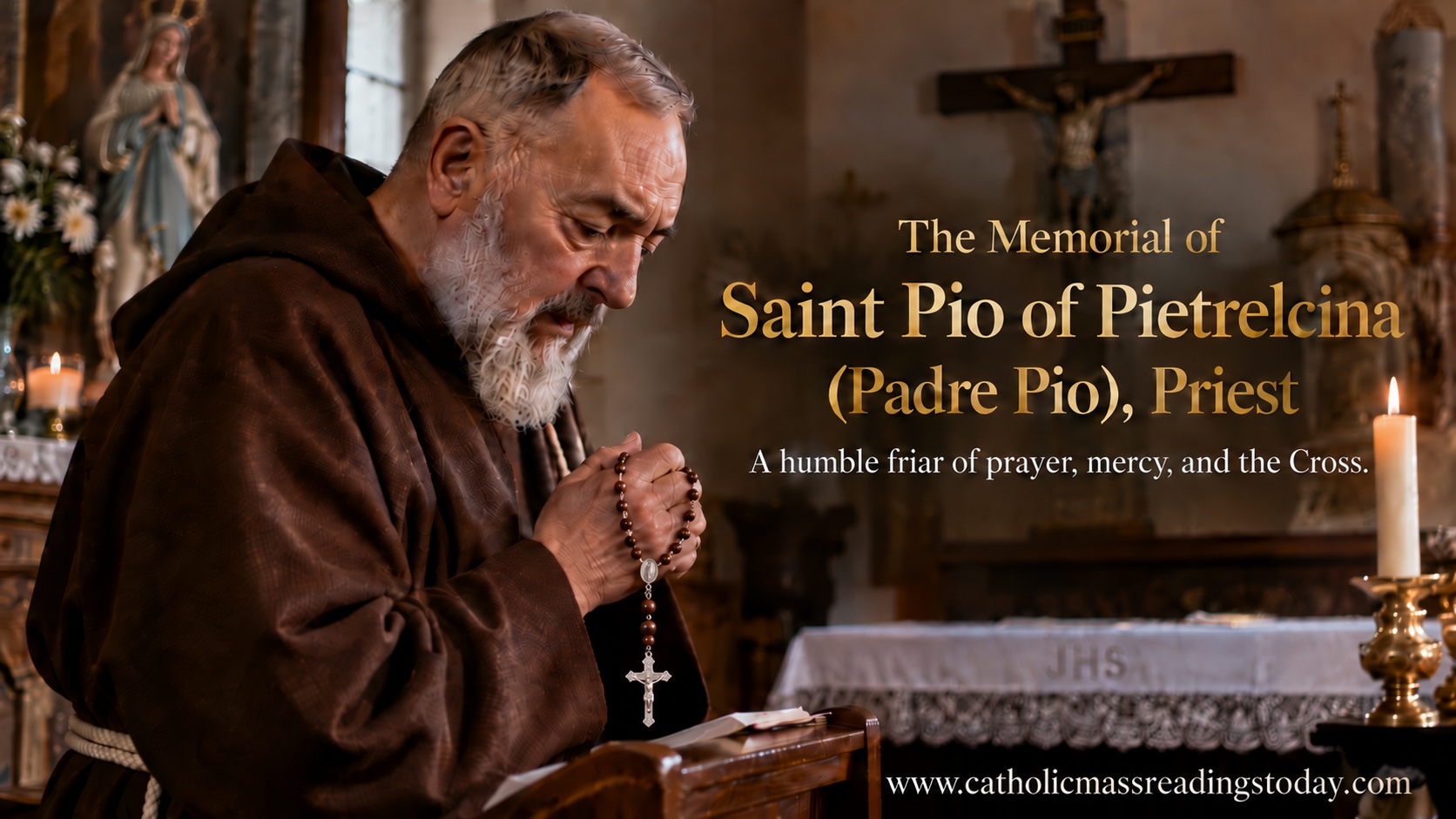
Every year on September 23, the Catholic Church celebrates the Memorial of Saint Pio of Pietrelcina, better known throughout the world as Padre Pio. His is one of the most remarkable Catholic stories of the modern era: a poor Italian boy who became a Capuchin friar, a priest devoted to the Eucharist and Confession, a spiritual father to countless people, a man marked for decades by the stigmata, and the founder of a hospital created to relieve human suffering.
To millions of Catholics, however, Padre Pio is remembered not primarily because of extraordinary phenomena surrounding his life, but because he was a priest who prayed, heard Confessions, celebrated Mass with profound devotion, accepted suffering with remarkable patience, and spent himself for souls.
The Church celebrates his memorial on September 23, the date of his death in 1968. Vatican sources remember him as a Capuchin priest whose life was centred on the Passion and Cross of Christ, prayer, sacramental ministry and service to those who suffered.
His story begins far from fame, in a small village in southern Italy.
The Birth and Childhood of Francesco Forgione
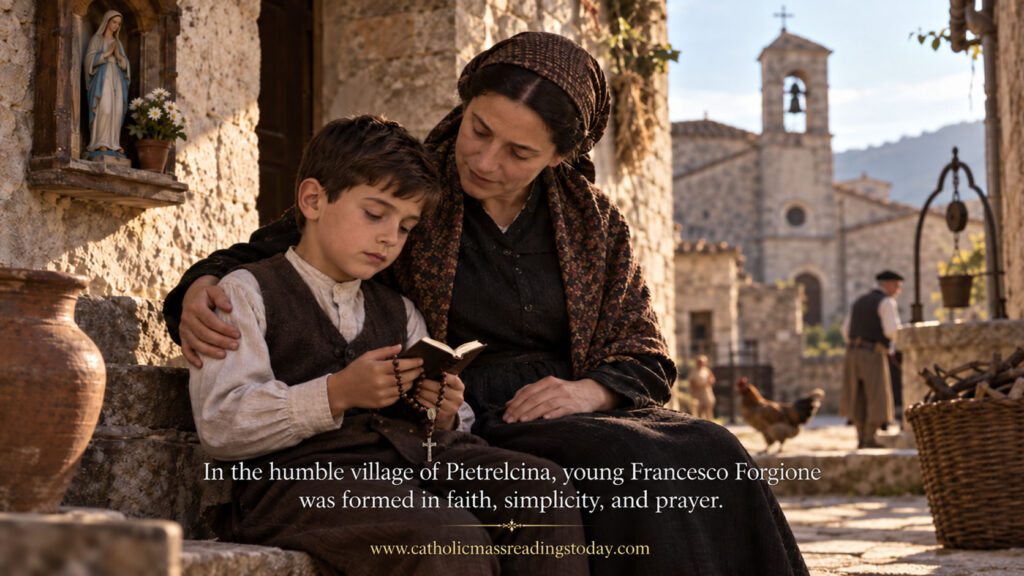
Padre Pio was born Francesco Forgione on May 25, 1887, in Pietrelcina, a village in the province of Benevento, Italy. His parents were Grazio Forgione and Maria Giuseppa De Nunzio, members of a modest farming family. He was baptized the following day and given the name Francesco. At the age of twelve, he received both Confirmation and his First Holy Communion.
The poverty of his family was real, but so was its faith.
The young Francesco grew up in an environment where Catholic devotion was woven into ordinary family life. From an early age, he developed a desire to give himself completely to God. That calling gradually became clearer until he expressed his wish to join the Capuchins, the Franciscan order known for simplicity, poverty, prayer and fraternity.
His family supported his vocation, even though helping him pursue the necessary education demanded sacrifice. Accounts from the Padre Pio Prayer Groups note that his father even emigrated for work so that Francesco could receive the schooling required for religious formation.
The child from Pietrelcina was preparing for a life that neither he nor his family could yet fully imagine.
Entering the Capuchin Order and Becoming Brother Pio
On January 6, 1903, at the age of sixteen, Francesco entered the novitiate of the Capuchin Friars at Morcone. Later that month, on January 22, he received the Franciscan habit and the religious name by which history would know him: Fra Pio, or Brother Pio. He made simple vows after his novitiate and solemn profession in January 1907.
The religious life he embraced was demanding. The Capuchin vocation called for poverty, chastity, obedience, prayer, penance, fraternity and service.
These were not temporary spiritual interests for Padre Pio. They became the structure of his entire life.
His health, however, was fragile from youth. Illness repeatedly interrupted his formation and later his priestly assignments. Yet those physical limitations did not weaken his desire for the priesthood.
On August 10, 1910, he was ordained a priest in Benevento. Because of continuing health problems, he spent significant periods near his family before being assigned permanently to San Giovanni Rotondo.
From then on, he would increasingly be known simply as Padre Pio.
A Priest Formed by the Eucharist and the Cross
For Padre Pio, the priesthood was never merely a position within the Church. It was a complete offering of himself to Christ.
His spirituality became profoundly centred on the Eucharist and the Cross.
The Vatican biography of Padre Pio describes the celebration of Holy Mass as the summit of his apostolic activity. Those who came to San Giovanni Rotondo frequently remembered the intense recollection with which he celebrated.
He understood the priesthood through the mystery of Christ offering Himself for the salvation of the world.
This helps explain why suffering played such an important role in Padre Pio’s spiritual life. He did not seek suffering as something good in itself. Rather, he understood suffering through Christ crucified. When pain could not be avoided, he tried to unite it to the sacrifice of Jesus.
Saint John Paul II later described Padre Pio’s life as inseparable from the spirituality of the Cross, saying that his trials, accepted in love, became a path toward holiness.
That spirituality would become dramatically visible in 1918.
Padre Pio and the Stigmata
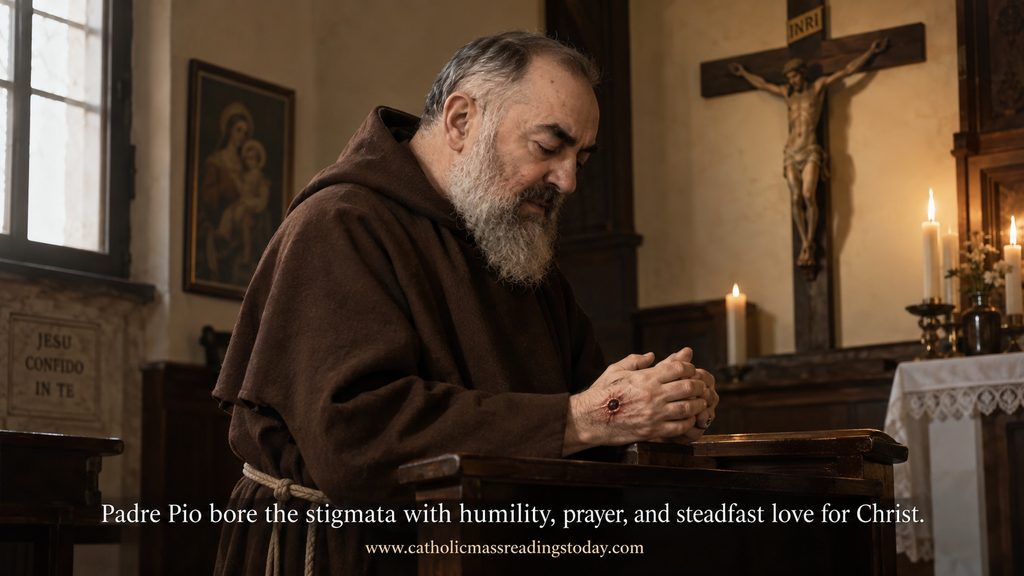
On September 20, 1918, while Padre Pio was praying in the choir of the friary church at San Giovanni Rotondo, he received the visible wounds traditionally known as the stigmata, wounds associated with the wounds of Christ’s crucifixion.
Vatican sources state that the stigmata remained for decades and became one of the most widely discussed features of his life. Saint John Paul II later referred directly to Padre Pio’s body as marked by the stigmata and interpreted them in relation to his profound spiritual union with the Passion of Christ.
The phenomenon attracted physicians, Church authorities, pilgrims, journalists and sceptics. Padre Pio himself did not appear to seek the publicity that followed. The wounds brought him attention he often found burdensome and became a source of intense physical and spiritual suffering.
For Catholics, the importance of the stigmata should not be separated from the rest of his life.
Padre Pio’s holiness does not rest merely on the existence of extraordinary wounds.
The Church ultimately recognized the heroic character of his virtues: his faith, obedience, charity, prayer, perseverance, sacramental ministry and service to the suffering. The Vatican’s official biography stresses precisely these qualities when recounting his cause for canonization.
The stigmata became one visible sign associated with his life, but his sanctity was lived daily in prayer, obedience, sacrifice and service.
The Long Hours in the Confessional
If there is one place, apart from the altar, where Padre Pio’s priesthood became most visible, it was the confessional.
People travelled enormous distances to confess their sins to him.
The Vatican describes sacramental reconciliation as one of the central features of his apostolate. Countless men and women sought his spiritual direction, counsel and absolution, sometimes waiting for long periods for the opportunity to confess.
Padre Pio could be demanding.
He did not treat sin casually, because he understood Confession not as a polite religious formality but as an encounter with the mercy of Christ that required honesty, repentance and conversion.
Yet behind that seriousness was a profound confidence in Divine Mercy.
Saint John Paul II later called Padre Pio a generous dispenser of God’s mercy and emphasized that the ministry of the confessional was one of the distinctive characteristics of his apostolate.
For Catholics today, this aspect of Padre Pio’s life remains especially important.
He reminds us that holiness is not built upon pretending we have no sins.
It is built upon allowing Christ to forgive them.
The confessional is therefore not a place of humiliation but of return.
Padre Pio spent extraordinary amounts of time helping people make that return.
Prayer at the Centre of Everything
Padre Pio often described himself in strikingly simple terms.
He wanted to be remembered as a poor friar who prayed.
Prayer was not one devotion among many in his life. It was the foundation beneath everything else.
The Vatican biography notes that he spent much of both day and night in prayer. He believed that prayer opened the heart to God and sustained his entire ministry.
This emphasis on prayer later took institutional form through the Padre Pio Prayer Groups, communities of believers committed to prayer and Christian life.
Saint John Paul II highlighted these groups during Padre Pio’s canonization, presenting prayer together with charity as the most concrete synthesis of Padre Pio’s teaching.
That pairing matters.
Padre Pio did not understand prayer as an escape from the suffering of the world.
Prayer led him toward suffering people.
The House for the Relief of Suffering
One of the greatest visible fruits of Padre Pio’s life was the establishment of the Casa Sollievo della Sofferenza, meaning the House for the Relief of Suffering.
Padre Pio wanted the sick to receive not only competent medical treatment but also care rooted in human dignity and compassion.
The hospital was officially inaugurated in San Giovanni Rotondo on May 5, 1956. Vatican records identify it as one of the major works through which Padre Pio expressed his concern for families, the sick and those in pain.
The institution did not disappear with him.
It continues to operate, combining healthcare and scientific research with the founding vision of compassionate care. The Holy See continues to exercise particular responsibility for the foundation associated with Padre Pio’s work. In 2026, Pope Leo XIV established a steering and supervisory commission for the foundation, specifically describing its mission as hospitality, assistance and care for the sick, pilgrims and their families.
This is one of the most important parts of Padre Pio’s legacy.
His spirituality was intensely mystical, but never merely private.
The man who spent hours before God also built something concrete for people in pain.
His life joined contemplation and charity.
Prayer rose toward heaven, while mercy moved outward toward the suffering.
Trials, Investigations and Restrictions
Padre Pio’s life was not a steady ascent from admiration to sainthood.
He endured serious investigations and restrictions.
Because of the extraordinary claims surrounding him, including the stigmata and reports of unusual spiritual phenomena, Church authorities investigated his life and ministry over a long period. At various times restrictions were placed upon his public ministry.
An official Vatican biography notes that he underwent investigations and restrictions affecting his priestly service, and emphasizes that he accepted these measures with humility and obedience.
Historical Vatican material records that restrictive measures began in the 1920s and at one stage included limitations on his public ministry. Later measures also affected how and with whom he could celebrate Mass. Some of these restrictions were eventually removed.
These periods were painful.
But they became an important part of the Church’s later understanding of Padre Pio.
His holiness was not expressed by defiance.
It was expressed by obedience.
Saint John Paul II drew attention to this during Padre Pio’s beatification, presenting obedience during misunderstanding and trial as part of his purification and conformity to Christ.
This is worth remembering whenever Padre Pio is reduced to stories of miracles or extraordinary phenomena.
One of the strongest witnesses of his life was far quieter:
he remained obedient to the Church even when obedience was painful.
Padre Pio and the People Who Came to Him
As his reputation spread, San Giovanni Rotondo became a destination for enormous numbers of pilgrims.
They came for different reasons.
- Some wanted Confession.
- Some wanted spiritual advice.
- Some were ill.
- Some were grieving.
- Some had lost their faith.
- Some came because they had heard remarkable stories about him.
Padre Pio could not solve every human problem placed before him. But the Vatican biography describes how, for more than fifty years, he received people seeking his ministry, counsel and consolation, particularly giving himself to the poor, sick and suffering.
Among the priests who met him was a young Polish cleric named Karol Wojtyła, who later became Pope Saint John Paul II. Vatican News records that Wojtyła went to Confession to Padre Pio in 1948. Decades later, as Pope, John Paul II would beatify and canonize him.
That connection has become one of the most memorable links between two major Catholic figures of the twentieth century.
The Final Years of Padre Pio
As Padre Pio grew older, his physical strength declined significantly.
By the later 1960s, he required increasing assistance. His health had never been particularly strong, and Vatican records note that it deteriorated rapidly during the final years of his life.
Yet as far as he was able, he continued to pray, celebrate Mass and exercise priestly ministry.
On September 22, 1968, Padre Pio celebrated what would be his final Mass. Accounts from organizations devoted to preserving his history describe him as already extremely weak. After the Mass, he required assistance and later gave what became his final public blessing.
Only hours remained.
The Death of Padre Pio
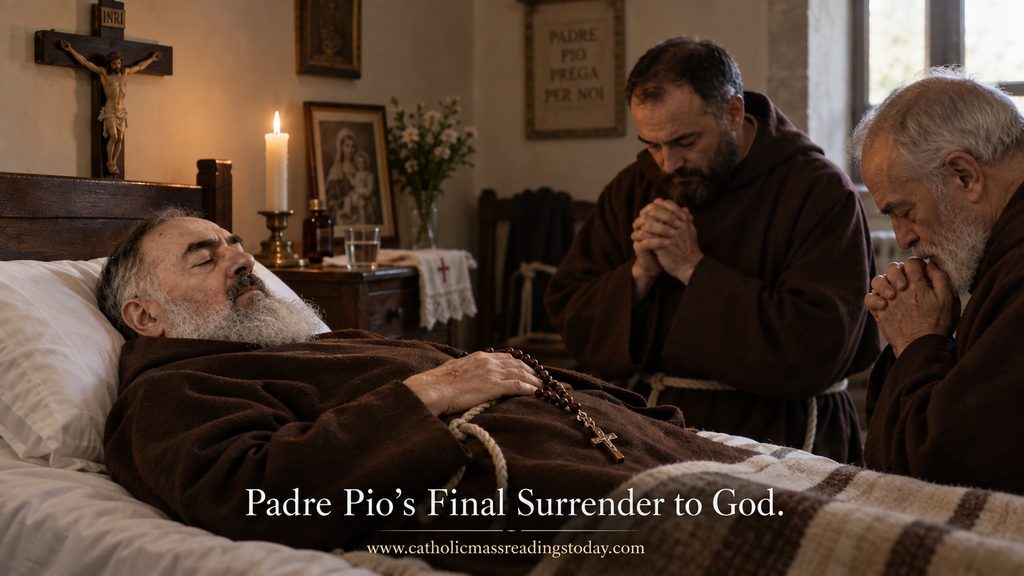
Padre Pio died in the early hours of September 23, 1968, in the friary at San Giovanni Rotondo.
He was eighty-one years old.
The Vatican’s official biography describes his death as peaceful after a period of declining health and records that an extraordinary number of people attended his funeral.
Other historical accounts preserved by institutions connected with his legacy describe him as having received the last sacraments, renewed his religious vows and died with the names of Jesus and Mary on his lips.
The visible wounds associated with the stigmata had also faded by the time of his death.
His earthly life ended quietly in the friary where he had spent more than fifty years.
But the movement of people toward San Giovanni Rotondo did not stop.
It increased.
From Padre Pio to Saint Pio of Pietrelcina
After his death, devotion to Padre Pio continued to spread internationally.
The Church’s formal investigation into his life proceeded through the canonical process required for beatification and canonization.
The Holy See granted the necessary authorization for the cause in 1982. After years of investigation, the Church formally recognized the heroic nature of his virtues. A healing attributed to his intercession was examined as part of the beatification process.
Pope John Paul II beatified Padre Pio on May 2, 1999.
Three years later, on June 16, 2002, John Paul II canonized him as Saint Pio of Pietrelcina.
At the canonization, the Pope emphasized several themes that defined Padre Pio’s life: the Cross, Divine Mercy, Confession, prayer, charity and service to the suffering.
The canonization did not mean that Catholics were being asked to imitate every extraordinary experience associated with Padre Pio.
Rather, the Church held him up as a model of faithful discipleship.
Why the Church Celebrates the Memorial of Saint Pio of Pietrelcina
The Memorial of Saint Pio of Pietrelcina, Padre Pio, Priest is important because his life brings together several essential dimensions of Catholic spirituality.
He points us first toward the Eucharist.
Holy Mass stood at the centre of his priestly life.
He points us toward Confession, where sinners encounter not condemnation but the mercy of Christ.
He points us toward prayer, reminding us that Christian activity without a deep relationship with God eventually becomes empty.
He points us toward suffering, not by romanticizing pain but by teaching that suffering entrusted to Christ does not have to become meaningless.
He points us toward charity, demonstrated concretely in the House for the Relief of Suffering.
And he points us toward obedience, particularly through the painful periods when he accepted restrictions imposed upon him.
For these reasons, Padre Pio remains much more than a Catholic personality associated with miraculous stories.
His life is a school of discipleship.
Padre Pio and the Sacrament of Reconciliation
One of the clearest lessons Catholics can take from Padre Pio today is a renewed appreciation for Confession.
Modern culture often encourages us either to excuse our failures or to become imprisoned by them.
The Gospel offers another way.
It calls sin what it is, but then offers mercy.
Padre Pio understood this deeply.
He could be firm with penitents because he believed conversion mattered. But he spent such extraordinary amounts of time in the confessional precisely because he believed that God’s mercy was greater than human sin.
A fitting way to observe his memorial, therefore, is to examine our own conscience honestly.
What have we excused for too long?
Where have we resisted grace?
Where have pride, resentment, dishonesty, impurity, selfishness or indifference entered our lives?
Padre Pio’s answer would not be despair.
It would be:
Return to Christ.
What Padre Pio Teaches Us About Prayer
Another lesson is perseverance in prayer.
Many people pray intensely only when life becomes difficult.
Padre Pio teaches something deeper.
Prayer is not merely what Christians do when everything else fails.
Prayer is where Christian life begins.
His life challenges us to ask whether prayer has become central or merely occasional.
- Do we make time for silence before God?
- Do we pray the Rosary?
- Do we spend time with Scripture?
- Do we speak honestly with Christ?
- Do we make room for Eucharistic Adoration when possible?
- Do we pray only for ourselves, or do we carry others before God?
The Memorial of Padre Pio can become an invitation to recover a serious interior life.
What Padre Pio Teaches Us About Suffering
Padre Pio also speaks powerfully to anyone carrying suffering that cannot simply be removed.
- Illness.
- Grief.
- Loneliness.
- Family difficulties.
- Disappointment.
- Physical pain.
- Spiritual darkness.
Padre Pio’s life does not tell us that suffering is easy.
It tells us that suffering is not necessarily empty.
When united to Christ, even what we would never have chosen can become a place where faith deepens, compassion grows and love becomes more sacrificial.
Saint John Paul II said during Padre Pio’s canonization that difficulties and sorrows accepted in love can become a privileged path toward holiness.
That does not mean Christians should seek unnecessary suffering or refuse medical help.
Padre Pio himself founded a hospital.
Christianity does not glorify illness.
It glorifies Christ, who enters human suffering and refuses to abandon us there.
Prayer and Charity Must Remain Together
The House for the Relief of Suffering perhaps expresses Padre Pio’s spirituality better than almost anything else.
He prayed intensely.
And then he acted.
This matters for Catholics today.
It is possible to speak beautifully about faith while ignoring the suffering person in front of us.
Padre Pio’s life will not allow that separation.
The person praying before the Crucifix must eventually notice the person carrying a cross.
The person receiving Christ in the Eucharist must eventually recognize Christ in the sick, lonely, poor and forgotten.
Saint John Paul II summarized Padre Pio’s teaching in two words:
prayer and charity.
That remains an excellent summary of the Christian life.
What Is Expected of Catholics on the Memorial of Padre Pio?
The Church does not ask Catholics simply to admire Padre Pio.
The deeper invitation is to imitate the virtues that made him holy.
His memorial should move us toward a more serious relationship with Christ.
- Perhaps that means making a good Confession.
- Perhaps it means returning to daily prayer.
- Perhaps it means attending Mass with greater attention.
- Perhaps it means praying the Rosary slowly instead of mechanically.
- Perhaps it means visiting someone who is sick.
- Perhaps it means offering practical help to someone carrying a heavy burden.
- Perhaps it means forgiving someone.
- Perhaps it means accepting some unavoidable suffering without allowing bitterness to consume us.
And perhaps it means trusting God when we do not understand what He is doing.
Padre Pio’s life repeatedly returned to that trust.
How Catholics Can Celebrate the Memorial of Saint Pio of Pietrelcina
A beautiful observance of September 23 can begin with Holy Mass.
If possible, Catholics can also receive the Sacrament of Reconciliation in honour of a saint whose priesthood was so deeply connected with bringing sinners back to God’s mercy.
The Rosary is also especially fitting, given Padre Pio’s deep Marian devotion.
Prayer for the sick has particular significance on this memorial, as does any act of charity toward someone who is suffering.
Families might read part of Padre Pio’s life together, speak about why the Church canonizes saints, and pray for the grace to persevere faithfully in difficult circumstances.
The most authentic celebration, however, is not external.
It is conversion.
If September 23 leaves us praying more sincerely, confessing more honestly, trusting Christ more deeply and loving suffering people more generously, then we have understood Padre Pio.
Padre Pio’s Continuing Importance to the Church
More than half a century after his death, Padre Pio remains one of the most widely loved Catholic saints of the modern period.
The ongoing work of the hospital he founded, the continuation of his Prayer Groups, the crowds of pilgrims drawn to San Giovanni Rotondo, and devotion to him across many nations all testify to the enduring influence of his life.
But the Church’s deepest reason for remembering him is not popularity.
It is holiness.
Padre Pio points beyond himself.
- He points to Christ crucified and risen.
- He points to the Eucharist.
- He points to mercy in the confessional.
- He points to Mary.
- He points to the sick.
- He points to the value of prayer.
And he points toward heaven.
That is why the Memorial of Saint Pio of Pietrelcina remains so important.
It is not simply the anniversary of the death of a famous friar.
It is an invitation to rediscover what an ordinary human life can become when it is surrendered completely to God.
A Saint for People Who Are Struggling
Perhaps one reason Padre Pio remains so beloved is that his life does not look effortless.
- He knew illness.
- He knew misunderstanding.
- He knew scrutiny.
- He knew limitations.
- He knew suffering.
- He knew what it was to obey when obedience hurt.
Yet through all of this, he continued praying.
That makes Padre Pio a powerful companion for Catholics who feel tired, discouraged or spiritually dry.
Holiness does not mean never struggling.
Sometimes holiness means continuing to say yes to God while struggling.
Padre Pio’s life shows us that grace can work through frailty.
“I Only Want to Be a Poor Friar Who Prays”
For all the extraordinary stories connected with Padre Pio, perhaps the simplest description of his life remains the best. He wanted to be a poor friar who prayed.
The Vatican biography records this desire directly.
That simplicity protects us from misunderstanding him.
Padre Pio did not live for fame, he did not build his identity around the stigmata. He did not ask Catholics to become fascinated with extraordinary phenomene but pointed people toward Jesus.
That remains the safest and most faithful way to honour him.
If devotion to Padre Pio makes us love Jesus more, receive the Eucharist more reverently, seek Confession more sincerely, pray more faithfully and serve the suffering more generously, then that devotion is bearing good fruit.
The Memorial of Saint Pio of Pietrelcina Today
As the Church celebrates the Memorial of Saint Pio of Pietrelcina, Padre Pio, Priest, his life asks us a simple but demanding question:
What place does Christ truly occupy in our lives?
Padre Pio was not canonized because he lived an easy life.
He was canonized because through suffering, misunderstanding, priestly ministry, prayer and service, he remained oriented toward God.
His story began in the poverty of Pietrelcina.
It continued through the Capuchin friary, the altar, the confessional, the wounds of suffering, the crowds of pilgrims and the halls of the hospital he founded.
It ended quietly in San Giovanni Rotondo in the early hours of September 23, 1968.
But his witness did not end there.
Today, Catholics across the world still invoke Saint Pio of Pietrelcina because his life continues to remind us that holiness is possible.
It begins not with extraordinary phenomena, but with something far more demanding:
- Prayer.
- Repentance.
- Obedience.
- Charity.
- Perseverance.
And a heart that keeps returning to Jesus Christ.
Prayer to Saint Pio of Pietrelcina
Saint Pio of Pietrelcina,
faithful priest of Jesus Christ,
you gave your life to prayer, the Holy Eucharist, Confession and the service of those who suffered.
Pray for us.
Teach us to seek God before everything else.
Help us to approach the Sacrament of Reconciliation with honest and repentant hearts.
Obtain for us a deeper love for Jesus in the Holy Eucharist and a faithful devotion to the Blessed Virgin Mary.
When suffering enters our lives, help us not to lose hope.
When prayer becomes difficult, teach us to persevere.
When we are misunderstood, teach us humility.
When others suffer around us, open our eyes so that our faith may become charity.
Pray for the sick, the lonely, the grieving, the discouraged and all those who carry heavy crosses.
May we learn from your example to trust in God’s mercy, remain faithful to the Church, and offer our lives each day to Christ.
Saint Pio of Pietrelcina,
pray for us.
Amen.