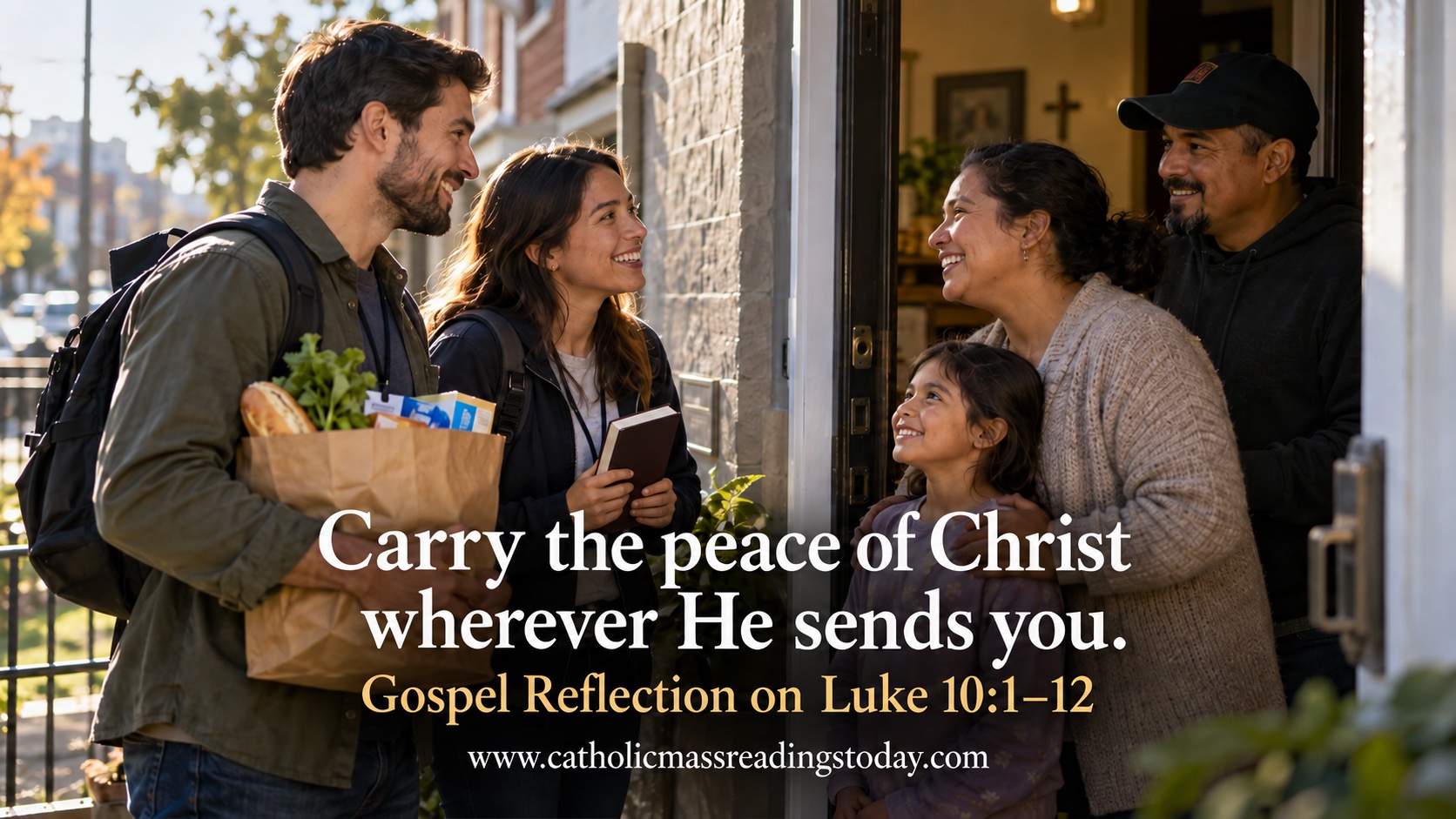
“Your Peace Will Rest Upon Him”
There is something beautiful in the way Jesus sends His disciples out in today’s Gospel. He does not send them alone. He sends them two by two. Before they preach, before they heal, and before they enter the towns, Jesus gives them a mission built on companionship, trust, simplicity, and peace.
The first thing He tells them is this: “The harvest is plentiful, but the labourers are few.”
There is so much work to be done. So many people are searching for hope, so many are carrying wounds, so many are longing for truth, and so many may not even realize that what they are really searching for is God. Yet Jesus does not first tell the disciples to become anxious about the size of the task. He tells them to pray: “Pray therefore the Lord of the harvest to send out labourers into His harvest.”
That is important because the mission belongs to God before it belongs to us. The harvest is His. The people are His. The work is His. We enter it only because He sends us.
Sometimes we look at the needs around us and feel overwhelmed. We see broken families, loneliness, violence, confusion, people drifting away from faith, and suffering that seems greater than anything we can solve. But Jesus does not ask one disciple to do everything. He asks each disciple to go where he is sent and to be faithful where he is.
Sent as Lambs in the Midst of Wolves
Jesus then says something that sounds almost frightening: “I send you out as lambs in the midst of wolves.”
He does not pretend that the mission will always be easy. There will be rejection. There will be misunderstanding. There will be hostility. There will be moments when people do not welcome the message.
And still, Jesus says: go.
Not because the disciples are stronger than the wolves, but because they belong to Him.
Their strength will not come from money, possessions, status, or worldly security. That is why Jesus tells them, “Carry no purse, no bag, no sandals.” He is teaching them to depend upon God.
This does not mean that Christians should be careless or irresponsible. It means that discipleship cannot be built upon the illusion that we control everything. Sometimes God asks us to move forward before we feel completely prepared. Sometimes He asks us to trust before we know how every detail will work out.
Faith often begins where control ends.
The Disciple of Christ Carries Peace
Then Jesus gives them something to carry into every home.
Not money.
Not power.
Not prestige.
Peace.
He says, “Whatever house you enter, first say, ‘Peace be to this house.’”
That should make us stop and think. The disciple of Christ is meant to carry peace. Not division. Not bitterness. Not unnecessary conflict. Not the need to win every argument.
Wherever a Christian goes, something of the peace of Christ should go with him.
- Into our homes.
- Into our workplaces.
- Into our friendships.
- Into our conversations.
- Into the way we respond when someone hurts us.
- Into the way we speak when emotions are high.
The question becomes very personal: what do people receive when we enter the room?
Do they receive peace or tension? Do they encounter patience or anger? Do they experience charity or judgment?
Jesus tells His disciples to offer peace even before they know whether it will be accepted. That teaches us something important. We are responsible for what we bring. We are not responsible for controlling how everyone responds.
If the peace is not received, Jesus says it returns to them. The disciple does not have to force it. The disciple does not have to become bitter because someone refuses the message.
There are moments when we must speak the truth, offer what is good, and then leave the result with God.
The mission continues.
Faith Must Be Spoken and Lived
Jesus also tells the disciples, “Whenever you enter a town and they receive you, heal the sick in it and say to them, ‘The Kingdom of God has come near to you.’”
Notice how the message and the action belong together.
They proclaim the Kingdom, and they care for the suffering.
Faith is spoken, and faith is lived.
The Gospel is not meant to remain only in words. The love of God should become visible in compassion, service, healing, generosity, forgiveness, and in the way we treat the person standing in front of us.
This is one of the great challenges of Christian life. It is possible to speak beautifully about faith while failing to live it. It is possible to know the right words while lacking charity. Jesus sends His disciples to do both: proclaim the Kingdom and make its presence visible through works of mercy.
The world does not only need to hear that God is near.
It needs to encounter people whose lives make that nearness believable.
“The Kingdom of God Has Come Near to You”
The message the disciples proclaim is extraordinary: “The Kingdom of God has come near to you.”
Not far away.
Not unreachable.
Not reserved only for some distant future.
Near.
In Jesus Christ, God has drawn near to His people.
That is the good news the disciples carry, and it is still the message entrusted to the Church today.
The Kingdom of God has come near.
Christ still sends His disciples.
The harvest is still plentiful.
The world still needs people who will carry His peace, speak His truth, serve those who suffer, and live in such a way that others can recognize that God is near.
We may not be among the seventy walking dusty roads from village to village, but we are still sent.
We are sent into our families, our workplaces, our neighbourhoods, our friendships, and all the ordinary places where God has placed us.
The Mission Begins in Ordinary Places
It is easy to think of missionary work as something done only by priests, religious, or people sent to distant countries. But today’s Gospel gives us a wider vision.
Every baptized Christian is called to witness to Christ.
The mission may begin with something very simple.
- A peaceful word when anger would have been easier.
- A patient response when someone tests our patience.
- A sincere act of kindness.
- A willingness to speak about Christ when the right moment comes.
- A prayer offered for someone who is suffering.
- A refusal to return hatred with hatred.
An act of forgiveness.
A life that quietly says, “The Kingdom of God has come near.”
These things may seem small, but the Kingdom often grows through what appears small.
A person who brings peace into a difficult home is doing missionary work.
A person who refuses gossip at work is doing missionary work.
A parent teaching a child to pray is doing missionary work.
A Catholic who visits someone who is lonely or sick is doing missionary work.
A Christian who remains gentle in the middle of hostility is showing the world something of Christ.
We Are Sent, but the Mission Is God’s
This Gospel also protects us from a common temptation: believing that everything depends upon us.
It does not.
Jesus sends the disciples, but the harvest belongs to God.
That means we should work faithfully without imagining that we must control every outcome.
- We cannot force another person to believe.
- We cannot heal every wound.
- We cannot solve every problem.
- We cannot make every person accept the Gospel.
- What we can do is be faithful.
- We can pray.
- We can speak truth with love.
- We can serve.
- We can carry peace.
- We can witness.
And then we leave the rest to God.
That brings great freedom.
The disciple is responsible for obedience, not results.
What Are We Bringing Into the World?
Today’s Gospel invites us to examine not only what we believe, but what we carry into the lives of others.
- Do we bring peace?
- Do we bring hope?
- Do we bring patience?
- Do we bring truth?
- Do we bring mercy?
Or do we bring anxiety, bitterness, criticism, anger, and division?
Jesus sends His disciples as people who carry His presence.
That means the mission begins not only in what we say, but in who we are becoming.
A peaceful disciple can carry the Gospel before speaking a single word.
A bitter disciple can contradict the Gospel even while using religious language.
This is why prayer comes first.
Before Jesus speaks about the road, the towns, the houses, or the healing, He speaks about prayer.
“Pray therefore the Lord of the harvest.”
Mission begins in prayer because mission belongs to God.
The Harvest Is Still Plentiful
The words Jesus spoke then remain true now.
The harvest is plentiful.
There are people searching for God who do not yet know how to name that longing.
There are Catholics who have drifted away and are waiting for a reason to return.
There are people carrying wounds that no one can see.
There are families in need of peace.
There are young people looking for meaning.
There are elderly people struggling with loneliness.
There are people in workplaces, schools, hospitals, neighbourhoods, and homes who need to encounter the love of Christ.
The harvest is still plentiful.
The question is whether we are willing to become labourers.
We do not need to be perfect.
The seventy were not perfect.
We need to be willing.
Willing to pray.
Willing to go.
Willing to carry peace.
Willing to trust.
Willing to live the Gospel where God has placed us.
Let Us Pray
Lord Jesus Christ,
You sent Your disciples into the world to carry Your peace, proclaim Your Kingdom, and serve those in need.
Make us faithful labourers in Your harvest.
Give us the courage to go wherever You send us, and the humility to remember that the mission belongs to You.
When we feel inadequate, teach us to depend upon Your grace. When we encounter rejection, keep bitterness from our hearts.
When we enter the lives of others, may we bring peace rather than division, hope rather than discouragement, and charity rather than judgment.
Help us to recognize the places where You are calling us to serve.
May our words proclaim Your truth, and may our actions make Your love visible.
Let our homes, our workplaces, our friendships, and our daily lives become places where others can discover that Your Kingdom has come near.
And may Your peace rest upon all those we meet.
Through Christ our Lord.
Amen.