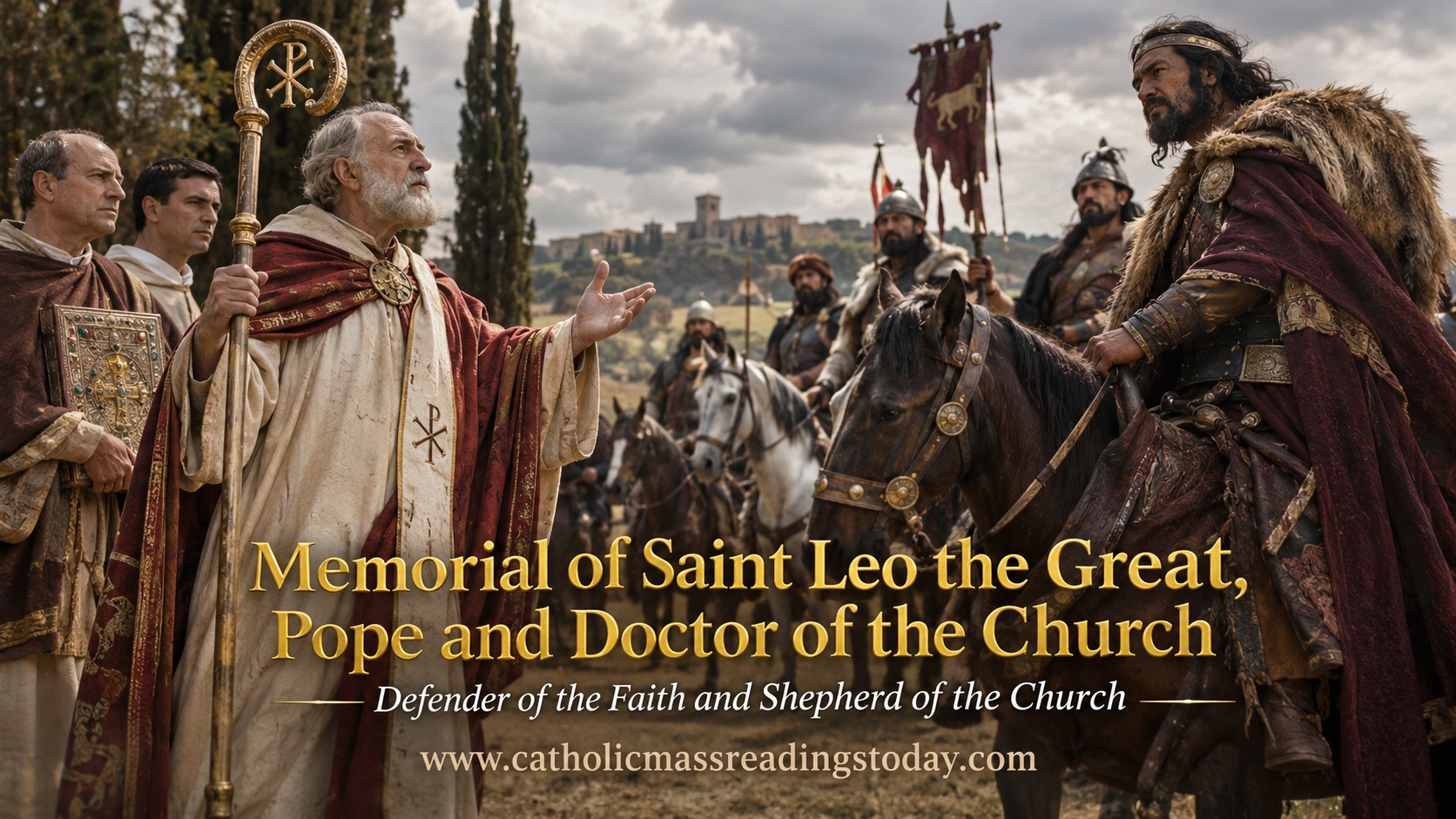
Every year on the 10th of November, the Catholic Church celebrates the Memorial of Saint Leo the Great, Pope and Doctor of the Church, remembering a remarkable shepherd whose courage, wisdom, and unwavering defence of the Christian faith helped guide the Church through one of the most troubled periods of her history.
Saint Leo the Great, also known as Pope Saint Leo I, served as Bishop of Rome from 440 until his death in 461. His pontificate unfolded at a time when the Western Roman Empire was weakening, invading armies threatened entire cities, and serious theological disputes challenged the unity of Christians.
Yet Saint Leo did not allow the difficulties of his age to weaken his confidence in Christ or his commitment to the Church. He became a defender of Catholic teaching, a courageous advocate for peace, a compassionate pastor of the suffering, and one of the most influential voices in the development of early Christian theology.
His greatness was not simply that he occupied the Chair of Saint Peter during a dangerous period. It was that he understood the responsibilities of his office and devoted his life to fulfilling them.
More than fifteen centuries after his death, the teachings of Saint Leo the Great continue to help Catholics understand the mystery of Jesus Christ, the dignity of Christian life, and the importance of remaining faithful to the Church.
The Birth and Early Life of Saint Leo the Great
Saint Leo the Great was born towards the end of the fourth century, probably around AD 390, during the closing decades of the Roman Empire’s dominance over the Mediterranean world.
The exact date and place of his birth are not known with certainty. Early Church records identify him as a native of Tuscany, in central Italy, and name his father as Quintianus.
Although the surviving historical records reveal very little about his childhood, Leo appears to have spent much of his early life in Rome, a city that would eventually become the centre of his priestly service and papal ministry.
The world into which he was born was undergoing profound changes.
Christianity, which had once suffered persecution under Roman emperors, had become increasingly influential throughout the Empire. Churches were being built, Christian communities were growing, and bishops were taking on greater responsibilities in both religious and public life.
At the same time, the Empire faced political instability, economic difficulties, and increasing pressure along its borders.
For Christians, this was also a period of intense theological discussion. The Church was continuing to clarify and defend the faith handed down by the Apostles, especially her teaching about the Holy Trinity and the divine and human nature of Jesus Christ.
It was within this changing world that Leo’s vocation took shape.
His later writings reveal a man deeply familiar with Sacred Scripture, the teachings of earlier Church Fathers, and the theological controversies of his time.
Although we cannot reconstruct every stage of his education, his intellectual formation and spiritual maturity eventually made him one of the most respected churchmen in Rome.
Saint Leo’s Early Service to the Church
Before becoming Pope, Saint Leo served as a deacon in the Church of Rome, holding an important position during the pontificates of Pope Celestine I and Pope Sixtus III.
In the early Church, deacons assisted bishops in pastoral administration, charitable responsibilities, and the practical work of serving the Christian community.
Leo’s responsibilities, however, extended beyond ordinary administrative duties.
He became known for his sound judgement, theological knowledge, and ability to handle difficult matters requiring both firmness and understanding.
His reputation reached well beyond Rome. Among the respected Christian writers associated with him was Saint John Cassian, who composed a work defending the doctrine of the Incarnation against the teachings associated with Nestorius. Cassian undertook this work at Leo’s request around AD 430 or 431.
This was an important indication of Leo’s growing influence. Even before his election as Pope, he was helping to defend the Church’s understanding of Jesus Christ as the divine Son of God who truly became man.
Leo also developed a reputation for diplomacy.
In 440, he was sent to Gaul, in present day France, to help resolve a serious political disagreement involving the Roman military commander Aetius and the official Albinus.
His selection for this sensitive mission demonstrated the confidence placed in him by both Church and imperial authorities.
What Leo did not know when he departed Rome was that this journey would lead him towards an entirely new responsibility.
The Election of Saint Leo the Great as Pope in AD 440
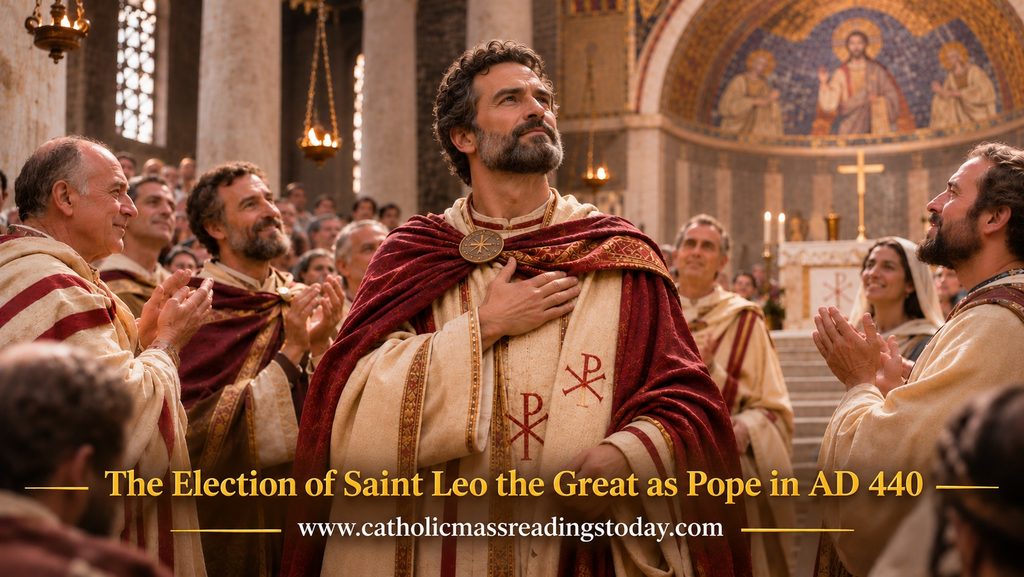
While Leo was carrying out his diplomatic mission in Gaul, Pope Sixtus III died on 19 August 440.
The Church of Rome needed a new Bishop, and Leo was chosen to succeed him.
He returned to Rome and was consecrated Pope on 29 September 440, becoming the first Pope to bear the name Leo.
His election came at a particularly difficult moment in history.
The Western Roman Empire was experiencing a gradual decline in political authority. Military threats were increasing, and many communities lived with uncertainty about their future.
The Church also faced internal difficulties, including disputes over Christian doctrine, questions of ecclesiastical authority, and the challenge of maintaining unity among Christian communities spread across different regions and cultures.
Saint Leo understood that the Pope’s responsibilities extended beyond the administration of the Church in Rome.
As Successor of Saint Peter, he believed he had a duty to strengthen the faith of Christians, support the bishops, protect the unity of the Church, and ensure that the teachings received from the Apostles remained faithfully preserved.
His pontificate would continue for more than twenty one years, becoming one of the most significant periods in the history of the early papacy.
A Pope Who Defended the True Identity of Jesus Christ
Among the greatest achievements of Saint Leo the Great was his defence of the Catholic Church’s teaching concerning the Person of Jesus Christ.
During the fifth century, Christians were engaged in serious theological disputes about how the divine and human natures of Christ should be understood.
The Church had always proclaimed that Jesus Christ is the Son of God who became man for our salvation.
However, different interpretations threatened to distort this central mystery of the Christian faith.
Some teachings placed such emphasis on the distinction between Christ’s divinity and humanity that they endangered the unity of His Person. Others, particularly the teaching associated with Eutyches, failed to preserve the full reality of Christ’s human nature after the Incarnation. These were not merely arguments about complicated theological language. They concerned the very foundation of Christian salvation.
If Jesus Christ were not truly God, He could not reveal the Father to humanity in the fullness of divine truth. If He were not truly man, He could not fully share our human condition, suffer, die, and redeem humanity through His sacrifice. Saint Leo recognised the seriousness of these questions.
He believed that the Church must preserve the complete truth about Jesus Christ, without diminishing either His divinity or His humanity.
For Leo, defending this doctrine meant protecting the faith upon which the Christian hope of salvation rests.
The Tome of Leo and the Council of Chalcedon
One of the most important documents written by Saint Leo the Great was his famous letter to Saint Flavian, Archbishop of Constantinople, commonly known as the Tome of Leo.
Written in 449, the letter explained with extraordinary clarity the Catholic teaching that Jesus Christ is one divine Person possessing two complete and distinct natures: divine and human.
Jesus is truly God and truly man.
His divinity was not diminished when He became human, nor was His humanity an illusion or something merely temporary.
In the mystery of the Incarnation, the eternal Son of God assumed our human nature while remaining fully divine.
Saint Leo’s teaching became especially influential at the Council of Chalcedon in 451, the fourth Ecumenical Council of the Church.
The bishops gathered to address the theological controversies surrounding the Person of Christ and to establish a clear statement of the apostolic faith.
Leo did not personally attend the Council, but his representatives participated, and his doctrinal letter played a major role in its deliberations.
When the Tome was read, the assembled bishops famously expressed their agreement by declaring:
“Peter has spoken through Leo.”
The Council of Chalcedon affirmed that Jesus Christ is one and the same Son, truly God and truly man, acknowledged in two natures without confusion, change, division, or separation.
This teaching remains fundamental to Catholic doctrine.
Whenever Catholics profess in the Creed that the Son of God came down from heaven and became man, they are affirming the same mystery of faith that Saint Leo so carefully defended.
His contribution was therefore far more than an achievement of theological scholarship.
It helped preserve the Church’s understanding of the Redeemer Himself.
Saint Leo the Great and the Authority of the Pope
Saint Leo also made a lasting contribution to the Catholic understanding of the papacy.
He taught that the Bishop of Rome exercises a special responsibility within the Church because of the ministry entrusted by Jesus Christ to Saint Peter.
In the Gospel according to Matthew, Jesus tells Peter:
“You are Peter, and on this rock I will build my Church.” (Matthew 16:18)
For Saint Leo, the authority associated with Saint Peter was not simply a matter of honour or political influence.
It carried the obligation to safeguard the apostolic faith, strengthen the unity of Christians, and provide pastoral guidance when serious difficulties arose.
Leo corresponded with bishops in different regions, addressed disputes concerning Church discipline, and intervened when he believed the unity or integrity of the faith was threatened.
He also sought to maintain proper relationships among the important episcopal sees of the ancient Church.
At the Council of Chalcedon, he supported the Council’s doctrinal definition concerning Christ while objecting to a disciplinary canon that proposed expanding the privileges of Constantinople.
His objection reflected his concern for the established order of the Church and his understanding of Rome’s particular apostolic responsibility.
Through his teaching and actions, Saint Leo helped shape the later development of Catholic doctrine concerning the role of the Roman Pontiff.
His understanding of pastoral authority was closely connected with responsibility.
The Pope was called not merely to govern, but to preserve the truth, protect the faithful, and serve the unity of Christ’s Church.
The Courageous Meeting Between Saint Leo and Attila the Hun
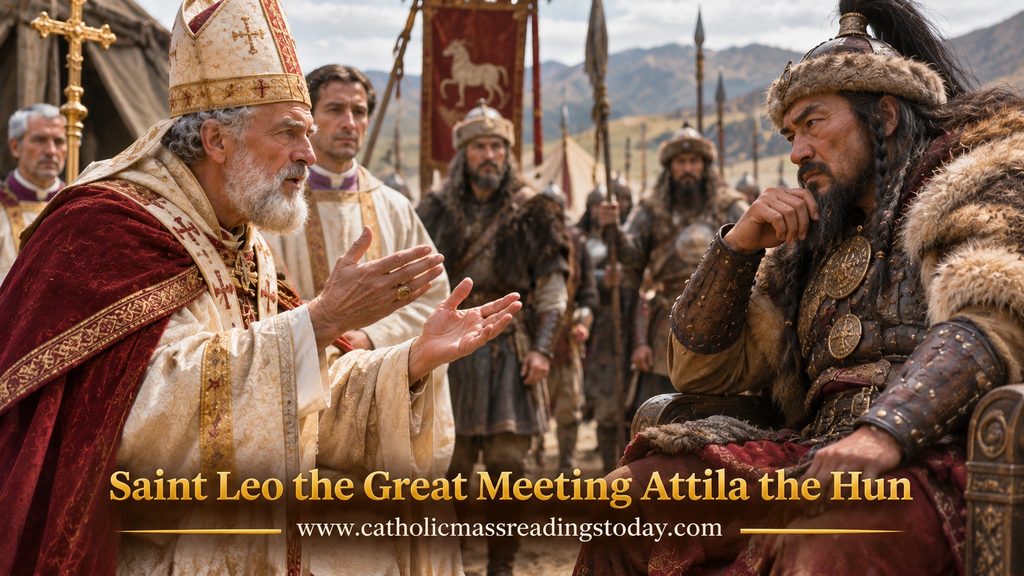
One of the best-known events in the life of Saint Leo the Great occurred in 452, when Attila the Hun led his forces into northern Italy.
The Huns had already devastated several cities, including Aquileia, and their advance caused widespread fear.
As the invading army threatened further destruction, the Roman authorities faced a grave crisis.
Saint Leo took part in a delegation sent to meet Attila near the River Mincio, in the region of Mantua.
It was an extraordinary encounter.
The Bishop of Rome, whose authority was spiritual rather than military, stood before one of the most feared commanders of his age.
Leo had no army with which to defeat the Huns. His mission depended upon negotiation, moral authority, and the possibility of reaching a peaceful agreement.
The discussions were successful in helping secure Attila’s withdrawal from Italy.
Although historians continue to examine the different political, military, and practical reasons behind Attila’s decision, Saint Leo’s participation in the negotiations became one of the most celebrated acts of diplomacy in Church history.
Later Christian tradition added a dramatic account to the event.
According to this tradition, Attila saw a vision of Saints Peter and Paul threatening him with divine punishment if he continued his advance against Rome.
This story became popular in Christian art and devotional accounts, although it belongs to later tradition rather than established contemporary historical evidence.
What remains historically significant is that Saint Leo was willing to face a powerful invading ruler in the hope of preventing further bloodshed.
His courage reflected a conviction that the Church must not remain indifferent when human lives are threatened.
For him, defending the dignity and safety of people was a responsibility deeply connected with the Gospel.
Saint Leo and the Vandal Sack of Rome in AD 455
Three years after his meeting with Attila, Saint Leo faced another serious crisis.
In 455, the Vandals, led by King Genseric, advanced towards Rome.
The political situation had become extremely unstable, and the city was poorly prepared to resist the invading forces. Once again, Saint Leo intervened. He went out to meet Genseric and appealed for the city and its inhabitants to be spared.
Unlike the earlier encounter with Attila, this intervention did not prevent the invasion.
The Vandals entered Rome and plundered the city for approximately two weeks.
Nevertheless, Leo’s negotiations have traditionally been credited with helping to limit the destruction and protect important churches where frightened inhabitants had sought refuge.
The episode reveals another important aspect of his character.
Saint Leo’s courage was not dependent upon the certainty of success. Even when he could not prevent suffering entirely, he did what he could to reduce it. After the invasion, the needs of the Christian community remained immense.
Families had lost possessions, livelihoods had been disrupted, and many people faced insecurity and hardship.
Saint Leo continued exercising his pastoral responsibilities, encouraging charity, strengthening the faithful, and helping the Church respond to the suffering surrounding her.
His leadership showed that Christian faith must be expressed not only through the defence of doctrine, but also through compassion towards those who suffer.
A Shepherd Who Cared for the Poor and the Suffering
Although Saint Leo the Great is often remembered for his theological writings and diplomatic achievements, his pastoral concern for ordinary Christians was equally important.
Fifth century Rome experienced periods of famine, poverty, social unrest, and the displacement of people fleeing violence.
Leo understood that the Church had a responsibility to care for those whose lives had been damaged by such difficulties.
In his preaching, he repeatedly encouraged charity, generosity, fasting, and concern for the poor.
He taught that the Christian life could not be separated from the needs of one’s neighbour.
Prayer and fasting were important spiritual practices, but they were meant to draw believers closer to God and make them more generous towards others.
A person who fasted while remaining indifferent to the hungry had failed to understand the deeper purpose of Christian sacrifice.
Likewise, those who possessed material resources were called to recognise them as gifts entrusted by God and to use them responsibly.
Saint Leo reminded the faithful that charity is not simply an occasional act of kindness. It is an essential expression of a living Christian faith.
His pastoral teaching remains meaningful today, when many families continue to experience poverty, displacement, illness, and uncertainty.
The Church honours Saint Leo not only because he defended the truth about Jesus Christ, but also because he sought to make Christ’s love visible in the lives of those who needed help.
The Sermons and Writings of Saint Leo the Great
Saint Leo was also one of the most accomplished preachers of the early Church.
Nearly one hundred of his sermons have survived, together with a substantial collection of letters addressing theological, pastoral, and administrative matters.
These writings provide an extraordinary picture of the faith and life of Christians in fifth-century Rome. His sermons were closely connected with the liturgical celebrations of the Church.
He preached about Christmas, Easter, the Passion of Christ, Pentecost, fasting, charity, and the responsibilities of Christian living.
His language combined theological depth with a desire to help ordinary believers understand what their faith meant.
Saint Leo did not regard the great mysteries of Christianity as distant events that belonged only to the past.
He taught that what Christ accomplished through His Incarnation, death, and Resurrection continues to transform the lives of believers through grace.
For him, celebrating Christmas meant recognising the astonishing dignity given to humanity through the coming of the Son of God.
Celebrating Easter meant living in the new life made possible by Christ’s victory over sin and death.
Receiving the sacraments meant allowing God’s grace to shape one’s character, decisions, and relationships.
One of the most enduring themes in his preaching concerns the dignity of the baptised Christian.
Saint Leo urged believers to remember the greatness of the gift they had received through Christ and to live in a manner worthy of that calling.
His message was simple but demanding: Christians must never forget who they have become through the grace of God.
To belong to Christ is both a privilege and a responsibility.
Saint Leo the Great and the Dignity of Christian Life
An important feature of Saint Leo’s teaching was his conviction that Christian holiness must be visible in everyday life.
He understood that the truth of the Gospel should influence the way people treat their families, conduct their work, use their possessions, and respond to those in need.
A Christian should not profess faith in Christ while deliberately living in a way that contradicts His commandments.
For Saint Leo, the Incarnation gives humanity a profound reason to live with dignity.
The eternal Son of God entered human history and assumed our nature, showing how deeply God loves the people He created.
Through Baptism, Christians are united with Christ and called to live as members of His Body.
This calling requires repentance, humility, charity, and a sincere effort to turn away from sin.
Saint Leo frequently connected Christian identity with the responsibility to reject conduct that dishonours God.
He encouraged believers to recognise that their lives had been transformed by grace and that they should therefore strive to reflect Christ in their actions.
His words speak powerfully to our own generation.
In a world where people can easily measure their worth through wealth, recognition, influence, or social standing, Saint Leo reminds us that the deepest dignity of the human person comes from God.
Our worth is not determined by what we possess or what others think of us, but by the love of God who created us and redeemed us through Jesus Christ.
The Final Years and Death of Saint Leo the Great
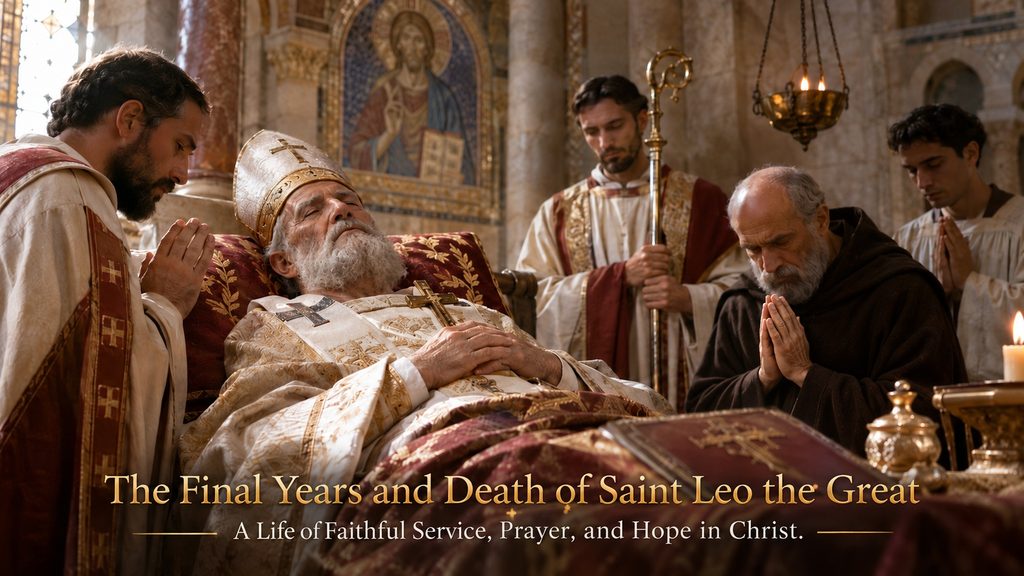
As Saint Leo grew older, the difficulties facing the Church and the Western Roman Empire continued.
Political authority remained unstable, economic hardship affected many communities, and theological disagreements required careful attention.
Despite these challenges, Leo continued his ministry as Bishop of Rome.
His letters reveal his concern for the discipline and unity of the Church, while his sermons demonstrate his continuing desire to strengthen the faith of ordinary Christians.
He remained committed to the conviction that the Church’s future depended upon faithfulness to the truth received from Christ and the Apostles.
After more than twenty-one years as Pope, Saint Leo the Great died in Rome on 10 November 461.
The exact circumstances surrounding his final illness and death are not well documented.
He was originally buried near the tomb of Saint Peter in the old Vatican Basilica.
In 688, during the pontificate of Pope Saint Sergius I, his remains were transferred to a more prominent place within the basilica.
His relics are now venerated in Saint Peter’s Basilica in Vatican City.
His death marked the end of an extraordinary pontificate, but the influence of his teaching continued to shape the Catholic Church long after his earthly life had ended.
Why Saint Leo Was Declared a Doctor of the Church
The Catholic Church honours certain saints with the title Doctor of the Church because of the exceptional importance of their teaching and their contribution to the understanding of the Christian faith.
Saint Leo the Great received this title formally from Pope Benedict XIV in 1754.
The recognition reflected the lasting significance of his theological writings, especially his defence of the mystery of the Incarnation.
His explanation of Jesus Christ as true God and true man remains one of the most important contributions to early Catholic theology. Yet his significance extends beyond the Council of Chalcedon.
His sermons helped generations of Christians understand the meaning of the liturgy, the dignity of Baptism, the importance of charity, and the relationship between Christian faith and daily life.
His letters also remain valuable historical witnesses to the development of Church governance and the responsibilities of the papacy.
Saint Leo demonstrated that theological knowledge should never become separated from pastoral care. He defended the faith with intellectual clarity while seeking to guide believers towards holiness.
This combination of doctrinal strength and pastoral wisdom helps explain why the Church continues to recognise him as one of her great teachers.
The History of the Memorial of Saint Leo the Great
Devotion to Saint Leo the Great developed through the centuries as Christians continued to recognise the importance of his pontificate and teaching.
His burial near Saint Peter’s tomb reflected the honour in which he was held by the Church of Rome.
As his sermons and letters were preserved, copied, and studied, his influence spread well beyond the city where he had served as Pope.
He came to be remembered as one of the great Fathers of the Western Church and one of the most significant early defenders of the Catholic understanding of Christ.
In 1754, his formal recognition as a Doctor of the Church further strengthened his place in Catholic tradition.
His feast was formerly celebrated on 11 April in the Roman calendar.
Following the twentieth-century reform of the Roman liturgical calendar, his memorial was assigned to 10 November, the anniversary of his death.
Today, the Catholic Church celebrates the Memorial of Saint Leo the Great, Pope and Doctor of the Church, on this date each year.
His memory has also been honoured by later Popes.
In 1961, marking the fifteen-hundredth anniversary of Saint Leo’s death, Pope Saint John XXIII issued the encyclical Aeterna Dei Sapientia, reflecting upon his life, teaching, and commitment to Christian unity.
On 5 March 2008, Pope Benedict XVI devoted a general audience to Saint Leo, recalling his defence of the faith, his pastoral concern for the suffering, and his contribution to the strengthening of the Church.
Such commemorations demonstrate that Saint Leo’s importance has not faded with the passing of centuries.
His life continues to offer guidance whenever the Church faces challenges concerning doctrine, unity, leadership, or the demands of Christian charity.
Why Saint Leo the Great Remains Important to the Catholic Church Today
Saint Leo the Great lived more than fifteen centuries ago, yet the challenges he confronted remain remarkably familiar.
The Church still faces misunderstandings about Christian doctrine, tensions that threaten unity, and the responsibility to proclaim the Gospel in a changing world.
Societies continue to experience war, political instability, poverty, and division.
Christians still struggle to remain faithful when their beliefs are challenged or when living according to the Gospel requires sacrifice.
Saint Leo’s example offers important guidance in each of these circumstances.
His defence of Christ’s divine and human natures reminds us that the truth about Jesus is the foundation of our salvation.
His commitment to the unity of the Church teaches that faithfulness to the Gospel requires both truth and charity.
His encounters with Attila and Genseric demonstrate the courage needed to seek peace and protect human life, even when circumstances appear overwhelming.
His concern for the poor reminds us that a Church faithful to Christ cannot overlook those who suffer.
And his preaching about Baptism encourages every Christian to recognise the dignity and responsibilities that come from belonging to Jesus Christ.
Saint Leo also teaches us something important about leadership.
True leadership is not simply the exercise of authority. It involves the willingness to carry responsibility, defend what is right, and serve others even when doing so is difficult.
His life reminds priests, religious, parents, teachers, and all those entrusted with leadership that authority must always be accompanied by humility, wisdom, and concern for the good of others.
What Catholics Can Learn from the Life of Saint Leo the Great
The life of Saint Leo the Great invites us to consider the kind of Christians we are becoming.
We may never be called to negotiate with an invading army or participate in a great theological council, but every day presents opportunities to practise the same virtues that shaped his life.
We are called to remain faithful to the truth even when it is unpopular, to seek peace rather than encourage division, and to defend the dignity of those whose voices are easily ignored.
We are also called to understand our faith more deeply.
Saint Leo spent his life explaining and defending the mystery of Jesus Christ because he recognised that knowing Christ is essential to loving and following Him faithfully.
Our Catholic faith should therefore be more than a tradition we inherit or a set of religious practices we perform.
It must become a living relationship with the Lord, nourished by Sacred Scripture, prayer, the Holy Eucharist, and the other sacraments.
Through his writings, Saint Leo also reminds us that holiness begins with remembering who we are.
We are children of God, called to live in the freedom and dignity made possible through Christ.
When we allow pride, selfishness, dishonesty, or resentment to govern our actions, we forget that calling.
But when we choose forgiveness, humility, generosity, and faithfulness, we begin to reflect the grace we have received.
The lasting message of Saint Leo the Great is that a strong faith must be rooted in the truth about Jesus Christ and expressed through a life of genuine love for God and neighbour.
The Enduring Legacy of Saint Leo the Great
The greatness of Saint Leo cannot be measured by a single event.
His meeting with Attila remains one of the most memorable stories of early papal history, but his legacy reaches much further.
He helped preserve the Church’s understanding of the Incarnation, strengthened the responsibilities of the papal office, encouraged Christian unity, and reminded the faithful that the Gospel must shape their daily lives.
He also showed that courage and compassion belong together.
The same Pope who firmly defended Catholic doctrine was willing to face invading rulers, comfort frightened communities, and encourage generosity towards the poor.
His life demonstrates that fidelity to Christ is not limited to words spoken from a pulpit or doctrines preserved in books.
It must also be seen in the courage to defend the vulnerable, the patience to seek reconciliation, and the generosity to serve those in need.
As the Church celebrates the Memorial of Saint Leo the Great, Pope and Doctor of the Church, we remember a shepherd who remained faithful during a time of extraordinary uncertainty.
He did not possess the power to remove every difficulty facing the Church or the world around him.
What he possessed was a deep confidence in Jesus Christ and a determination to fulfil the responsibility entrusted to him.
That is why his witness remains so meaningful today.
Saint Leo the Great reminds us that the Church’s true strength does not come from worldly influence or political power, but from her faithfulness to Jesus Christ, who remains her Lord and Saviour through every generation.
May his example inspire us to stand firm in the faith, remain united in charity, defend the dignity of every person, and live each day in a manner worthy of our Christian calling.
Let Us Pray
O God, who never allow the gates of hell to prevail against Your Church, firmly founded on the rock of the Apostles,
You raised up Saint Leo the Great to defend the truth of the Gospel and strengthen the unity of Your people.
Through his intercession, grant us courage to remain steadfast in the Catholic faith, wisdom to recognise Your holy will, and charity to serve our brothers and sisters with sincere love.
May we always profess Jesus Christ as true God and true man, remain faithful to the teachings of Your Church, and live according to the dignity of our Baptism.
Through our Lord Jesus Christ, Your Son, who lives and reigns with You in the unity of the Holy Spirit, God, for ever and ever.
Amen.
Saint Leo the Great, Pope and Doctor of the Church, pray for us.