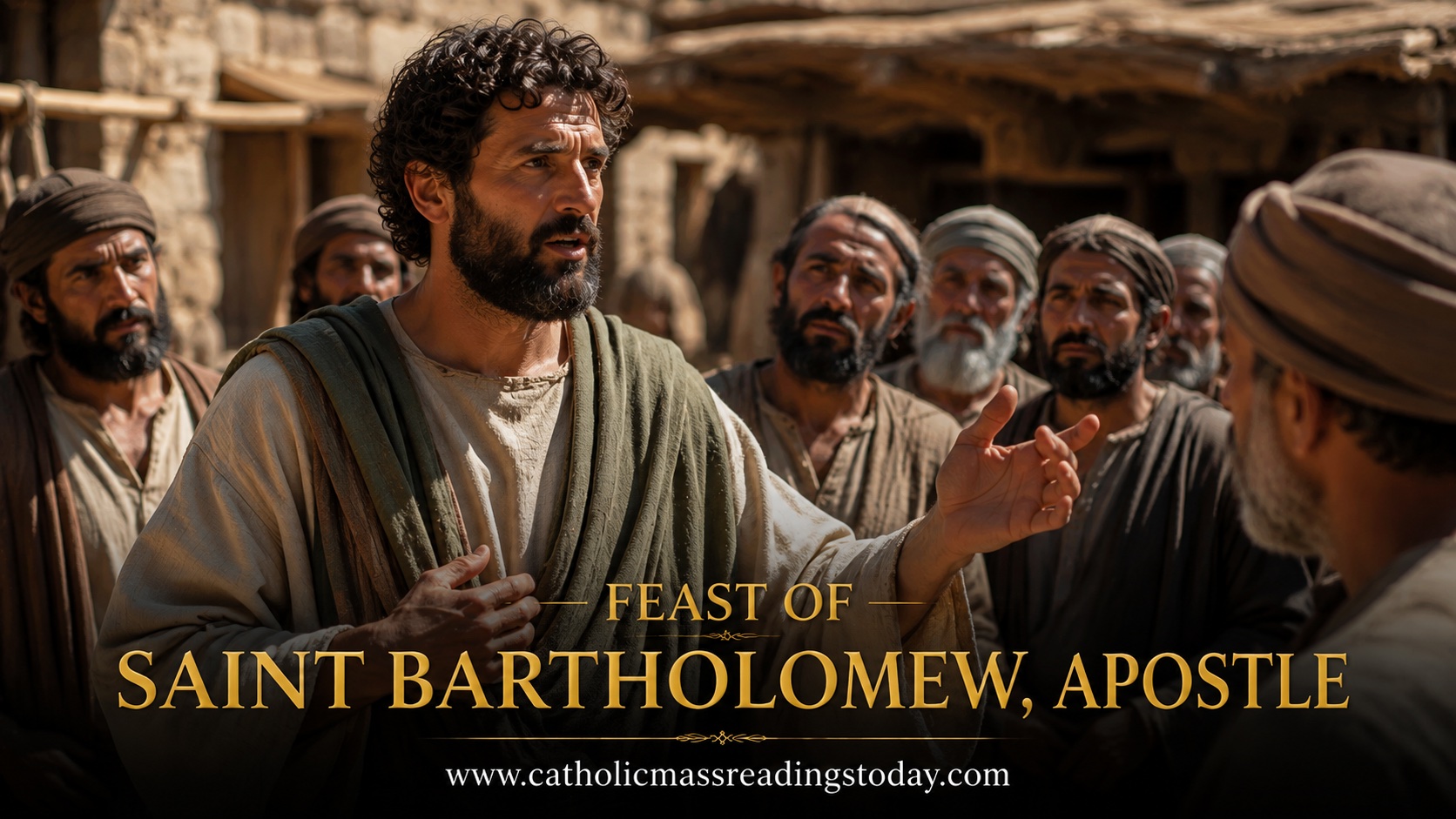
Feast Day: August 24
Each year on August 24, the Catholic Church celebrates the Feast of Saint Bartholomew, Apostle, honoring one of the Twelve chosen by Jesus Christ to accompany Him, hear His teaching, witness His works, and carry the Gospel into the world.
Saint Bartholomew is one of those Apostles about whom the New Testament tells us relatively little. Yet the few glimpses Scripture gives us, joined to the ancient traditions of the Church, reveal a remarkable man: sincere in heart, initially skeptical, courageous enough to investigate the truth for himself, and ultimately willing to surrender everything including his life for Jesus Christ.
His story begins quietly. There is no dramatic account of his childhood or youth preserved for us. We do not know the exact year of his birth, the names of his parents, or many details of his life before meeting Christ. What we do know is that Bartholomew belonged to the generation that would stand at the very foundation of the Church.
And behind the name Bartholomew stands one of the most memorable encounters in Saint John’s Gospel: the calling of Nathanael, the man whom Jesus described with the extraordinary words, “Behold, an Israelite indeed, in whom is no guile!”
Who Was Saint Bartholomew?
Bartholomew appears in the lists of the Twelve Apostles in the Gospels of Matthew, Mark and Luke, and again among the Apostles in the Acts of the Apostles.
The name Bartholomew is generally understood as coming from the Aramaic Bar-Tolmai, meaning “son of Tolmai” or “son of Talmai.” For this reason, Bartholomew may have functioned more like a patronymic than a personal name.
An ancient Christian tradition identifies Bartholomew with Nathanael, whom we meet in John 1:45–51. This identification has long been accepted in the Latin Catholic tradition, although Scripture itself does not explicitly state, “Nathanael is Bartholomew.” The connection is strengthened by the fact that Nathanael appears closely associated with Philip in John’s Gospel, while Bartholomew is paired with Philip in the Synoptic lists of the Apostles.
If this traditional identification is correct, the Gospel of John gives us a beautiful window into Bartholomew’s first meeting with Christ.
Philip Finds Nathanael
The story begins with Philip. After encountering Jesus, Philip went searching for Nathanael with the excitement of someone who had discovered what generations of Israel had been awaiting. “We have found him of whom Moses in the law and also the prophets wrote,” Philip told him, identifying Him as Jesus of Nazareth. Nathanael’s response was hardly enthusiastic.
“Can anything good come out of Nazareth?”
It is an unexpectedly candid sentence from the mouth of a future Apostle.
Nathanael did not immediately believe. He questioned. Perhaps Nazareth seemed too insignificant to be associated with Israel’s long awaited Messiah. Whatever lay behind his skepticism, Philip did not respond with a lengthy argument. He simply said:
“Come and see.”
Those three words changed Nathanael’s life. They also capture something essential about Christian evangelization. Faith cannot be reduced to winning arguments. Ultimately, Christianity is an encounter with a Person. Philip brought his friend to Jesus and allowed Christ Himself to do the rest.
“Behold, an Israelite Indeed”
As Nathanael approached, Jesus said: “Behold, an Israelite indeed, in whom is no guile!”
Nathanael must have been startled. “How do you know me?” he asked.
Then came Christ’s mysterious answer: “Before Philip called you, when you were under the fig tree, I saw you.”
Scripture does not tell us what Nathanael had been doing beneath that tree. Perhaps he had been praying. Perhaps something deeply personal had happened there. Attempts to reconstruct the moment remain speculation.
What matters is Nathanael’s reaction. Something in Jesus’ words reached a place in his heart that no stranger should have known.
His skepticism gave way to faith: “Rabbi, you are the Son of God! You are the King of Israel!”
The man who moments earlier had wondered whether anything good could come from Nazareth was now standing before Jesus and confessing Him as the Son of God. This is one reason the story of Saint Bartholomew remains so powerful. Christ was not frightened by Nathanael’s questions. He saw beneath them.
Jesus saw the man himself and He loved what He found there: sincerity, openness and a heart capable of recognizing truth when truth stood before him.
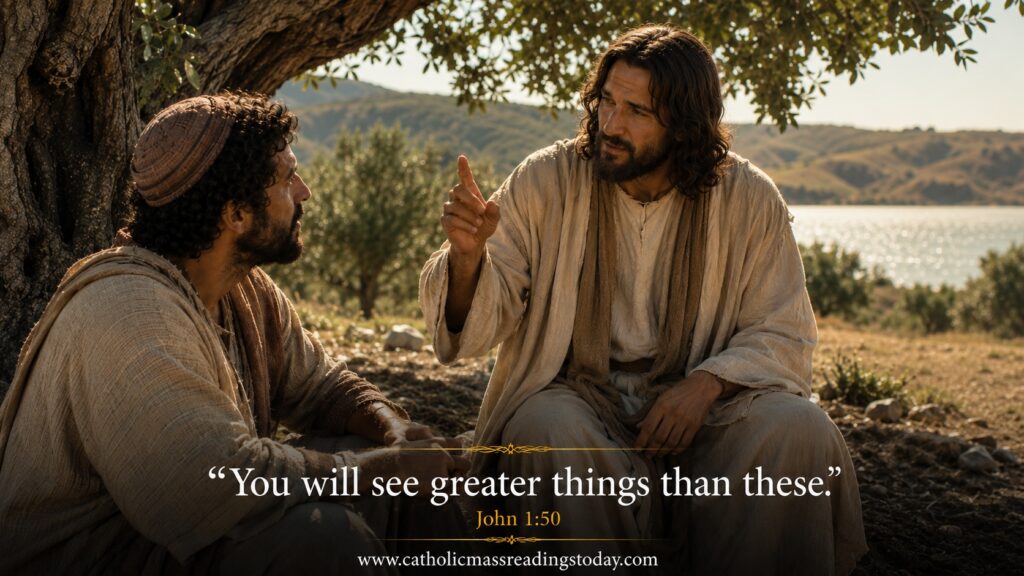
“You Will See Greater Things Than These”
Jesus did not allow Nathanael’s journey to end with that first confession.
He promised him something greater: “You shall see greater things than these.”
Then Christ spoke of heaven being opened and the angels of God ascending and descending upon the Son of Man. Nathanael had only begun to discover who Jesus truly was.
If Nathanael and Bartholomew are indeed the same Apostle, as Catholic tradition has long held, he would eventually witness far more than he could possibly have imagined beneath that fig tree.
He would hear Christ preach the Kingdom of God, he would witness miracles, he would experience the confusion and fear surrounding the Passion, he would come to know the astonishing truth of the Resurrection and his life would eventually be consumed by the mission of proclaiming the very Christ he had once approached with skepticism.
Bartholomew Among the Twelve Apostles
Jesus did not gather the Twelve merely as companions. He formed them for a mission. They lived close to Him, listened to His teaching and watched the manner in which He treated sinners, the sick, the poor and those pushed to the margins of society.
Their formation was not merely intellectual. Christ was preparing them to become witnesses.
The Apostles saw that God’s Kingdom did not resemble worldly kingdoms. Its greatness was revealed through humility. Authority became service. The sinner was called to conversion rather than abandoned. The poor were blessed. Enemies were to be loved. Forgiveness was to be offered again and again.
Bartholomew belonged to this intimate circle. Like the other Apostles, however, he had to pass through the terrible darkness of Christ’s Passion before fully understanding the mystery he had been called to proclaim.
From the Cross to the Resurrection
The Gospels do not individually describe Bartholomew’s actions during the Passion. We know, however, that the Twelve experienced the devastation of seeing Jesus arrested and crucified. Their expectations were shattered. Fear descended upon them.
Then came Easter. The risen Christ transformed frightened disciples into witnesses.
John’s Gospel later names Nathanael among the disciples gathered by the Sea of Tiberias when the risen Jesus appeared to them. There, once again, Christ revealed Himself to His disciples and shared a meal with them.
The man who had once been invited to “come and see” had now seen the impossible: Jesus Christ victorious over death.
Christianity would never again be merely an interesting possibility for him. It was now something for which he could live and eventually die.
Saint Bartholomew and Pentecost
After the Ascension of Christ, Acts 1:13 specifically names Bartholomew among the Apostles gathered together in Jerusalem. They remained united in prayer as they awaited the Holy Spirit promised by Jesus.
At Pentecost, the Church’s missionary life burst into the open. The Apostles who had once hidden in fear became courageous proclaimers of Christ. From Jerusalem, the Gospel began moving outward.
The Apostles carried with them no armies, political authority or great wealth. They carried the testimony of what they had seen and heard.
- Jesus Christ had died.
- Jesus Christ had risen.
And salvation was being offered to the nations through Him. Bartholomew would spend the rest of his life serving that proclamation.
Where Did Saint Bartholomew Preach?
Here we move from the firm ground of the New Testament into ancient Christian tradition, and it is important to distinguish between the two. The Bible does not give us a detailed itinerary of Bartholomew’s missionary travels after Pentecost.
Ancient traditions, however, associate him with missionary work in several regions, including parts of Asia Minor and areas farther east. One especially old tradition connects him with India. Eusebius of Caesarea, writing in the early fourth century, reported that when Pantaenus traveled to India, he found that the Gospel of Matthew had preceded him there and that Bartholomew had been associated with its proclamation.
Other traditions connect the Apostle with Mesopotamia, Persia and Armenia.
It is difficult to reconstruct a precise journey from traditions that developed in different Christian communities. What they consistently preserve, however, is the memory of Bartholomew as a missionary Apostle who carried the Gospel far beyond the land in which he had first encountered Jesus.
That alone tells us something important about him. The invitation “Come and see” became the mission “Go and proclaim.”
Saint Bartholomew in Armenia
The tradition linking Saint Bartholomew with Armenia became especially strong.
Armenian Christianity venerates Bartholomew, together with Saint Jude Thaddeus, among its apostolic founders. According to this tradition, Bartholomew preached Christ in Armenia and brought people to the Christian faith despite strong opposition.
This was dangerous work.
The Gospel challenged the religious and social structures of the ancient world. To proclaim that Jesus Christ is Lord was not merely to introduce another private devotion. Christianity demanded conversion of life and the abandonment of idolatry.
According to later accounts, Bartholomew’s preaching brought converts to Christ, including people connected with the ruling household. His success provoked hostility from those who regarded the growing Christian faith as a threat.
The Apostle who had once been invited by Philip to meet Jesus was now inviting entire peoples to encounter Him.
And eventually, that mission would cost him his life.
The Martyrdom of Saint Bartholomew
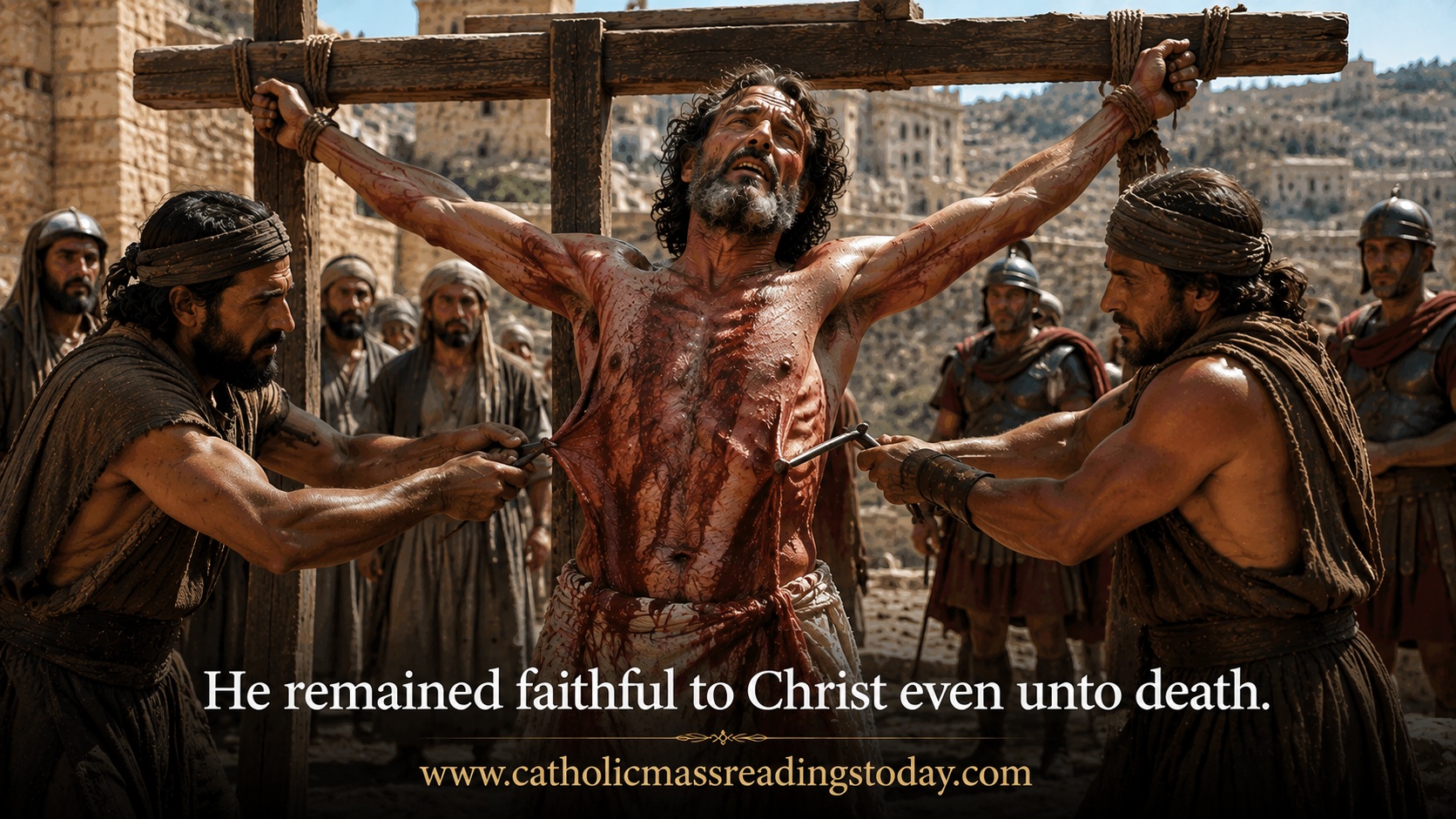
The precise historical circumstances of Saint Bartholomew’s death cannot be established with certainty. Ancient Christian tradition is clear, however, in remembering him as a martyr. The best known tradition places his martyrdom in Armenia, often associated with Albanopolis. Different early and later accounts preserve different descriptions of his execution.
The tradition that became most famous in Western Christianity holds that Bartholomew was flayed alive and then beheaded because of his preaching of the Gospel. It is a horrifying image, and Christian art did not shy away from it.
For this reason Saint Bartholomew is frequently depicted holding a knife, the instrument associated with his martyrdom. In some works he is represented holding his own flayed skin.
The most famous example appears in Michelangelo’s Last Judgment in the Sistine Chapel, where Saint Bartholomew holds his skin in his hand. Yet the Church does not remember him primarily because of the brutality inflicted upon him. She remembers him because he remained faithful.
Martyrdom is not a Christian fascination with suffering. It is the supreme testimony that there are truths more precious than earthly life itself. Bartholomew had met Christ. He had known Him and he had witnessed the beginnings of the Church.
And according to the ancient memory preserved by Christianity, when forced to choose between abandoning Christ and surrendering his own life, the Apostle chose Christ.
From “Can Anything Good Come Out of Nazareth?” to Martyrdom
There is something deeply moving about considering the beginning and end of Bartholomew’s discipleship together.
His journey began with a question: “Can anything good come out of Nazareth?” It ended, according to tradition, with his blood poured out because he would not deny Jesus of Nazareth.
That is what grace can accomplish in a human life. Christ did not demand that Nathanael arrive already possessing perfect faith. He received him as he was, answered the deeper longing within him and called him forward.
The skeptical man became an Apostle, the man beneath the fig tree became a missionary. The one who was told to “come and see” eventually traveled into distant lands telling others to come and see Christ for themselves. And the disciple who confessed, “You are the Son of God,” sealed that confession with his life.
What Saint Bartholomew Teaches the Church Today
The Feast of Saint Bartholomew, Apostle speaks powerfully to Christians living many centuries after his death because the fundamental question has not changed.
Who is Jesus Christ to us?
Nathanael could have remained beneath the fig tree. He could have dismissed Philip. He could have allowed prejudice against Nazareth to prevent him from taking a few steps toward Jesus. Instead, he went.
Sometimes the distance between doubt and faith begins with that small act of openness. “Come and see.”
There are people today who stand where Nathanael once stood. They have questions about God. Some have been disappointed by Christians. Others are suspicious of the Church. Some have lived for years without prayer and wonder whether God could possibly still be interested in them.
Saint Bartholomew reminds us that Christ is not afraid of the person who approaches Him honestly. God sees deeper than appearances. He sees beneath our questions, our wounds, our failures and the image we present to everyone else.
“Before Philip called you… I saw you.” Those words can be heard personally by every Christian. Before anyone noticed our struggle, Christ saw us. Before anyone understood our prayer, Christ knew it. Before we began looking for God, God was already looking upon us with love.
The Importance of Saint Bartholomew to the Catholic Church
Saint Bartholomew is important to the Catholic Church first because he is an Apostle of Jesus Christ. The Church is apostolic. The faith Catholics profess today is not something reinvented in every generation. It comes to us through the witness entrusted by Christ to the Apostles and handed on within the life of the Church.
When Catholics profess in the Creed that they believe in “one, holy, catholic and apostolic Church,” they acknowledge this living continuity with the men Christ Himself called. Bartholomew therefore belongs to the foundations of the Church’s earthly mission.
His life also reminds Catholics that evangelization is never simply the work of priests, bishops, missionaries or religious communities. Philip brought Nathanael to Jesus before Nathanael became an Apostle.
One believer introduced another person to Christ. That remains one of the simplest and most powerful forms of evangelization.
- A parent who teaches a child to pray is doing it.
- A friend who invites another person to Mass is doing it.
- A Catholic who quietly explains why faith matters during a difficult conversation is doing it.
- A Christian whose mercy causes another person to wonder about the source of that love is doing it.
We do not save anyone by our own power. Like Philip, we simply help people come closer to the One who can transform them.
Saint Bartholomew and the Courage to Live Without Guile
Perhaps one of the greatest compliments Jesus gives anyone in the Gospels is His description of Nathanael: “An Israelite indeed, in whom is no guile!” There is a lesson here that is particularly relevant to modern life.
We live in an age where appearances can easily become more important than character. Public images are carefully constructed. Social media can encourage us to present edited versions of ourselves. Success can sometimes be measured by visibility rather than holiness.
Christ looks elsewhere. He looks at the heart.
Saint Bartholomew reminds us of the beauty of a life without duplicity: believing what we profess, keeping our word, admitting our failures, seeking forgiveness when we sin, refusing dishonesty even when dishonesty would benefit us, and remaining the same person before God that we claim to be before others.
Holiness begins with truth and truth ultimately leads us to Christ.
Why the Feast of Saint Bartholomew Still Matters
The Feast of Saint Bartholomew, Apostle is not simply an annual remembrance of a man who lived almost two thousand years ago.
It is an invitation to rediscover our own discipleship. Philip says: Come and see.
Nathanael asks questions and Jesus sees him. Nathanael believes. Christ calls him deeper. The Apostle follows. The Holy Spirit sends him and tradition remembers him giving his life for the Gospel. That same movement lies at the heart of every Christian vocation.
We encounter Christ so that we may follow Him. We follow Him so that He may transform us. He transforms us so that He may send us. And He sends us so that others may discover the life we ourselves have received.
Saint Bartholomew’s earthly journey ended in martyrdom, but the Gospel he proclaimed did not end with him.
Nearly two millennia later, churches throughout the world still celebrate his feast. Christians still hear his name proclaimed in the liturgy. His apostolic witness remains part of the Church’s memory, and his first confession before Jesus still speaks across the centuries:
“Rabbi, you are the Son of God! You are the King of Israel!”
On this Feast of Saint Bartholomew, Apostle, may those words become more than the confession of an ancient disciple. May they become ours.
Prayer for the Feast of Saint Bartholomew, Apostle
O God,
who called Saint Bartholomew the Apostle
to follow Your Son
and made him a faithful witness of the Gospel,
grant us, through his intercession,
a sincere and steadfast heart.
Remove from us all falsehood and pride,
strengthen us when our faith is tested,
and give us the courage to confess Jesus Christ
not only with our lips,
but through the witness of our daily lives.
As Saint Bartholomew left everything to follow Christ
and carried the Good News to others,
make us faithful instruments of Your love.
May those who encounter us
be drawn not to ourselves,
but to Your Son.
Give courage to missionaries,
strength to Christians who suffer for their faith,
hope to those who doubt,
and perseverance to all who seek You with sincere hearts.
Through the intercession of Saint Bartholomew,
keep Your Church faithful to the teaching of the Apostles
and united in the truth of the Gospel,
until the day when we behold the heavens opened
and rejoice forever in Your Kingdom.
Through Christ our Lord.
Amen.
Saint Bartholomew, Apostle of Christ, pray for us.