Beholding the Glory of Christ: Understanding the Feast of the Transfiguration
Celebrated on 6 August
Every year on 6 August, the Catholic Church celebrates one of the most profound and hope-filled feasts in the liturgical calendar: the Feast of the Transfiguration of the Lord. This sacred celebration invites the faithful to ascend spiritually with Peter, James, and John to the holy mountain, where Jesus revealed His divine glory before their eyes. For a brief but unforgettable moment, the veil covering His humanity was lifted, allowing His disciples to behold the splendour of the Son of God.
The Transfiguration is far more than a miraculous event recorded in the Gospels. It is a revelation of Christ’s identity, a confirmation of His mission, and a promise of the glory awaiting all who remain faithful to Him. It stands at the very heart of the Christian mystery, connecting the Incarnation, the Passion, the Resurrection, and the hope of eternal life.
For Catholics throughout the world, the Feast of the Transfiguration is an invitation to renew our confidence in Christ, to listen more attentively to His voice, and to allow His light to transform our own lives.
The Gospel Account of the Transfiguration
The Transfiguration is recorded in Matthew 17:1 – 9, Mark 9:2 – 10, and Luke 9:28 – 36, with Saint Peter later recalling the event in 2 Peter 1:16 – 18 as an eyewitness.
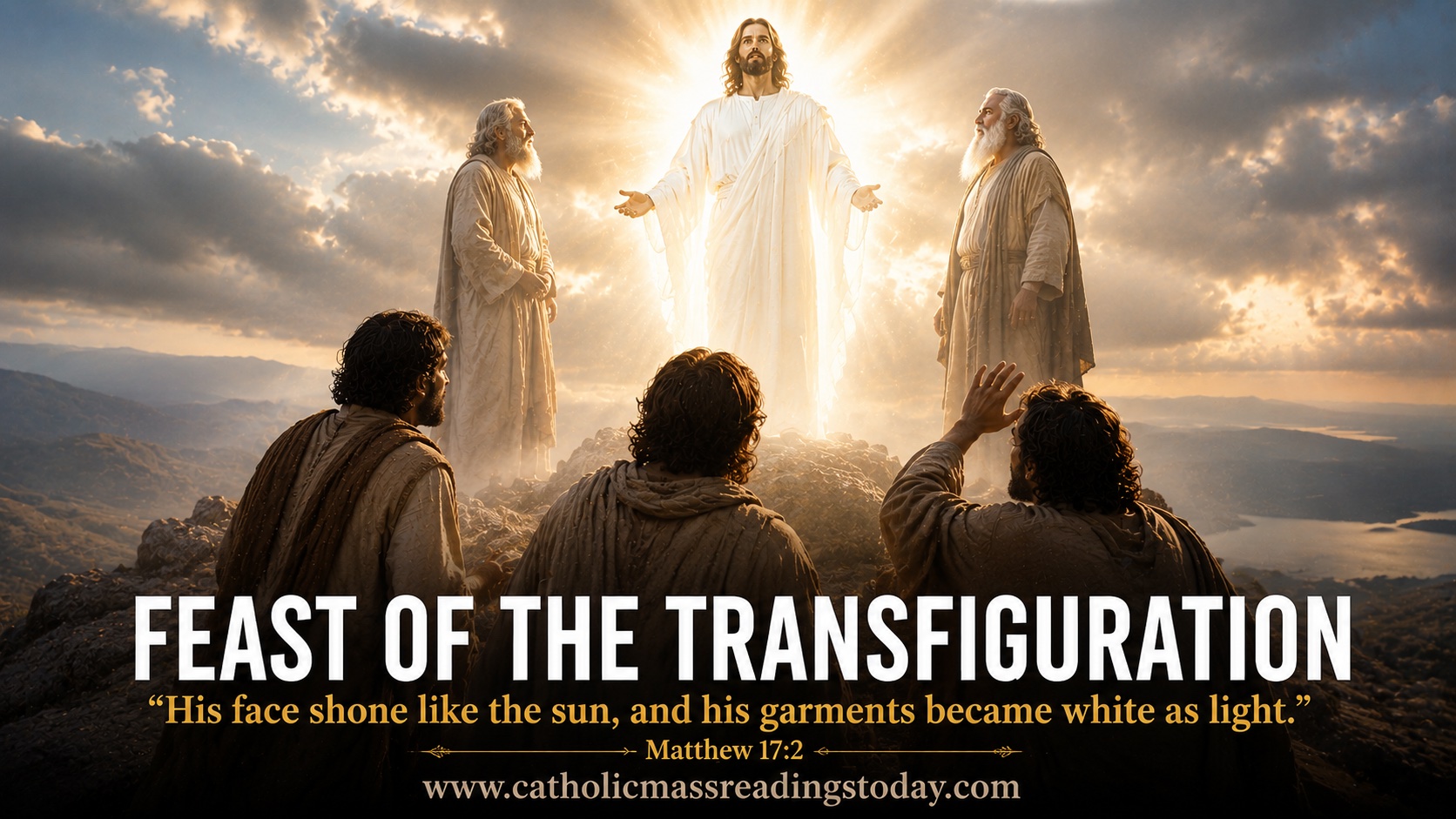
The Gospel tells us that Jesus took three of His closest disciples, Peter, James, and John and led them up a high mountain to pray. While they were there, something extraordinary happened.
His face shone like the sun, his garments became dazzling white. The glory that had always belonged to Him as the eternal Son of God became visible to human eyes.
Suddenly, Moses and Elijah appeared beside Him, speaking with Him about His coming Passion in Jerusalem. Overwhelmed by what he witnessed, Peter exclaimed:
“Lord, it is well that we are here.”
Before he could say more, a bright cloud overshadowed them, and the voice of God the Father declared:
“This is my beloved Son, with whom I am well pleased; listen to him.”
The disciples fell to the ground in awe and fear, then Jesus approached them, touched them gently, and said:
“Rise, and have no fear.”
When they looked up, they saw Jesus alone. The vision had passed, but it would remain forever engraved upon their hearts.
Why Did Jesus Reveal His Glory?
At first glance, the Transfiguration may seem like a miraculous display intended simply to amaze the disciples. It’s purpose, however, was much deeper.
Only a short time earlier, Jesus had begun speaking openly about His coming suffering and death in Jerusalem.
His disciples struggled to understand. How could the promised Messiah suffer? How could the Son of God be rejected?
Before asking them to follow Him to Calvary, Jesus first strengthened their faith by allowing them to glimpse Easter before Good Friday.
The mountain of glory prepared them for the mountain of sacrifice. The Cross would not be the end of His story, the Resurrection was already hidden within it.
The Church has always understood the Transfiguration as God’s loving preparation for the scandal of the Cross.
The Meaning of Moses and Elijah
The appearance of Moses and Elijah is filled with profound significance.
Moses represents the Law. Through him, God gave Israel the Ten Commandments and established His covenant with His chosen people.
Elijah represents the Prophets, who faithfully called Israel back to God throughout its history. Together, they symbolise the whole of the Old Testament.
Their presence reveals that every promise, prophecy, sacrifice, and covenant finds its fulfilment in Jesus Christ. He is not merely another prophet, he is the One to whom all the prophets pointed.
Everything that God had prepared throughout salvation history reaches its fulfilment in Him.
The Voice of the Father
The Father’s words from the cloud are among the most important ever recorded in Scripture:
“This is my beloved Son, with whom I am well pleased; listen to him.”
These words reveal both the identity and the authority of Christ. Jesus is not simply an inspired teacher. He is the eternal Son of God. The Father’s command is beautifully simple:
Listen to Him.
In every generation the Church hears those words anew. Our world is filled with competing voices.
There are voices of fear, division and voices promising happiness without God.
The Feast of the Transfiguration reminds us that above every other voice stands the voice of Christ.
His Gospel alone leads us to life.
A Feast Rooted in the Early Church
The mystery of the Transfiguration has been honoured by Christians since the earliest centuries.
Pilgrims travelling to the Holy Land identified Mount Tabor as the traditional site of the Transfiguration, although some scholars have proposed other locations. By the fourth century, churches had already been built there to commemorate this sacred event.
In the Christian East, the Feast of the Transfiguration became one of the great feasts of the liturgical year and was celebrated with great solemnity.
Its celebration gradually spread throughout the Western Church.
In 1457, Pope Callixtus III extended the feast to the entire Latin Church in thanksgiving for the Christian victory at the Siege of Belgrade (1456), where Europe was defended against advancing Ottoman forces. News of the victory reached Rome on 6 August, and the Pope associated that joyful news with the Feast of the Transfiguration, seeing in it a reminder that Christ’s glory ultimately triumphs over darkness.
Since then, Catholics throughout the world have celebrated this feast each year on 6 August.
Why the Transfiguration Matters Today
It would be easy to think that the Transfiguration belongs only to the apostles who witnessed it.
Yet its message is just as important today. Every Christian experiences moments of uncertainty.
There are times when prayer feels difficult. There are seasons marked by illness, grief, disappointment, or unanswered questions.
The Transfiguration reminds us that suffering never has the final word. The disciples saw Christ’s glory before they witnessed His Passion.
Likewise, we are called to remember His victory whenever we carry our own crosses. The light of Tabor continues to shine into every dark valley.
The Call to Holiness
The Feast of the Transfiguration also speaks about our own vocation.
Saint Paul teaches that Christians are being transformed into the image of Christ “from glory to glory” (2 Corinthians 3:18).
Holiness is not simply about avoiding sin.
It is about allowing Christ to reshape our minds, hearts, and lives until His light becomes visible through us.
- Every act of forgiveness…
- Every sacrifice made in love…
- Every prayer offered in faith…
- Every work of mercy…
All of these are part of God’s transforming work within His people.
The Transfiguration reminds us that sanctity is not reserved for a select few. It is the calling of every baptised Christian.
The Eucharist and the Glory of Christ
The mystery of the Transfiguration also deepens our appreciation of the Holy Eucharist.
On Mount Tabor, the disciples briefly saw Christ’s divine glory.
At every Holy Mass, that same Lord becomes truly present under the humble appearances of bread and wine.
His glory is hidden rather than visible, yet His presence is no less real.
The Eucharist is the greatest encounter with the transfigured Christ that Catholics can experience on earth.
Each Communion strengthens us to carry our crosses and continue our pilgrimage toward Heaven.
How Catholics Are Called to Celebrate This Feast
The Feast of the Transfiguration is not merely remembered; it is meant to be lived.
The most fitting way to celebrate is by participating in the Holy Sacrifice of the Mass, where the Church proclaims the Gospel of the Transfiguration and receives Christ in the Eucharist.
Many Catholics also spend time in Eucharistic Adoration, reflecting quietly on the glory of Christ hidden in the Blessed Sacrament.
Families may read the Gospel account together, pray the Rosary, or spend time thanking God for the gift of His Son.
This feast also invites us to examine whose voice we are listening to each day. In prayer, we can ask the Holy Spirit to help us recognise Christ’s voice in Sacred Scripture, in the teachings of the Church, and in the quiet movements of grace within our hearts.
Above all, the Feast of the Transfiguration calls us to descend the mountain renewed, carrying Christ’s light into our homes, workplaces, schools, and communities. Like the apostles, we cannot remain on the mountain forever. We are sent back into the world to bear witness to the One whose glory we have encountered.
Lessons the Feast Teaches Every Christian
The Transfiguration continues to teach timeless lessons.
- It reminds us that Jesus is truly the Son of God.
- It reveals that the Cross and glory are inseparable.
- It strengthens us to persevere through suffering with hope.
- It calls us to listen attentively to Christ above every competing voice.
- It encourages us to seek holiness through ordinary faithfulness.
And it assures us that the glory revealed on Mount Tabor is the destiny prepared for all who remain faithful to Christ.
The Hope of Eternal Glory
The Feast of the Transfiguration points beyond history itself. It offers a glimpse of the future promised to God’s faithful people. The dazzling light surrounding Christ is not merely His own glory.
It foreshadows the glory of the Resurrection and the eternal joy of Heaven.
For Christians, death is not the end. Beyond every cross lies the empty tomb., beyond every earthly struggle shines the everlasting Kingdom of God.
This feast reminds us that our journey is not aimless. We are pilgrims walking toward the eternal light of Christ.
He embraces the Cross
The Feast of the Transfiguration is one of the Church’s most radiant celebrations because it allows us to glimpse the splendour of Jesus Christ before He embraces the Cross. On the holy mountain, the Father reveals His beloved Son and calls the whole world to listen to Him. That invitation remains just as urgent today.
As we celebrate this feast, may we lift our eyes above the distractions of daily life and fix them on Christ, whose face shines with the glory of the Father. May His light strengthen us in moments of trial, deepen our love for the Eucharist, and inspire us to become faithful witnesses of His Gospel.
And when we leave the mountain to face the ordinary challenges of life, may we carry within us the same hope that sustained Peter, James, and John: the certainty that the Lord who revealed His glory on Tabor is the same Lord who walks beside us each day and who will one day lead us into the everlasting light of His heavenly Kingdom.
Let us Pray
Lord Jesus Christ,
On the holy mountain You revealed the radiance of Your divine glory and allowed Your disciples to glimpse the beauty of the Kingdom that has no end. As we celebrate the Feast of Your Transfiguration, lift our hearts above the worries and distractions of this world, so that our eyes may remain fixed on You.
Teach us to listen to Your voice with willing hearts and to trust You even when the road before us leads through sacrifice and uncertainty. When our faith grows weak, remind us that beyond every cross lies the promise of resurrection, and beyond every trial shines the light of Your everlasting glory.
Transform us by Your grace each day. May our words reflect Your truth, our actions reveal Your love, and our lives bear witness to the hope that comes from walking with You. Help us to become instruments of peace in our families, our communities, and wherever You send us.
Through the loving intercession of the Blessed Virgin Mary, strengthen us to remain faithful until the day when we shall behold You face to face and rejoice forever in the glory of Your heavenly Kingdom.
You live and reign with the Father, in the unity of the Holy Spirit, God, for ever and ever.
Amen.