“Who Is My Neighbour?”
The Question That Reveals the Heart
There is something very revealing in the question the lawyer asks Jesus: “Who is my neighbour?” He already knows the commandment. He knows that he must love God and love his neighbour as himself. But he wants to know where the boundary is. Who counts? Who does not? How far does love have to go?
Jesus answers not with a definition, but with a story.
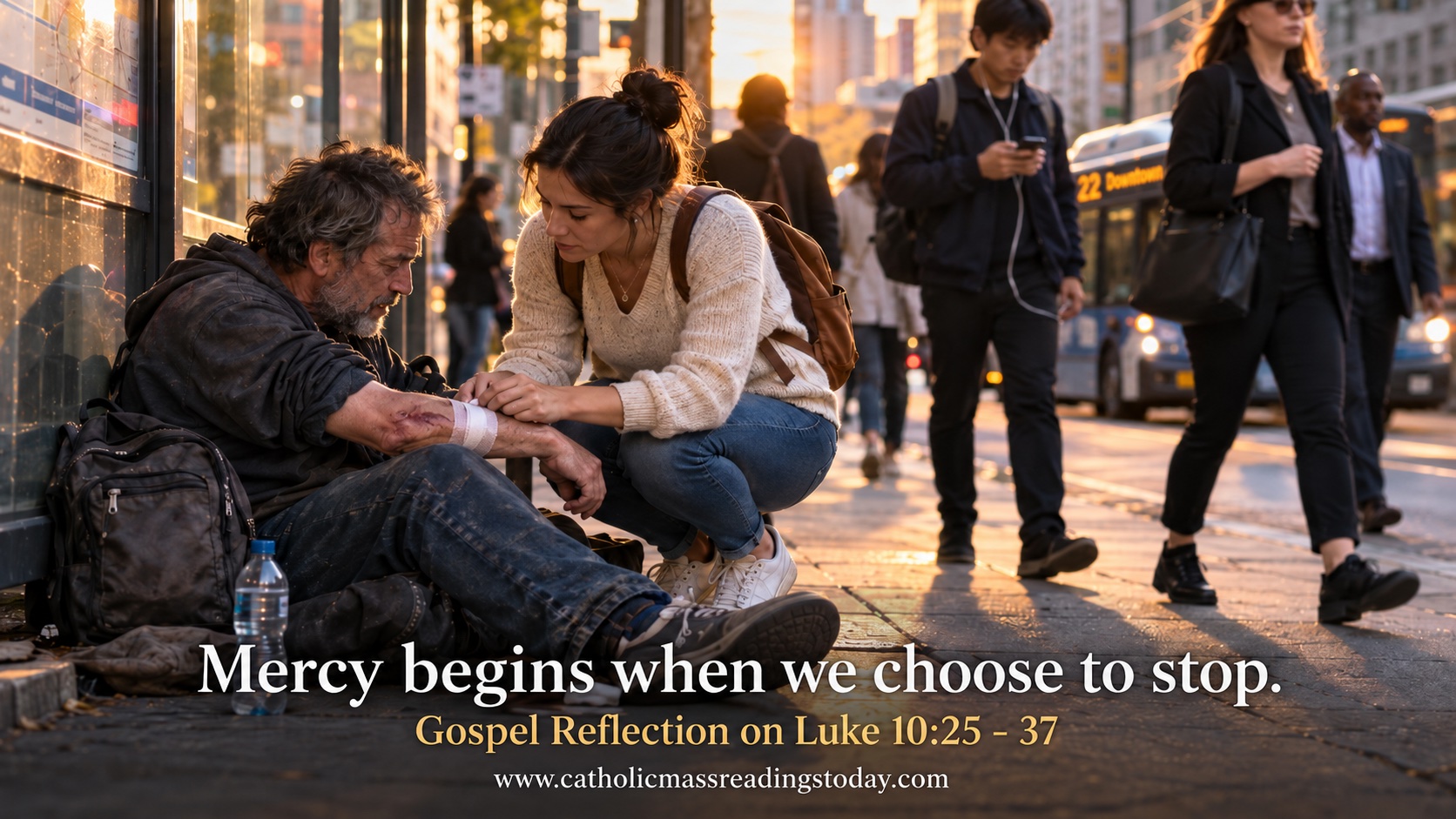
A man is left beaten, stripped and half dead on the road. A priest sees him and passes by. A Levite sees him and passes by. Both men notice the suffering, but neither one stops.
Then comes the Samaritan, and that detail matters. For many of Jesus’ listeners, a Samaritan would not have been the person they expected to become the hero of the story. He was an outsider, someone from a group viewed with suspicion and hostility.
Yet he is the one who stops. He sees the wounded man and he has compassion.
Neighbourly Love Begins When Compassion Becomes Action
That is where neighbourly love begins. Not merely with seeing, but with allowing what we see to move us.
The priest sees. The Levite sees. The Samaritan sees and acts.
He goes to the wounded man, binds his wounds, pours on oil and wine, lifts him onto his own animal, takes him to an inn, stays involved, pays for his care, and even then, he promises to return.
Mercy costs him something. Time, money, comfort, convenience and effort.
He does not ask, “What will happen to me if I stop?” He responds to the suffering in front of him, and that is exactly where Jesus turns the lawyer’s question around.
The lawyer asks, “Who is my neighbour?” But Jesus does not really answer by drawing a circle around certain people. Instead, He asks, “Which of these proved neighbour to the man?”
In other words, the question is not only, “Who deserves my love?” The deeper question is: “Am I becoming a neighbour?”
That changes everything.
Mercy Refuses to Draw Narrow Boundaries
Neighbourly love is not limited by race, tribe, religion, social class, nationality, politics, or whether someone can repay us.
The wounded man had nothing to offer the Samaritan. He could not reward him. He could not repay him. He may not even have been conscious enough to say thank you. And still, the Samaritan loved him.
That is mercy.
And Jesus tells us, “Go and do likewise.”
Those words are simple, but demanding. It is easy to admire the Good Samaritan. It is harder to become one.
We meet wounded people all the time, not always lying beside a road. Sometimes they are sitting beside us at work, living in our home, standing in front of us in a queue, calling us on the phone or even sitting alone in church. They may be carrying grief, debt, illness, shame, loneliness, or a burden that is invisible to everyone else.
The question is: do we see them? And if we see them, do we stop?
A Faith That Remains Only in Words Is Not Enough
The Gospel challenges a faith that remains only in words.
The priest and the Levite were religious men. They knew the law. They knew worship. But in that moment, knowledge was not enough.
The wounded man needed mercy.
Jesus shows us that love of God and love of neighbour can never be separated. We cannot say that we love God while deliberately walking past the suffering of another person.
Our faith must become visible in compassion, generosity, patience, forgiveness and in the willingness to stop when someone needs us.
This does not mean we can solve every problem. We cannot help everyone in every way, but we can refuse to become indifferent.
Sometimes mercy is giving money. Sometimes it is giving time. Sometimes it is listening. Sometimes it is making a phone call. Sometimes it is visiting someone who is alone. Sometimes it is forgiving. Sometimes it is defending someone who is being treated unfairly, and sometimes it is simply refusing to walk past.
Christ Teaches Us to See the Person Before the Label
There is another beautiful truth in this Gospel.
The Samaritan does not ask whether the wounded man is one of his own. He simply sees a human being in need.
That is how Christ teaches us to see.
Before labels, before divisions and before differences, there is a person. A person created by God, a person with dignity and a person whose suffering matters.
Perhaps the most uncomfortable part of the Gospel is this: sometimes the neighbour God asks us to love is not the person we would have chosen.
It may be someone difficult. Someone who thinks differently. Someone from another background. Someone who has hurt us. Someone we would rather avoid.
But mercy does not wait for perfect circumstances. It begins with the person placed before us.
We Are Also the Wounded Man
This parable also points us toward Christ Himself because, in a deeper way, we are the wounded man.
Sin has wounded humanity. We could not heal ourselves. And Christ came to us.
He did not pass by. He drew near. He lifted us. He poured out His grace. He paid the cost. He carried us toward healing.
The mercy we are asked to give is the mercy we have first received.
That is why the command of Jesus is possible: “Go and do likewise.”
Not because we are naturally perfect at mercy, but because Christ has been merciful to us.
Who Needs Me to Become a Neighbour Today?
So perhaps today the question is not only, “Who is my neighbour?”
Perhaps it is: “Who needs me to become a neighbour today?”
Who needs patience? Who needs forgiveness? Who needs attention? Who needs compassion? Who needs me to stop?
The road from Jerusalem to Jericho still runs through our ordinary lives, and somewhere along that road, someone is waiting for mercy.
Let Us Pray
Lord Jesus Christ,
You teach us that love of God and love of neighbour belong together.
Give us eyes that truly see the people around us.
Protect us from becoming indifferent to suffering.
When it would be easier to pass by, give us the courage to stop.
When someone is different from us, teach us to see first their dignity as a child of God.
When mercy costs us time, comfort, money or convenience, give us generous hearts.
Forgive us for the times we have seen suffering and chosen not to become involved.
Make us people of compassion.
Teach us to bind wounds, to comfort the lonely, to welcome the stranger, to forgive those who have hurt us, and to serve without asking what we will receive in return.
Lord,
You did not pass by when humanity lay wounded by sin.
You came near to us, You lifted us, You showed us mercy.
May the mercy we have received from You become the mercy we give to others.
And when You place someone in need along our path, give us the grace to hear Your words and live them:
“Go and do likewise.”
Through Christ our Lord.
Amen.