When Mercy Becomes the True Expression of God’s Law
The Compassion of Christ in the Face of Human Suffering
Today’s Gospel presents us with a moment that reveals something profoundly beautiful about the heart of Jesus Christ. He has been invited to dine at the house of a leading Pharisee on the Sabbath, a day set apart for worship and rest. Yet the atmosphere surrounding this gathering is not entirely one of friendship and hospitality. Saint Luke tells us that those present were watching Jesus closely.
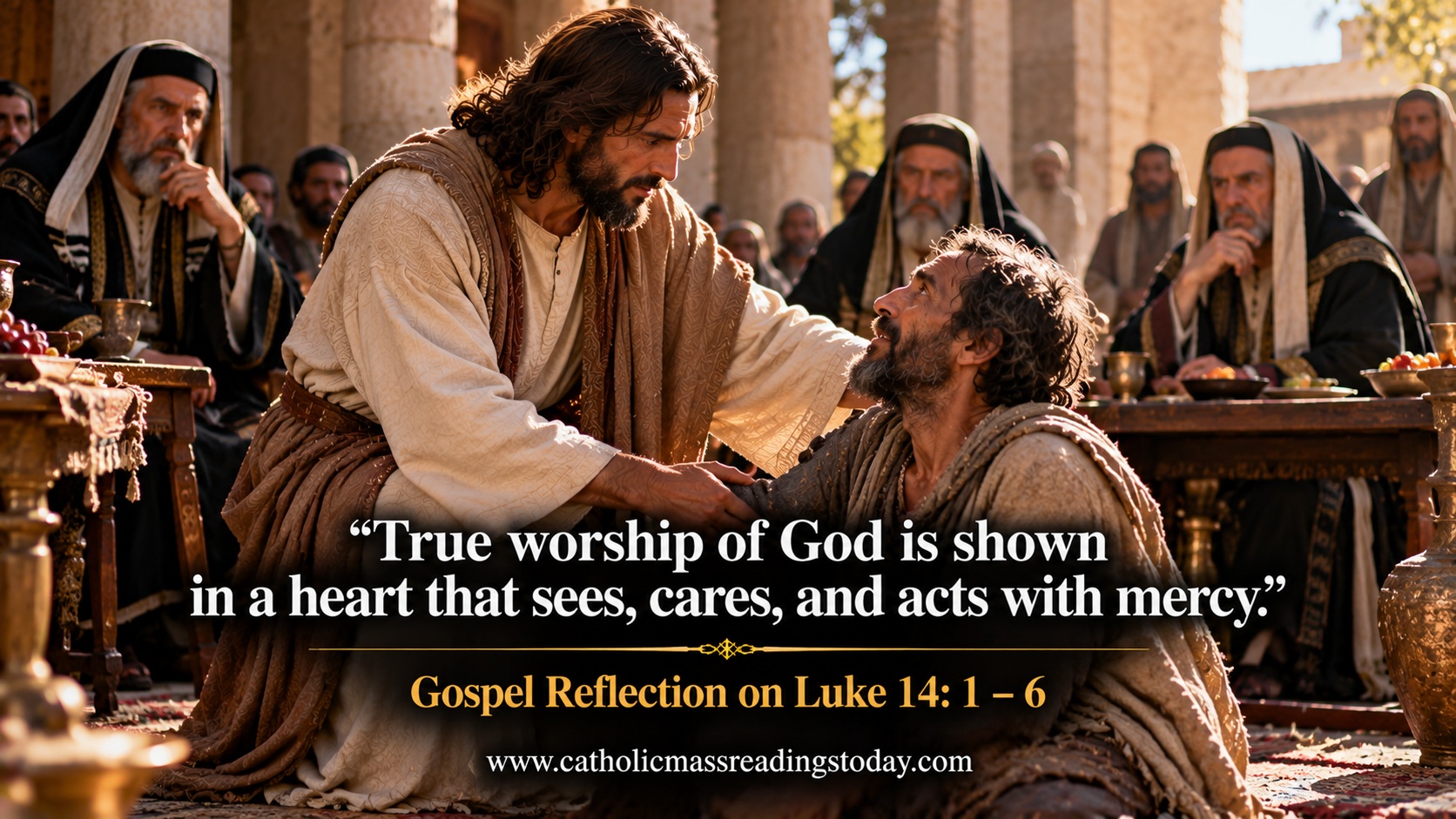
Before Him stands a man suffering from dropsy, a condition involving an abnormal accumulation of fluid in the body. We are not told how long this man has suffered, what difficulties he has endured, or how his illness has affected his daily life. But we know that Jesus sees him and this is where the beauty of today’s Gospel begins.
While others are watching Jesus to see whether He will do something they can question, Jesus directs His attention towards a suffering human being.
The difference is striking. Some see a possible violation of their understanding of the Sabbath law. Jesus sees a person in need of compassion.
How often does something similar happen in our own lives? We may become so concerned with procedures, expectations, appearances, and personal opinions that we fail to recognise the suffering of the person standing before us.
Yet the Gospel reminds us that no human being should ever become less important than the rules we claim to uphold in God’s name.
Jesus does not disregard the law of God. Rather, He reveals its deepest meaning, showing that authentic obedience to God can never be separated from love.
Is It Lawful to Heal on the Sabbath?
Jesus turns to the lawyers and Pharisees and asks a simple but penetrating question: “Is it lawful to heal on the sabbath, or not?”
They remain silent.
Their silence is significant because it reveals the difficulty of their position. They know that the Sabbath is sacred, but they are confronted with the undeniable goodness of relieving another person’s suffering.
The Sabbath was given by God as a blessing, a day of rest, worship, and remembrance of His saving works. It was never intended to become an obstacle to mercy.
In healing the sick man, Jesus reveals that the holiness of the Sabbath is not diminished by an act of compassion. On the contrary, such an act expresses the goodness of the God whom the Sabbath honours.
This is an important lesson for us as Catholics.
The commandments of God and the moral teachings of the Church are not burdens imposed without purpose. They guide us towards holiness, protect human dignity, and help us grow in love of God and neighbour.
But we must be careful never to use our religious observance as an excuse for indifference, harshness, or a lack of compassion.
We may attend Holy Mass regularly, recite our prayers faithfully, and observe the practices of our faith. These are beautiful and necessary parts of Christian life. Yet their fruits must also become visible in the way we treat others.
What happens when someone in our family needs forgiveness? When a neighbour is struggling financially? When an elderly person needs our attention or when someone who has made serious mistakes seeks an opportunity to begin again?
Do we respond with the compassion of Christ, or do we find reasons to turn away?
Our faith must never become a matter of outward observance alone. It must transform the heart and make us more capable of loving as Christ loves.
The Dignity of the Human Person Comes Before Indifference
When those gathered at the table remain silent, Jesus takes the sick man, heals him, and allows him to go.
The Gospel describes this extraordinary act with remarkable simplicity.
There is no elaborate ceremony, no public display intended to impress the guests, and no demand for recognition.
Jesus simply restores the man’s health.
In that moment, the suffering person becomes the centre of Christ’s concern.
This reveals a truth that lies at the heart of Catholic moral and social teaching: every human person possesses an inherent dignity because he or she is created in the image and likeness of God.
That dignity does not depend upon wealth, physical strength, social position, or the ability to contribute something that others consider valuable.
The sick, the elderly, the poor, the disabled, and those who are easily overlooked remain precious in the eyes of God.
Jesus does not ask whether the man deserves to be healed. He does not measure his worth according to his circumstances.
He responds to his need with mercy, and perhaps this is where today’s Gospel challenges us most deeply.
We live in a world where people are sometimes valued according to what they possess, what they achieve, or what they can offer in return. Yet Christ teaches us to recognise the value of a person before considering anything else.
A Christian cannot sincerely claim to love God while deliberately closing his heart to the suffering of his neighbour.
This does not mean that we can solve every problem or remove every burden from another person’s life. But it does mean that we must never allow ourselves to become comfortable with indifference.
Sometimes compassion begins with something very simple: taking time to listen, visiting someone who is sick, helping a struggling family, or treating a person with patience when everyone else seems to have lost patience with them.
These acts may appear small, but they reveal something of the love of Christ.
The Question That Exposes the Human Heart
After healing the man, Jesus asks another question: “Which of you, having a son or an ox that has fallen into a well, will not immediately pull him out on a sabbath day?”
The answer is obvious.
No loving parent would leave a child in danger simply because the rescue was needed on the Sabbath. Even an animal in distress would ordinarily receive immediate assistance.
Jesus uses this familiar situation to reveal the inconsistency of those who question His healing of a suffering man.
If people understand the urgency of rescuing someone or something precious to them, why should they hesitate to recognise the goodness of restoring another human being to health?
The question exposes a danger that can quietly enter our own hearts.
We may be deeply compassionate when suffering touches someone close to us, yet less understanding when the person in need is a stranger, someone we dislike, or someone whose circumstances we do not fully understand.
We may be quick to defend those we love while becoming impatient with the weaknesses of others.
But the Gospel calls us to a wider love.
Christ teaches us that our responsibility towards our neighbour cannot be limited to those who belong to our family, share our opinions, or make us feel comfortable.
Every human person is deserving of dignity and respect.
And when we encounter suffering, the first movement of our hearts should not be towards judgment, but towards compassion.
There is a question worth carrying into our day: When I see someone struggling, do I first look for a reason not to help, or do I ask myself what love requires of me?
The answer can reveal much about the condition of our spiritual lives.
The Sabbath, the Eucharist, and the Call to Live What We Celebrate
For Catholics, today’s Gospel also invites a deeper reflection on the meaning of Sunday, the Lord’s Day.
Sunday is the day on which the Church celebrates the Resurrection of Jesus Christ. It is a day devoted especially to the worship of God, participation in Holy Mass, rest, and the renewal of family and Christian community life.
But the holiness of Sunday must never be understood as something disconnected from charity.
When we gather for the Eucharist, we encounter the Lord who gave Himself completely for our salvation.
We listen to His Word, receive His grace, and are called to become more closely united with Him.
Yet this encounter must continue beyond the walls of the church.
The Christ we worship in the Eucharist is the same Christ who calls us to recognise Him in the poor, the sick, the lonely, and those who suffer.
If we leave Holy Mass without becoming more willing to forgive, more patient with our families, or more attentive to the needs of others, we should ask whether we are allowing the grace of the sacrament to bear fruit in our lives.
The Eucharist is not simply an obligation to be fulfilled. It is the source and summit of Christian life, drawing us into communion with Christ and strengthening us to live according to His love.
The mercy we receive from God must become the mercy we extend to others.
And this is why today’s Gospel is not merely a lesson about a disagreement that took place many centuries ago. It speaks directly to the way we live our Catholic faith today.
Allowing Christ to Heal the Hardness Within Us
There is one final detail in today’s Gospel that deserves our attention.
After Jesus explains the goodness of His action, those who questioned Him are unable to reply.
Their silence leaves us with an opportunity to examine our own hearts.
Perhaps the greatest obstacle to receiving the teaching of Jesus is not always a lack of knowledge. Sometimes it is the unwillingness to allow His words to challenge our attitudes.
We may know the commandments, understand the prayers, and be familiar with the teachings of the Church, yet still struggle to surrender our pride, resentment, or harsh judgments.
We may recognise another person’s physical suffering while remaining unaware of the hardness developing within our own hearts, and so today, we too need the healing presence of Christ.
We need Him to heal the impatience that makes us unkind, the pride that prevents us from admitting our mistakes, and the resentment that keeps us from forgiving.
We need Him to teach us that holiness is not measured simply by how carefully we observe religious practices, but also by how deeply those practices lead us into communion with God and genuine charity towards others.
The man suffering from dropsy received a physical healing.
But those gathered around Jesus were being offered another kind of healing: the healing of their understanding, their attitudes, and their hearts.
The same invitation is offered to us today.
Let us ask ourselves whether our faith is making us more compassionate, whether our prayers are helping us become more patient, and whether our love for God is reflected in the way we treat those who need our help.
May we never become so concerned with defending our own righteousness that we fail to recognise an opportunity to practise mercy.
For the heart that truly belongs to Christ is a heart that learns to recognise suffering and respond with love.
And whenever we choose compassion over indifference, forgiveness over resentment, and humble service over pride, we allow something of the healing presence of Jesus to become visible in our world.
Let Us Pray
Lord Jesus Christ, Divine Physician of our souls and bodies, You looked with compassion upon the suffering man and restored him to health.
Look with mercy upon us today, and heal whatever prevents us from loving You and our neighbour with sincere hearts.
Forgive us for the times we have been quick to judge and slow to show compassion.
Remove from our hearts every trace of pride, selfishness, and indifference, and grant us the grace to recognise Your presence in those who suffer.
Teach us to honour Your commandments with faithfulness and love, never forgetting that Your law leads us towards holiness, justice, and mercy.
Bless the sick, the elderly, the poor, and all those who carry burdens known to You alone.
Comfort those who feel forgotten, strengthen those who are weary, and give hope to those who are discouraged.
Lord, as we gather to worship You in the Holy Eucharist, may the grace we receive transform the way we live.
Help us to become instruments of Your compassion within our families, our communities, and wherever You lead us.
May our words bring encouragement, our actions bring comfort, and our lives bear witness to the goodness of Your Sacred Heart.
You who live and reign with God the Father, in the unity of the Holy Spirit, God, for ever and ever.
Amen.