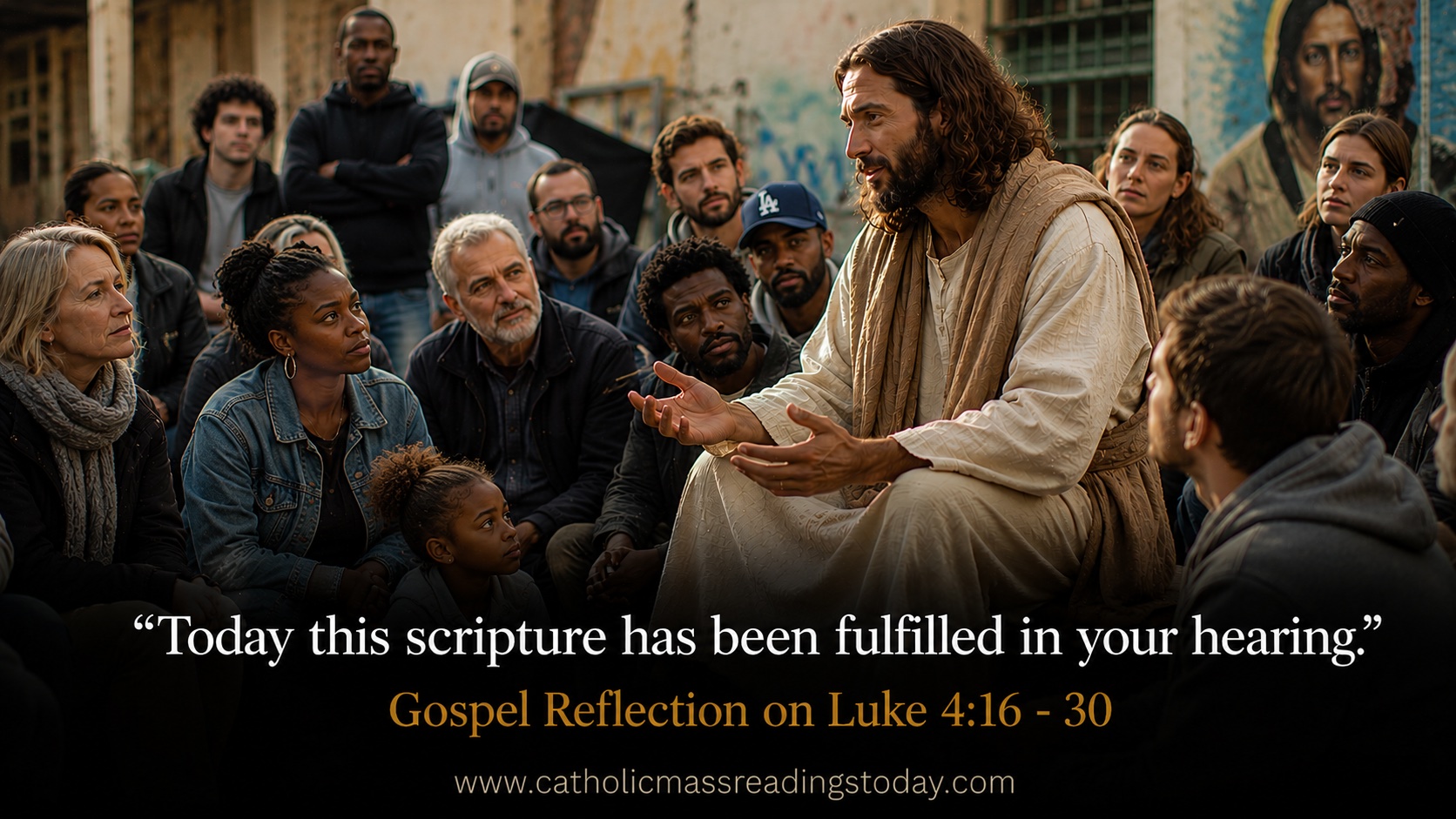
“He Has Sent Me to Preach Good News to the Poor”
There is something deeply striking about the return of Jesus to Nazareth. He comes back to the town where He had grown up, enters the synagogue on the Sabbath “as was his custom,” and stands among people who believe they already know Him. They know His family, they know where He comes from, and they remember Him as the son of Joseph. Yet on this particular Sabbath, the familiar face before them is about to reveal a mystery far greater than they are prepared to receive.
Jesus is handed the scroll of the Prophet Isaiah and reads the words announcing that the Spirit of the Lord is upon Him, that He has been anointed to preach good news to the poor, proclaim release to captives, restore sight to the blind, set the oppressed free and proclaim the acceptable year of the Lord. When He finishes, He closes the scroll, returns it to the attendant and sits down. The synagogue falls into a profound attentiveness. Every eye is fixed upon Him. Then Jesus makes the declaration upon which the entire scene turns: “Today this scripture has been fulfilled in your hearing.”
Jesus is doing far more than explaining an ancient prophecy. He is revealing that the prophecy finds its fulfilment in Him. Israel has waited through generations for God’s saving promise, and now the One for whom they have waited is standing among them. The promised time of salvation has arrived.
At first, the people are impressed. They marvel at His gracious words. But before this encounter is over, admiration will become suspicion, suspicion will become anger, and anger will become violence. The same people who listened to Him with wonder will drive Him from their town and attempt to throw Him from the brow of a hill.
This dramatic change confronts every Christian with an uncomfortable truth: it is possible to stand very close to Christ and still refuse to recognize Him.
When Familiarity Prevents Us From Seeing Christ
The people of Nazareth ask, “Is not this Joseph’s son?” Their difficulty is not that Jesus is completely unknown to them. Their difficulty is that He is too familiar. They believe they already know who He is. They remember the family from which He came and the ordinary life He lived among them. How can someone so familiar now speak with such authority? How can the carpenter’s son claim that an ancient prophecy concerning God’s salvation is being fulfilled in Him?
They have placed Jesus inside the limits of what they think they know about Him. When He reveals Himself as greater than those limits, they resist.
That danger did not disappear with Nazareth. It can enter Christian life whenever the things of God become so familiar that they cease to astonish us. A Catholic can hear the Gospel proclaimed hundreds of times and eventually stop truly listening. We can make the Sign of the Cross almost automatically without remembering that we are invoking the Most Holy Trinity. We can walk into a Catholic church and forget that we have entered a sacred place in which Christ is truly present in the Blessed Sacrament.
Most seriously, we can approach Holy Communion so routinely that we lose our sense of wonder before the extraordinary mystery taking place. What appears to our senses as bread and wine becomes, through the consecration, the Body and Blood of Christ. The Lord whom Nazareth failed to recognize beneath the familiarity of the carpenter’s son still comes to us beneath humble appearances.
The people of Nazareth saw someone they thought they already understood. Faith was asking them to recognize the Son of God.
Every Mass presents us with that same invitation: to look beyond what appears ordinary and recognize the presence of the extraordinary God.
“Today This Scripture Has Been Fulfilled”
One word in the declaration of Jesus deserves to remain in our hearts: today.
Jesus does not tell the people that one day, somewhere in the distant future, Isaiah’s prophecy will be fulfilled. He tells them, “Today this scripture has been fulfilled in your hearing.”
Christianity is firmly rooted in events that happened in history, but Christian faith is not merely the remembrance of a distant past. Jesus Christ is risen and alive. His Word continues to address His Church. His grace continues to transform lives. His saving presence remains among His people.
This is why the proclamation of Scripture at Mass is not simply the public reading of an ancient religious document. Christ speaks through His Word. The Gospel therefore asks us not only what Jesus said to the people of Nazareth, but what Jesus is saying to us today.
Perhaps there is something we have postponed for too long. We may know that we should forgive someone, yet continue telling ourselves that we will deal with it another day. We may know that it has been too long since our last sincere confession. A damaged relationship may need healing. A habit may have slowly gained control over our life. Perhaps God has been asking us to become more generous, more prayerful, more honest or more attentive to someone who needs us.
Human beings are remarkably skilled at postponing conversion. We imagine that tomorrow will somehow make obedience easier.
Christ says: Today.
Yesterday has already passed into the mercy of God. Tomorrow remains within His providence. Today is the moment placed in our hands. Today we can repent. Today we can forgive. Today we can love. Today we can begin again.
Good News for the Poor
Jesus announces that He has been anointed “to preach good news to the poor.” These words reveal something fundamental about the heart of God.
Throughout His earthly ministry, Jesus repeatedly draws close to people whom the world easily overlooks. He touches lepers, welcomes sinners, notices widows, receives children and restores dignity to people whom society has pushed aside. The poor are not an afterthought in the Gospel, and therefore they cannot become an afterthought in Christian life.
The Catholic faith never allows us to separate love of God from love of neighbour. The person who kneels before Christ present in the Blessed Sacrament must learn to recognize something of the face of Christ in the hungry, the homeless, the lonely, the refugee, the elderly person who has been forgotten, the unborn child whose life is vulnerable, the family struggling to survive and every human being whose dignity is threatened.
Yet the Gospel is not merely a programme for material assistance. Jesus reaches into an even deeper poverty, because a person can possess considerable material wealth and still be desperately poor within.
Someone can have thousands of contacts on a phone and have nobody with whom he can honestly share his pain. Someone can live in a beautiful home and be imprisoned by loneliness. A person may have professional success and public admiration while quietly struggling with addiction, resentment or fear. Someone can possess everything the world promised would produce happiness and still wonder why the heart remains empty.
Christ comes for these people too. Indeed, before God, every one of us is poor. None of us can purchase grace. None of us can earn redemption by our own power. None of us can save ourselves.
And this is the Good News: we do not have to save ourselves. Christ has come to save us.
Christ Comes to Set the Captive Free
Jesus also declares that He has been sent “to proclaim release to the captives.” We naturally think of physical imprisonment, and care for prisoners rightly belongs among the corporal works of mercy. Yet there are also prisons that have no visible walls.
A person can become imprisoned by alcohol, drugs or pornography. Another may spend years imprisoned by anger over something that happened long ago. Someone else may become a prisoner of money, ambition, jealousy or the constant need for approval. Others live beneath the weight of shame, convinced that the sins of their past have placed them permanently beyond God’s mercy.
Jesus enters precisely these places. He does not come merely to tell the captive that chains exist. He comes to bring freedom.
This is why the Sacrament of Reconciliation is one of the great treasures Christ has entrusted to His Church. When we approach confession with sincere repentance, we do not encounter a God waiting for an opportunity to humiliate us. We encounter the mercy of Christ, who desires to forgive sin and restore what sin has wounded.
There are chains human strength alone cannot break, but grace can break them. There are wounds that years have failed to heal, but Christ can enter them. There are sins we may think God could never forgive, but the Cross tells us how far divine mercy is willing to go to bring the sinner home.
Recovering of Sight to the Blind
Jesus announces “recovering of sight to the blind.” During His ministry He will literally restore sight, but the Gospel also reveals a deeper blindness of the human heart.
We can possess perfectly functioning eyes and still fail to see.
We can live in the same house with someone and fail to notice that he or she is suffering. We can recognize every fault in the people around us while remaining strangely blind to our own. We can look at a poor person and see an inconvenience rather than a brother or sister. We can look at someone who has sinned and see only the sin rather than a human being whom Christ still desires to redeem. We can look at our possessions and think only about ownership rather than stewardship.
Most importantly, we can look at Jesus and see only the Christ we want Him to be.
That was the blindness of Nazareth. The people could see Jesus physically, but they could not accept who He truly was.
The Christian must therefore continually pray: Lord, teach me to see. Teach me to see myself truthfully, to see others with mercy, to recognize the poor with compassion and to recognize sin without excusing it. Give me eyes capable of recognizing goodness without envy and, above all, the spiritual sight to recognize You when You come to me in ways I did not expect.
The People Wanted a Messiah on Their Own Terms
The people of Nazareth have heard what Jesus has done elsewhere, particularly at Capernaum, and they expect Him to do the same among them. Jesus understands their expectation: “What we have heard you did at Capernaum, do here also in your own country.”
They want signs, but Jesus refuses to become a performer whose purpose is to satisfy curiosity or prove Himself on demand.
The same temptation can enter our relationship with God. Without realizing it, we may place conditions upon our faith. We may tell God within our hearts: heal this person and then I will believe; solve this financial difficulty and then I will trust You; give me the relationship I want and then I will know that You love me; remove this suffering and then I will follow You.
There is nothing wrong with bringing these needs to God. Jesus Himself teaches us to ask, seek and knock. The problem begins when our petition becomes a condition upon which our faithfulness depends.
God does not cease to be God because He has not followed our plan.
Eventually, mature faith must learn the prayer that Jesus Himself will pray in Gethsemane: “Not my will, but yours, be done.”
Those words can be much harder to pray than asking for a miracle, because they require something deeper than desire. They require trust.
The God Whose Mercy Cannot Be Confined
Jesus then reminds His listeners of two episodes from Israel’s Scriptures. During the famine in the days of Elijah, the prophet was sent to a widow at Zarephath in Sidon. During the ministry of Elisha, Naaman the Syrian was cleansed of leprosy.
The examples are deliberately uncomfortable because both recipients stand outside Israel.
Jesus is revealing that God’s mercy cannot be imprisoned within the boundaries human beings create. This is where admiration in the synagogue begins to turn into anger. The people appear prepared to welcome a Messiah who confirms their expectations and favours their community. They are far less prepared for a Messiah whose saving mercy reaches people they consider outsiders.
This remains one of the great tests of authentic religion.
It is easy to believe that God loves those who resemble us, agree with us or belong to our community. The Gospel continually stretches the human heart beyond those comfortable boundaries.
The Church is catholic precisely because the saving mission of Christ is universal. His Gospel is intended for every nation, every race, every language and every social class. His mercy reaches the sinner who returns, the stranger, the forgotten and even the person whom we ourselves struggle to love.
This universal mercy does not mean that truth ceases to matter. Jesus calls people to conversion. He does not simply approve everything we choose to do. But the invitation to conversion is offered to all because Christ gave Himself for all.
We do not possess God as though He belonged to our group.
We belong to Him.
When the Word of God Challenges Us
Perhaps the most sobering feature of the Gospel is the speed with which the mood changes. At first, the people speak well of Jesus. Soon afterward, the synagogue is filled with wrath.
What happened? Jesus began touching something they did not want touched.
They welcomed gracious words while those words remained comfortable. When His teaching challenged their assumptions, admiration became hostility.
This gives us a powerful way of examining our own relationship with the Word of God. Do we love Scripture only when Scripture agrees with us?
We readily receive passages about God’s mercy when we need comfort. We treasure teachings about hope when life becomes difficult. We welcome promises of eternal life when facing death. Yet the same Word also speaks about repentance, chastity, marriage, forgiveness of enemies, generosity, honesty, care for the poor, the sanctity of human life, humility and the necessity of carrying the Cross.
When Christ’s teaching confronts our desires, the question that faced Nazareth also faces us: Will we allow Jesus to change us, or will we attempt to change Jesus?
Mature Catholic faith does not begin by asking how the Gospel can be adjusted to fit the life we have already chosen. It asks how our lives must be transformed by the Gospel.
“No Prophet Is Acceptable in His Own Country”
Jesus speaks the painful words: “No prophet is acceptable in his own country.”
Anyone who has seriously attempted to live the Christian faith may understand something of this. Sometimes the hardest place to witness to Christ is among those who already know us.
Someone experiences a genuine conversion and begins taking prayer seriously, only to discover that relatives think he has become excessive. A person abandons a sinful way of life and former friends cannot understand the change. A young Catholic tries to live chastely and is mocked. A professional refuses to participate in dishonest practices and is treated as foolish. Someone begins attending Mass faithfully and others wonder why religion has suddenly become so important.
The people closest to us often remember who we used to be. Sometimes they struggle to accept who grace is helping us become.
This must never lead to spiritual pride. Christian witness is not the declaration that we are better than everyone around us. We remain sinners in need of mercy.
Often the most powerful Christian witness is not an argument or a sermon. It is the quiet consistency of a life being transformed by grace.
From Nazareth Toward Calvary
The rejection finally becomes violent. The people rise, drive Jesus from the town and lead Him toward the brow of the hill with the intention of throwing Him down. Yet Saint Luke tells us that Jesus, “passing through the midst of them, went away.”
His hour has not yet come. But Nazareth already points toward Jerusalem.
Again Christ will be rejected. Again He will be taken outside. Again people will turn against Him. At Calvary, however, He will not simply pass through their midst and leave. He will surrender Himself.
The One who proclaimed freedom to captives will allow Himself to be bound. The One who proclaimed sight to the blind will be struck and mocked. The One who proclaimed good news to the poor will be stripped of His garments. The One rejected by His own people will stretch out His arms upon the Cross for the salvation of the world.
Here we reach the deepest meaning of His mission.
The Good News is not merely something Jesus announces. Jesus Himself is the Good News.
He does not simply tell humanity that God loves us. In Christ, God’s love enters human history. He does not merely speak about freedom. Through His Cross and Resurrection, He breaks the slavery of sin and opens the way to eternal life.
Christ Still Passes Through Our Midst
There is something almost haunting about the final words of this Gospel. Jesus passes through their midst and goes away.
The people of Nazareth had Christ among them. They heard His voice. They witnessed His presence.
And they allowed Him to leave. That should cause every Christian heart to pause.
God respects human freedom. Christ calls, but He does not force the heart. We can repeatedly resist grace. We can silence conscience. We can postpone repentance until another day. We can become so certain that God must act according to our expectations that we fail to recognize Him when He is already standing before us.
We should therefore pray never to become so familiar with Christ that we cease to listen to Him.
Every Gospel proclaimed at Mass is an invitation. Every worthy reception of the Holy Eucharist is an encounter with the living Christ. Every sincere confession is an invitation home. Every person who needs our mercy may become an unexpected meeting with Jesus. Every morning is another opportunity to answer His call.
And still the word remains:
Today.
Let the Gospel Be Fulfilled in Us Today
The Gospel of Nazareth is not given to us so that we can simply condemn people who rejected Jesus two thousand years ago. It asks us whether there may be a Nazareth hidden within our own hearts.
What happens when Christ challenges something I want to keep? What happens when His Word contradicts my preferences? What happens when His mercy extends toward someone I dislike? What happens when He asks me to forgive? What happens when the teaching of His Church requires sacrifice from me?
These questions cannot be answered merely with words. Our lives answer them.
The Christian life begins again whenever we allow Christ’s “today” to become our own. Today can be the day we forgive. Today can be the day we pray again after months of spiritual dryness. Today can be the day we return to confession. Today can be the day we finally notice the poor person we have repeatedly passed. Today can be the day we call someone who is lonely. Today can be the day we stop defending the sin that is separating us from God. Today can be the day we trust Christ even when we do not understand the road upon which He is leading us.
Christ still comes to preach good news to the poor, liberty to captives, sight to the blind and freedom to those who are oppressed. And in one way or another, every one of us stands among the poor, captive, blind and wounded people who need Him.
The question is not whether Christ has come.
He has.
The question is whether we will receive Him.
Let us Pray
Almighty and eternal God,
You sent Your beloved Son, Jesus Christ,
to bring good news to the poor,
freedom to captives,
sight to the blind
and liberty to those who are oppressed.
Open our hearts to receive His Word
with humility and faith.
Deliver us from the blindness
that prevents us from recognizing Your presence
and from the pride that accepts Your Word
only when it agrees with our desires.
Give us compassion for the poor,
mercy toward the sinner,
courage to defend the dignity of every human person
and generous hearts toward those
whom the world has forgotten.
Break the chains of sin that bind us.
Heal the wounds we carry within us.
Strengthen those who have lost hope,
comfort those who suffer
and draw back to Yourself
all who have wandered far from You.
When Your truth challenges us,
give us the humility to change.
When Your will differs from our own,
teach us to trust.
When we encounter Christ in the Holy Eucharist,
in Sacred Scripture
and in our brothers and sisters,
give us eyes of faith to recognize Him.
May we never allow Jesus
to pass through our midst unrecognized,
but welcome Him into our hearts
and allow His grace to transform our lives.
Through the intercession of the Blessed Virgin Mary,
Mother of Christ and Mother of the Church,
keep us faithful to Your Son
until the day we behold Him face to face
in the joy of Your eternal Kingdom.
Through Christ our Lord.
Amen.
Mary, Mother of the Church, pray for us.