“Can a Blind Man Lead a Blind Man?”
There is something deeply unsettling about the question Jesus asks in today’s Gospel: “Can a blind man lead a blind man?” It is easy to hear these words and immediately think of someone else, someone whose choices seem misguided, whose faults appear obvious, or whose life we believe needs correction. Yet Jesus does not allow us to remain comfortably focused on the shortcomings of others. He turns the light toward our own hearts.
Before we try to lead another person, Christ asks whether we ourselves can see.
Learning First to Be Disciples
Jesus tells us, “A disciple is not above his teacher, but every one when he is fully taught will be like his teacher.” This reminds us that the Christian life begins not with having all the answers, but with allowing ourselves to be taught by Christ.
There is a temptation, especially in a world where everyone can instantly express an opinion, to speak before listening and to judge before understanding. We can become so certain of our own vision that we no longer ask whether our thoughts, words and decisions are truly being shaped by the Gospel.
The disciple of Jesus must remain teachable. We never reach a point where we no longer need conversion. We never become so mature in faith that we can stop listening to the Word of God, examining our conscience, seeking forgiveness or allowing Christ to correct us.
The moment we believe that only other people need to change may be the very moment we most urgently need to look within.
The Speck and the Log
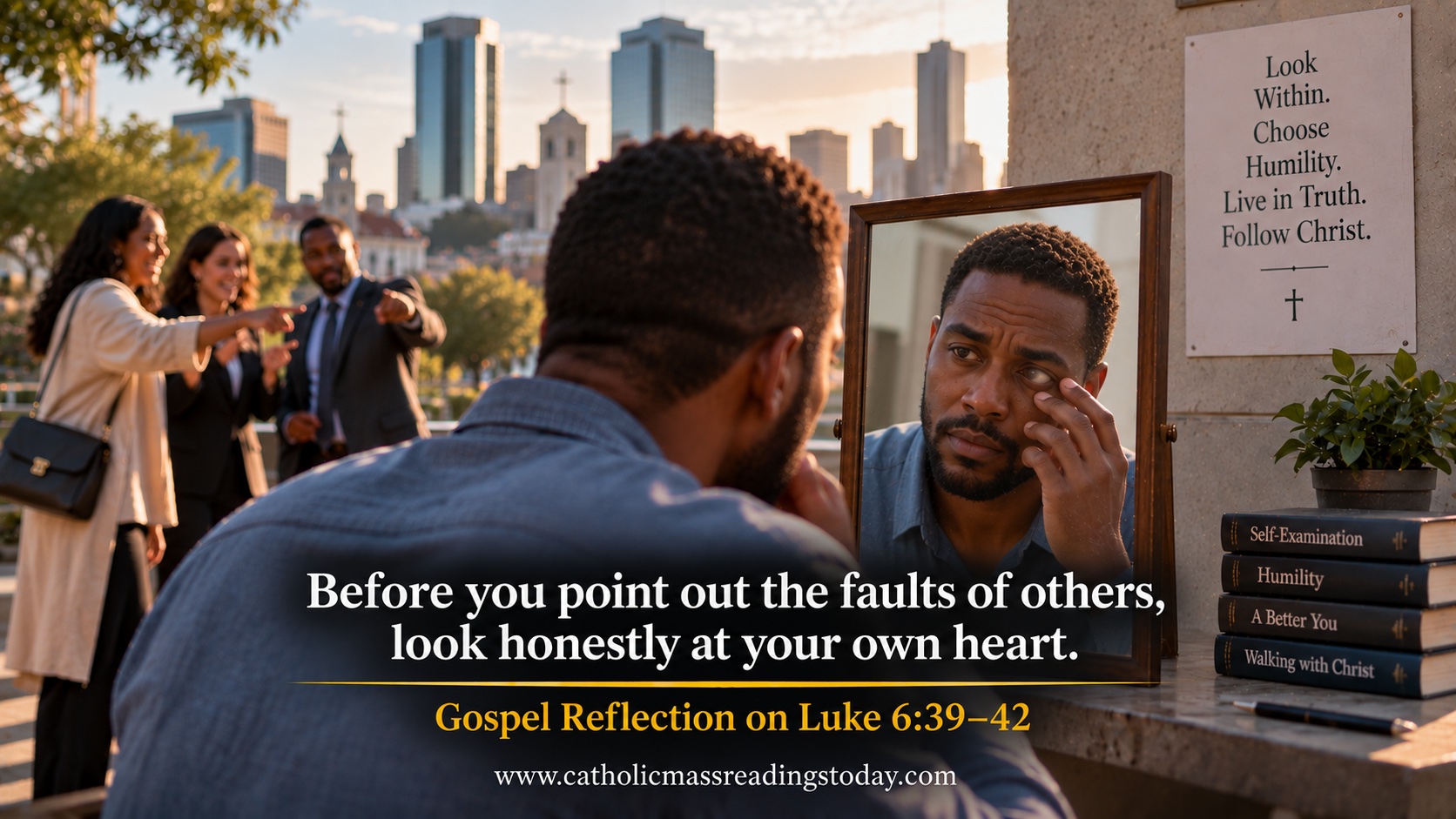
Jesus then gives us one of the most memorable images in the Gospel: “Why do you see the speck that is in your brother’s eye, but do not notice the log that is in your own eye?”
Christ knows the human heart remarkably well.
We can recognize another person’s impatience while excusing our own anger. We can condemn another person’s pride while refusing to admit our own. We may speak strongly about another person’s failures while quietly making excuses for ourselves.
Jesus is not telling us that sin does not matter. Nor is He saying that Christians should never correct one another. Fraternal correction has its place in the Christian life. Parents must guide their children. Pastors must teach their people. Friends sometimes have a duty to speak difficult truths to one another.
But correction without humility can quickly become condemnation.
Christ therefore establishes an order: “First take the log out of your own eye, and then you will see clearly.”
Notice that Jesus does not say we should ignore the speck in our brother’s eye. He says that we must first learn to see clearly.
Seeing Clearly Through Mercy
To see clearly is to see another person as God sees them—not merely as a collection of mistakes, but as someone created in His image and loved by Him.
This kind of vision requires humility.
When we remember our own sins, we become slower to condemn. When we remember how patiently God has dealt with us, we become more patient with others. When we remember the times we have knelt before God asking for mercy, it becomes harder to stand proudly over another person’s weakness.
This is why the Sacrament of Reconciliation is such a precious gift. In confession, we stop examining everyone else’s conscience and allow God to examine ours. We name our own sins. We receive mercy we could never earn. And when we leave forgiven, we should carry some of that mercy into the way we treat others.
A person who has truly encountered the mercy of God should gradually become more merciful.
When We Are Certain That We Are Right
Today’s Gospel has particular importance in our time. We live in an age of quick judgments. A few words, an image or a short video can be enough for people to pronounce judgment upon someone they have never met. Anger spreads quickly, while patience and careful listening often seem too slow.
Christ proposes another way.
Before asking, “What is wrong with that person?” the Christian learns to ask, “Lord, what still needs to change in me?”
That question requires courage.
It is much easier to identify another person’s speck than to stand honestly before God and allow Him to reveal the log we have learned to live with.
Yet this is not meant to discourage us. Christ exposes what is within us because He desires to heal us. The physician must reveal the wound before treating it. The light of Christ enters the hidden places of the heart not to humiliate us, but to make us free.
Let Christ Open Our Eyes
The deepest blindness in today’s Gospel is therefore not physical blindness. It is the blindness that prevents us from recognizing our own need for God.
We begin to see clearly when we stop pretending that we can save ourselves.
We begin to see clearly when Scripture is allowed to challenge us rather than merely confirm what we already believe.
We begin to see clearly when we can say sincerely, “Lord, I may be wrong. Teach me.”
And once Christ has begun healing our vision, something changes in the way we approach other people. We can still speak the truth, but without cruelty. We can correct without humiliating. We can disagree without hatred. We can help someone rise without pretending that we ourselves have never fallen.
That is Christian maturity.
The world does not need more people pointing angrily at the faults of others. It needs disciples whose eyes have been opened by Christ, men and women humble enough to recognize their own weakness and merciful enough to accompany others toward the truth.
Today, then, let us resist the temptation to hear this Gospel for somebody else.
Let us stand before Jesus ourselves.
And let our prayer be simple: Lord, before I try to change another person’s heart, begin with mine. Before I point toward another person’s darkness, bring Your light into me. Remove whatever prevents me from seeing clearly, so that whatever I say or do for another may come not from pride, but from truth and love.
Let us Pray
Lord Jesus Christ, divine Teacher and light of our hearts, open our eyes that we may see ourselves in the light of Your truth. Deliver us from pride, from hasty judgment and from the blindness that makes us attentive to the faults of others while ignoring our own need for conversion.
Give us humble and teachable hearts. When we must correct another, let our words arise from charity and never from contempt. When we encounter weakness in our brothers and sisters, remind us of the patience and mercy You have shown to us.
Purify our hearts, enlighten our minds and guide our steps, that we may follow You faithfully and help others not by standing above them, but by walking beside them on the road that leads to You.
You who live and reign with God the Father, in the unity of the Holy Spirit, God, for ever and ever.
Amen.