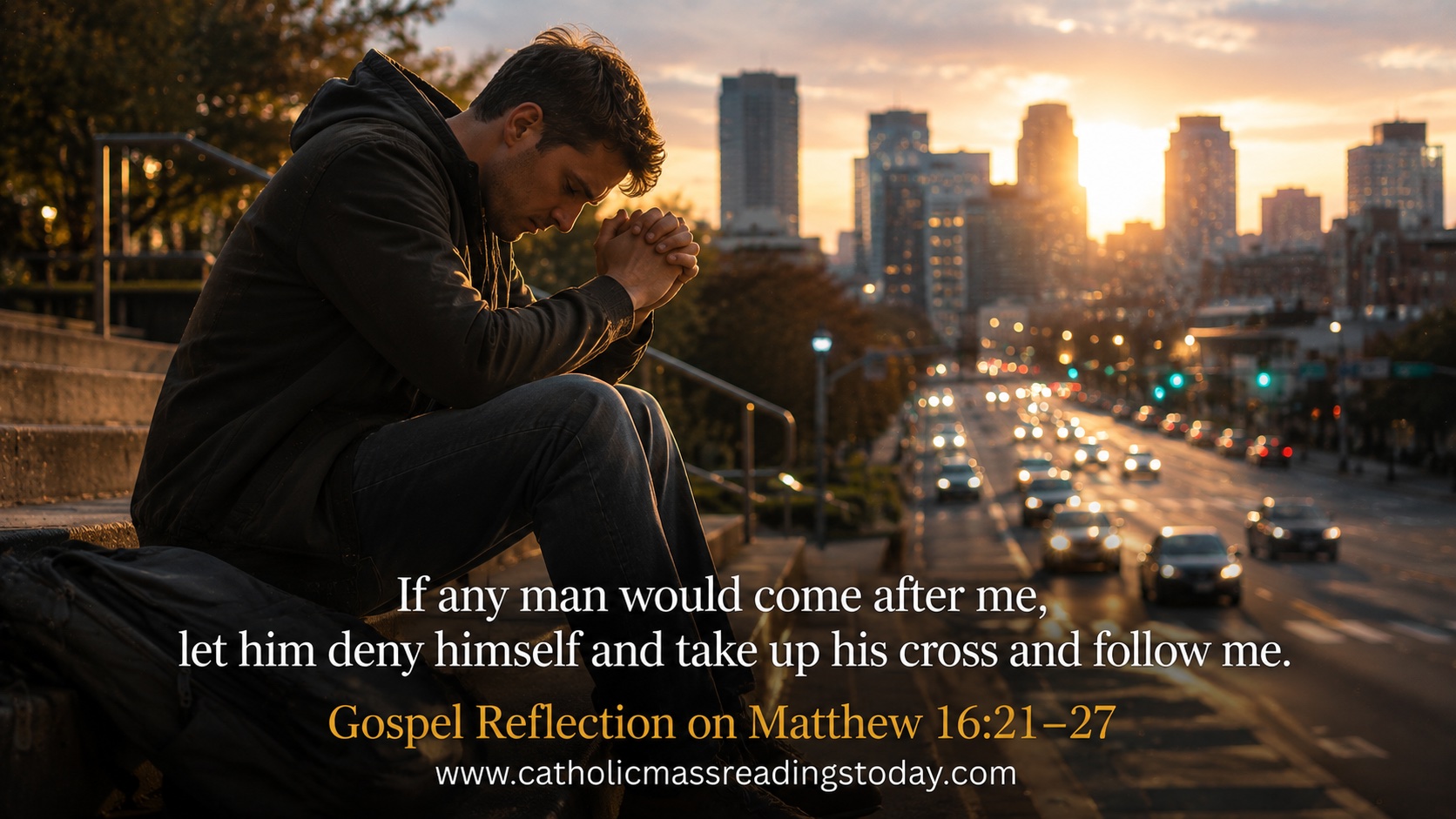
“If Any Man Would Come After Me, Let Him Deny Himself.”
There are moments in the Gospel when Jesus speaks words that comfort the human heart, and there are moments when He speaks words that disturb us precisely because they reach places within us that we would rather protect. Today’s Gospel belongs to the second kind.
Jesus does not hide from His disciples what lies ahead. He tells them plainly that He must go to Jerusalem, suffer at the hands of the elders, chief priests and scribes, be killed, and on the third day be raised. Peter hears the suffering and the death, but seems unable to hear the promise of resurrection. He takes Jesus aside and protests: “God forbid, Lord! This shall never happen to you.”
We can understand Peter. He loves Jesus. He has only just confessed Him as the Christ, the Son of the living God. How could the Messiah now speak about rejection, suffering and death?
Yet Jesus responds with startling severity: “Get behind me, Satan! You are a hindrance to me; for you are not on the side of God, but of men.”
The words are severe because the temptation is serious. Peter wants a Christ without Calvary. Jesus knows that there can be no Easter without the Cross.
And then He turns the lesson toward every disciple, including us:
“If any man would come after me, let him deny himself and take up his cross and follow me.”
Peter Loved Jesus, but He Had Not Yet Learned the Way of the Cross
Peter’s mistake does not come from hatred. It comes from love that has not yet been purified by faith.
He wants to protect Jesus from suffering. Humanly speaking, this seems reasonable. When we love someone, we do not want that person to suffer. Yet Peter is trying to persuade Jesus to abandon the very path through which the Father’s saving plan will be accomplished.
Peter wants Jesus to be the Messiah according to human expectations. Jesus must teach Peter to see according to God.
This is why the words “Get behind me” are so significant. Peter belongs behind Christ, following Him. The disciple does not walk ahead of the Master and decide where the Master should go. The disciple follows.
This is one of the most difficult lessons of Christian life. We often want Christ to follow the plans we have made rather than surrendering ourselves to the path He places before us. We pray for God’s will, but sometimes what we really mean is that we hope God will approve ours.
We may say, “Lord, I will follow You, but not through this illness. Not through this disappointment. Not through this financial difficulty. Not through this rejection. Not through this family problem. Not through this sacrifice. Give me another road.”
Yet sometimes the road we desperately want God to remove becomes the very place where He transforms us.
Faith does not mean pretending suffering is good. Christianity does not glorify pain for its own sake. Jesus Himself healed the sick, comforted the grieving and showed compassion to those who suffered. But the Cross reveals something extraordinary: when suffering cannot be avoided, it does not have to be meaningless. United with Christ, even suffering can become a place of love, purification, offering and grace.
“Let Him Deny Himself”
Jesus then tells us something that stands directly against much of what the world teaches:
“Let him deny himself.”
Self denial does not mean believing that we have no value. Christianity teaches exactly the opposite. Every human person possesses immeasurable dignity because he or she is created in the image of God and redeemed by Christ.
To deny ourselves means refusing to make the self the centre of everything.
There is a part of us that constantly says: my comfort, my desires, my reputation, my plans, my success, my pleasure, my way.
Jesus invites us into another kind of life.
The Christian begins to ask: What does God desire? How can I love? Whom can I serve? What must I surrender? What is true? What is right?
This kind of self-denial happens every day.
A husband or wife denies self when love requires patience rather than winning an argument. A parent denies self when exhausted but still gives time and attention to a child. Someone who has been hurt denies self when he refuses to feed resentment and begins the difficult journey toward forgiveness. A young person denies self when he refuses something sinful even though friends consider it normal. A professional denies self when honesty costs an opportunity for advancement.
These sacrifices may never be noticed by the world.
God sees them.
Christian holiness is often built through thousands of small decisions in which we quietly choose Christ over ourselves.
“Take Up His Cross and Follow Me”
Jesus does not tell us merely to carry a cross. He tells us to carry it and follow Him.
That distinction matters.
Everyone suffers. Believers and unbelievers experience illness, grief, disappointment, betrayal, loneliness, financial hardship and death. The presence of suffering alone does not make something Christian.
What makes the Cross Christian is that it is carried with Christ and after Christ.
We do not worship the Cross because suffering is beautiful. We venerate the Cross because upon it Love revealed how far Love was willing to go.
Jesus did not remain on Calvary. The Cross opened toward the Resurrection.
This changes everything.
When a Christian stands before suffering, he does not have to say, “This pain is the end of my story.” He can say, “I do not understand this, Lord, but I will not walk through it without You.”
Sometimes faith does not provide an immediate explanation for suffering. It gives us something deeper: the presence of Christ within it.
The Lord who asks us to carry the cross is the Lord who carried His first.
He knows its weight.
The Cross We Carry Is Not Always the Cross We Choose
There is another important truth in today’s Gospel. We often imagine discipleship in terms of the sacrifices we would be willing to make for God. But frequently, the hardest crosses are precisely those we did not choose.
Nobody chooses the death of someone they love. Nobody desires betrayal. Nobody asks for a family crisis, unemployment, loneliness, rejection or a future that suddenly looks different from everything they had planned.
These experiences should never be romanticized. Some situations, particularly abuse or injustice, require action, protection and help; “carry your cross” must never be misused to tell someone to remain passively in preventable harm.
But there are other crosses that simply belong to the fragility of human life and cannot immediately be removed.
In those moments Christ does not necessarily answer every “Why?”
Instead, He says:
Follow Me.
- One day at a time.
- One prayer at a time.
- One act of faith at a time.
Sometimes following Jesus means walking without seeing very far ahead.
“Whoever Would Save His Life Will Lose It”
Jesus then gives us one of the great paradoxes of Christianity:
“Whoever would save his life will lose it, and whoever loses his life for my sake will find it.”
The world often tells us that happiness comes from accumulating more: more money, more possessions, more influence, more admiration, more experiences and more control.
Jesus asks a radically different question:
What if life is found not in possessing more, but in giving ourselves away in love?
Think of the people whose lives have most deeply changed the world. The saints did not become great by protecting themselves from sacrifice. Saint Francis of Assisi surrendered wealth. Saint Maximilian Kolbe surrendered his life for another prisoner. Saint Teresa of Calcutta gave herself to people whom much of society preferred not to see. Countless mothers, fathers, priests, religious, missionaries and ordinary Christians have discovered the same mystery in quieter ways.
The more love gives itself, the more fully it becomes what it was created to be.
This mystery reaches its perfection in Jesus.
On Calvary, Christ appears to lose everything. His clothing is taken. His reputation is destroyed. His disciples scatter. His body is wounded. Finally, His earthly life is surrendered.
Yet precisely through that complete gift of Himself comes redemption.
The world sees defeat.
God reveals victory.
“What Will It Profit a Man If He Gains the Whole World?”
Then Jesus asks perhaps the most searching question in today’s Gospel:
“For what will it profit a man, if he gains the whole world and forfeits his life?”
We should allow that question to remain with us.
What are we pursuing? What are we sacrificing to obtain it? And what is happening to our souls while we pursue it?
There is nothing inherently wrong with professional success, financial stability, education, achievement or material possessions. These can all be genuine blessings and can be used for enormous good.
The danger begins when temporary things become ultimate things.
A person can become successful in the eyes of everyone around him and yet gradually lose his marriage, his integrity, his prayer life, his compassion and eventually his relationship with God.
What has he gained?
We live in a world that constantly measures us. Salaries measure economic value. Social media counts followers and reactions. Careers give titles. Society admires influence, beauty, wealth and visibility.
Christ introduces another measure:
the soul.
Before God, the value of one human soul exceeds everything this world can offer.
Eventually, every possession will belong to someone else. Every title will be handed to another person. Every building we own will be occupied by others. Our bodies themselves will return to the earth.
What remains is what we have become before God.
That is why Jesus is not asking us to despise the world. He is teaching us to put the world in its proper place.
Do Not Be Afraid of Losing What Cannot Save You
Much of our resistance to God comes from fear. We fear what obedience might cost.
If I forgive, perhaps the other person will think I am weak. If I live according to the Church’s moral teaching, perhaps people will reject me. If I become generous, perhaps I will have less for myself. If I surrender this sinful relationship, perhaps I will be lonely. If I truly give God control of my future, perhaps He will lead me somewhere I never planned to go.
Peter was afraid of what the road to Jerusalem would mean.
Jesus saw beyond Jerusalem.
Peter saw the Cross.
Jesus knew the Resurrection.
We often see only the Good Friday of our present circumstances while God sees an Easter that remains hidden from us. This is where trust begins.
Christian hope does not mean believing that everything will happen exactly as we want. It means believing that if we remain with Christ, nothing surrendered to Him is ultimately wasted.
The Eucharist Teaches Us How to Give Ourselves
For Catholics, there is a profound connection between today’s Gospel and the Holy Eucharist.
At every Mass we encounter the One who gave Himself completely.
“This is my body, which will be given for you.”
Christ does not merely tell us about self-giving love. He gives Himself to us.
When we approach Holy Communion, therefore, we should not simply ask Jesus to enter our lives. We should also place our lives before Him.
- Our work.
- Our families.
- Our struggles.
- Our fears.
- Our wounds.
- Our plans.
- Our sacrifices.
- Our future.
We bring them to the altar and unite them with the perfect offering of Christ.
Saint Paul describes this beautifully when he urges Christians to offer their bodies as “a living sacrifice, holy and acceptable to God.”
The Christian life becomes Eucharistic when we learn to say with Jesus: My life is not merely something to possess. It is something to give.
Following Christ in Ordinary Life
Most of us will not be asked to carry a wooden cross through the streets of Jerusalem. Yet every day presents opportunities to live the mystery of the Cross.
- Perhaps your cross today is caring for someone who depends upon you.
- Perhaps it is remaining faithful in a difficult season of marriage.
- Perhaps it is grief that nobody else fully understands.
- Perhaps it is resisting a temptation that returns again and again.
- Perhaps it is forgiving someone whose apology may never come.
- Perhaps it is accepting that your life has taken a direction you never expected.
- Perhaps your cross is simply remaining faithful when prayer feels dry and God seems silent.
Do not underestimate these ordinary acts of fidelity.
Holiness is rarely built in one dramatic moment. It is usually formed through daily choices repeated with love.
Every morning the Christian has the opportunity to say:
Jesus, today I choose again to follow You.
The Cross Is Not the End of the Story
There is one detail we must never overlook in today’s Gospel.
Before Jesus speaks about denying ourselves and carrying the Cross, He tells His disciples that He will suffer, be killed and on the third day be raised.
The Resurrection is present from the beginning.
Peter becomes overwhelmed by the prediction of suffering and seems unable to hear what comes after it.
We can do the same. When life becomes difficult, suffering can fill our entire field of vision. We see the hospital room, the empty chair, the unpaid bill, the broken relationship, the unanswered prayer or the uncertain future.
Christ sees further. Christianity is not a religion that ends at Calvary.
We are an Easter people.
The Cross is real. Suffering is real. Death is real. But none of them has the final word. Christ does.
What Jesus Is Asking of Us Today
Today’s Gospel ultimately brings us before a very personal question.
Jesus does not say, “If anyone wishes to admire me.”
He says:
“If any man would come after me…”
Christianity is not simply admiration of Jesus. It is discipleship, and discipleship requires movement.
There may be something today that Christ is asking us to leave behind. There may be a resentment that needs to be surrendered, a confession that needs to be made, a relationship that needs healing, an act of generosity that has been postponed or a difficult truth that must finally be faced.
We cannot follow Christ while insisting that He remain behind us. Like Peter, we must learn our proper place: behind Jesus, following wherever He leads.
There will be moments when that road passes through places we would never have chosen.
But the One walking ahead of us bears the wounds of Calvary and the glory of the Resurrection.
He knows where the road leads and so the deepest prayer arising from today’s Gospel may be very simple:
Lord Jesus, give me the courage to follow You when following You costs me something.
For what would it profit us to gain everything the world can give and lose the one treasure for which we were created?
- Our possessions will pass.
- Our achievements will fade.
- Our earthly lives will end.
But the person who gives his life to Christ does not ultimately lose it.
In Christ, he finds it.
Let us Pray
Almighty and eternal God,
You sent Your beloved Son
to show us the way that leads to life
through the mystery of His Cross and Resurrection.
Give us the grace to follow Him faithfully,
not only when the road is easy,
but also when discipleship demands sacrifice.
Free our hearts from selfishness,
from the desire for human approval,
and from attachment to anything
that separates us from You.
When the crosses of life become heavy,
strengthen us with the grace of Your Holy Spirit.
When we do not understand the road before us,
teach us to trust Your providence.
When we are tempted to turn away from Christ,
draw us once more to His Sacred Heart.
Through the Holy Eucharist,
unite our sacrifices to the perfect offering of Your Son,
that our lives may become a living sacrifice,
holy and pleasing to You.
Teach us to seek first Your Kingdom,
to treasure our souls above the passing things of this world,
and to recognize Christ in those who need our love.
May the Blessed Virgin Mary,
who faithfully followed her Son even to the Cross,
intercede for us,
that after carrying our crosses with faith on earth,
we may share forever
in the joy of Christ’s Resurrection.
Through the same Christ our Lord.
Amen.
Mary, Mother of the Crucified and Risen Lord, pray for us.