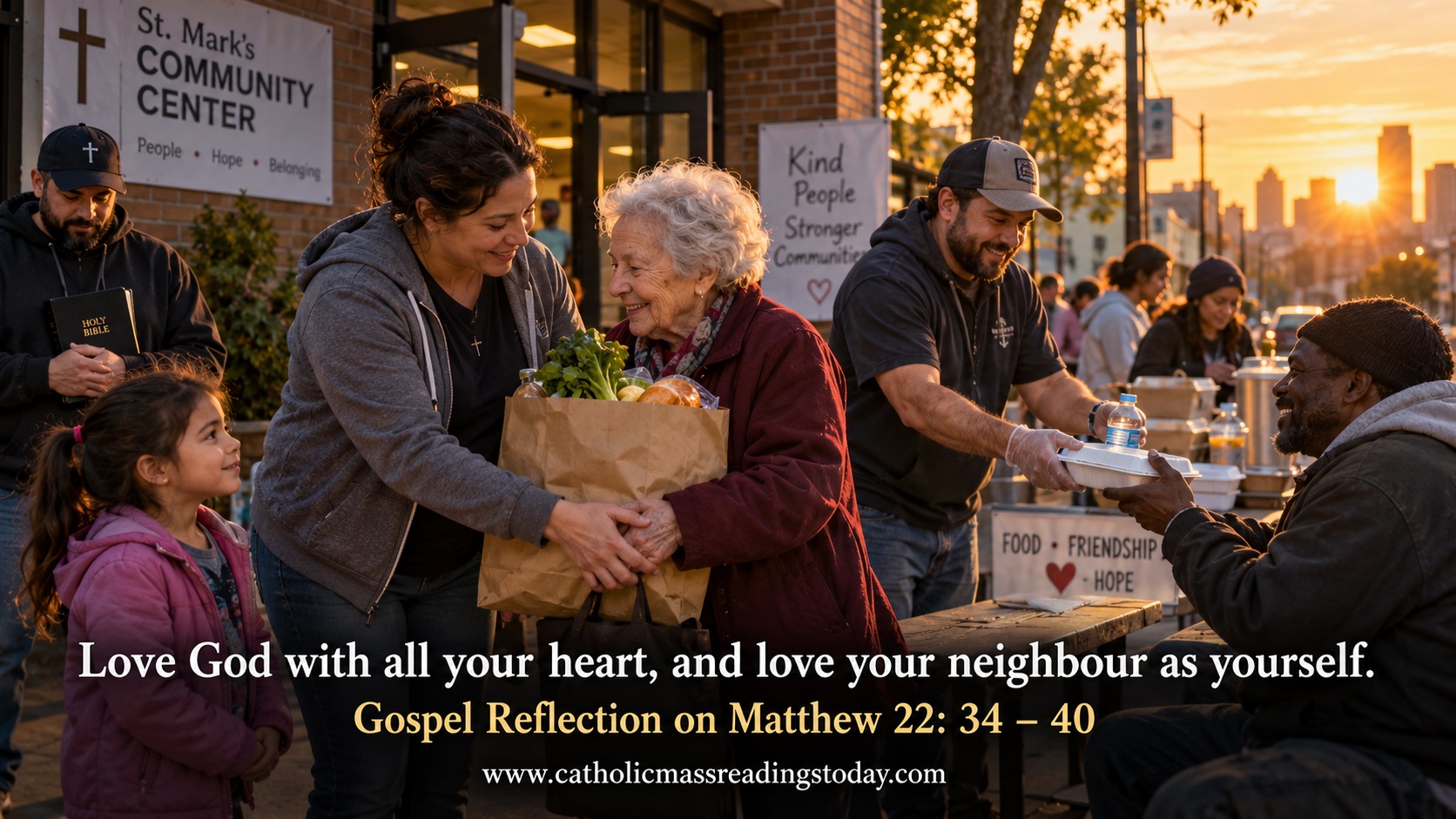
Love God and Love Your Neighbour as Yourself
There is a question in today’s Gospel that goes straight to the heart of what it means to be a Christian.
A lawyer approaches Jesus and asks Him, “Teacher, which is the great commandment in the law?”
It may sound like a simple question, but the man is testing Jesus, hoping to find fault in His answer and Jesus responds with words that contain the very foundation of our faith.
“You shall love the Lord your God with all your heart, and with all your soul, and with all your mind.”
Then He adds something equally important. “You shall love your neighbour as yourself.”
Two commandments, yet one inseparable call to love.
What Jesus teaches us here is that our relationship with God cannot be separated from the way we treat other people.
We cannot claim to love God deeply while deliberately choosing to hurt, despise, or neglect those around us and this is where today’s Gospel becomes deeply personal.
Many of us find it easy to speak about loving God. We attend Mass, we say our prayers, we read Scripture, we ask the Lord to bless our families and guide our lives and these are beautiful and necessary parts of our faith. But Jesus invites us to look beyond our words and religious practices and examine what happens when we leave the church.
How do we speak to our husbands, our wives, and our children when we are tired or frustrated?
How do we treat someone who has offended us?
Do we show patience towards the elderly, compassion towards the poor, and understanding towards those who are struggling? Perhaps most importantly, how do we treat people who cannot offer us anything in return?
Because love is not simply something we feel.
It is something we choose and something we demonstrate through our actions.
- Sometimes loving our neighbour means offering forgiveness when our hearts are still hurting.
- Sometimes it means listening patiently when we would rather walk away.
- Sometimes it means sharing what little we have with someone who has even less.
- Sometimes it means refusing to speak badly about a person, even when everyone around us is doing so.
These ordinary moments may seem small, but they reveal whether the love we profess has truly taken root in our hearts, yet there is something else we must not overlook.
Jesus does not simply command us to love our neighbour. He tells us to love our neighbour as ourselves.
This reminds us that every human being possesses a dignity that comes from God, including ourselves. We are not called to despise ourselves, nor to believe that our lives have no value. Rather, we are invited to recognise that the same God who loves us also loves the person standing before us.
The person who agrees with us and the person who challenges us, the person who treats us kindly and the person who tests our patience, the familiar face and the stranger we may never meet again.
Every one of them is someone God calls us to love, and loving others does not mean approving of everything they do. True love sometimes requires honesty, correction, and the courage to stand for what is right. But even when we disagree, we must never forget the dignity of the person before us.
Jesus also teaches us that loving God must come first. Not because God needs our affection, but because our hearts find their proper direction when He is at the centre of our lives.
When we genuinely love the Lord, we begin to see others differently. We become less concerned with proving ourselves right and more willing to understand.
Less interested in keeping score of the wrongs done to us and more willing to forgive, less attached to our own comfort and more attentive to the suffering of others and perhaps this is the question we should carry with us today.
If someone watched the way I lived without ever hearing me speak about my faith, would they recognise the love of Christ in me? Would they see it in my patience? In my honesty? In the way I speak to my family, treat my colleagues, and respond to those in need?
Because in the end, Jesus does not ask us merely to know the commandments. He asks us to live them and sometimes, the greatest witness we can give to our faith is not a beautiful prayer spoken aloud, but a simple act of love offered quietly, when nobody else is watching.
We may not always succeed. There will be moments when our patience fails, when selfishness gets the better of us, and when loving others feels terribly difficult. But we must remember that Christian love is not something we achieve through our own strength alone.
It is a grace we receive from God and a virtue we must continue to practise.
Every day gives us another opportunity to love Him more faithfully and to love our neighbour more generously.
So today, before we ask God for another blessing, perhaps we should ask Him for something deeper.
- A heart that loves as He loves.
- A heart that forgives.
- A heart that sees beyond appearances.
And a heart that remembers that the greatest commandment is not simply to speak about love, but to live it.
Let Us Pray
Lord Jesus, You have taught us that love is the foundation of every commandment.
Forgive us for the times we have spoken of loving You while failing to show kindness, patience, and compassion towards others.
Teach us to love You with all our hearts, with all our souls, and with all our minds.
Help us to place You at the centre of our lives so that everything we say and do may reflect Your goodness.
Give us the grace to forgive those who have hurt us, to care for those who are suffering, and to respect the dignity of every person we encounter.
When love becomes difficult, strengthen us.
When pride divides us, humble our hearts.
And when we are tempted to turn away from someone in need, remind us that in loving our neighbour, we are responding to Your love.
Lord, may our faith never remain only on our lips.
Let it be seen in our actions, felt in our kindness, and recognised in the way we treat one another.
Amen.